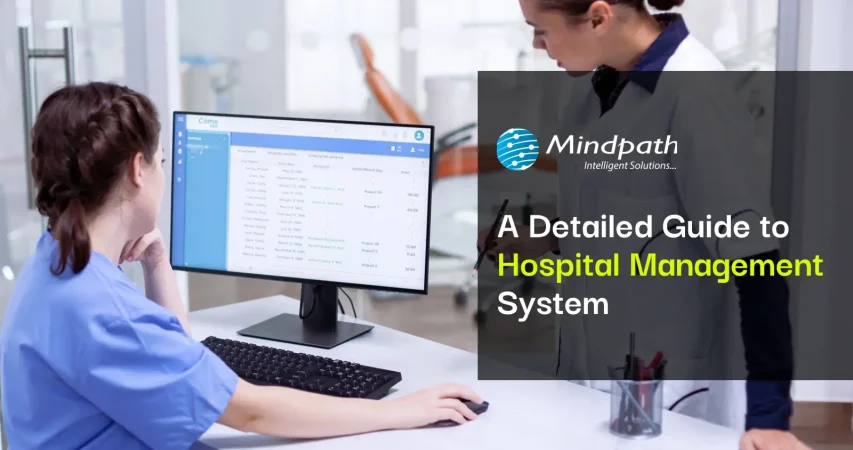
Hospital Management System – A Comprehensive Guide

Join our Newsletter!

Featured Posts

Support Is One Click Away

Home

Hospital Management System – A Comprehensive Guide

hospital management system

Hospital Management System – A Comprehensive Guide

How do hospitals maintain and keep everything running smoothly? Starting from patient records to important surgery schedules, billing and staff coordination, each and everything is well maintained and smooth, isn’t it? Are you curious to know what’s behind this? Well, it’s Hospital Management System (HMS) which does the magic in handling hospital operations smoothly.  

Are you confused about what does it mean and why is it essential for modern hospitals? Don’t worry, we have got you covered! This blog will walk you through everything you need to know about HMS. So, let’s dive in to learn! 

Is your Hospital Management System keeping up with today’s healthcare demands? Mindpath provides Healthcare Software Development Services that help healthcare organizations build smarter systems and deliver better patient outcomes.

What is a Hospital Management System?

A hospital management system (HMS) is a type of software that helps hospitals manage everything effortlessly. It allows the doctors, nurses and other staff of a hospital to collect, store and share patient data in a secure and organized way. With the help of this system, the medical teams can easily get access to records such as X-rays, prescriptions and other important documents of patients.  

In most of the hospitals, doctors, nurses and the staff spend a lot of their time doing paperwork which can slow down things and also impact the patient’s overall experience. HMS can help in reducing the workload by handling many tasks automatically. It can bring all the necessary information and tools into one place which can help hospitals run their daily operations more proficiently with less delays. 

As per Market Research Future (MRFR) analysis, the global Hospital Management Software Market was valued at USD 29.33 billion in 2024. It is projected to reach USD 54.20 billion by 2034, growing at a rate of 6.33% annually between 2025 and 2034. This growth shows the increasing demand for smarter, more connected healthcare systems. 

Must Read: Types of Healthcare Software 

Now that you have a clear idea about what HMS is, there is a major question that arises: 

What is the Function of HMS?

When a hospital begins implementing HMS, numerous day-to-day activities are simplified and streamlined. An HMS assists personnel in focusing more on patients and less on documentation. Let us discuss some important functions that make this system so valuable: 

1. Scheduling Appointments

HMS facilitates patients to schedule appointments easily and doctors’ schedule efficiently which can eliminate confusion and lengthy waiting times. 

2. Patient Data Management

It stores all the patient records including medical history, test results as well treatment details which can help doctors and nurses to quickly access the right information when needed. 

3. Handling Billing and Invoice

It makes the billing process faster and more accurate by handling everything, from bill generation to payment tracking as well as insurance processing. 

4. Inventory Management

Hospitals can keep track of medicines, equipments and supplies which helps in avoiding shortages and guarantees everything is available on time. 

5. Reporting and Analytics

The system provides useful reports on hospital performance and operations, which helps in planning and improving services.  

6. Communication

It facilitates easier communication between doctors, nurses and patients to remain connected and exchange crucial updates, resulting in improved coordination and care. 

7. Integration with Other Systems

Hospital management software can easily integrate with other systems such as electronic medical records so that everything is integrated into one place with a complete view of every patient’s care experience. 

Struggling to improve efficiency and patient outcomes in hospital operations? Discover how AI in healthcare is transforming hospital management with intelligent automation and data-driven insights.

Let us learn about some of the key benefits if you’re looking for more information about hospital management system: 

Key Benefits of Hospital Management System

A good hospital management software system can make a huge difference in how smoothly a hospital runs. It assists both staff and the patients by improving the quality of care and simplifying daily tasks. Here are some major benefits of you can expect: 
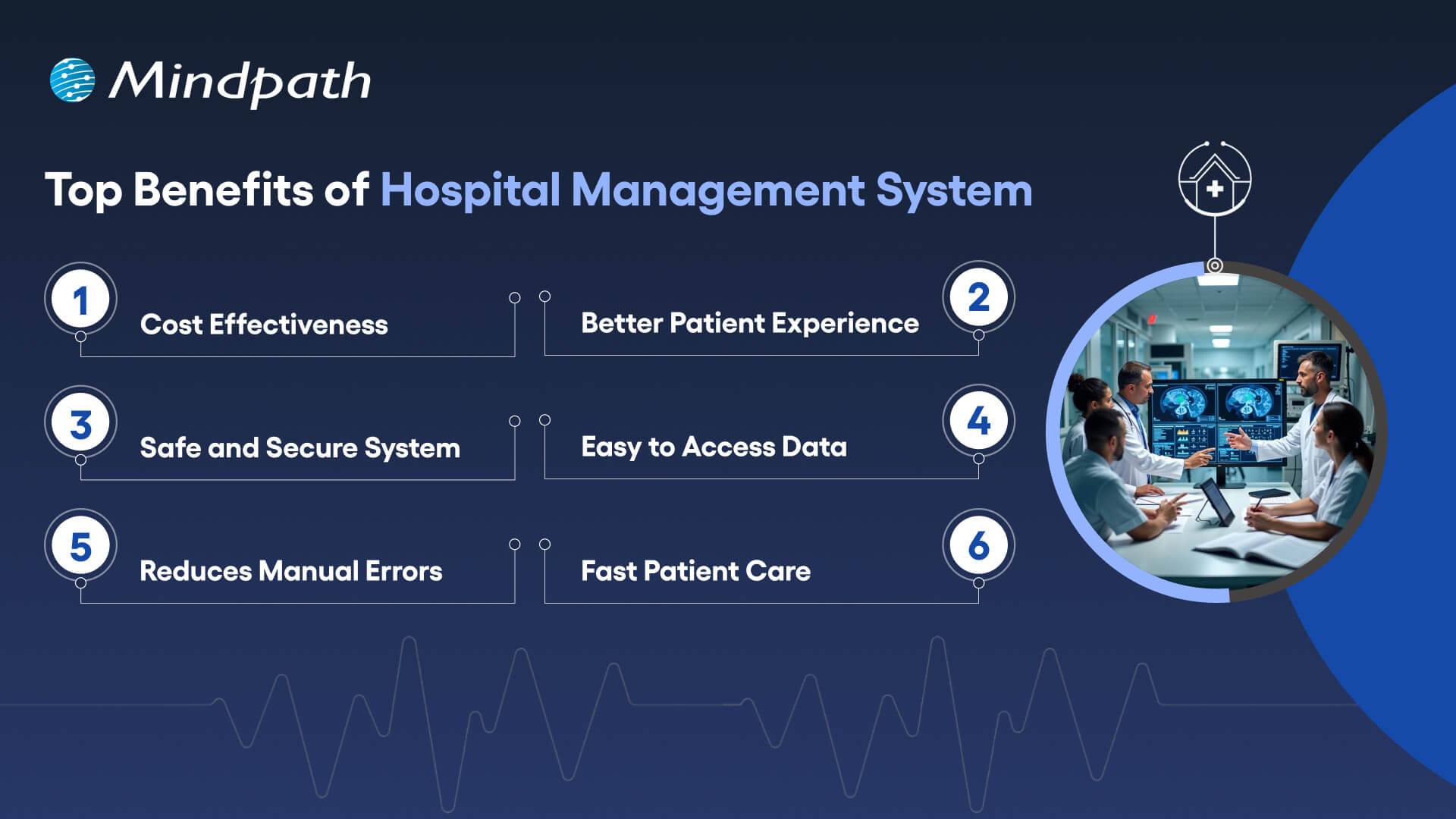
Benefits of Hospital Managemnt System

1. Cost Effectiveness

With everything automated and systematized, hospitals are able to cut down on paperwork, labor costs, and wastage of supplies. It also aids in improved planning and utilization of resources such as medicines and equipment. This reduces unnecessary costs and makes the operations more cost-effective, enabling the hospital to utilize its budget where it’s actually needed. 

2. Better Patient Experience

Patients are able to schedule appointments with minimal waits, receive follow-up reminders, and view their reports online. It makes them feel more in charge of their treatment and less anxious. It makes everything easier, from arrival to discharge, which results in a more pleasant, efficient hospital stay for each patient. 

3. Safe and Secure System

Patient data is stored securely and shared only to permitted staff members. This protects information from abuse or loss. A secure system ensures trust between patients and the hospital, and ensures appropriate processing of sensitive information  while keeping the hospital in line with privacy and security regulations. 

4. Easy to Access Data

All medical information such as treatment history, test reports, and medications are kept in one place. Doctors, nurses, and medical staff are able to access this info quickly from various departments. This streamlines treatment and prevents the need to repeat tests or inquire about the same information from patients repeatedly. 

5. Reduces Manual Errors

The system maintains accurate and up-to-date information, preventing staff from making mistakes such as providing the wrong medication or omitting important steps. Access to information in real time eliminates confusion, enhances coordination, and ensures that doctors adhere to the proper treatment protocols based on the most current and comprehensive patient information. 

6. Speed Up Patient Care Process

When doctors and staff have quick access to patient records and reports, they can make faster decisions. Automated tasks like test scheduling and report delivery save time. This helps patients get the care they need without delays, which is especially important in emergency or critical care situations. 

Curious how AI is transforming industries and healthcare? Explore Generative AI use cases across diverse sectors and see how it’s reshaping healthcare platforms.

Ready to Upgrade Your Healthcare System?

A hospital management system can really make a difference in how a hospital operates. From enhancing patient care to accelerating operations and minimizing mistakes, HMS makes hospitals more efficient, well-organized, and responsive. Be it scheduling appointments, record management, or cost-cutting, HMS makes everything more efficient and reliable for patients and staff alike. 

At Mindpath, we specialize in delivering modern healthcare software development services that make hospital processes faster and smarter. Whether you’re planning a full hospital management system project or need a custom solution for specific tasks, we’re here to help. 

As a trusted healthcare app development company, we focus on building secure, user-friendly, and high-performing digital solutions. Our team understands the needs of healthcare and creates tools that support doctors, staff, and patients every step of the way. 

Frequently Asked Questions

1. Why is a Hospital Management System important for modern healthcare facilities?

A Hospital Management System helps hospitals handle complex operations in a structured and digital way. As patient volumes grow, manual processes become inefficient. HMS ensures better coordination, faster access to information, improved compliance, and smoother workflows, helping healthcare facilities deliver consistent and quality care. 

2. Can a Hospital Management System be customized for different hospital sizes?

Yes, a Hospital Management System can be customized based on the size and needs of the hospital. Small clinics may require basic modules, while large multi-specialty hospitals need advanced integrations, analytics, and multi-department access. Flexible architecture allows the system to scale as the organization grows. 

3. How does HMS support regulatory compliance in healthcare?

HMS helps hospitals maintain accurate digital records, secure patient data, and track treatment history systematically. Automated documentation and audit trails make it easier to comply with healthcare regulations and data protection standards. This reduces legal risks and ensures transparency in hospital operations. 

4. What technologies are commonly used to build a hospital management system?

Modern systems are built using cloud computing, secure databases, API integrations, and sometimes AI-driven analytics. These technologies enable real-time data access, system interoperability, and remote accessibility. Strong cybersecurity frameworks are also implemented to protect sensitive medical information. 

5. How long does it take to implement a Hospital Management System?

Implementation time depends on hospital size, required features, and integration complexity. Basic setups may take a few months, while large-scale systems with multiple modules and integrations can take longer. Proper planning, staff training, and phased deployment ensure smoother adoption and minimal operational disruption. 
Related Post

Hiring ReactJS developers? Follow our expert tips to find the right talent and build a strong development team.
Discover the ultimate guide to hiring Node.js developers in London. Learn about the skills, benefits, and cost factors involved in finding the right talent for your project.

Related Post

full stack development trends

The full-stack development landscape is changing rapidly, and 2026 is already showing great possibilities for new ideas and better tools. Getting familiar with the newest full-stack development trends can help developers, startups, and businesses create smarter solutions. User needs are increasing, along with the requirement for flexible and efficient development solutions, which means teams are taking a fresh look at how they build, test, and scale applications. Knowing how to navigate these changes can have a significant impact next time whenever you develop a new item or launch a new product.

With speed, scalability, and seamless user experience as the new focus, developers are integrating advanced front-end technologies with back-end solutions to develop modern digital products. With cloud platforms available everywhere and low-code solutions evolving more rapidly, full-stack development is moving to a whole new level.  These solutions are transforming processes that not only save time but also improve quality and naturally foster greater teamwork. In this blog, we will provide further insight into the most important trends shaping full-stack development in 2026.

Looking to implement the advantages of full-stack development in your next project? Take a look at our full-stack development services, where our team will support and guide you to bring those benefits to the real world.

Understanding Full-Stack Development

Full-stack development refers to building both the front-end and back-end of a software application. Let’s dive in to understand! Every application has two main sections. The front-end is what users see and interact with, like buttons, images, and forms. The backend encompasses all the activities that take place in the background – saving data, running logic, interacting with other systems, etc.

Each side requires different skill sets and tool sets. Full-stack development combines both sides into one process. Full-stack development enables developers to create complete applications and allows us to develop the application seamlessly from the user interface through the server and database. This means that the application includes both of those components as one shared system, which makes development more efficient and organized.

Some advantages of full-stack development include:

  1. A full-stack developer saves money by doing both front-end and back-end work, minimizing the need for multiple specialists.
  2. They speed-up the development process by working across the entire tech stack, ensuring faster delivery and smooth collaboration.
  3. With strong knowledge of current tools and trends, they support modern full-stack development by integrating advanced features like AI and responsive design.
  4. Full-stack developers take full ownership of the codebase, simplifying responsibility and streamlining debugging.
  5. They deliver well-rounded, quality solutions by working across the UI, backend logic and business processes, database activities and data expansion, and testing.
  6. They even provide ongoing support and maintenance, which ensures long-term stability, security, and enhancement.

Read in detail: Full-stack development benefits.

Full-Stack Development Trends 2026

As technology continues to grow, developers are embracing smarter tools and faster methods to build complete applications. The emerging trends in full-stack development are shaping how teams work, improve performance, and deliver better user experiences in 2026. Here are the top trends to watch:

full-stack development trends

1. Artificial Intelligence

Artificial Intelligence is one of the key full-stack development trends shaping how modern applications are built. It helps solve complex problems faster and allows systems to work without human interruption. Full-stack developers are well-suited for AI roles because they understand both design and logic, making it easier to build intelligent solutions. As the future of full-stack development evolves, AI will play a major role in improving performance and user experience.

2. Cloud Computing

Cloud computing is a fast-growing technology that allows access to data storage, processing power, and other resources over the internet. It supports the future tech stack for developers by offering flexibility, easy scaling, and pay-as-you-go pricing. Full-stack cloud developers are in demand to build and manage cloud-based applications that support collaboration and performance. To grow in this area, developers should understand IaaS, PaaS, SaaS and gain hands-on experience with platforms like AWS, Azure, and Google Cloud.

Also Read: Cloud Computing Trends

3. DevOps

DevOps is a practice that combines development and operations to improve how software is built, tested, and deployed. It helps teams work better together and use tools like continuous integration and delivery to release updates faster. DevOps plays an important role in improving application speed, quality, and reliability. As part of full-stack development trends, it supports the demand for efficient workflows and strong collaboration in building modern applications.

4. Progressive Web Apps

Progressive Web Apps (PWAs) are web applications that offer an app-like experience using modern browser features. They work offline, load quickly, send push notifications, and can be installed on devices without using much storage. As part of web development trends 2026, PWAs help businesses reach more users, especially on mobile, while keeping development simple and cost-effective. Their flexibility and performance make them a smart choice for companies looking to improve user experience.

5. Blockchain

Blockchain is a secure and transparent technology that stores data across a network of computers, making it difficult to change or hack. It is widely used in industries like finance and healthcare to protect transactions and manage decentralized systems. As part of full-stack development trends and the latest trends in web development, blockchain allows developers to build safer and more reliable applications. To work in this area, full-stack developers need skills in decentralized tools, enterprise systems, and Web3 architecture.

Must Read: AI in Cybersecurity

6. Cybersecurity

Cybersecurity is the practice of protecting systems, networks, and applications from online threats like malware, phishing, and DDoS attacks. It has become a key part of full-stack development trends as developers need to build secure applications from the ground up. Companies are now including cybersecurity in their future tech stack for developers to keep data and systems safe. Full-stack developers aiming to work in this field should learn network security, web application security, cryptography, and secure coding practices.

7. Low-Code and No-Code Development

Low-code and no-code development platforms allow users to build websites and apps with minimal or no programming skills. These tools are growing as part of full-stack development trends because they save time, reduce costs, and make development accessible to more people. While they are great for simple projects, they may not be suitable for complex or large-scale solutions. As part of the trends in software development, LCNC tools offer fast results and full-stack capabilities for quick product launches.

Looking for the best way to scale your digital growth? Discover why full stack development for web projects is becoming the smart choice for businesses.

Ready to Leverage Full-Stack Development Trends for Your Next Project?

Full-stack development trends are shaping how modern applications are built, improved, and maintained. With advancements like AI, cloud, DevOps, and PWAs, developers and businesses can achieve faster, smarter, and more secure results. Staying updated with these trends will help you build stronger digital products that meet the growing demands of users in 2026 and beyond.

At Mindpath, we offer expert full-stack development services tailored to your business goals. Our skilled developers handle everything from front-end design to back-end logic, delivering complete, scalable solutions. If you’re looking to hire full-stack developers who understand the latest tools and technologies, our team is here to help you build your web and mobile applications with confidence and efficiency.

Frequently Asked Questions

1. How can developers stay updated with fast-changing full-stack development trends?

Staying updated requires continuous learning through official documentation, developer communities, and hands-on practice. Following trusted tech sources, experimenting with new tools, and working on real projects helps developers understand trends practically and apply them effectively in modern application development.

2. Why is adaptability becoming important for full-stack developers in 2026?

Technology is evolving quickly, and tools or frameworks can change within a short time. Developers who can adapt to new technologies, learn different stacks, and adjust to changing project needs are better positioned to build scalable and future-ready applications.

3. How do modern full-stack trends improve collaboration within development teams?

New approaches like integrated workflows and shared tools allow frontend and backend processes to work more closely. This reduces communication gaps, improves coordination, and ensures that teams can deliver consistent and high-quality applications more efficiently.

4. What role does performance optimization play in modern full-stack development?

Performance is critical as users expect fast and seamless experiences. Modern trends focus on optimizing load times, reducing server response delays, and improving overall efficiency. This ensures applications remain responsive, scalable, and capable of handling growing user demands.

5. How should businesses approach adopting new full-stack development trends?

Businesses should evaluate trends based on their specific goals and project requirements rather than adopting everything at once. Starting with scalable and practical technologies, testing them in smaller implementations, and gradually expanding ensures better results and reduces unnecessary risks.

Modernizing legacy systems

In the prevailing digital economy, business entities cannot rely on outdated or obsolete systems. In fact, such systems can act as major handicaps in their path and impede their ability to achieve their business goals and objectives. This is why it is crucial for contemporary businesses to prioritize legacy system modernization.

In the prevailing business world, the practice relating to modernizing legacy systems has been gaining high momentum. About 72% business executives state that their legacy systems hold them back, leading to lower business productivity. Let us explore how legacy system modernization can create value for modern businesses. 

Are you looking to update your outdated systems but unsure how to start? Contact us, and we will help you modernize with the right strategy according to your business needs.

What are Legacy Systems?

Before looking at the benefits of modernizing legacy systems to revolutionize their operations, it is essential to get familiar with legacy systems. So it is crucial to know the answer to the question: What are legacy systems? In the computing realm, legacy systems refer to old technologies, methods, or computer systems. So they are basically outdated systems that are still in use regardless of their obsolete nature. 

In the fast-paced digital world, the use of such systems gives rise to a host of challenges and bottlenecks for business entities, such as the hindrance of innovation, a rise in costs, and restricted growth of the business. In order to address these challenges, it is a must for businesses to focus on the modernization of legacy systems.

Also Read: Digital Transformation for Businesses

Need to Modernize Legacy Systems

Modernizing legacy systems matters for business organizations since it serves as a catalyst and minimizes inefficiencies. The prioritization of legacy modernization is critical for modern organizations. It can serve as the ultimate pathway that can facilitate the scaling and integration of new digital technologies. 

In the competitive business landscape, embracing modernization of legacy systems is of high strategic importance. This practice can lead to cost savings for firms. Moreover, it can also improve the operational efficiency of entities and give them an edge over their competitors and rivals. Thus, by modernizing obsolete and old systems, business entities have the opportunity to grow and flourish in the dynamic and competitive business landscape. 

Curious how small businesses can leverage the latest tech to grow smarter and faster? Explore emerging technologies for small businesses to discover tools and solutions that can transform your operations and boost efficiency.

Top Benefits of Modernizing Legacy Systems

Organizations need to familiarize themselves with the top benefits that can arise on their path by modernizing their legacy systems. This strategic move has the potential to equip businesses across diverse industries to sustainably carry out their operations and excel in their respective domains. If you are wondering, what are the benefits of modernization? The answer is presented below. Some of the key benefits of modernization include: 

1. Better Productivity

All businesses intend to operate in a productive and efficient manner. The use of legacy systems may act as a major hurdle in their path, as it may restrict their productivity and efficiency. This is where modernization comes into the picture. Through modernization of legacy systems, businesses have the opportunity to improve their efficiency and effectiveness and streamline their operations. Furthermore, this decision can also enable businesses to optimally use their valuable time and gain a competitive edge in the market.

2. Reduced Cost in the Long-Term

Modernization of legacy systems can help firms reduce their costs in the long run. Regular updating of legacy systems may require a lot of money, and thus, the financial stability of businesses may be adversely affected. A smarter decision that your business can make involves transitioning to new systems through modernization. It can act as a pathway that can help your business save costs. You must remember that modern systems, especially the ones that run on the cloud, are much cheaper for businesses to run. 

3. Minimization of IT Complexity

One of the main challenges that arises from using legacy systems revolves around complex IT aspects. As technology or systems become obsolete, it becomes a daunting task to patch loopholes and errors. Every single update may require extra time and additional effort. If businesses replace legacy systems through modernization, they can definitely eliminate such complexity. Moreover, IT teams will be empowered to manage their operations by leveraging new and efficient systems, methods, or technologies.  

4. Improved User Experience

Legacy systems not only create challenges for business teams, but they also have a negative impact on the experience of users. Thus, in order to improve the overall experience of users, businesses must focus on modernizing legacy systems. It can certainly have a positive impact on user experience and improve their loyalty towards a business. On the other hand, poor quality of experience can drive users away from businesses. 

Looking to elevate your user interactions with smarter solutions? Discover the latest trends in conversational AI chatbots and see how businesses are using them to deliver seamless and engaging customer experiences.

5. Better Quality of Security

In the digital world, security is undoubtedly one of the main priorities of a majority of businesses. The use of legacy systems can increase the vulnerability of businesses in the volatile cyberspace. Malicious actors such as online hackers or cybercriminals may be able to breach the cybersecurity layer in legacy systems due to their obsolete nature. 

Thus, it is essential for businesses to focus on modernizing their legacy systems. By doing so, there is an opportunity for businesses to strengthen their cybersecurity resilience as well as their cybersecurity posture. The use of modern and updated systems has the potential to minimize the cybersecurity risks that arise in the path of businesses.  

6. Better Integration with Modern Tools and Technology

The modernization of legacy systems enables businesses to adopt new digital technologies in a seamless manner. Legacy systems may give rise to several challenges and obstructions. However, that is not the case when it comes to modern systems. Therefore, there is a possibility to integrate a diverse range of tools such as customer relationship management software, enterprise resource planning systems, payment systems, and many more by modernising the legacy system of your business.  

7. Better Flexibility

The modernization of legacy systems promotes flexibility as well as scalability for businesses. As your business expands in the future, you can easily expand modern systems without any trouble. On the other hand, the businesses that rely on legacy systems may face numerous obstacles in their path when their business grows. Due to the obsolete or outdated nature of their systems, they may not be able to handle a larger dataset or a larger number of users. As a result, their efficiency may be affected, and they may not be able to flexibly carry out their business operations.

8. Improved Workflow

Businesses operating in diverse industries and sectors can improve their workflows by modernizing their legacy systems. This practice can allow them to leverage the latest digital technologies and smooth their processes and operations. Moreover, they can be in a position to reduce their costs associated with downtime. Thus, you can surely see the positive change in the processes, practices, and operations of your business. 

Want to stay ahead with workflows that leverage modern tools and integrations? Discover the game‑changing SaaS trends helping businesses build flexible, efficient systems that align with workflow modernization.

Final Words

It is a fundamental necessity for contemporary business entities to prioritize the modernization of their legacy systems. This decision can certainly empower your business to thrive in the competitive business arena. Some of the top benefits that may arise in the path of your business include better productivity, lower cost, minimization of IT complexity, improved user experience, and a higher level of security. The other benefits that may also arise for your business include improved integration with modern tools and technology, better flexibility, and improved workflow. 

We at Mindpath intend to replace your legacy systems with updated ones through modernization. The experts will ensure that your business can derive optimum value from this transition, and it can reach new heights. 

Unlock the benefits of modernizing legacy systems, from increased productivity to growth, with Mindpath’s expert solutions.
low-rank adaptation (lora)

The landscape of artificial intelligence is advancing at a higher rate. And it has made it crucial to ensure efficient adoption of LLMs or Large Language Models.  Low-rank adaptation (LoRA) has emerged as an effective technique to fine-tune LLMs. Developers are now looking for scalable methods to customize AI models. Well, LoRA offers them a lightweight and cost-effective technique.

Furthermore, it has made the process of low-rank adaptation of LoRA in fine-tuning feasible, accessible, and efficient. In this detailed blog, we will explore more about the LoRA adaptation, understand what it is, and how it works. Besides, we will also discuss why it is an important method for fine-tuning LLMs in 2025. So, read on!

Struggling to figure out how advanced tuning methods like LoRA can give your business a competitive AI advantage? Mindpath’s AI development services help you harness LoRA-driven fine-tuning to build smarter, faster, and more efficient AI solutions.

Low-Rank Adaptation (LoRA) – An Overview

Before exploring more about low-rank adaptation (LoRA), let’s start with the basics, i.e., what is low-rank adaptation in LoRA? It is an efficient fine-tuning method that trains large LLMs to easily handle new tasks. The best part is, with this method, developers don’t need to change any parameters. Instead of updating all parameters. LoRA freezes the model weight and then injects a few new weights or trainable low-rank matrices. Fine-tuning with LoRA significantly lowers the number of trainable matrices without affecting the model’s base knowledge.

Importance of LoRA

Large language models such as ChatGPT are powered by massive neural networks. These networks have trillions of parameters. And during pre-training, these parameters are fine-tuned to make models work properly. While it makes AI models powerful, there is no guarantee that they will work efficiently for certain tasks. Adapting a larger language model to a specific use case, like custom support automation or legal documentation, requires full fine-tuning. For instance, if you want to fine-tune GPT-4, then you will have to work on around 1.8 trillion parameters. Besides, the process demands enormous infrastructure and GPU memory.

However, low rank adoption (LoRA) provides developers with a more efficient and smarter alternative. It allows them to inject small training parameters into specific layers. This, in turn, reduces GPU memory requirements. Furthermore, it leads to minimal disruption, lower costs, and quick training. If you think Low Rank Adoption is the only parameter-efficient method, let us inform you that QLoRA or Quantization LoRA is now gaining popularity in the industry. The reason behind this is that it combines high-precision computation with low-precision storage.

Low Rank Adaptation LoRA Example

Now, let’s have a look at a Low rank adaptation LoRA example in order to get a clear idea about the impact of LoRA. Let’s assume you want to fin-tune BERT. You may opt for a full fine-tuning. But for that, you will have to retrain nearly 108,314,886 parameters. Besides, the method is resource-intensive.

On the other hand, using LoRA, you can freeze the model’s original weights. It allows you to train only the necessary adapters related to your tasks. In fact, you can achieve the desired results just by training only 78,342 parameters. As a result, you will witness a significant reduction in training time as well as machine cost.

New to fine-tuning techniques like LoRA and unsure where to start? Explore Large Language Model (LLM) to build a strong foundation before diving deeper.

Low-Rank Adaptation (LoRA) Techniques

Now that you have a clear understanding of low rank adaptation (LoRA), let’s talk about the right way to use Low-Rank Adaptation (LoRA) Techniques. To ensure desired outcomes, developers can follow these steps.

1. Selecting a Base Model

 Begin by choosing a suitable AI model. You can opt for GPT-4 or GPT-3 as per your need.

2. Create Datasets

After the selection of a model, next, you need to collect quality datasets. Here, you must ensure that those datasets match your fine-tuning objectives.

3. Deploy LoRA Modules

While deploying LoRA adapters, choose the right attention layers. To avoid any issues, ensure a balance between performance and efficiency.

4. Rank Tuning

Select an appropriate rank. While smaller ranks can lower training costs, they can limit the model’s expressiveness. In general, the value can range between 4 and 46, based on the task.

5. Train Adapter Parameters

Here you need to be careful. First of all, freeze all the original parameters. Once done, you can start training low-rank parameters on your dataset. There is no need to train all parameters.

6. Process Validation

Use a separate validation set to monitor the performance of the model. Keep in mind that if the training data is limited and the rank is too high, this can increase the risk of overfitting.

7. PEFT Libraries Integration

To streamline the implementation process, developers can deploy libraries such as Hugging Face’s Parameter-Efficient Fine-Tuning library. It offers plug-and-play support.

Wondering how LoRA compares to traditional fine-tuning approaches? Discover OpenAI’s Fine-Tuning API to understand when efficient fine-tuning matters most.

The Hidden Cost of Full Fine-Tuning

To get a clear understanding of the importance of Low-rank adaptation (LoRA), it is critical to understand the exhaustive technique it replaces, i.e., Full Fine-Tuning.

A pre-trained large language model is essentially a huge network of weight matrices that encode the learned knowledge of the model. When developers go for a full fine-tuning, they feed the model specialized datasets. After that, the model adjusts each parameter to align with the new task.

This process involves calculating errors in the output and sending gradient updates through the entire network using an optimizer such as Adam. However, this technique comes with some critical drawbacks.

1. High Computational Cost

Fine-tuning a model with billions of parameters requires massive GPU memory. To store the AI model, optimizer stats, and necessary gradients, you will need enough VRAM, around hundreds of gigabytes.

2. Storage Inefficiency

Full fine-tuning creates a new model file. A 70B model, at 16-bit precision, can be around 140GB. Storing this size of file for every user who needs a custom AI model is unsuitable. That means maintaining separate models at large is nearly impossible.

3. Risk of Forgetting

Updating all weights to understand the new tasks can overwrite the existing capabilities of the model. For instance, it may not be able to translate language. This can significantly reduce the model’s versatility.

For years, AI model customization was exclusive to the AI labs that created them. However, things have started to change, all thanks to low-rank adaptation (LoRA). It has changed the rules of fine-tuning.

Curious about what LoRA actually optimizes inside modern AI models? Explore attention mechanism explained to understand the architecture behind efficient adaptation.

Why LoRA is an Excellent Option for Fine-Tuning LLMs?

Low rank adaptation (LoRA) is an ideal method for fine-tuning LLMs. After all, it brings efficiency, scalability and versatility to the process.

Here are some benefits of LoRA that prove why it is an excellent option.

1. Parameter Efficiency

As mentioned above, LoRA reduces the number of parameters. It makes fine-tuning possible utilizing low-resource hardware. Apart from this, it opens doors for independent developers to customize AI models.

2. Retain Pre-Trained Knowledge

By preserving base model weight, LoRA eliminates the risk of catastrophic forgetting. Using this, developers can ensure that a model’s general language understanding capability remains intact while expanding to new domains.

3. Scalable Fine-Tuning

With low rank adaptation (LoRA), fine-tuning is faster compared to other techniques. Developers can fine-tune multiple versions of models for various domains. There is no need to duplicate the entire model. As a result, version control will be easier.

4. Full Impact with Zero Latency

The weights of the adapter can be easily merged with the pre-trained models during inference. This helps maintain runtime performance without added latency.

5. Versatility

LoRA seamlessly integrates with popular transformer architectures such as BERT, T5, and GPT. That’s why it is a versatile fine-tuning solution in 2026.

Thinking about where LoRA-fine-tuned models create real business value? Discover generative AI use cases in diverse industries to see how efficient AI adaptation drives impact.

Final Thoughts

Low-rank adaptation (LoRA) is now transforming the process of fine-tuning large language models. By reducing the total number of trainable parameters while maintaining the model’s integrity, LoRA has made fine-tuning more scalable, cost-effective, and accessible. Whether you are developing a multilingual translator or a healthcare chatbot, it offers the precision and flexibility required to train AI for real-world applications.

Developing and fine-tuning AI models can get complicated. This is where Mindpath comes in. Our AI development services can help you in designing and fine-tuning models using low-rank adaptation (LoRA). While doing that, we also ensure that all the things fit perfectly into your workflows. Let us make your AI solution personalized and powerful.