

Hiring a Node.js Developer: Top Tips to Find the Perfect Fit for Your Project

Join our Newsletter!

Featured Posts

Support Is One Click Away

Home

Hiring a Node.js Developer: Top Tips to Find the Perfect Fit for Your Project

node js developer hire

Hiring a Node.js Developer: Top Tips to Find the Perfect Fit for Your Project

Imagine hiring a developer who can effortlessly build web applications that handle thousands of users at once. Sounds exciting, right? With Node.js developers, you can achieve this with ease. In this blog we will explore the key advantages of hiring a node.js developer that can be very beneficial for your project.  

Node.js is a famous open-source runtime environment for JavaScript that empowers one in developing fast and scalable applications. It makes use of the V8 Engine from Google Chrome for running code fast and efficiently. Unlike traditional servers, Node.js handles many requests at once using a single process, thanks to its non-blocking I/O operations. This makes it great for applications that need to manage a lot of connections. Moreover, a JavaScript developer can easily use it for front-end and back-end development with no additional study of a new language. Staying updated with the latest trends of Node.js ensures you leverage its full potential and keep your development practices current.

It is crucial to hire a node.js developer who can assist you in developing fast and efficient web applications. Node.js developers work with technology that has the ability to accommodate very many users at the same time without failing—instantly applicable for real-time applications such as chat apps or online games. They can build scalable systems that can grow with your business. Additionally, a good Node.js developer will be able to work both on the front and the back end of your application, which will potentially make your application flawless in terms of user experience. Hiring a Node.js developer will, in turn, save you time, improve performance, and assure that your app is being developed with the latest tools and practices. 

Let us dive deep into the advantages of hiring Node.js developers in today’s modern world, which will be beneficial for your project. 

Key Tips for Hiring a Node.js Developers    

1. Simplify Your Hiring Process 

Make it easy for the best Node.js developers to join your company. Instead, leverage industry-centric networks and professional groups to find candidates quickly and effectively. Keeping your process crystal clear and organized will help attract qualified people. 

2. Clarify Roles and Responsibilities 

While you hire a Node.js developer, clearly mention roles and responsibilities in the job description. The major role would include writing server-side codes, providing data security, and API development. This guides the appeal of candidates that fit the needs. You will remain focused and clear in your hiring process if you know exactly what the role involves. 

3. Review Portfolios  

Request portfolios and client reviews from the candidates to assess their experience and work quality. You should hire Node.js developers who have previously handled projects like yours. Also, one must check if they use testing tools like Mocha, Jasmine, Jest, and Ava for good code quality. A review of their portfolio will let you know about their practical skills and whether they deliver successful projects. 

4. Testing Soft Skills 

While hiring a Node.js developer, communication and problem-solving skills should be assessed if the work is going to be remote. Good collaboration and handling challenges effectively are key to the success of projects. One of the most critical areas in which soft skills are essential for smooth integration with the team and a productive work environment. 

5. Have a Talk About the Hiring Cost 

Be transparent with your budget. Costs can range with respect to the location and experience of developers. You should offer to pay competitively and state other benefits to attract the best candidates. Talking about money first sets your expectations clear and sets up a working relationship. 

6. Adaptability and Learning Test 

Since technology keeps on changing, you want to hire a Node.js developer who is flexible and ready to learn. Ask them about their experience with new tools and how they stay up-to-date on the latest industry trends. Adaptability and commitment to learning guarantee that developers will stay updated and be effective contributors towards the projects. 

Looking for a Node.js developer to bring your ideas into life?

At Mindpath, we have got a professional team ready to take any challenge from you and work on giving the best digital solutions.

Market demand for Node.js developers   

The demand to hire Node.js developers is increasing considerably. According to research, with the help of Node.js, it saves 68% of a developer’s productivity since a single language, JavaScript, enables a developer to write both frontend and backend code.   

Node.js is favored by younger developers: 46% of Node.js developers are in the age range of 25-35 years. This probably supports the assumption that Node.js has a great future: these developers will continue working with and enhancing this technology. About 36% of Node.js developers have top-rated tools and libraries in use, thus advocating for quality and innovations. Node.js is popular worldwide, having spread across some 85 countries. Development languages used by Node.js developers are more than 45. Node.js is a choice for startups and small businesses; 60% of developers work in companies with less than 100 employees. 

Most Node.js developers have more than 5 years of experience, thus laying a very strong base in the technology. The bulk of the talent is focused either on back-end or full-stack, clearly stipulating that Node.js is capable of handling complicated server-side tasks. About 85% of node.js is applied in web applications and 43% apply it in enterprise-level projects, thus putting emphasis on its wide scope of applicability. 

Hire Node.js Developers at Mindpath 

Mindpath has a great team of Node.js developers who can develop fast, powerful, and engaging digital solutions. We have rich experience in handling all types of projects, from commencement to completion. We make it possible to transform your idea into reality. We can provide the best solutions with the support of our expert Node.js team. Here are the steps to hire Node.js developers at Mindpath: 

1. Define Your Requirements 

Get in touch to discuss your project ideas and goals. We’ll dive into your needs, and then create a detailed proposal that includes our plan, timeline, and costs. 

2. Find Perfect Match 

We hand-pick Node.js developers who are a good match for your project. You get a chance to interview and choose the best candidates to work on your project according to your needs and vision. 

3. Launch Your Project 

We will undertake your project with a perfect team and begin with a fully itemized plan and schedule. We shall be keeping you posted for feedback to make sure everything is running according to your expectations. 

4. Continuous Support 

We don’t feel that our work ends with the launch. We’ll be here for you throughout development and when the project goes live, making sure everything goes your way, nice and smooth. 

Conclusion 

In a technological world that is ever-changing, Node.js has been at the top of web development trends since it introduced unmatched performance and scalability. It can handle a variety of requests efficiently, besides the advantage of using the same JavaScript for both frontend and backend development that makes Node.js a powerful tool for building modern web applications. This is further proved by the increasing need for Node.js developers in order to remain relevant in technology and, probably, to make some innovative solutions happen with the help of skilled professionals. Mindpath realizes how important it is to be ahead in this very dynamic field. Be assured that our team of Node.js experts will spare no effort in creating high-performance, scalable, and engaging solutions for every client’s needs.  

Looking for top-tier Node.js talent to elevate your project?ur It Projects?  

Mindpath offers expert developers ready to deliver innovative and high-performance solutions.
Related Post

Explore common myths about AI, uncover the truths behind them, and learn how Mindpath’s AI development services can transform your business.

Related Post

Data and Analytics Trends

Have you ever wondered how data is shaping the future? As businesses continue to rely on insights to make smarter decisions, the world of data and analytics is evolving at lightning speed. What trends will dominate in 2025? How will they transform industries and influence everyday life?  

Data and analytics trends are significant because they enable firms to make better decisions. Companies that use cutting-edge tools and techniques can better understand their customers, enhance their goods, and identify new growth prospects. These patterns also make it simpler to anticipate future issues and handle them more quickly. In today’s rapidly changing world, being updated on data and analytics trends provides organizations a significant edge, allowing them to remain ahead of the competition and prosper in the long run. 

Let’s explore the top data and analytics innovations to watch out for in the coming year! 

Data And Analytics Trends In 2025

1. AI and ML Transform Data Analytics

Artificial Intelligence and machine learning are altering the way organizations utilize data. These modern technologies assist in automating monotonous operations, analyzing vast volumes of data, and identifying trends that people might overlook. This allows businesses such as healthcare, retail, banking, and telecommunications to work more efficiently, solve issues faster, and make better judgements. One significant advantage of machine learning is its capacity to analyze data in real time, detecting unexpected patterns or problems and alerting teams to action. This saves time and helps to avoid larger complications. 

Self-driving automobiles provide an excellent illustration of AI and machine learning in action. These devices utilize complex algorithms and cameras to accurately detect objects and ensure safe navigation. This technology has the huge potential to make self-driving cars generally accepted, opening the door for safer and more intelligent transportation systems. It demonstrates how powerful AI and ML can be in determining the future of many sectors.  

2. Empowering Everyone with Data Democratization

Data is no longer only for specialists; it has become a significant resource for everyone in an organization. Businesses are attempting to make data more accessible and usable, especially for those without technological expertise. This trend, known as data democratization, means that more employees can benefit from insights and apply them to better decision-making. Companies do this by simplifying how data is organized, providing user-friendly tools, and training people on how to utilize data successfully. Generative AI technologies aid in the discovery of insights, while data fabric tools link systems and data mesh organize data by business sector. Employees also have access to self-service resources such as data visualization dashboards, learning knowledge bases, and concept testing tools.  

3. DataOps for Better Analytics

DataOps, which stands for Data Operations, is transforming how businesses manage and use their data. It simplifies the whole data management process, resulting in faster and higher-quality data analysis. By automating operations and cultivating a collaborative culture, DataOps ensures that data flows swiftly and consistently, making it simpler to extract useful insights. Companies use DataOps to create organized pipelines for collecting, processing, and securely delivering data from source to destination. These pipelines accelerate data transfer while ensuring security and compliance with laws. This enables firms to develop higher-quality analytics, resulting in more informed choices and faster problem-solving. 

For example, an important food store used DataOps to optimize its data flow. By integrating its systems with a unified data platform, the firm synchronized data throughout its entire infrastructure, allowing for real-time monitoring and more efficient operations. This not only increased productivity but also guaranteed that all levels of the organization had access to reliable, actionable data. As more firms use DataOps, they are seeing its potential to turn data management into a competitive advantage, driving innovation and expansion. 

4. Prioritizing Data Governance

As data becomes more fundamental to corporate activities, protecting its security, integrity, and compliance is essential. This is when data governance becomes crucial. It entails developing policies and processes for data access, sharing, privacy, and compliance with legislation. Data that is both dependable and of high quality is essential in analytics. Without adequate governance, firms risk using inconsistent or incorrect data, which can result in bad judgements. By setting explicit standards, businesses can guarantee that their data is accurate, consistent, and secure.  

Data governance is essential for firms that manage vast volumes of data from numerous sources, particularly sensitive information. For example, a telecoms corporation used a robust governance structure to increase data protection and administration. They improved data control by establishing consistent rules and processes, while also preserving compliance and protecting it from danger. 

5. Hybrid Cloud Gains Momentum

Hybrid cloud computing is gaining popularity because it combines the benefits of both cloud and on-premises technology. It enables organizations to select the appropriate resources for their services, applications, and data management, resulting in increased flexibility and performance.  For data analytics, hybrid cloud computing assures that enterprises can access their data at any time and from any location. It also allows for seamless integration of cloud and on-premises applications, eliminating data silos and offering more accurate, complete insights. City Plumbing Suppliers is an excellent example of a hybrid strategy, which they implemented during their cloud migration. By upgrading their old platform and combining it with cloud-based infrastructure, they could benefit from both on-premises and cloud environments. This enabled the organization to increase performance, expand better, and provide more complex services. 

6. Edge Analytics Takes the Spotlight

As the Internet of Things (IoT) and edge computing evolve, processing and analyzing data near to its source has emerged as an important trend in data analytics. This change improves data management and reduces operating expenses by allowing for faster and more efficient analysis. Edge analytics minimizes latency in IoT systems, resulting in faster decision-making. This is especially significant in real-time applications, where early detection of problems can help prevent equipment failures, decrease downtime, and save money. 

One excellent example of edge analytics in action is predictive maintenance for industrial firms. These systems monitor equipment by collecting data from sensors positioned around the facility. When the system identifies any odd behavior, it promptly warns operators, allowing them to take action before a problem happens. This ensures smoother operations and cost savings. 

How Mindpath Can Help?

Mindpath can help your company capitalize on the most recent data and analytics developments. We have the experience to help you use              Artificial Intelligence and machine learning to improve data analysis, make data available to everyone in your organization, and ensure your data is safe and well-managed. We can help you adopt DataOps to accelerate data processing and increase insight quality. We also help organizations build up data governance policies to ensure that their data is accurate, safe, and consistent with legislation. If you’re looking for hybrid cloud solutions or edge analytics, Mindpath can help you integrate these technologies into your organization to improve performance, make faster decisions, and save money. 

Wrapping Note!

The future of data and analytics is fast changing, with significant technologies like Artificial Intelligence and machine learning, data democratization, DataOps, data governance, hybrid cloud computing, and edge analytics expected to affect sectors by 2025. These advancements will enable firms to get deeper insights, make better decisions, and remain ahead of the competition. As businesses seek to maximize the benefits of these innovations, it is crucial to have the necessary tools and knowledge to apply them successfully. Mindpath is here to help you navigate these disruptive trends, providing the resources and tools you need to optimize your data management, make better decisions, and drive commercial success. 

Ready to stay ahead with the latest data and analytics trends?

Let Mindpath help you leverage AI, DataOps, and more to transform your business.

Discover the top data and analytics trends for 2025, from AI and ML to hybrid cloud and edge analytics and learn how Mindpath can help.
Cost of Hiring Reactjs Developers

Without a robust and engaging web presence, your business is going nowhere, and this might be a perfect reason to hire ReactJS developers. Once you know the cost of hiring ReactJS developers, you can measure the value they will bring to your web projects. Let us discover why you must know the costs of hiring React developers and the factors that influence hiring costs.

Want to adopt ReactJS in your next project? Mindpath’s ReactJS development services will provide expertise that will help you in building interactive web applications according to your business requirements.

Reasons to Focus on ReactJS

ReactJS is a component-based, open-source JavaScript library that has been the favorite pick for frontend development since 2013. It is still one of the most powerful tools for creating visually appealing UIs. Any business that thinks of hiring frontend developers should focus on ReactJS for its distinctive features. Some of the notable features of React include component-based architecture, cross-platform development with React Native, virtual DOM, and a strong community. ReactJS not only facilitates faster development but also ensures that you get web applications that offer better performance and scalability.

While hiring guides can help you pick the right talent for your teams, it is important to learn about the costs of hiring React developers. Why? Many hiring managers will believe that the cost of hiring a ReactJS developer is all about their salary. Interestingly, employers must also consider other factors, such as location and experience, along with additional costs, to determine hiring costs.

Must Read: ReactJS Developer Skills

Cost of Hiring a ReactJS Developer

Professional ReactJS developers can help you craft the best user experiences in web applications. However, the expertise of ReactJS developers comes at a cost. The search for answers to “How much does it cost to hire a ReactJS developer?” might lead you directly to salary forecasts for React developers. On the other hand, the salary is not the only thing that you must consider in the cost of hiring a ReactJS developer. The following factors will help you understand how to determine the ideal compensation for React developers in your web projects.

1. Experience of the Developer

The foremost factor that influences the salary of ReactJS developers is their experience. Junior or entry-level developers have limited professional experience and can build basic components, work on simpler tasks, and support senior developers. Mid-level developers have a better understanding of React concepts and can work on complex features alongside contributing to architecture design.

Senior developers are the top-tier talent with more than five years of professional experience and can design the whole application architecture. Senior ReactJS developers can also guide junior developers, optimize performance, and scale up web applications with ease. The estimates for ReactJS developer cost in 2025 suggest that senior developers can earn more than $150,000 per year. Similarly, junior developers can earn almost $70,000 annually, while mid-level developers can ask for $100,000 to $120,000 per year.

2. Geographical Location

Hiring managers must also take the geographical location into account while calculating the costs of recruiting React developers. Location is an important factor in determining the hiring cost as it implies variations in market competitiveness, demand for talent, and cost of living. For instance, the cost of hiring a ReactJS developer in North America will be higher than the global average. Why? You can find tech hubs like Silicon Valley and New York, along with major Canadian cities that have a higher cost of living.

The average annual salary of a ReactJS developer in North America can vary from $90,000 to $120,000. The only other competitive market for ReactJS development is Western Europe, where countries like the UK, Germany, and France seek high-quality talent. One of the best choices for a cost-effective React development solution is the Asia-Pacific region, which includes India, China, and the Philippines. The annual salary for React developers in the Asia-Pacific region is considerably lower than in Western countries.

Want to scale your application seamlessly as your customer base grows? Learn how the benefits of ReactJS development services make large-scale, high-traffic apps easier to maintain and expand.

3. Scope and Complexity of the Project

Employers must also pay attention to the scope and complexity level of their web project while calculating the hiring costs for a ReactJS developer. You may want to build simple web apps, mid-sized applications, or large-scale enterprise applications with ReactJS. Each type of project will demand a specific level of expertise, which indirectly influences the cost of ReactJS developers. For instance, junior developers can create simple applications with basic UIs or static websites with minor features.

The estimates for ReactJS project development cost might be a little higher for medium-sized applications, which will require mid-level to senior developers. Such types of applications may need custom designs, dynamic features, or integrations with third-party APIs, which call for experts and more costs. Large enterprise applications that need complex architectures and intricate state management will require senior and lead developers, thereby increasing costs.

4. Hiring Model

One of the key factors that determines the cost of hiring a ReactJS developer is the hiring model. Do you want a full-time in-house developer or a freelancer? If you hire an in-house developer to work on a full-time basis, it will cost you the most. The recruitment costs for in-house developers in the USA can vary between $5000 and $20,000 for each hire. The primary reason to hire an in-house React developer is the assurance of maximum control.

Hiring managers can opt for freelance developers or hire developers on a contractual basis to reduce costs and ensure flexibility. You should hire freelancers only when you need access to specialized skills and faster onboarding. Some employers also choose cost-effective ReactJS development services through outsourcing or dedicated remote teams. Outsourcing offers access to a vast talent pool and better options for scalability with fewer administrative setbacks.

5. Other Additional Costs

The direct salary or hourly compensation for ReactJS developers is only the tip of the iceberg. Employers and hiring managers must also pay attention to the additional costs of hiring React developers. The notable additional costs include recruitment costs, training costs, infrastructure costs, and benefits for full-time developers.

Recruitment costs include the costs of job board posting, agency fee, and the time invested in screening and interviews. Infrastructure costs point to the cost of laptops, cloud services, testing tools, and software licenses for IDEs, developer tools, and communication. Training and onboarding costs, along with benefits and perks like health insurance, stock options, and bonuses, also determine the hiring costs of React developers.

Want to ensure your next digital product is built by a partner who truly understands your business goals? Discover what matters most when choosing the right React development company for your business.

Final Thoughts

The list of answers to “What factors affect ReactJS developer rates?” reveals that the salary is not the only cost. Hiring managers can determine the salary by considering different factors such as experience, geographical location, and hiring model. The additional costs of hiring a React developer include training and onboarding costs, recruitment costs, and infrastructure costs.

The cost of ReactJS projects at Mindpath also encompasses support and maintenance without imposing additional costs. On top of it, with reliable platforms like Mindpath, you will get transparent cost estimates for ReactJS development services. Explore the most cost-effective ReactJS development solutions for your projects with Mindpath.

How much does hiring a ReactJS developer cost? Learn about factors affecting rates, and how to find the best talent within your budget.
Hiring a full stack developer

Have you thought about how hiring a full-stack developer could impact the success of your digital initiative? In a fast-paced world like technology, companies seek the ability to manage both front-end and back-end development.  What characteristics will define the best developer for your business requirements?

That’s where careful thought comes into play. Every business has its own specific objectives. If you choose a full-stack developer without careful consideration and evaluation can lead to gaps in performance. Avoid making a rushed decision without thinking it through, and taking the time to know what is important will help you move in the right direction. So, while you start planning your next steps, let’s discuss the key things you keep in mind, so that your hiring choice actively supports growth and innovation.

Hiring full-stack developers brings end-to-end technical support to scale your business faster. Mindpath can help you get the best talent that fits your requirements.

Who is a Full-Stack Developer?

A full-stack developer is a person who can work on both the front end and back end of a website or application. The front end comprises everything that the user sees and interacts with, and the back end is part of the app that runs on the server in addition to managing the database and application logic. The combination of this front-end and back-end skill set helps to make full-stack developers more flexible and valuable in creating all types of digital experiences.

Hiring a full-stack developer means hiring a person who knows how to link the design of a site, functionality, and performance. Full-stack developers understand programming languages, frameworks, and server environments. They make sure the design runs smoothly during the entire development process. By being aware of multiple layers of development, full-stack development saves time and money while allowing businesses to deliver a more efficient product.

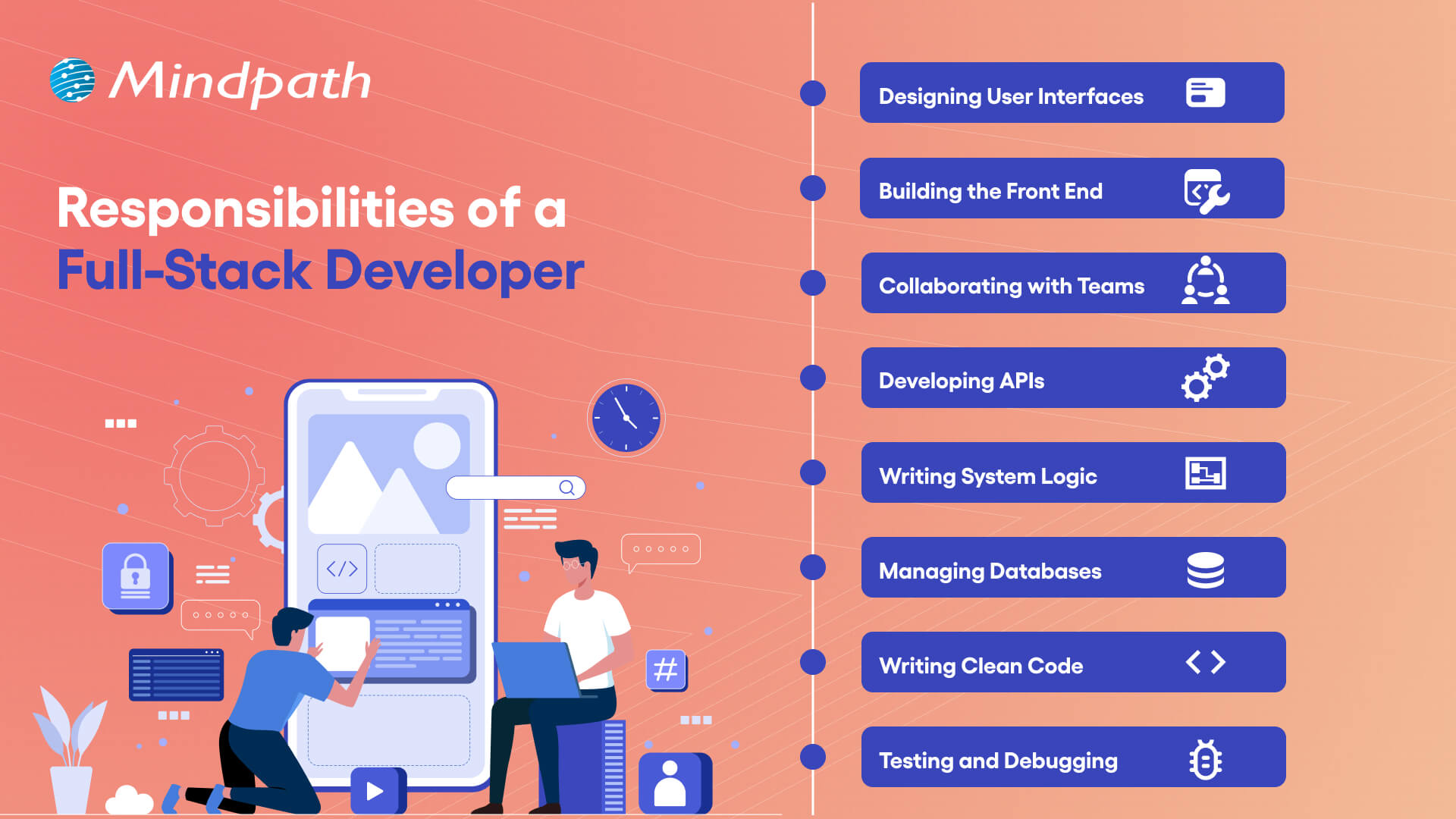
Responsibilities of a Full-Stack Developer

It’s important to recognize the broad spectrum of responsibility that comes with hiring a full-stack developer. The following responsibilities communicate how they join the layers of development into a smooth-flowing digital solution.

Responsibilities of a Full-Stack Developer

1. Designing User Interfaces

A freelance full-stack developer builds interfaces that have visual appeal and work on any device. They ensure that the website is responsive and works well for the user.

2. Building the Front End

Using HTML, CSS, and JavaScript, they build the experience that the user interacts with and engages with the visual. This allows for seamless movement through the site visually.

3. Collaborating with Teams

They collaborate with designers, managers, and stakeholders to achieve project outcomes. The benefits of collaboration can be easily seen, as it assures the application is built correctly.

4. Developing APIs

Full-stack developers are responsible for the build of APIs to interconnect systems and services. This allows the same data to move between the front end and back end.

5. Writing System Logic

They create a logic that drives the functions within an application. It responds to requests, processes data, and provides accurate results.

6. Managing Databases

A freelance full-stack developer sets up, maintains, and stores data in databases for user information. They secure data management, and they optimize the strategies for saving data.

7. Writing Clean Code

They write code that is maintainable and structured with performance in mind. Clean coding practices support a reduction in error and an increase in ease of modification.

8. Testing and Debugging

A full-stack developer tests an application to look for bugs. They debug the bugs to make sure it runs smoothly and reliably.

If you are planning to hire a full-stack developer, it is essential to understand the impact they can have on your product’s success. Explore our blog on Full Stack Developer Is Key to MVP Success to have a deeper understaning on how a full-stack developer can accelerate your MVP and give your product a competitive edge.

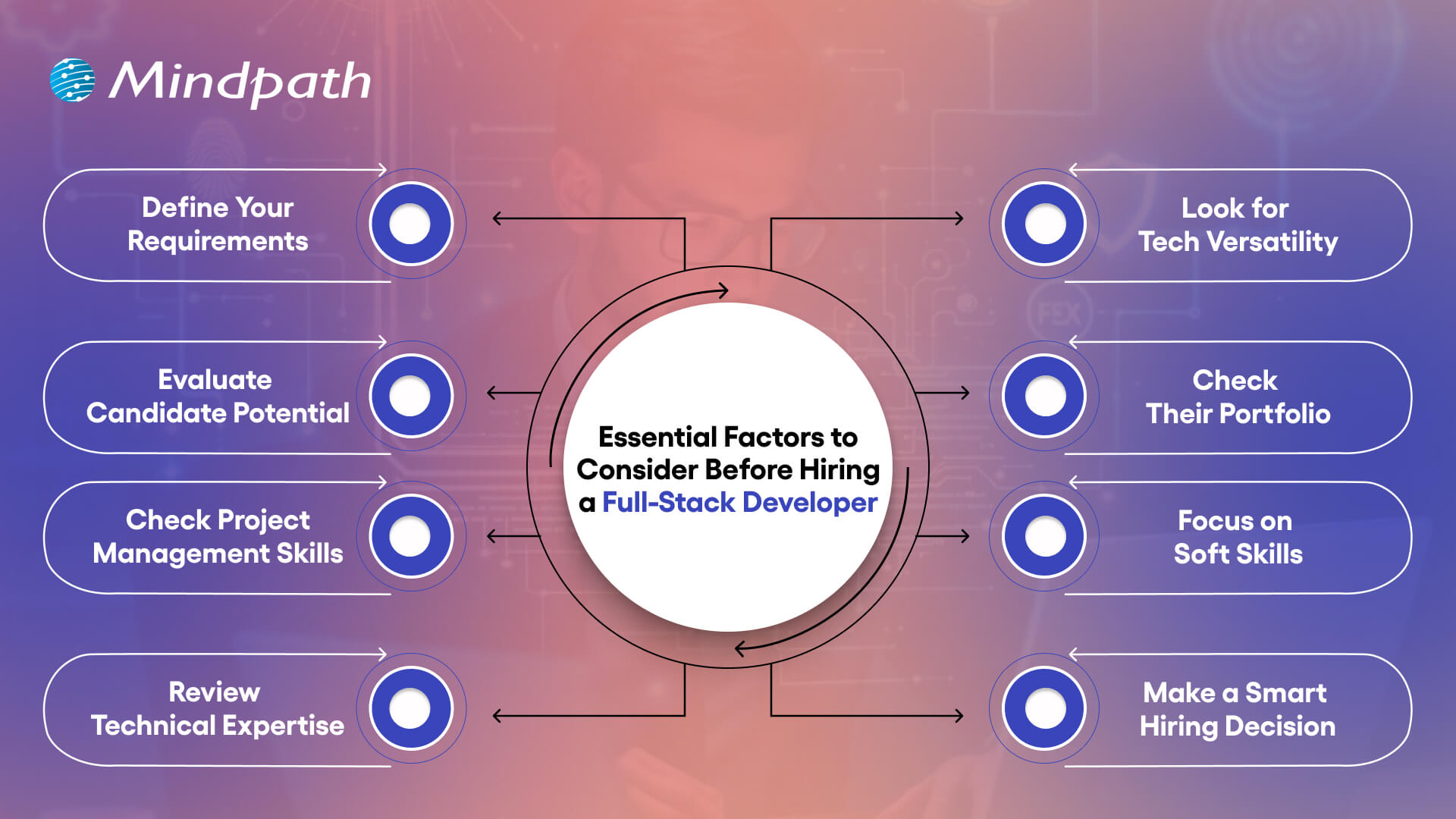
Essential Factors to Consider Before Hiring a Full-Stack Developer

Recruiting a full-stack developer isn’t just about evaluating technical skills. The following is a list of critical factors that will help you recruit a developer who aligns with your project needs and business objectives.

Essential Factors to Consider Before Hiring a Full-Stack Developer

1. Define Your Requirements

It’s important to create a clear document outlining your project needs prior to hiring a full-stack developer. This ensures the full-stack developer understands the features you need and the level of design you are expecting. Clarified requirements can aid in a quicker delivery to you and avoid any confusion.

2. Evaluate Candidate Potential

An experienced full-stack web developer has industry knowledge and experience. They can quickly adapt and move between projects as needed. Their ability to jump between projects can prove valuable when a deadline is around the corner.

3. Check Project Management Skills

When you hire a full-stack developer, you’re also getting a project manager with skills that go beyond simply coding. They have the ability to plan resources, lead teams, and manage the stages of development. Because of these proficiencies, they’re often the ones leading projects.

4. Review Technical Expertise

A good developer will know the languages behind building interfaces, HTML, CSS, and JavaScript. They will also know some back-end language, such as Python, PHP, or Ruby, and database experience with something like MySQL. It is a strong combination for full-stack development.

5. Look for Tech Versatility

Ensure that when hiring a full-stack developer, you validate their experience with multiple technologies. They should have knowledge of front-end frameworks, backend frameworks, and databases. You want real project experience that demonstrates their skills.

6. Check Their Portfolio

Request past work to evaluate their capabilities. A solid portfolio can illustrate how they overcome obstacles and provide solutions. Even newbies will be able to display some ability through sample work.

7. Focus on Soft Skills

A developer should recognize business requirements as well as perform technical tasks. A developer must be able to communicate without barriers to clients and teams. Good soft skills make it easy to comply with authority.

8. Make a Smart Hiring Decision

Finding the appropriate talent for full-stack web developer jobs can be a time-consuming process. Hiring a full-stack developer through a talent agency can help alleviate risk and guarantee that developers know what they are doing.

Want to transform your business inside out? Full-stack development makes it possible by optimizing operations and speeding up product launches. Explore the Benefits of Full-Stack Development every business needs to succeed.

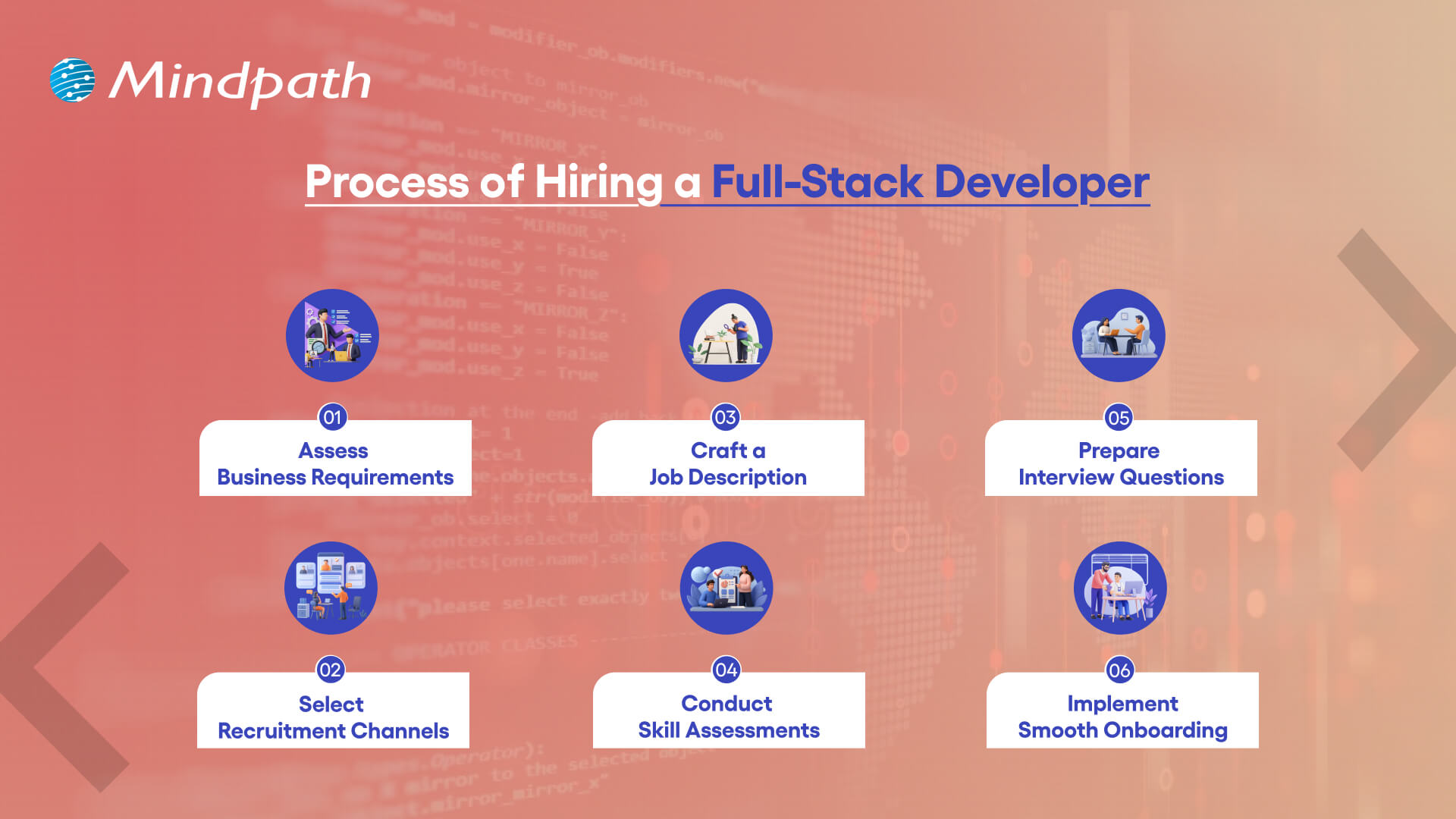
How to Hire a Full-Stack Developer

Selecting a full-stack developer involves an intentional process based on the right talent and your desired project specifications. The following steps will help you make a careful and confident hiring decision.

Process of Hiring a Full-Stack Developer

1. Assess Business Requirements

Prior to hiring a full-stack developer, make sure to define the project’s scope, budget, and timeline. Decide whether you need to hire someone full-time or if your project would require a freelance expert.

2. Select Recruitment Channels

Source candidates from networking sites, freelance platforms, and job boards. You can also connect with a full-stack development company to get the right talent.

3. Craft a Job Description

A good full-stack developer job description is a detailed description of the hard skills and tools, and the responsibilities for the job. A good job description helps you find the right candidates at a much quicker pace.

4. Conduct Skill Assessments

You can assess coding and problem-solving by utilizing structured coding tests or tasks. This method is a better hiring practice for a full-stack developer.

5. Prepare Interview Questions

Assess their familiarity with frontend, backend, and databases. A good candidate will often follow the best full-stack developer practices through good full-stack developer courses.

6. Implement Smooth Onboarding

After hiring a full-stack developer, tell them about their roles and responsibilities, the tools they will use, and the culture of the company. Successful onboarding ensures we’re setting them up for success and justifies their full-stack developer salary.

If you’re unsure whether to hire a full-time developer or a freelancer. Explore our blog on Freelance Full-Stack Developer to determine the best fit for your project’s needs. 

Ready to Hire a Full-Stack Developer for Your Next Project?

Hiring a full-stack developer is a smart decision for businesses aiming to build strong digital solutions. By focusing on skills, experience, and project needs, companies can find the right professional who delivers efficient results. The right choice not only saves time and costs but also ensures long-term success in competitive markets.

At Mindpath, you can hire full-stack developers who combine technical expertise with business understanding. Our developers work on both frontend and backend with precision, helping you achieve faster and smoother project delivery. With a proven track record across industries, Mindpath offers reliable talent that aligns perfectly with your goals and drives real value.

Unlock the secrets to hiring top full-stack developers. Explore key factors like experience, project fit, problem-solving skills, and communication for success.