Revolutionizing Industries: Top Machine Learning Applications for Businesses in 2025

Join our Newsletter!

Featured Posts

Support Is One Click Away

Home

Revolutionizing Industries: Top Machine Learning Applications for Businesses in 2025

Machine Learning Applications

Revolutionizing Industries: Top Machine Learning Applications for Businesses in 2025

Have you ever wondered how businesses are staying ahead in the ever-evolving world of technology? As we step into 2025, machine learning is no longer just a buzzword—it’s a driving force behind smarter decisions, personalized experiences, and streamlined operations. But what are the top applications of machine learning that can truly transform your business? In this blog, we will dive into the possibilities and explore how this cutting-edge technology is reshaping industries worldwide.  

Machine learning is a form of technology that enables computers to learn and make choices independently without explicit instructions. It employs data to identify trends, forecast outcomes, and enhance over time. For instance, it operates features such as recommendation engines on e-commerce sites or virtual assistants like Siri and Alexa. Machine learning is increasingly integrated into our lives and enterprises. It enables businesses to operate more swiftly, enhance customer service, and potentially reduce costs. Understanding the application of machine learning can provide companies with an advantage in addressing challenges and maintaining a lead over their rivals. For individuals, it’s useful to grasp how this technology influences the tools and services we utilize daily.  

Let’s dive into the machine learning applications 2025! 

Top Machine Learning Applications in 2025

1. PyTorch

PyTorch is a robust framework for machine learning that has gained significant popularity in the last few years. It was constructed on a previous library named Torch, but as Torch is no longer maintained, PyTorch has become the preferred library for developers. A major advantage is TorchScript, which enables developers to transition smoothly between testing and production settings with minimal effort. It additionally facilitates distributed training, enabling machine learning models to be trained more quickly and on larger datasets, making it perfect for companies that require high performance.  

In 2025, PyTorch remains distinguished by providing extra tools such as Captum for comprehending how models arrive at decisions and PyTorch Geometric for developing intelligent systems that operate with interconnected data like networks or graphs. For users of scikit-learn, skorch guarantees compatibility, facilitating seamless integration. Programmers and enthusiasts have the option to participate in communities such as PyTorchDiscuss to exchange ideas and explore more complex machine learning subjects. As machine learning influences the future, PyTorch is essential in making these developments reachable and efficient.  

2. Accord.NET

Accord.NET is a machine learning library specifically created for C# programmers. Developed by César Roberto de Souza and initially released in 2010, it has gained popularity among users of the .NET platform. Accord.NET offers an extensive array of capabilities, such as tools for statistics, machine learning, and neural networks. It additionally provides a range of algorithms including classification, regression, and clustering, which are crucial for creating intelligent systems. In addition to machine learning, Accord.NET offers libraries for audio and image processing, enhancing its versatility for media analysis and recognition applications. Developers can obtain Accord.NET as source code, pre-built installers, or through NuGet packages, which serve as a package manager tailored for Microsoft’s development tools. As the significance of machine learning expands, frameworks such as Accord.NET simplify the process for developers to build creative applications while operating within known environments.  

3. Caffe

Caffe, which stands for Convolutional Architecture for Fast Feature Embedding, is a deep learning framework created by the Berkeley Vision and Learning Center in 2017. Crafted in C++, it aims for superior performance and adaptability, facilitating smooth transitions between CPU and GPU processing. It additionally offers interfaces for Python and MATLAB, enhancing its versatility for developers. Caffe is famous for its speed, handling more than 60 million images daily using only one NVIDIA K40 GPU. This makes it a perfect option for activities such as image classification and segmentation. It seamlessly works with GPU and CPU libraries such as NVIDIA cuDNN and Intel MKL, guaranteeing effective performance on different platforms. Caffe is commonly utilized in computer vision, speech processing, and multimedia applications because of its speed and dependability. It’s popular with startups, academic scholars, and global corporations.  

4. Scikit-learn

Scikit-learn is a popular library for machine learning in Python, providing an easy and effective approach to create predictive models. Initially launched in 2007 as a Google Summer of Code initiative by David Cournapeau, it has developed into one of the most widely used tools for machine learning. Scikit-learn is constructed on libraries such as NumPy, SciPy, Matplotlib, and Pandas, allowing for smooth integration with these tools, which makes it an ideal option for data scientists and developersAlthough mainly written in Python, certain core algorithms are implemented in Cython to improve speed and performance. Scikit-learn offers various supervised and unsupervised learning techniques, such as classification, regression, clustering, support vector machines, decision trees, and random forests. Its adaptability and intuitive interface render it perfect for both novices and experts aiming to develop robust machine learning models effectively.  

5. TensorFlow

TensorFlow is an open-source framework created by the Google Brain team in 2015 for machine learning purposes. It provides a variety of tools and libraries for creating, training, and deploying machine learning models. TensorFlow simplifies model creation for beginners through high-level APIs such as Keras. The platform offers great flexibility, delivering various levels of abstraction to meet your requirements. TensorFlow enables the deployment of models in diverse environments such as the cloud, web browsers, or on devices. For mobile applications, TensorFlow Lite is accessible, whereas TensorFlow.js is intended for training and deploying models within JavaScript settings. TensorFlow is compatible with several programming languages, including Python, C++, Java, and JavaScript. It additionally provides third-party packages for languages such as MATLAB, R, and Julia. TensorFlow is a great option for developers due to its flexible tools and wide-ranging compatibility, making it suitable for both small projects and extensive machine learning systems. 

6. Apache Spark

Apache Spark is a free, open-source framework for cluster computing that enables developers to efficiently process vast quantities of data. Created at UC Berkeley’s AMPLab and launched in 2014, Spark is centered on Spark Core, which emphasizes the Resilient Distributed Datasets (RDD) model for managing data across clusters. Spark SQL is a robust element that accommodates structured and semi-structured data through DataFrames. It’s very adaptable and can operate in various settings such as standalone clusters, Hadoop YARN, EC2, Mesos, or Kubernetes. This flexibility makes it a favored option for companies dealing with big data. Moreover, Apache Spark is capable of retrieving data from various sources, including the Hadoop Distributed File System (HDFS), as well as non-relational databases like Apache Cassandra, HBase, and Hive. The agility and versatility of Spark make it perfect for managing intricate data processing operations on multiple platforms. 

Also Read: Agentic AI: Empowering Machines with Decision-Making Abilities

Machine Learning Services at Mindpath

At Mindpath, we offer machine learning solutions to assist companies in making more informed decisions using data. Our team develops tailored solutions enabling you to examine data, forecast trends, and automate procedures. From creating algorithms to incorporating models into your systems, we guarantee that your machine learning tools function effortlessly to meet your requirements. Whether you’re enhancing customer experiences or streamlining operations, Mindpath’s knowledge in machine learning can assist you in uncovering valuable insights and fostering business growth. Allow us to assist you in maximizing your data and staying ahead of your rivals. 

Wrapping Note!

In 2025, machine learning will certainly transform the business landscape, presenting countless chances to innovate, improve efficiency, and maintain competitiveness in a world that relies heavily on data. The use of machine learning is revolutionizing industries worldwide, enhancing customer experiences, streamlining processes, and providing actionable insights. By utilizing robust frameworks such as PyTorch, TensorFlow, Caffe, and more, companies can unleash new possibilities and address intricate challenges effortlessly. At Mindpath, we recognize the significance of leveraging this advanced technology to enhance growth and efficiency. Utilizing our machine learning solutions, you can achieve a competitive advantage by making more informed decisions and optimizing your operations.  

Ready to unlock the power of machine learning for your business? 

Partner with Mindpath today to explore tailored solutions that drive growth and innovation.
Related Post

Discover the ultimate guide to hiring Node.js developers in London. Learn about the skills, benefits, and cost factors involved in finding the right talent for your project.

Related Post

Node.js developer in New York expenses vary depending on criteria such as expertise, project size, and hiring technique. Whether you’re a startup searching for a low-cost alternative or a major company looking for top-tier expertise, understanding these expenses will help you make an informed selection.

1. Hourly Rates for Node.js Developers

Hiring a Node.js developer in New York is based on experience. Junior developers (0-2 years) charge $12-$50 per hour for minor bug fixes, API connections, and application changes. Mid-level developers (3-5 years experience) charge $50-$100 per hour and specialize in full-stack development, performance optimization, and complicated backend operations. Senior developers (5+ years) charge $80-$150+ per hour and have extensive abilities in system architecture, database administration, and high-performance solutions. The more experienced the developer, the greater the cost because of their ability to manage complicated projects efficiently. If you’re seeking cost-effective alternatives, remote hiring from nations with reduced labor expenses can be a possibility. However, recruiting locally in New York allows for greater cooperation, real-time assistance, and easier project management. Deciding the right developer level depends on your project requirements, budget, and long-term goals.

2. Project-Based Costs

The overall cost of a Node.js project varies depending on its complexity, length, and team size. Small projects, such as rudimentary web apps with limited functionality, often cost between $12,000 and $25,000. Medium projects, which include bespoke apps with various connectors and real-time capabilities, cost between $25,000 and $45,000. Large-scale projects can cost more than $60,000. Examples include enterprise-level programs with high scalability, improved security, and cloud integration. A separate development team is frequently required for larger projects, which raises the cost even further. Businesses can collaborate with a Node.js development business, with yearly service rates ranging from $72,000 to $116,000. Choosing between freelancers, an in-house team, and an agency has a big influence on the overall cost. While freelancers are cost-effective for short-term work, agencies provide comprehensive development services with long-term support. Evaluating your project scope beforehand helps in budgeting and selecting the best hiring model.

3. Factors Affecting Hiring Costs

Several factors affect the cost of hiring a Node.js developer in New York. Project complexity is important—simple apps cost less, but complicated projects needing high scalability, AI integration, or data security raise costs. The hiring approach also influences price. Freelancers charge less but may not provide ongoing help. In-house developers provide consistency but incur additional overhead expenditures like salary and perks. Development agencies offer comprehensive solutions but are usually the most expensive. Another important consideration for developers is their location. Hiring in New York facilitates smoother cooperation and speedier communication, but it is more expensive than outsourcing to nations like as India or Eastern Europe, where hourly rates are much cheaper. When selecting a developer, you must consider experience, quality, and affordability. By carefully considering these factors, businesses can find a cost-effective yet skilled Node.js developer to match their project’s needs.

Need skilled Node.js developers in New York for your next project? At Mindpath, provides expert developers to build secure, scalable, and high-performance applications. Whether you need a dedicated team or a single developer, we offer flexible hiring models to fit your budget and project needs.

Partner with Mindpath today and bring your vision to life with top-tier Node.js development!

Discover the ultimate guide to hiring Node.js developers in London. Learn about the skills, benefits, and cost factors involved in finding the right talent for your project.
AI consultant

How can organizations navigate the dizzying speed of change in technology while being sure that they are creating action at every juncture? This is where the AI consultant comes in. The AI consultant is a facilitator who provides leaders with the ability to make decisions that create real change, instead of jumping from trend to trend with no direction other than the next trend. The role of AI consultant is all about actions that create a clear path forward. Isn’t it better to trust expertise that brings certainty to uncertainty?

Digital transformation then clearly becomes a much less daunting task. With appropriate direction, businesses can streamline processes, strengthen data-driven decisions, and increase customer experience.  Leaders can then invest in strategies that produce measurable results. No more guessing. Once each leader knows the target, transformation becomes an adventure where challenges can be tackled with purpose and growth can become scalable. In this blog, we will get into how an AI consultant can support companies pursuing digital transformation.

The expertise brought in by the AI consulting brings technical insights as well as strategic thinking. Mindpath’s AI Consulting Services help unlock new effectiveness and innovations in your business.

Why Do Businesses Need an AI Consultant?

An artificial intelligence consultant provides businesses with insight into how artificial intelligence can not only solve the problems they currently face but also improve operational effectiveness. They assess the company and what it needs and determine options for AI tools based on those needs, ensuring alignment through every stage of growth, operational efficiency, and an enhanced decision-making process going forward.

The consultant can also help address the gap between innovating AI technology and implementing that technology into the enterprise. They have both technical depth and strategic insight and offer organizations a roadmap to assist leaders in planning and applying solutions to achieve succinct outcomes. The prime focus is on measuring outcomes that create value, improve competitiveness, and position organizations for a digital transformation journey in the months and years ahead.

Must Read: Benefits of AI consulting

Responsibilities of an AI Consultant

By partnering with an AI consulting firm, businesses are able to work with experts who know how to make technology work for them. Their work includes strategy and planning as well as execution, ensuring AI solutions fit the overall business goals and create value that can be measured.

1. Finding the Right AI Opportunities

An AI consultant analyzes the existing processes of an organization to identify how artificial intelligence can offer measurable business value. They identify the use cases for an organization, including, but not limited to, automation, predictive insights, or improved customer experience, that can help to drive better results. This essentially creates the foundation for organizations to develop better opportunities from standard quotidian tasks that allow for AI business transformation.

2. Selecting the Right Tools and Platforms

An AI consulting service helps organizations determine the correct platforms and technology for their size, budget, and goals. For large enterprises, the consultant might recommend complex on-premises systems. For startups, a cloud solution might be the better choice. The right choice means that overall, AI adoption will go more smoothly, and you’re more likely to get better results from every project.

3. Training and Testing AI Models

The AI consultant regulates the building, training, and evaluation process before deployment. The AI consultant creates test cases for both accuracy and performance so that the solution sufficiently meets the business requirements. This process is crucial to the establishment of AI that can produce reliable and predictable results and information. This is also a part of AI consulting for business growth.

4. Preparing and Analyzing Data

All AI solutions require quality data, and this is why the AI consultant is so important. They clean, structure, and prepare datasets to make sure machine learning models can run reliably and accurately. Investing your data quality efforts in these specific steps provides the best foundation for solution scenarios like churn prediction or demand forecasting.

5. Monitoring and Improving AI Systems

Once deployed, AI systems require ongoing attention and refinement to remain effective. The AI consultant updates and operates the AI models, ensures the system scales, and deals with ethical implications. This continuing process facilitates flexible technology to adapt to the changing needs of the client’s business and ensures ongoing return on investment resulting from AI business transformation.

AI consulting is helping businesses in strategy making to become industry leaders. If you also want to know how, check out our blog: AI in business startegy

How Does an AI Consultant Drive Digital Transformation?

Understanding how AI consultants propel transformation is important for businesses that want to make better decisions and remain competitive. They can help organizations use AI in a more effective way and make sure that everything they do will lead to real change and long-lasting success.

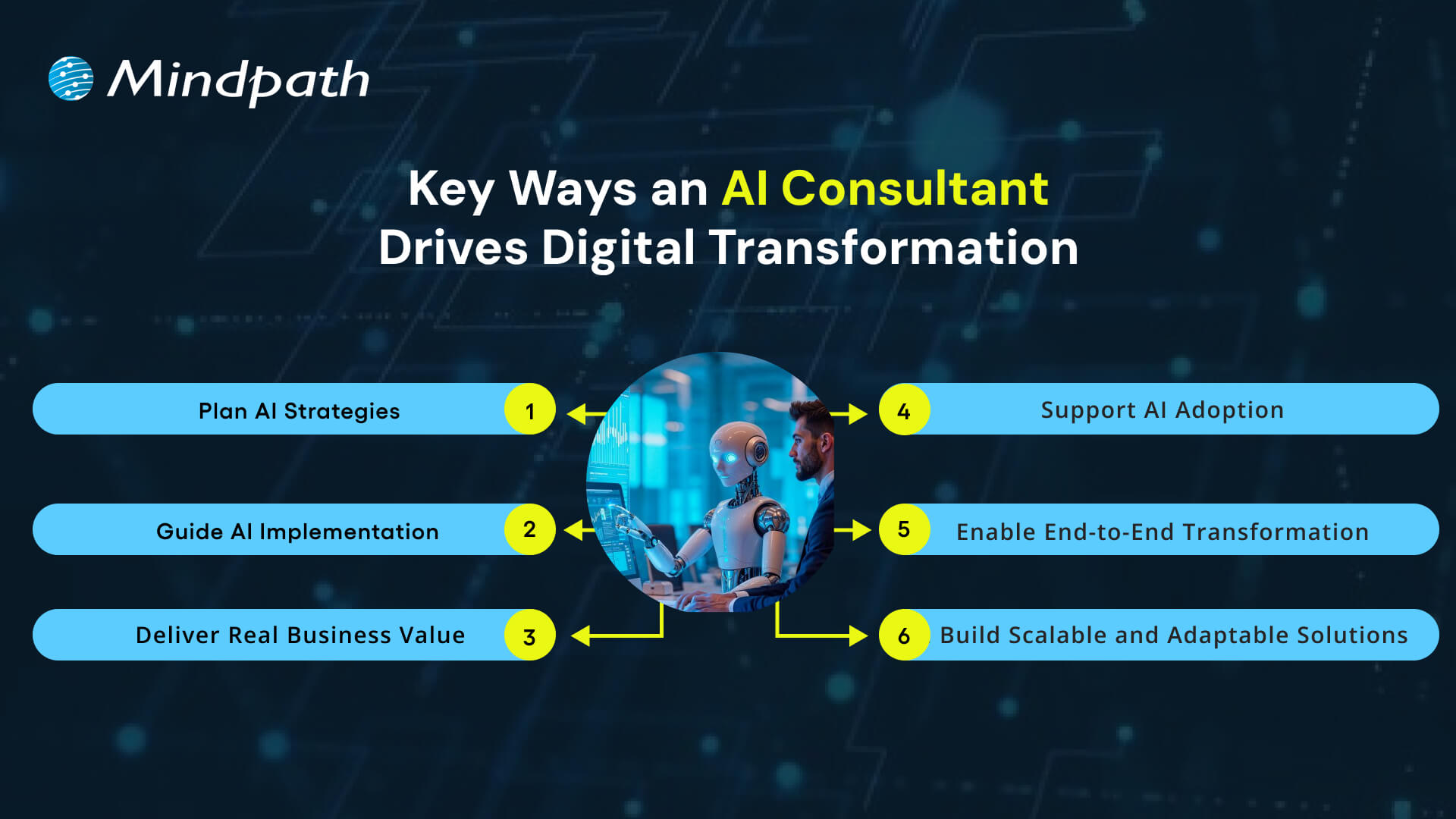
Key Ways an AI Consultant Drives Digital Transformation

1. Plan AI Strategies

An AI consultant assists organizations in synchronizing AI initiatives with fundamental business priorities while emphasizing outcomes over simply tools. They structure strategies that will connect data, technology, and business objectives into practical plans of action that ensure that digital transformation with AI delivers measurable outcomes throughout the organization.

2. Guide AI Implementation

Experts ensure teams apply AI technologies correctly in the right context, considering infrastructure, data, and practical implementation throughout the process. The increased exposure ensures reduced failed experiments, while returning greater proportions of success to AI projects.

3. Deliver Real Business Value

They emphasize outcomes that impact performance, not to simply automate. They work with experts to help companies develop smarter products, optimize workflows, and enhance the customer experience. All AI solutions are focused on achieving measurable outcomes and long-term benefits.

4. Support AI Adoption

Utilizing AI is much more than a technical shift; it’s an organizational change. They provide teams with tools to help them change their workflows, train them, and support their integration of AI tools into their regular workflows; all of which encourage a short adoption window, continued use of AI across the organization.

5. Enable End-to-End Transformation

Experts advocate total digital transformation through the alignment of people, processes, and technology, connecting leadership with technical and non-technical teams to maximize the impact of AI on transforming the future. The holistic nature of these AI consultant roles makes them central to any successful long-term transformation program.

6. Build Scalable and Adaptable Solutions

They will help provide assurance that these AI systems can be flexible and scalable to adapt to future needs when business requirements change. They monitor the AI systems are performing correctly and making iterative improvements as the businesses grow continuously. The continuous support allows organizations to realize the best potential of their AI systems over extended periods.

AI consulting is transforming the way modern businesses grow and compete in the market. Discover more on why organizations need AI consulting services to unlock growth and drive innovation in a rapidly changing market.

Want to Unlock the Full Potential of AI for Your Business?

Digital transformation is only effective when organizations thoughtfully and strategically leverage AI to transform processes, decisions, and experiences. An AI consultant partners with organizations to identify overall goals, align technology to deliver on those goals, build actionable plans, and deliver measurable results. With AI applied in a measured and thoughtful manner across all functions and operations, organizations can gain long-term growth, efficiency, and competitive advantage while using technology as a true driver and enabler of success.

We at Mindpath provide expert AI consulting services that guide businesses through planning, implementation, and scaling of AI solutions. Our team ensures every initiative aligns with strategic priorities, enabling measurable results and continuous improvement. By combining technical expertise with business insight, we empower organizations to leverage AI effectively and gain lasting value from their digital transformation efforts.

ai agents

Just think if there was a digital assistant that not only obeyed commands, but was able to understand goals, make decisions and learn from experience? Sounds exciting, right? What if we told you this already exists? Yes, you heard correctly. This is where AI Agent comes in, which is a smart system that is intelligent enough to work independently and get the job done without having to check in with a human often, truly showcasing how AI is transforming future possibilities.

These days, companies are turning to automation and intelligence-based tools, which would make artificial intelligence agents important, no matter where you are in business. They can assist organizations in their own endeavors. They can make a company’s operations more efficient, provide real-time personalization for customers, and provide companies with less effort or worry, especially when dealing with complex operations. Do you want to know more? Well, we have you covered. This blog will guide you through everything you need to know about AI agents. 

To start with, let’s understand the meaning of AI agent!

Want to turn AI agent concepts into real, high-performing applications? Mindpath offers AI development services, where we design and deliver intelligent systems tailored for future-ready organizations.

What is an AI Agent?

AI agents are smart computer programs that can think and act on their own. They look at everything around them and understand what is going on and then decide what they should do next in order to accomplish a specific objective. These agents gather input from their environment through sensors or data feeds and respond by carrying out actions through digital systems or physical devices. They are like good digital employees that don’t require someone to keep an eye on them at all times.

What is unique about artificial intelligence agents is that they can learn and make decisions on their own. They act according to rules, operate on data, and in some cases, learn from experience so that they become more efficient in what they do. You will encounter them in numerous fields such as business, science, and technology where they assist in accomplishing things quicker and more efficiently. These agents are increasingly becoming a significant aspect of how we utilize technology today. 

Also Read: Agentic AI

Types of AI Agents 

AI agents come in different types, each designed to handle tasks in unique ways depending on their abilities. Understanding these types helps us see how they solve problems and make decisions in various situations. Below are some common kinds of AI agents and examples of how they work in real life:

1. Model-Based Agents

These use an internal idea, or model, of their environment to make smarter choices. They can remember what happened and plan ahead based on how things are connected. A GPS navigation system is a good example as it uses traffic and map data to suggest the best route in real time, showing how AI agent architecture works with memory and planning.

2. Goal-Based Agents

This type of agents are mainly focused on reaching a goal and making decisions by thinking about what might happen next. They pick actions that move them closer to what they want to achieve. For example, a self-driving car makes choices like stopping or changing lanes based on the goal of getting passengers to their destination safely.

3. Reactive Agents

These are the simplest kind that respond only to what’s happening right now. They don’t remember anything from the past and follow basic “if this happens, then do that” rules. A common AI agent example for this is a thermostat that turns heating or cooling on based on the current room temperature.

4. Utility-Based Agents

These take it a step further by not only pursuing goals but considering what choice provides the best outcome. They opt for actions based on what is most useful or gratifying. For example, a delivery drone can take a longer route to escape adverse weather while ensuring it reaches its destination on time and securely.

5. Learning Agents

These get better over time by learning from what they do and how well it worked. They have different parts that help them act, learn, and explore new options. A Netflix-style recommendation system is one such AI agent platform, improving suggestions as it learns what users like.

Curious about how AI agents deliver faster, smarter real-time responses? Our in-depth blog on Conversational AI explains how these systems understand users, learn from interactions, and continuously improve.

As we now have a basic idea about artificial intelligence agents, here are some benefits it can offer. 

Understanding the Benefits of AI Agents

According to Grand View Research, the global AI agents market size was estimated at USD 5.40 billion in 2024 and is expected to grow at a CAGR of 45.8% from 2026 to 2030. This rapid growth is driven by the increasing adoption of open-source AI agents that offer flexibility and innovation across industries. These intelligent systems bring numerous benefits such as: 

AI Agents Market Size & Trends

1. Ensure Accuracy

These tools can check their own work, find missing details, and fix mistakes. This helps keep results more accurate, even when things move quickly. It’s a smart way to keep quality high without slowing down. 

2. Cut Operational Costs

Automation helps cut down the cost of manual work and mistakes. It also reduces the need for constant back-and-forth between teams. That means more money saved on everyday business tasks. making AI in business strategy a valuable investment for long-term growth.

3. Build Custom Applications

Companies can develop tailored tools trained on their specific data and requirements. These solutions are designed to perform tasks according to the organization’s unique workflows and preferences. This makes AI for developers more effective and aligned with individual business goals. 

4. 24/7 Availability

AI tools can keep working in the background, even after work hours. They help with projects or answer customer questions at any time. This makes support and progress continue non-stop. 

5. Free Up Team Responsibilities

By handling repetitive tasks, these tools give team members more time to focus on creative ideas and big projects. It eases the load of daily tasks. This opens space for planning, strategy, and innovation. 

6. Boost Efficiency

Agentic AI tools help teams save time by handling many small decisions in complex tasks. This means people don’t need to step in every time, which makes work faster. With the right AI agent frameworks, teams can finish more in less time. 

Curious about which technologies are truly driving the next era of AI innovation? Explore our blog on GenAI tools to discover the most powerful solutions shaping the future of AI development.

Let us next learn how to create an AI agent:

Steps to Build an Artificial Intelligence Agent

Building an artificial intelligence agent involves a clear and structured process to ensure it performs effectively. Here’s a simple overview of the essential steps involved in creating a reliable and intelligent AI agent: 

1. Set Clear Goals and Purpose

Begin by clearly defining the specific tasks and functions the artificial intelligence agent will perform. Identify the problems it should solve and the target users it will serve, ensuring its goals match your business needs. Consider real-world use cases to determine the features and capabilities required. 

2. Gather and Prepare the Right Data

Gather data that reflects the type of interactions the artificial intelligence agent will handle, such as chat transcripts, voice recordings, or past user activity logs. Clean the data by removing errors and inconsistencies, then label it to help the agent understand user intent and context. Proper preparation of high-quality data is essential for accurate learning. 

3. Pick the Right Machine – Learning Model

Select a machine learning model suitable for your AI agent’s task, like neural networks for understanding language or reinforcement learning for decision-making. With your data in mind, determine if you can use a pre-trained model, or if you need to train a model from scratch instead. Fine-tuning pre-trained models can help calibrate them to your needs. and this is an area where the role of AI consultant becomes crucial in guiding the right model selection.

4. Train Your AI Agent to Learn

You will now configure your training environment and load the cleaned/labeled data you have. In the same way as traditional essential machine learning, the data has to be separated into training and testing data. The parameters need to be set like learning rate, epochs, and start training. Be aware of the performance metrics, the training metrics to make sure the model is learning as expected and when adjustments are needed. 

5. Test It to Make Sure It Works Well

Evaluate the artificial intelligence agent by running the AI agent through designated tasks, measuring accuracy, response time, and quality interaction with the user. You will use different testing methods like unit testing, user testing, and A/B testing to figure out its relative strengths and weaknesses. Lastly, you will also informally call out any open issues about the experience such as overfitting and refining the training or changing data as required. 

6. Launch and Keep Monitoring

Launch the AI agent on a dedicated platform, website, app, or voice interface and make sure that the integration is seamless. Monitor its usability using real-time analytics and user feedback to have a clear understanding of its performance and any analytics issues as soon as they arrive. To sustain systems and achieve the original intended purpose of engagement, systems should be routinely maintained, updated and improved. 

Wondering if your business is prepared to adopt AI and harness its full potential? Check out is your business ready for AI to assess readiness and start building a smart, future-proof strategy.

Are You Looking to Experience the Power of AI Agents?

AI agents have changed the way we interact with machines by letting systems do things on their own, learn on their own, and achieve more results in a shorter time. They provide freedom from manual effort, support better decisions, and improve efficiency in most industries and business functions. 

At Mindpath, we offer AI development services that fit your business needs. Our AI agents automate the routine tasks, improve the customer engagement experience, and support smarter ways of working, so that you can do things better in an increasingly competitive and tech-driven landscape.