

The Ultimate Face-Off: Python vs. ReactJS for App Development

Join our Newsletter!

Featured Posts

Support Is One Click Away

Home

The Ultimate Face-Off: Python vs. ReactJS for App Development

Python vs. ReactJS

The Ultimate Face-Off: Python vs. ReactJS for App Development

Curious about which technology will bring your app vision to life? Are you torn between the flexibility of Python and the dynamic capabilities of ReactJS? In the ever-evolving world of app development, choosing the right technology can make all the difference. In this blog, let’s dive into the ultimate face-off between Python and ReactJS to uncover which one stands out for your next project. So, let’s dig in! 

Overview of ReactJS

ReactJS is a popular technology for creating visually appealing and functional websites and applications. ReactJS, developed by Facebook, assists developers in creating website components that may be reused in a wide variety of places. This makes it easy to build and update websites. ReactJS is recognized for its speed and versatility, and it integrates well with other technologies, making it an excellent choice for a wide range of web projects. 

Benefits of ReactJS

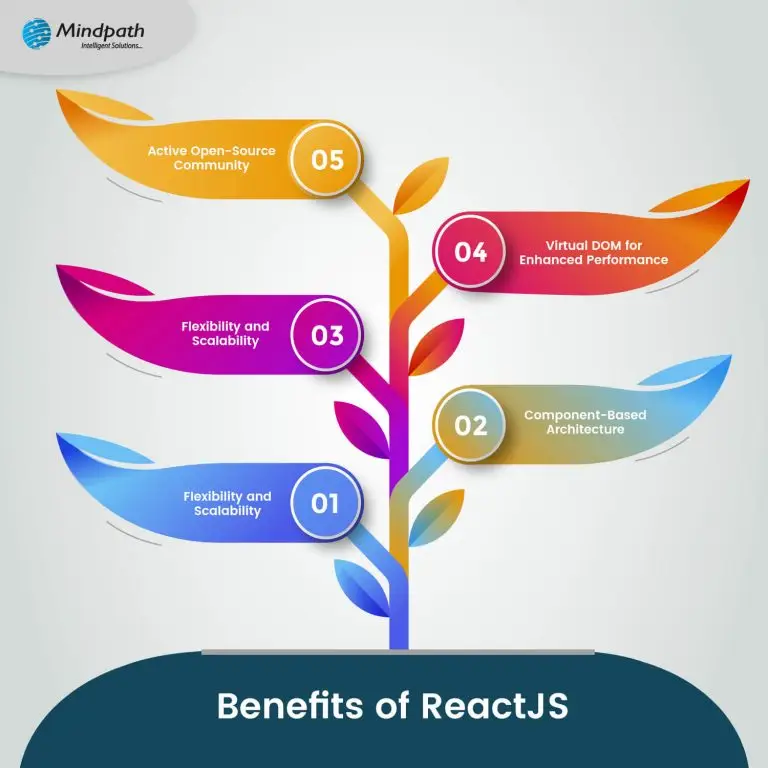
Benefits of ReactJS

1. Flexibility and Scalability

React JS is well known for its adaptability, which makes it appropriate for a variety of projects, ranging from small-scale apps to complex business solutions. Because of its component-based architecture, developers may more easily manage and maintain codebases by breaking large user interfaces down into reusable components. React JS’s flexibility lets developers start small and grow as their needs arise, all without sacrificing development efficiency or speed. While bigger apps employ React’s scalability to efficiently manage enormous data and sophisticated user interactions, smaller ones benefit from its simple setup and quick rendering times. React’s extensive ecosystem of libraries, tools, and community support helps solve a wide range of development problems, which further improves scalability. 

2. Rich Ecosystem and Tooling

A wide range of tools and frameworks that improve the development process are available with React JS. Webpack, which bundles assets, Babel, which trans piles JavaScript, and ESLint, which Lints code, are important tools. These make code quality maintenance, cross-browser compatibility, and module bundling easier. Styled Components makes styling easier; React Router makes routing easier, and Redux manages the state of the application. Each package promotes modularity and scalability in React apps by addressing development demands. Strong community assistance and copious documentation are advantageous to developers as they guarantee dependable answers and prompt issue resolution. This ecosystem results in lower development costs and faster project delivery for companies using React JS development services.  

3. Active Open-Source Community

React JS is an open-source project led by Facebook, which means it’s developed and improved by a huge community of people from around the world. Because it’s open source, React JS is constantly updated and refined based on what users need, not just what a company wants. This lively community helps React grow quickly by creating helpful tools, libraries, and learning materials. Developers can rely on this rich ecosystem for support, knowing they have many resources to build whatever they can dream up.

4. Virtual DOM for Enhanced Performance

Document Object Model (DOM) is used by React JS to greatly improve rendering speed. React JS apps are more responsive overall and update more quickly because of optimized approaches, particularly in situations where dynamic content and frequent state modifications are present. The ability of Virtual DOM to optimize performance by decreasing pointless DOM changes and improving rendering speed is the main benefit of utilizing it with React JS. This helps developers create strong, dynamic online apps and leads to smoother user experiences. By employing the Virtual DOM, companies and developers using React JS development services can be guaranteed that their apps are not only scalable and maintainable but also perform exceptionally well across a range of devices and user interactions. 

5. Component-Based Architecture

Component-based architecture in React JS is the process of breaking down user interfaces into independent, reusable components. By encapsulating distinct functionality, styles, and behaviors in each component, developers may effectively manage and scale complicated applications. Additionally, by isolating changes inside individual components, the modular design of components minimizes the possibility of unintentional side effects throughout the application, improving maintainability. This improves readability and expedites the development process, which facilitates communication and comprehension of the codebase structure among developers working on React JS development services.   

Overview of Python

Python is an easy-to-use programming language for developing a wide range of applications. It’s simple to read and write, making programming more efficient. Python is useful for swiftly developing applications and connecting multiple units of software together. It allows you to divide down code into reusable components, making it easier to maintain and update. Furthermore, Python is accessible for free on many platforms, and it is widely used due to its simplicity and versatility. 

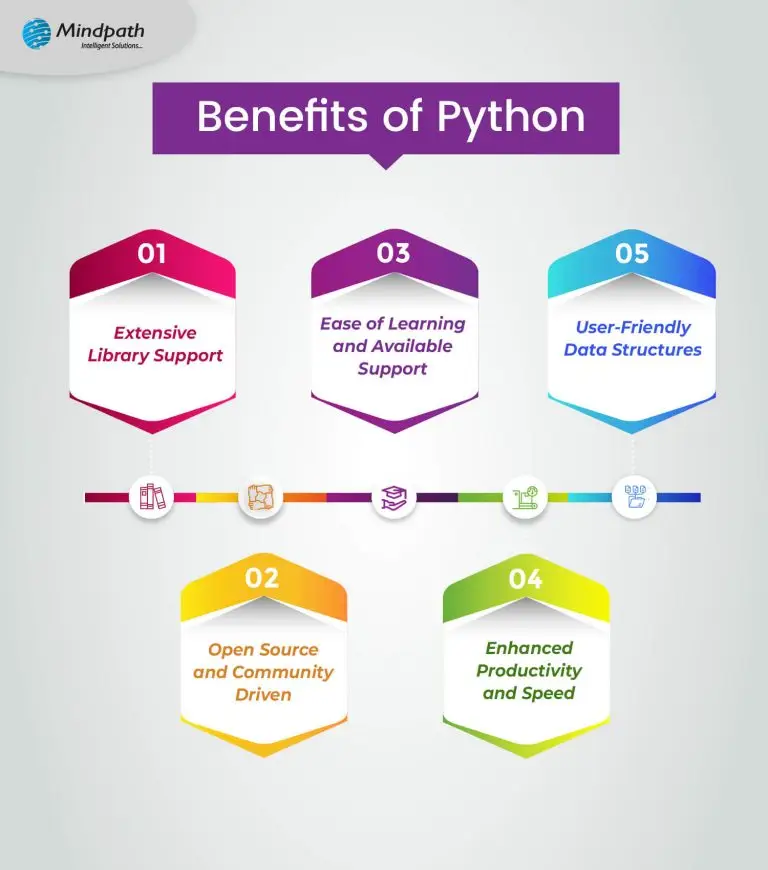
Benefits of Python
Benefits of Python

1. Extensive Library Support

Python includes a large number of built-in tools for managing internet connections, processing text, and dealing with multiple operating systems. This means you won’t have to start from the beginning on many everyday tasks. Instead, you may utilize these pre-built tools to complete complicated tasks more quickly and easily. Python includes several features, allowing you to write less code and focus on what makes your project different. 

2. Open Source and Community-Driven

Python was created under an open-source license certified by the OSI, which means it is totally free to use, share, and change, including for commercial uses. This openness stimulates wider adoption and innovation. Python’s development is largely impacted by the developer community, which actively contributes to its evolution. They work together to exchange ideas, resolve difficulties, and develop new features via conferences, online forums, and email lists. This collaborative effort results in a diverse ecosystem of modules and tools, making Python flexible and always evolving. Python’s community support guarantees that it is up to date and suitable for a wide range of applications. 

3. Ease of Learning and Available Support

Python is easy to learn because of its straightforward and simple syntax, making it ideal for beginners. Its code is simple to read and comprehend, allowing inexperienced programmers to get started fast. Python also adheres to a set of guidelines known as PEP 8, which outlines best practices for producing clean and organized code. Python also has a large community of users and active developers that contribute to a variety of online resources, tutorials, and forums. This substantial community support makes it easy for beginners to learn, get solutions, and improve their Python abilities. 

4. Enhanced Productivity and Speed

Python has a clear and organized object-oriented structure, making it simple to create and manage projects. It provides powerful capabilities for managing processes, working with text, and linking diverse software components, all of which increase productivity and efficiency. Python also has its own testing system, which allows developers to easily identify and correct issues. Python’s characteristics make it an excellent choice for developing complicated applications, including ones that must handle numerous network protocols. 

5. User-Friendly Data Structures

Python includes built-in data structures such as lists and dictionaries that are simple to use and help construct efficient and quick programs. These technologies enable developers to easily organize and handle data without requiring a lot of additional code. Python also provides dynamic typing, which eliminates the need to specify data types in advance, making writing easier and more flexible. This decreases the amount of code required, which speeds up development and makes it more user-friendly. 

Need top-notch ReactJS development?

Partner with Mindpath for innovative, high-performance solutions. 

Python vs. ReactJS: A Comparison Table

Feature 

ReactJS  

Python  

Learning Curve 

Faster and more responsive web applications 

Easier syntax but slower in web response times 

Inheritance 

Prototype-based inheritance allows flexible structures 

True OOP inheritance, but may add complexity 

Numeric Types 

Efficient handling of numeric data in modern browsers 

Offers various numeric types but can be slower 

Web and Mobile Development 

Highly efficient for web apps, supports mobile development 

Great for server-side but slower for web apps 

Scalability 

Supports multithreading, highly scalable 

Limited by GIL, less efficient for multi-threading 

Community 

Active and rapidly growing community 

Mature but may be more conservative in evolution 

Extensibility 

Supports modern tools like Babel, Webpack, and Express 

Extensive tools but not always optimized for front-end 

Universality 

Great for full-stack development across web, mobile, and IoT 

Mainly back-end focused; less suited for mobile apps 

Data Processing 

Excellent for data-intensive applications with parallel processing 

Slower due to single-threaded data processing 

React Development Services at Mindpath

At Mindpath, we put ReactJS into practice to come up with powerful and scalable web solutions. With over ten years of experience, our team is well-equipped to handle a wide array of ReactJS development needs. Here’s a review of the services we offer: 

  1. ReactJS Front-End Development: We are involved in creating responsive and dynamic user interfaces to improve user experience and interaction with your website.
  2. React Native App Development: Our team develops cross-platform mobile apps with React Native and gives them the native look and feel across iOS and Android devices.
  3. ReactJS Consulting: We expertly guide you on the usage of ReactJS in your projects so that the development strategy and architecture may be better optimized for the projects.
  4. ReactJS API Integration: We will integrate your ReactJS applications easily with external APIs and connect them seamlessly for smooth data and functionality exchange.
  5. ReactJS Enterprise App Development: We develop scalable and reliable applications that large organizations can use to take up complex requirements with high performance and efficiency.
  6. ReactJS Maintenance & Support: Continuous maintenance and support services that keep your ReactJS applications in motion, fixing any issues fast.
  7. React Web Design: We design engaging and user-friendly web interfaces that provide an impressive user experience through a focus on aesthetics and functionality using ReactJS.
  8. Custom React JS App Development: Build customized ReactJS applications that meet your business requirements, providing personalized solutions to all your needs.
  9. ReactJS Upgradation: Upgrade your existing ReactJS applications to their latest versions, offering you brand new features and improved performance.
  10. ReactJS Product Development: We develop innovative products with ReactJS; high quality and performance-driven applications that fulfill your business needs.
  11. ReactJS Ecommerce Development: We will build robust, interactive e-commerce platforms using ReactJS to ensure a great online shopping experience.
  12. ReactJS Migration: We help migrate your existing applications to ReactJS while ensuring smooth transitioning and improved performance.
  13. ReactJS Plugin Development: Developing custom plugins for ReactJS that extend functionality and fit in perfectly with other tools and systems.
  14. 1 ReactJS Social Media & Interactive Apps: Let us help you create engaging social media and interactive applications using ReactJS that improve user interaction and their experiences.
  15. ReactJS Customization Services: We will customize ReactJS components and applications according to your needs and wishes.

Final Thought!

The choice between Python and ReactJS for app development is determined by your project’s individual requirements. ReactJS’s component-based design enables the creation of dynamic and interactive user interfaces, making it perfect for web and mobile development. Its robust ecosystem, scalability, and active community support make it a top choice for front-end development. Python, on the other hand, is ideal for backend programming, data processing, and applications that require quick prototyping due to its simplicity, numerous libraries, and adaptability.  

Mindpath is dedicated to delivering top-tier ReactJS development services that are suited to your specific business requirements. With a decade of expertise and a team of experienced experts, we specialize in developing ReactJS-based online and mobile applications that are responsive, scalable, and high-performing. Whether we’re designing new apps, connecting APIs, or providing continuous support and maintenance, we guarantee that your project will be handled with the highest skill and attention to detail. 

Want to build fast, engaging web applications?

Let our expert ReactJS team transform your vision into reality. 
Related Post

Explore the impact of Generative AI in retail and e-commerce, enhancing customer experiences, streamlining operations, and driving engagement.

Related Post

Important to Consider When Hiring a Canadian ReactJS Developer
Hiring a ReactJS developer in Canada requires evaluating both technical expertise and problem-solving abilities. The ideal candidate should have a strong JavaScript foundation, in-depth React knowledge, experience with state management, and proficiency in front-end technologies. Additionally, expertise in version control, API integration, and performance optimization plays a crucial role in developing efficient applications. To ensure a successful hire, it’s essential to assess their ability to write clean, maintainable code and collaborate effectively. Below are four key factors to consider when hiring a ReactJS developer.

1. Strong JavaScript and React Fundamentals

A skilled ReactJS developer must have a deep understanding of JavaScript (ES6+), JSX, props, state, and component lifecycle methods. Proficiency in higher-order functions, closures, and asynchronous programming is crucial for building scalable applications. Additionally, a strong grasp of React hooks, context API, and functional components ensures efficient state management and UI rendering. This foundation allows developers to write optimized, reusable components and implement modern front-end development best practices, leading to faster and more maintainable web applications.

2. Proficiency in State Management and API Integration

Managing application state efficiently is crucial for complex React projects. Developers should be proficient in Redux, Context API, or other state management libraries to handle global state effectively. Experience in fetching, handling, and updating data from external APIs using Axios or Fetch API is equally important. Understanding RESTful APIs, GraphQL, and authentication mechanisms enhances their ability to build dynamic applications. These skills ensure smooth data handling and seamless communication between the frontend and backend, improving user experience and application performance.

3. Expertise in Frontend Technologies and Testing

A ReactJS developer should have a strong command of HTML, CSS, and responsive design principles to build user-friendly interfaces. Familiarity with CSS preprocessors like Sass or Less helps maintain scalable stylesheets. Additionally, experience with unit testing frameworks like Jest and React Testing Library ensures code reliability. Writing testable components minimizes bugs and enhances maintainability. Ensuring proficiency in these areas helps create visually appealing, robust applications that work seamlessly across different devices and browsers.

4. Version Control, Performance Optimization, and Tools

Version control is essential for collaborative development. A proficient ReactJS developer should have expertise in Git for managing code changes and maintaining project history. Knowledge of React performance optimization techniques like lazy loading, memoization, and efficient rendering improves application speed. Familiarity with React Router for navigation, Webpack for bundling, and accessibility best practices enhances overall development quality. These skills ensure that applications remain fast, scalable, and easy to maintain while following industry standards.

Looking for skilled ReactJS developers in Canada? Mindpath, connects you with top professionals to build high-performance web applications. Our experts specialize in React development, state management, API integration, performance optimization, and modern front-end technologies. Whether you need a dedicated team or individual talent, we have the right solution for your project. Partner with Mindpath today and hire expert ReactJS developers for your next big project!

Get in Touch Now!

Discover the key factors influencing software development costs and how to optimize your budget. Learn how Mindpath can help.
Data and Analytics Trends

Have you ever wondered how data is shaping the future? As businesses continue to rely on insights to make smarter decisions, the world of data and analytics is evolving at lightning speed. What trends will dominate in 2025? How will they transform industries and influence everyday life?  

Data and analytics trends are significant because they enable firms to make better decisions. Companies that use cutting-edge tools and techniques can better understand their customers, enhance their goods, and identify new growth prospects. These patterns also make it simpler to anticipate future issues and handle them more quickly. In today’s rapidly changing world, being updated on data and analytics trends provides organizations a significant edge, allowing them to remain ahead of the competition and prosper in the long run. 

Let’s explore the top data and analytics innovations to watch out for in the coming year! 

Data And Analytics Trends In 2025

1. AI and ML Transform Data Analytics

Artificial Intelligence and machine learning are altering the way organizations utilize data. These modern technologies assist in automating monotonous operations, analyzing vast volumes of data, and identifying trends that people might overlook. This allows businesses such as healthcare, retail, banking, and telecommunications to work more efficiently, solve issues faster, and make better judgements. One significant advantage of machine learning is its capacity to analyze data in real time, detecting unexpected patterns or problems and alerting teams to action. This saves time and helps to avoid larger complications. 

Self-driving automobiles provide an excellent illustration of AI and machine learning in action. These devices utilize complex algorithms and cameras to accurately detect objects and ensure safe navigation. This technology has the huge potential to make self-driving cars generally accepted, opening the door for safer and more intelligent transportation systems. It demonstrates how powerful AI and ML can be in determining the future of many sectors.  

2. Empowering Everyone with Data Democratization

Data is no longer only for specialists; it has become a significant resource for everyone in an organization. Businesses are attempting to make data more accessible and usable, especially for those without technological expertise. This trend, known as data democratization, means that more employees can benefit from insights and apply them to better decision-making. Companies do this by simplifying how data is organized, providing user-friendly tools, and training people on how to utilize data successfully. Generative AI technologies aid in the discovery of insights, while data fabric tools link systems and data mesh organize data by business sector. Employees also have access to self-service resources such as data visualization dashboards, learning knowledge bases, and concept testing tools.  

3. DataOps for Better Analytics

DataOps, which stands for Data Operations, is transforming how businesses manage and use their data. It simplifies the whole data management process, resulting in faster and higher-quality data analysis. By automating operations and cultivating a collaborative culture, DataOps ensures that data flows swiftly and consistently, making it simpler to extract useful insights. Companies use DataOps to create organized pipelines for collecting, processing, and securely delivering data from source to destination. These pipelines accelerate data transfer while ensuring security and compliance with laws. This enables firms to develop higher-quality analytics, resulting in more informed choices and faster problem-solving. 

For example, an important food store used DataOps to optimize its data flow. By integrating its systems with a unified data platform, the firm synchronized data throughout its entire infrastructure, allowing for real-time monitoring and more efficient operations. This not only increased productivity but also guaranteed that all levels of the organization had access to reliable, actionable data. As more firms use DataOps, they are seeing its potential to turn data management into a competitive advantage, driving innovation and expansion. 

4. Prioritizing Data Governance

As data becomes more fundamental to corporate activities, protecting its security, integrity, and compliance is essential. This is when data governance becomes crucial. It entails developing policies and processes for data access, sharing, privacy, and compliance with legislation. Data that is both dependable and of high quality is essential in analytics. Without adequate governance, firms risk using inconsistent or incorrect data, which can result in bad judgements. By setting explicit standards, businesses can guarantee that their data is accurate, consistent, and secure.  

Data governance is essential for firms that manage vast volumes of data from numerous sources, particularly sensitive information. For example, a telecoms corporation used a robust governance structure to increase data protection and administration. They improved data control by establishing consistent rules and processes, while also preserving compliance and protecting it from danger. 

5. Hybrid Cloud Gains Momentum

Hybrid cloud computing is gaining popularity because it combines the benefits of both cloud and on-premises technology. It enables organizations to select the appropriate resources for their services, applications, and data management, resulting in increased flexibility and performance.  For data analytics, hybrid cloud computing assures that enterprises can access their data at any time and from any location. It also allows for seamless integration of cloud and on-premises applications, eliminating data silos and offering more accurate, complete insights. City Plumbing Suppliers is an excellent example of a hybrid strategy, which they implemented during their cloud migration. By upgrading their old platform and combining it with cloud-based infrastructure, they could benefit from both on-premises and cloud environments. This enabled the organization to increase performance, expand better, and provide more complex services. 

6. Edge Analytics Takes the Spotlight

As the Internet of Things (IoT) and edge computing evolve, processing and analyzing data near to its source has emerged as an important trend in data analytics. This change improves data management and reduces operating expenses by allowing for faster and more efficient analysis. Edge analytics minimizes latency in IoT systems, resulting in faster decision-making. This is especially significant in real-time applications, where early detection of problems can help prevent equipment failures, decrease downtime, and save money. 

One excellent example of edge analytics in action is predictive maintenance for industrial firms. These systems monitor equipment by collecting data from sensors positioned around the facility. When the system identifies any odd behavior, it promptly warns operators, allowing them to take action before a problem happens. This ensures smoother operations and cost savings. 

How Mindpath Can Help?

Mindpath can help your company capitalize on the most recent data and analytics developments. We have the experience to help you use              Artificial Intelligence and machine learning to improve data analysis, make data available to everyone in your organization, and ensure your data is safe and well-managed. We can help you adopt DataOps to accelerate data processing and increase insight quality. We also help organizations build up data governance policies to ensure that their data is accurate, safe, and consistent with legislation. If you’re looking for hybrid cloud solutions or edge analytics, Mindpath can help you integrate these technologies into your organization to improve performance, make faster decisions, and save money. 

Wrapping Note!

The future of data and analytics is fast changing, with significant technologies like Artificial Intelligence and machine learning, data democratization, DataOps, data governance, hybrid cloud computing, and edge analytics expected to affect sectors by 2025. These advancements will enable firms to get deeper insights, make better decisions, and remain ahead of the competition. As businesses seek to maximize the benefits of these innovations, it is crucial to have the necessary tools and knowledge to apply them successfully. Mindpath is here to help you navigate these disruptive trends, providing the resources and tools you need to optimize your data management, make better decisions, and drive commercial success. 

Ready to stay ahead with the latest data and analytics trends?

Let Mindpath help you leverage AI, DataOps, and more to transform your business.

Discover the top data and analytics trends for 2025, from AI and ML to hybrid cloud and edge analytics and learn how Mindpath can help.
legacy modernization

Technology is a high-paced thing, and companies are under pressure to keep up with it. Legacy Modernization has come to be a serious agenda among companies that currently use the old systems to conduct their daily operations. You may find that the performance is slowing down, maintenance costs are increasing, and security threats are increasing yearly. All these problems cause tension amongst teams and restrict innovation. Then, what actually happens when the old systems are retarding progress? And how do companies get back in control without derailing the fundamental processes?

Meanwhile, leaders desire systems that can enable development, flexibility, and more intelligent decision-making. Their goals are to enhance performance besides safeguarding the vital data and business logic. Such an equilibrium needs a good technical direction and strategy. Thus, it is critical to comprehend the acceptable strategy to achieve success in the long term. This blog will discuss all the major points of legacy modernization step by step.

Ready to move beyond outdated systems that slow down your business? Mindpath offers legacy modernization services to help you upgrade and transform legacy applications into scalable and future-ready solutions.

What is Legacy Modernization?

Legacy modernization involves updating old software and infrastructure to new modern technologies and architectures. It enhances the performance, security and scalability without altering the underlying business logic. Businesses rely on it in order to remain competitive and promote growth. This strategy enhances the current systems and makes them ready to meet the current digital requirements without necessarily interfering with day to day activities.

However, legacy system modernization goes beyond technical upgrades. Companies need to reconsider procedures, user experience and long term objectives. They enhance efficiency, mitigate risk and facilitate innovativeness with strategic change. An effective modernization strategy puts technology into business performance and establishes a platform to achieve the long-term digital development.

Must Read: Benefits of Modernizing Legacy Systems

Why is Legacy Modernization Important?

Outdated systems slow progress and increase risk. The modernization of legacy applications helps businesses improve performance, security, and flexibility. Here are some of its key benefits:

1. Legacy modernization reduces high maintenance and infrastructure costs. It also reduces the reliance on the old systems and costly specialists support.

2. It enhances the rate of speed and general dependability of the system. Teams are also able to update at a higher pace and handle changes with ease.

3. It enhances security because it eliminates the risks associated with outdated software. Organizations remain updated on new compliance standards and regulations as well.

4. It improves agility and promotes inter-team innovation. Companies are able to introduce new functionality in a shorter time and react to the needs of the market.

5. Contemporary systems can easily manage increasing traffic and information. They are also compatible with cloud computing and other sophisticated analytics solutions.

6. It improves user experience by making the user interfaces and performance cleaner. There is a greater work efficiency and confidence among the employees when using the system.

Curious about the best way to transition from legacy systems to modern platforms? Check out our legacy modernization roadmap blog to uncover proven steps and strategies.

How to Modernize Legacy Applications?

Organizations must take a clear and strategic approach to legacy modernization to avoid disruption and control risk. A structured plan helps teams upgrade systems efficiently while supporting business goals and future growth.

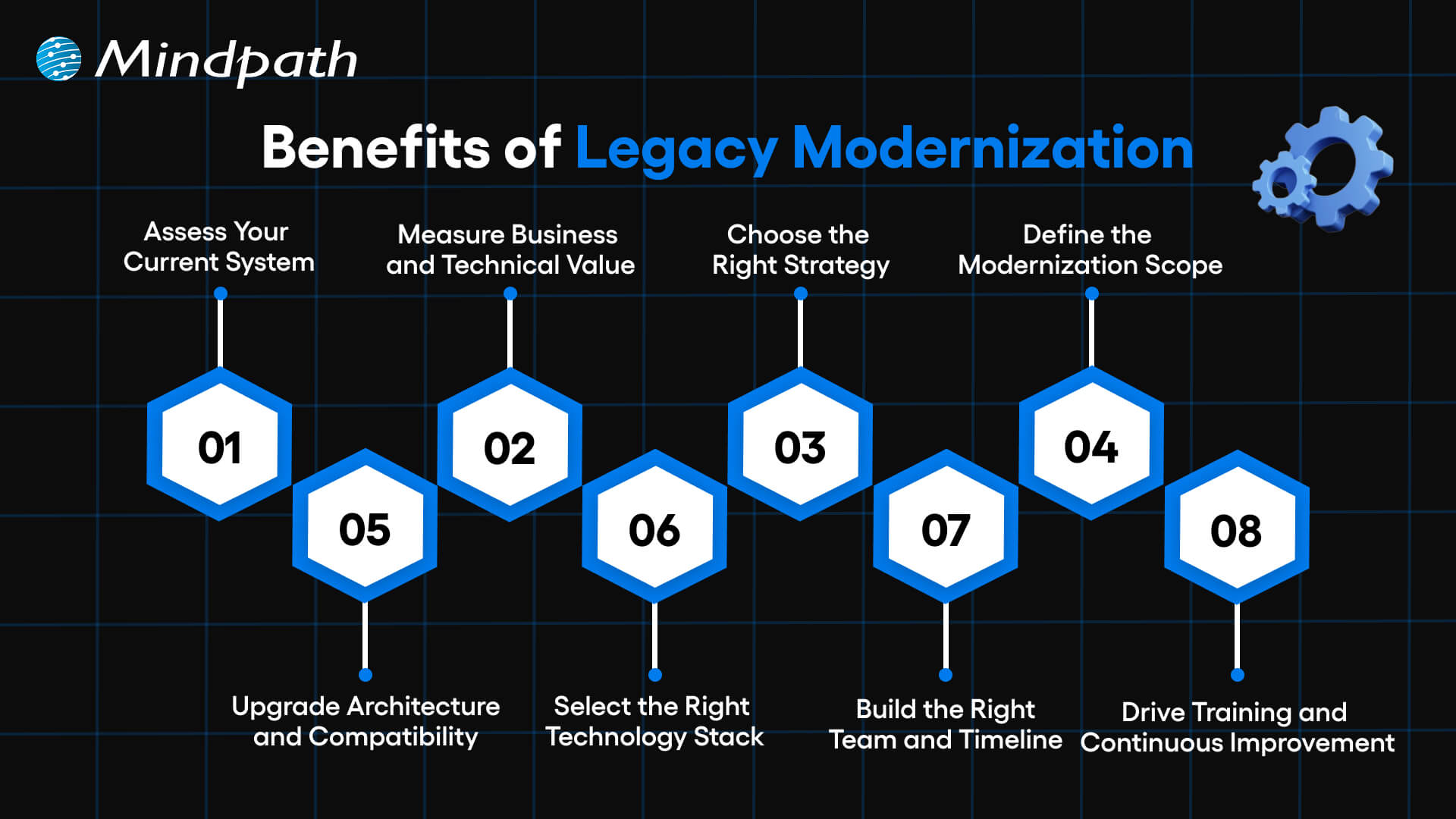
benefits of legacy modernization

1. Assess Your Current System

Evaluate your applications both business and IT. Determine deficiencies in performance, security and scalability. This step builds a strong base for legacy modernization decisions.

2. Measure Business and Technical Value

Assess business fit, agility, cost, complexity and risk. Know the amount of value each system brings in the present day. Clear insights strengthen your legacy app modernization strategy.

3. Choose the Right Strategy

Select a legacy modernization approach that aligns with business goals. Compare such options as rehost, refactor, rebuild or replace. Take the course of action that brings more quickly and reduces the risk.

4. Define the Modernization Scope

Target key points that lead to business performance. Eliminate the old and unwanted functions that complicate things. A clear scope helps teams modernize legacy applications with confidence.

5. Upgrade Architecture and Compatibility

Use scalable architecture when needed e.g. microservices. Enhance dynamism and streamline administration of the system. Enhance seamless integration with other tools/ platforms.

6. Select the Right Technology Stack

Select technologies that will be able to accommodate existing needs and expand in the future. Never act on your judgment without consulting experts. Good testing will guarantee effectiveness, protection and dependability.

7. Build the Right Team and Timeline

Create a cross functional team with established responsibilities and ownership. Develop and maintain documentation. Set realistic milestones to guide legacy modernization progress.

8. Drive Training and Continuous Improvement

Train the staff on effective use of the new system. Onboarding is encouraged by means of structured support. Continuous updates keep legacy modernization relevant and sustainable.

Want to align your legacy systems with your long-term business goals? Explore the legacy modernization strategy for business growth to build a result-driven transformation plan.

Key Challenges in Legacy Modernization

There are some valid advantages of legacy modernization, but it also possesses actual challenges. During the transition, organizations have to be ready to overcome technical, financial, and operational challenges.

1. Complex Legacy Code

Systems are difficult to comprehend and expand due to old-fashioned code and lack of documentation. Such complexity slows the development and raises its maintenance costs.

2. Integration Barriers

The old systems also fail to make connections with cloud providers and new APIs. Architecture reengineering will require teams to be mindful of downtime and the gaps in security.

3. Security and Compliance Gaps

The existing security and regulations are not met in aging systems. It is necessary that Legacy Modernization involves proactive protocols, encryption, and compliance control updates.

4. High Costs and Limited Resources

Modernization demands investment in equipment, education, and infrastructures. Lack of a proper roadmap will increase costs and strain internal resources.

5. User Resistance to Change

Employees tend to be at ease with the well-known systems. Good communication, training will enable teams to adjust to Legacy Modernization programs.

6. Performance and Scalability Limits

Old applications are unsuitable to meet the increasing data and user requirements. Legacy Modernization enhances speed, stability, as well as long term scalability.

7. Knowledge and Skill Gaps

It may be challenging to locate professionals with knowledge of old technologies. Lack of experience will put risks and time delays at a higher level and make the project more complex.

8. Data Migration Risks

Migration of mass volumes of old data can result in loss, corruption or compatibility problems. There has to be audits, backups and testing of data to ensure data integrity in Legacy Modernization.

Planning to integrate AI into your legacy infrastructure for better decision-making? Learn about AI-driven legacy system modernization to transform your systems intelligently.

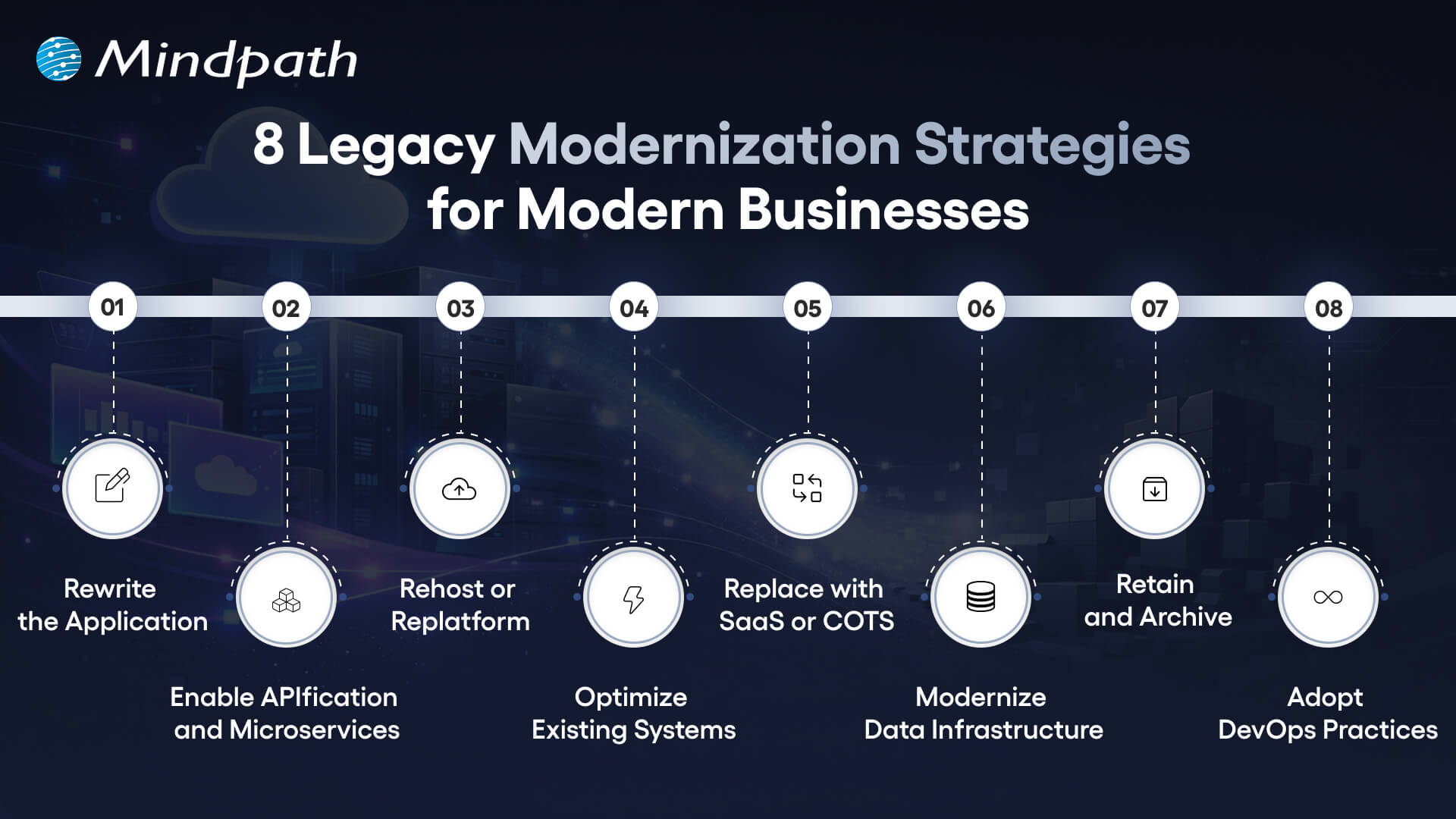
8 Legacy Modernization Strategies for Modern Businesses

Companies must have a strategy in place when modernizing old systems. The right legacy modernization strategies assist in decreasing risk and faster business worth.

8 legacy modernization strategies for modern businesses

1. Rewrite the Application

Rewrite the old systems using new languages. This strategy will modernize the application and enhance quicker updates. It also reduces the long term maintenance.

2. Enable APIfication and Microservices

Divide monolithic systems into small services. APIs can be used to better integrate them. Innovation is accelerated through this model.

3. Rehost or Replat form

Migration to the cloud with minimal code modification. It is a move that minimizes infrastructure expenses within a very short time. The teams enhance scalability without causing much disturbance.

4. Optimize Existing Systems

Check the workloads as well as code performance gaps. Minimize the usage of infrastructure and operations expenditures. Utilize savings to finance additional upgrades.

Must Read: Monolith to Microservices

5. Replace with SaaS or COTS

Use pre-made platforms that will satisfy business requirements. Accomplish security and compliance. Implement solutions in a shorter time and with reduced risk.

6. Modernize Data Infrastructure

Move the old databases to scaled systems. Enhance the speed, analytics, and flexibility. This step should be aligned to Legacy Modernization.

7. Retain and Archive

Retain those systems that retain the necessary value. Audits of applications that are rarely used in the archive. Unnecessary changes and risks should be avoided.

8. Adopt DevOps Practices

Implement continuous integration and testing. Publishing is faster and teamwork becomes better. Enhance the performance and stability of the systems.

Planning to enhance your modernization efforts with better automation and continuous delivery? Discover DevOps best practices to build a more agile and scalable transformation process.

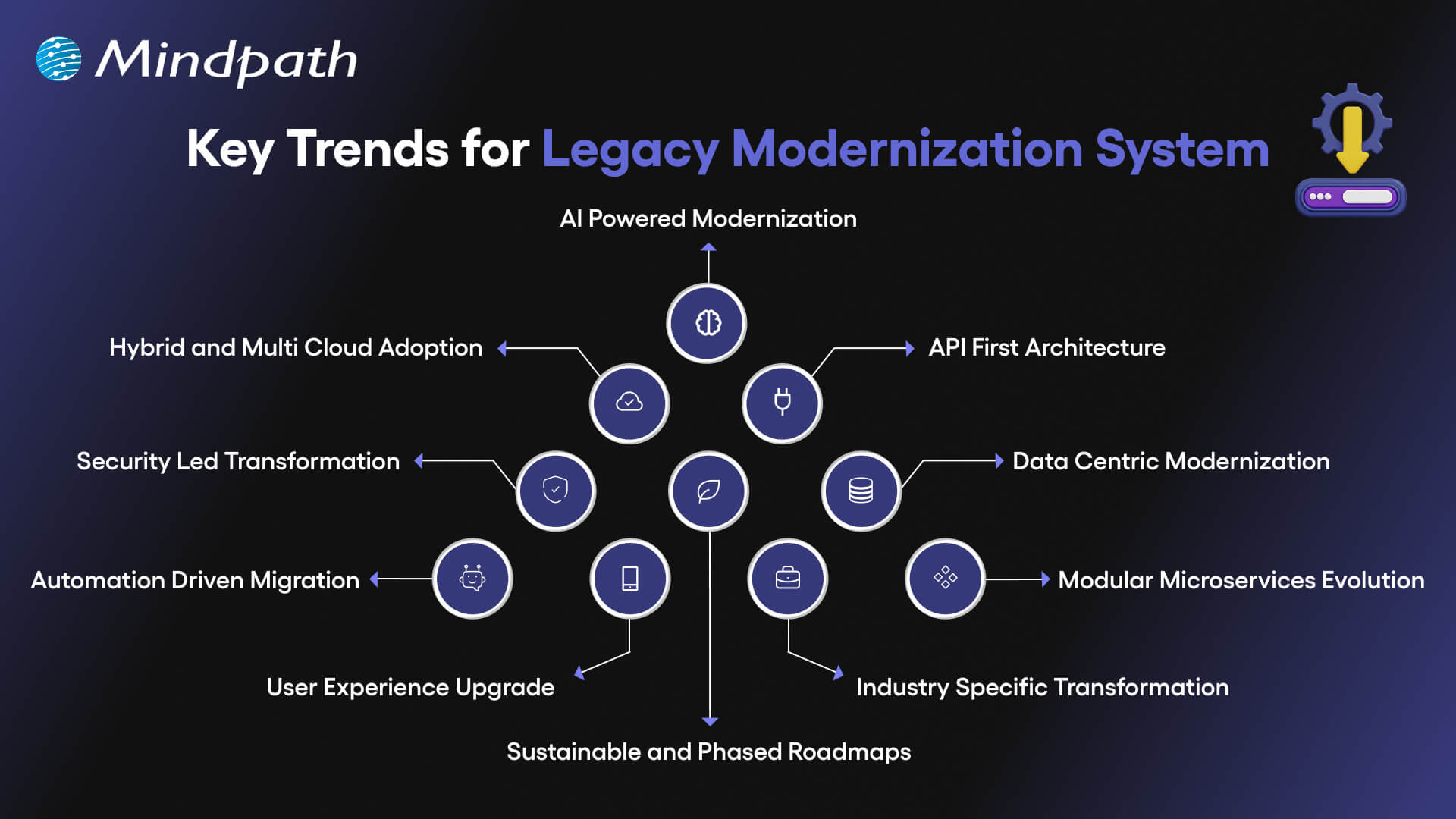
Key Trends for Legacy Modernization System

Organizations are still redefining their technology environment to remain competitive. The modernization trends point to the new directions that lead to faster, smarter and more scalable transformation.

key trends for legacy modernization system

1. AI Powered Modernization

Code refactoring, re-architecture and system analysis are now assisted by AI. According to legacy modernization trends, many enterprises spend lots of money in AI. It enhances preciseness, less threat, and accelerates change.

2. Hybrid and Multi Cloud Adoption

Organizations have stopped relying on one cloud provider. They operate hybrid and multi cloud environments to be flexible and resilient. Container platforms assist systems to operate efficiently in environments.

3. API First Architecture

Enterprises substitute monolithic models with modular API based models. The APIs enhance integrations, scalability, and expedited feature upgrade. The change holds its ground in the contemporary legacy modernization patterns.

4. Security Led Transformation

The presence of stringent rules encourages companies to advance the old security checks. Zero trust models, encryption, and enhanced access management are implemented in teams. Every modernization roadmap is currently being influenced by security.

5. Data Centric Modernization

Isolated data warehouses are sent to unified lake house platforms by businesses. This measure enhances real-time understanding and information controls. Powerful data strategy is a key to successful legacy software modernization.

Curious about how AI can reduce costs and improve system capabilities? Check out the benefits of AI to transform your business operations.

6. Automation Driven Migration

Code scanning, risk detection, and recommendation are processes performed by AI-based tools. Jurisdictional testing and documentation lowers the manual work involved. These applications reduce migration time.

7. Modular Microservices Evolution

Businesses upgrade microservices using containers and orchestration technology. AI assists in tracking and optimization of working loads. This will enhance system stability and scalability.

8. User Experience Upgrade

The future UX concentrates on customization, usability, and functionality. Component based design models substitute strict legacy interfaces. These enhancements are in line with wider patterns of legacy modernization.

9. Industry Specific Transformation

Banks, healthcare providers, and manufacturers need individual solutions. Modern systems are now able to comply with strict industry rules. A strong legacy modernization framework supports niche requirements effectively.

10. Sustainable and Phased Roadmaps

Companies are ready to upgrade slowly than to rewrite everything. Planned phase will guarantee the sustainability of long term and reduce disruption. This approach makes modernization anticipative and expandable.

Want to make your legacy modernization efforts more environmentally responsible? Explore sustainable technology to build eco-friendly and future-ready systems.

Examples of Legacy Systems

Several organizations are still using the old systems to execute important activities. These are the legacy systems that are still in use and support day-to-day processes in spite of low adaptability and scalability.

1. Cloud Enablement in Financial Services

To enhance scaling and reporting, a fintech company has transferred the core systems to the cloud. This legacy modernization decreased manual labor and increased reliability.

2. Clinical Platform Enhancement

A microservices-based upgrade of an oncology system to speed up its performance. The transformations enhanced integration and helped to make medical decisions faster.

3. High-Performance Trading Systems

Microservices and automated deployments were embraced in a trading platform. This legacy modernization enabled speed and increased volume of transactions.

4. Digital Leasing Transformation

One leasing system upgraded its infrastructure to initiate operations more quickly. The upgrade made the operations less complex and efficient.

5. Smart Assessment Innovation

One of the education platforms presented AI-based grading tools. The educators used to save some time and received more rapid performance feedback.

6. Scalable K-12 Learning Infrastructure

One school system optimized its cloud environment to its maximum. The upgrade also enhanced the uptime and made the learning process stable.

Wondering how to connect legacy modernization with broader business goals? Explore about digital transformation for business to align technology with strategic growth.

Ready to Future Proof Your Business?

Legacy systems limit growth, increase risk, and slow innovation. Organizations that invest in legacy modernization improve performance, security, and scalability while reducing long term costs. A clear strategy helps teams modernize in phases and avoid disruption. With the right approach, businesses build flexible systems that support innovation, improve user experience, and create lasting competitive advantage in a fast changing digital market.

Mindpath stands as a trusted legacy modernization service provider delivering practical and scalable solutions. Our team assesses existing systems, defines a clear roadmap, and executes modernization with minimal disruption. We focus on performance, security, and cloud readiness to create measurable business value. With proven expertise and strong technology partnerships, Mindpath helps enterprises modernize confidently and achieve sustainable digital growth.

FAQs

1. What is Legacy Modernization and why should my business consider it now?

Legacy modernization helps businesses upgrade aging systems to improve speed, security, and scalability. Companies adopt it to reduce operational risks and support innovation. When technology limits growth, modernization creates a strong digital foundation. It also prepares organizations to integrate cloud, data analytics, and automation effectively.

2. How do I know if my organization needs legacy modernization?

Frequent system failures, high maintenance costs, and slow feature releases signal deeper issues. If your teams struggle to scale or integrate modern tools, your systems likely restrict progress. Legacy modernization helps you overcome these limits and align technology with current business goals and customer expectations.

3. How can Mindpath support our modernization journey?

Mindpath’s legacy modernization services focus on strategy, assessment, and execution with minimal disruption. Our experts analyze your systems, design a practical roadmap, and implement scalable solutions. As a trusted legacy modernization company, Mindpath ensures measurable performance gains and long-term technology stability.

4. What technical approaches work best for modernizing complex legacy systems?

The right approach depends on architecture, dependencies, and business priorities. Teams may rehost applications in the cloud, refactor code into microservices, or rebuild critical components. A structured legacy modernization plan ensures integration stability, secure data migration, and improved system performance.

5. How do we manage risk during legacy application transformation?

Teams reduce risk through phased execution, automated testing, and strong DevOps practices. Clear documentation and system audits help identify hidden dependencies early. Mindpath’s legacy modernization services follow controlled deployment models that protect data integrity and maintain operational continuity throughout the transition.