Augmented Reality in E-Commerce: Everything You Need to Know

Join our Newsletter!

Featured Posts

Support Is One Click Away

Home

Augmented Reality in E-Commerce: Everything You Need to Know

Augmented reality in ecommerce

Augmented Reality in E-Commerce: Everything You Need to Know

The e-commerce model has led to the transformation of how business operations are conducted in the 21st century. This novel concept has expanded the boundaries for businesses. E-commerce businesses are in a position to exploit a broad range of advanced technologies. A new technology that has been redefining the e-commerce landscape is augmented reality.

Augmented reality in e-commerce has the potential to enhance the online shopping experience of customers. This is possible since AR commerce blends digital products with the real-world environment of customers. Thus, augmented reality allows customers to view as well as interact with virtual products before making the purchase. It is the perfect time to learn how the augmented reality process is revolutionising the e-commerce setting. 

Want to prepare your online store for the growing demand for immersive and interactive shopping experiences? Connect with Mindpath to discover how you can bring advanced AR capabilities into your business.

What is Augmented Reality?

Before exploring the impact of augmented reality in e-commerce, you need to know what is augmented reality. Augmented reality refers to the technology that is capable of overlaying digital information on how a user views the real world in real time. This advanced technology enhances their reality by adding computer-generated elements to it. 

Within a short span of time, augmented reality has gained massive popularity. This is because it can merge the physical and digital worlds, thereby creating an interactive experience for users. You can have such a surreal experience either through a smartphone, AR glasses, or a tablet.  

Is your e-commerce business ready for the next phase of digital innovation? Explore digital transformation for businesses to discover how AR fits into modern growth strategies.

How E-commerce Businesses are Using Augmented Reality?

Although the AR technology is in its infancy, its application in the e-commerce space has been surging. Many e-commerce businesses have been leveraging the technology in diverse ways to shape the experiences of their customers. 

1. Virtual Try-Ons

While purchasing apparel, people usually prefer to try on the garments. You do not need to physically try on apparel thanks to the use of Augmented reality in e-commerce. This is because you can try it out virtually before deciding whether to buy it or not. Therefore, the augmented reality technology helps online shoppers comprehend what they are purchasing and how the items will look on them. 

2. Interactive User Manuals

An interactive user manual is considered to be a great application of AR in e-commerce. This is especially useful when customers buy a product that has a learning curve before it can be used easily. Such manuals can be a great help for users as they can refer to them to understand how the product works. Interactive user manuals are capable of responding to the actions of users. Moreover, they can offer on-page contextual support while using a website or software. 

3. Preview Placement

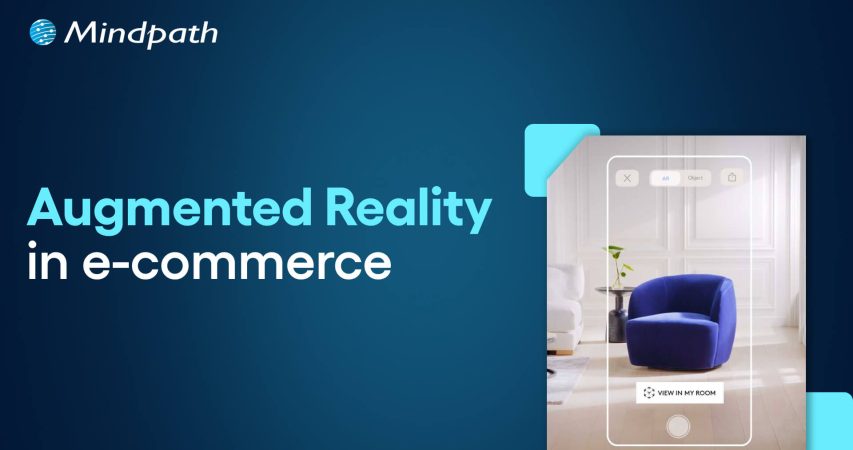
The preview placement gives customers a view in real-time of what a product will look like in their own environment. This can be extremely helpful when you decide to buy furniture or a television set for your home. Many brands have started using AR in order to help their customers visualize how their products will fit in the homes of customers. It has undoubtedly simplified the overall shopping experience for modern customers. 

4. Social Media Filters

There was a time when social media filters were used by online users just for fun. However, a number of brands have started leveraging social media filters to showcase their products. Many brands have already come to realize that the novelty factor relating to AT filters has the potential to boost customer engagement. Such strategic use of AR by brands has been wowing customers today. 

How do businesses measure the real impact of AR on conversions and engagement? Explore the importance of data-driven decision-making for Businesses to discover how insights optimize e-commerce performance.

Benefits of Augmented Reality for Businesses

The proper use of AR by e-commerce businesses can give rise to immense value for them. The capabilities of Augmented Reality can give an edge to modern businesses while they create value for their customers. 

1. Better Customer Engagement 

You need to bear in mind that augmented reality technology is highly interactive in nature. Thus, it can make it easier for customers to get hooked on the sites of online businesses. The longer they stay on the site, the higher the chances for them to make a purchase. Even if they do not make a purchase, it will create an opportunity for them to build a relationship with the brand. Thus, the quality of customer engagement can improve. 

2. Reaching Out to New Customers

In the highly competitive e-commerce landscape, businesses need to constantly look for new customers. The use of Augmented Reality can certainly give you an edge as a business. In the noisy world, it can serve as a suitable tool that can help grab the attention of your potential customers. You can create a highly engaging AR campaign in order to make your business seen and heard by online users. 

3. Reduced Returns

When businesses use AR technology, they not only empower themselves but also empower their customers. As customers have a lot of information, when businesses use AR, the possibility of product returns drops considerably. The application of AR makes it possible for customers to get a glimpse of how certain products will look in their personal space. So they can be more sure while making their purchase decisions. 

4. Possible Challenges That May Arise

The rising number of augmented reality examples shows that the future of AR in e-commerce is full of new possibilities. However, it is crucial for businesses to bear in mind that they may face a number of challenges while adopting AR technology. The insight can help them prepare themselves to use the novel technology in a strategic manner.

Wondering how artificial intelligence complements augmented reality in online shopping? Explore AI in e-commerce to discover how intelligent technologies personalize experiences and increase conversions.

5. High-Quality 3D Models

A common technological challenge that businesses may encounter is related to achieving high-quality 3D models. Businesses must keep in mind that the models need to be realistic in nature in order to boost customer engagement and experience. However, in the technical sense, it may not be an easy task to achieve. In order to reduce this kind of complexity, it is advisable for businesses to use robust tools. 

6. Balancing Efficiency and Cost

It is very important to bear in mind that generating 3D assets can be a costly affair. In fact, the costs may range between a few hundred and several thousand dollars per product. In order to strike a balance between cost and efficiency, businesses can consider leveraging cloud infrastructure. 

7. Seamless Integration with Workflow

Another challenge that may arise in the path of businesses revolves around the integration of AR technology with the existing workflow.  Complexities may arise when online retailers try to integrate 3D assets into their current product catalogue. It is vital to remember that this specific process needs to be smooth and streamlined. It must also be scalable to enhance overall customer satisfaction. 

It is essential for online retailers to effectively address these challenges. By addressing these obstacles and bottlenecks, they can leverage AR technology to the fullest and offer a highly engaging experience to their target audience. 

Planning to deliver AR experiences through mobile commerce apps? Discover mobile app development technologies to explore tools that power interactive shopping journeys.

Final Words

Augmented Reality has emerged as a breath of fresh air in the prevailing e-commerce landscape. The novel technology has been gaining high momentum as it creates a plethora of benefits for businesses in the form of better customer engagement, the ability to reach out to new customers, and reduced returns.

Mindpath’s innovative services relating to augmented reality can create immense value for modern businesses. Our experts will ensure that your businesses can boost customer engagement by leveraging augmented reality technology. You can capitalise on the real potential of AR technology and witness your business reach new heights.  

Related Post

Look for JavaScript skills, Node.js frameworks, database knowledge (SQL/NoSQL), API expertise, security practices, and Git proficiency.

Related Post

AI in business strategy

Think about the potential of AI in business strategy, accelerating your organization with enhanced insights and improved decisions. Imagine having intelligent tools to assess complex data, identify unseen patterns, and let your team have more freedom to genuinely innovate and grow. By adopting the right mindset, companies today are giving themselves a true competitive advantage with AI and changing every aspect of their operations daily.

This intelligent technology is helping companies find new opportunities, create more relevant customer experiences, and briskly adapt to changes in market needs. Embedding artificial intelligence benefits organizations to yield positive results. When used prudently, AI becomes a trusted partner in increasing efficiencies and establishing long-term, viable success.

In this article, you will learn about how AI can transform your strategy and scale your business. Let’s dive in!

Want to enhance your business strategy with artificial intelligence? Mindpath AI development services have a combination of providing strategic insights with hands-on expertise to provide intelligent growth across your organization.

What is an AI Business Strategy?

A business strategy is like an explicit blueprint that directs a company toward its goals. It answers important questions about where a business wants to go, how it plans to get there, and what makes it different from the rest of the marketplace. A clear strategy helps everyone understand the overall objective of the business and keeps colleagues headed in the right direction while working together.

Bringing AI into the plan strengthens the marketing strategy. An artificial intelligence strategy or AI strategy for business growth means using artificial intelligence to better facilitate your business objectives. This could mean improving customer service, making more effective decisions with your data, or even many other entirely distinct initiatives. The aim is to leverage smart tools to execute better, smarter, faster, while staying ahead of your competition.

Also Read: AI in E-Commerce

Benefits of an AI Business Strategy

Having an AI business strategy can open up new opportunities and make your company more competitive. Here are some key benefits that show why investing in AI is worth it:

benefits of an ai business strategy

1. Maximized Efficiency and Productivity

AI can take care of repetitive work, so teams can spend more time on creative ideas and solving problems. It makes daily tasks easier and quicker, which improves workflow in every department. By spotting delays and gaps in processes, AI helps companies get things done faster. This boost in productivity helps businesses stay competitive. Companies can do more with less time and effort when using AI in business.

2. Smarter Data-Driven Decision Making

Using AI in business helps leaders make better decisions based on real data. AI tools can study huge amounts of information and find trends or risks that people might miss. This means managers can act faster and with more confidence. Predictive tools even help businesses see what customers might want next. Smart decision-making is key to staying ahead in a changing market.

You can learn more about how AI can transform decision-making in our guide, Power of AI in Decision-Making.

3. New Opportunities and Innovation

AI encourages companies to try new ideas and find fresh ways to earn money. It supports innovation by helping teams develop new products or enter new markets. With AI, companies can test different ways to work and reach more people. This can create new income streams and keep a business strong in tough markets. Staying open to new ways of working keeps the company growing.

4. Superior Customer Experience

AI for customer service makes it easier to understand what customers like and want. Businesses can offer more personal services, like tailored suggestions or special offers. Chatbots and AI tools give customers quick answers, anytime they need help. This keeps people happy and more likely to come back. Good customer service is always important, and digital transformation with AI makes it even better.

5. Clearer Strategic Direction

AI business strategies help companies plan for the future with clear data. Teams can set better goals because they know what is working and what needs to be changed. AI tools keep an eye on the market and help businesses adjust plans when needed. This makes it easier to stay on track even if things shift. A strong strategy backed by AI keeps everyone moving in the same direction.

Want to know if your business is ready to implement AI in the right way? Explore our blog – AI Readiness Checklist.

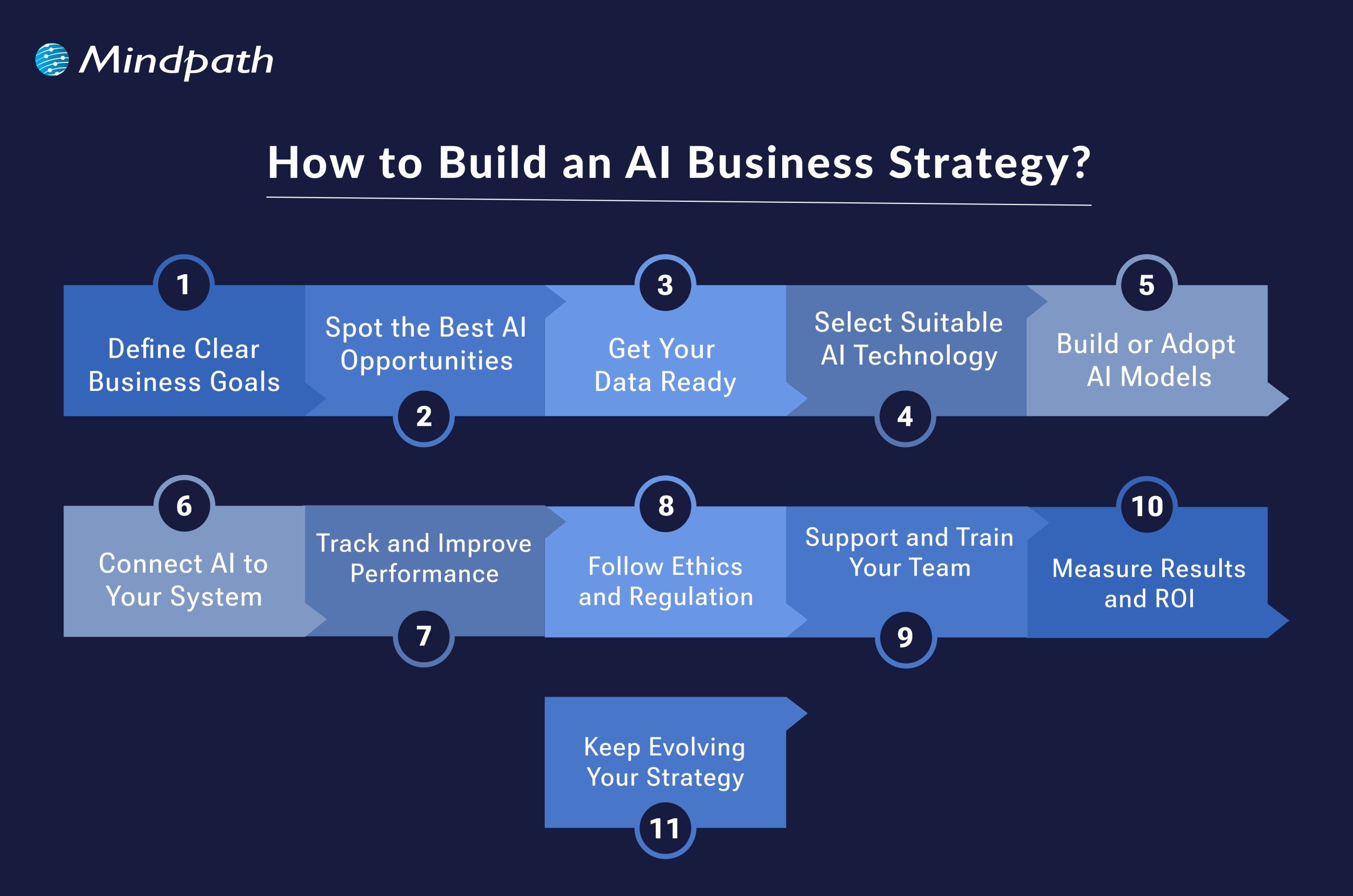
How to Build an AI Business Strategy?

Building an AI business strategy takes careful planning and clear goals. Here are some practical steps to help you get started the right way:

How to Build an AI Business Strategy

1. Define Clear Business Goals

Start by deciding what you want to achieve with AI, like increasing sales, lowering costs, or improving customer service. Clear goals strategized by the expert AI consultant help you focus your efforts where they matter most. Knowing what you want makes it easier to pick the right AI tools later. A strong direction keeps your entire team aligned and motivated.

2. Spot the Best AI Opportunities

Look at your daily operations and see where AI can add the most value. This might be in customer support, marketing, supply chain, or product development. Finding the right areas will help you get quick wins and build confidence. Prioritizing these areas makes your investment more effective.

3. Get Your Data Ready

Good data is the foundation for AI success. Collect useful data from different parts of your business and make sure it’s accurate and well-organized. Clean and reliable data will help your AI tools work properly. Better data means better insights and fewer errors down the road.

4. Select Suitable AI Technologies

Explore the AI tools that match your goals and the type of data you have. This could include machine learning, chatbots, or automation software. Choose technologies that are practical and align with your strategy. Pick tools that your team can actually use and manage well.

5. Build or Adopt AI Models

Develop AI models that fit your business needs, either with your own experts or trusted partners. Some companies build custom models, while others use ready-made solutions. Test your models to make sure they perform well in real-world situations. Good models help you solve problems faster and smarter.

Ready to adopt the recent AI trends into your business? Read our detailed blog on Top AI trends, which provides a deeper understanding of how to implement AI into your business for future growth.

6. Connect AI to Your Systems

Make sure your new AI tools work smoothly with your current software and workflows. This may need teamwork between IT, data, and business teams. Good integration helps people use AI with less hassle. Seamless systems keep operations running without major disruptions.

7. Track and Improve Performance

Keep an eye on how your AI strategy is working post-implementation. Use regular checks to fix any issues and update the system with fresh data. A little maintenance keeps your strategy useful and accurate over time. Monitoring helps you spot new opportunities for improvement too.

8. Follow Ethics and Regulations

Think about the rules and responsibilities that come with using AI. Protect customer privacy and make sure your AI solution doesn’t create unfair bias. Stay up to date with local and international laws. Acting responsibly builds trust with customers and partners.

9. Support and Train Your Team

Help your team learn how AI fits into their work. Offer training so they feel comfortable using new tools and workflows. Encourage them to ask questions and share feedback. Well-trained employees make AI adoption smoother and more effective.

10. Measure Results and ROI

Decide which numbers will show if AI is really helping your business. This might be cost savings, higher sales, or better customer feedback. Keep tracking these results over time to see progress. Proving ROI makes it easier to get support for future AI projects.

11. Keep Evolving Your Strategy

Treat your AI business strategy as a work in progress. Keep testing, learning, and improving how you use AI as your goals change. Regular updates keep you competitive in a fast-changing market. A flexible approach helps you make the most of every opportunity.

Planning to leverage the power of artificial intelligence, understanding the technologies that drive it has become a crucial advantage. To dive deeper into the tools and technologies behind AI innovation, explore our detailed guide on the AI programming languages.

Ready to Transform Your Business with AI?

Adopting AI in business strategy helps your company make smarter choices, improve operations, and deliver better customer experiences. By understanding your goals and using AI wisely, you can drive innovation and stay ahead of the competition. Start with clear steps, keep learning, and stay flexible. This approach ensures that AI becomes a real advantage for your business growth.

At Mindpath, our AI development services are designed to help you unlock real results with confidence. We create solutions that match your unique needs, from custom AI models to smooth system integration. Our team works closely with you to ensure your strategy delivers value today and in the future. Let’s build an AI-powered roadmap for your success.

Cloud-Ready Workspace

Are you ready to take your workspace to the next level? Imagine having all your tools, files, and communication channels accessible from anywhere, anytime. Sounds like the future, right? The good news is, building a cloud-ready workspace can turn that vision into reality. But where do you start? What are the essential steps to create a seamless, efficient, and secure cloud-based environment for your team? Let’s explore how you can set up a cloud-ready workspace that boosts collaboration and productivity.  

What is a Cloud-Ready Workspace?

A cloud-ready workspace is a system or program that was not initially developed for the cloud but can be modified to function in one. These systems can be deployed on cloud platforms such as AWS, Azure, and Google Cloud, which offer significant resources to enterprises. Using cloud-ready systems offers various benefits, including simple scaling, increased flexibility, and cost savings. You can customize the resources you utilize based on your requirements, and you only pay for what you really use. However, migrating these systems to the cloud frequently necessitates substantial IT labor and expense. Upgrading and linking them to other tools might take some time, but the long-term benefits, such as increased productivity and access to sophisticated cloud services, can be worthwhile. 

Why is Cloud- Ready Workspace Important?

As organizations progressively migrate to the cloud, having a workforce prepared to function in this environment is crucial. The transition to cloud-based technologies has been ongoing for some years, and it is now an integral component of how businesses work. 

Knowing how to use cloud services is becoming increasingly important as more work is done remotely and digitally. However, not all employees may be prepared for the transition. Businesses can prepare their teams to prosper in a cloud-driven environment by focusing on training, employing the appropriate personnel, and cultivating a cloud-friendly culture. 

Steps to Create Cloud-Ready Workspace

1. Build Cloud Fluency Across Your Team

To prepare your team for cloud-based work, you will need to make certain adjustments to the way your firm functions. Leadership frequently sets the example, but everyone must be involved in the process. Many businesses use core values to drive decision-making, and these values should support the transition to cloud-based work. 

The epidemic has made everyone more acclimated to change, and as we adjust, it is essential that we focus on how we handle these adjustments. As corporations face new difficulties like the Great Resignation, there is an increased emphasis on equity and inclusiveness. Moving away from focusing just on efficiency and towards increasing staff resilience might provide your organization with a significant competitive advantage. Creating a cloud-ready workspace requires a fresh perspective and listening to your team’s input. 

2. Use Inclusive Strategies for Lasting Change

Regardless of the structure of your business, it is crucial to include everyone to  bring about long-lasting change. Whether your culture is hierarchical, flat, or matrixed, use its strengths to help the transition. This makes the transition feel more natural and long-lasting. A useful starting point is Kotter’s 8-Step Process for Leading Change, which has been revised to meet today’s difficulties, especially those caused by COVID-19. Begin by instilling a feeling of urgency, then bring together a varied collection of people from various jobs to assist with the planning and implementation of the change. 

3. Offer and Require Cloud Training

Create a learning plan for different positions to help your company adapt to the cloud. Begin with leadership, then expand to departments and individuals. If necessary, work with a cloud professional to guide training. Mandatory training at all levels guarantees that the cloud initiative reaches everyone. Leaders who invest in acquiring new skills inspire the rest of their teams to do the same. An good strategy should emphasize the benefits of cloud computing for both the business and the employees, therefore motivating the workforce. 

4. Encourage and Reward Cloud Adoption

Employees who are recognized and rewarded for using cloud technology are more likely to follow suit. Leadership can recognize cloud adopters for completing training, obtaining certifications, or promoting the move. Simple acknowledgements, such as “kudos” in meetings or emails, can go a long way. Monetary incentives and promotions are also beneficial. 

Gamifying the process, such as awarding internal badges for completing training milestones, adds enjoyment and competitiveness to the learning experience. A knowledgeable cloud partner can help in the development of these incentive programs and collaborate with management or human resources to guarantee widespread adoption. 

5. Keep Cloud-Adopting Employees

After investing in cloud training, it is essential to maintain employee engagement and commitment to your firm. Employee retention is vital, particularly in today’s competitive labour market, where turnover is costly. Retaining cloud-skilled people increases productivity, morale, and corporate performance while lowering the cost of acquiring new workers. 

Employees are more likely to depart if they feel underpaid or have limited options to advance their careers. Providing ongoing learning opportunities in the cloud is crucial but retention extends beyond training. To retain cloud adopters, make sure they feel valued, are adequately compensated, have job stability, and can use their abilities. Promotions and increases are crucial for top performers to prevent them from pursuing other possibilities. 

6. Hire Cloud-Ready Talent

To create a cloud-ready workforce, consider employing new workers who already have the required cloud capabilities. Because these abilities are in great demand, ensure sure your hiring process is well-planned and provides competitive remuneration. To attract individuals who want to work with current technology, mention cloud-based abilities in job descriptions, even if the role isn’t entirely cloud-focused. You can also boost your company’s reputation as a technologically advanced organization by providing cloud-related information on networks such as LinkedIn, highlighting your cloud projects and innovation. 

7. Partner with Experts to Strengthen Your Cloud Workforce

If your organization lacks the means to acquire new employees or conduct elaborate training programs, collaborating with a cloud specialist can give vital assistance. A qualified cloud partner can design a bespoke training roadmap that offers rapid gains while also addressing your team’s individual needs. They can help in managing and accelerating your cloud adoption process, helping you to complete cloud-based initiatives more quickly and efficiently. 

A technology partner can assist in design, execute, and manage the installation of bigger, more complicated cloud initiatives, minimizing the pressure on your own team. This technique allows you to grow swiftly without having to hire full-time IT staff, saving you time and money. An experienced cloud partner provides technical expertise and helps your team via best practices, guaranteeing a seamless and successful transition to the cloud. 

Also Read: The Synergy of AI and Cloud Computing

Build a Coud-Ready Workspace at Mindpath

At Mindpath, we assist organizations in developing cloud-ready workspaces that are efficient, adaptable, and future-focused. A cloud-ready workplace enables teams to work from any location, access tools effortlessly, and adapt to new business requirements.  Our approach is straightforward and suited to your objectives. We examine your present systems to determine what is required for a successful transfer to the cloud. Whether you’re modernizing your infrastructure, integrating secure cloud platforms, or training your workforce, we’ll walk you through every step. With our knowledge, your workplace will be ready to meet the demands of today’s fast-paced digital environment. 

Wrapping Note!

Creating a cloud-ready workspace is no longer a choice but a necessity for businesses aiming to thrive in today’s dynamic environment. By adopting the right strategies, providing training, rewarding adoption, and partnering with experts, your organization can transition seamlessly to the cloud. Mindpath is here to simplify this journey for you. With our tailored solutions and expert guidance, we empower your team to embrace the cloud confidently, ensuring your workspace is not only ready for today but also for the challenges of tomorrow. Transform your workplace with Mindpath and stay ahead in a digital-first world.  

Ready to transform your business with a cloud-ready workspace?

Partner with Mindpath for expert solutions tailored to your needs.

Discover the steps to build a cloud-ready workspace, boost team productivity, and embrace a seamless, future-focused digital transformation.
Node.js Success Stories

Have you ever wondered what makes companies like Netflix, Walmart, and LinkedIn so efficient and scalable in their digital operations? The answer often lies in the technologies they choose—like Node.js. But what exactly is Node.js doing behind the scenes? How is it helping these companies stay ahead of the competition? In this blog, we’ll dive into the real-world use cases of successful companies leveraging Node.js. 

Node.js is an open-source, cross-platform runtime environment that enables developers to execute JavaScript outside of the browser. It is based on Google Chrome’s V8 JavaScript engine, which makes it very efficient and speedy. What distinguishes Node.js is its non-blocking, asynchronous architecture. Instead of establishing separate threads for each request, Node.js processes tasks within a single process, allowing it to manage hundreds of connections at once. It executes I/O activities such as reading files and accessing databases without interrupting other processes, resulting in smooth and scalable performance. With its capacity to handle real-time apps and high traffic, Node.js has emerged as a popular alternative for developing contemporary, high-performance web applications. 

Let’s delve into the inspiring success stories of companies leveraging Node.js! 

Use Cases of Successful Companies Leveraging NodeJS

1. LinkedIn

LinkedIn leveraged Node.js to make their software quicker, more efficient, and easier to operate. One of the most significant advantages was the drastic reduction in resource use. LinkedIn was able to reduce the number of servers necessary to run its service by an incredible 10:1 ratio using Node.js. This reduced expenditures while simultaneously improving the application’s overall speed and scalability. 

Another significant benefit was the usage of JavaScript on both the client (where users interact) and server-side (where the app’s activities take place). This improved consistency in the development process, allowing teams to collaborate fluidly across both ends of the program. Developers could manage client-server interactions more effectively, resulting in quicker updates and enhanced user experiences. 

2. Netflix

Netflix switched to Node.js to address issues with their previous technological stack. The prior monolithic application architecture made it impossible to grow as the user base expanded. Furthermore, switching between the backend and frontend was sluggish, causing delays and unsatisfactory experiences for users. The system’s simultaneous loading of components made it difficult to customize the user interface to fit individual tastes. Using Java presented its own set of issues, including lengthy build times that hampered development and deployment, making it difficult for teams to provide changes on time. 

Switching to Node.js resolved these difficulties. The transition between the backend and frontend was smoother, resulting in a better user experience. Node.js also enables Netflix to use a microservices design, which divides the program into smaller, more manageable components rather than a single huge system. This enhancement increased flexibility, making it easier to update and customize the user interface to meet specific demands. 

By using Node.js, Netflix improved app speed, accelerated development, and assured a far more user-friendly experience, fulfilling the expectations of its ever-expanding audience. 

3. NASA

NASA used Node.js to address fundamental issues in data management and accessibility. Data from spacesuits and missions were spread across several places, making retrieval and analysis challenging. Furthermore, the majority of NASA’s mission data was stored in segregated databases that were difficult to query, and its on-premises data centers were not built to support current cloud technologies. Compounding this, many of NASA’s applications already relied on JavaScript, necessitating a more compatible and efficient alternative. 

NASA was able to rebuild its systems due to Node.js and the microservices architecture it implemented. This strategy enabled traditional databases to be transferred to the cloud and accessible via APIs, resulting in a more seamless integration between older systems such as Oracle and SQL Server and newer cloud databases.  

NASA used Node.js to optimize complicated procedures, increase data portability, and enhance cloud readiness. The end result was a speedier and more efficient system, allowing NASA to focus on expanding space missions and scientific research without being hampered by antiquated infrastructure. 

4. Walmart

Walmart employed Node.js to address issues with their current Java-based eCommerce infrastructure. Their monolithic application hampered communication among remote teams and lacked modularity, impeding development processes. Furthermore, their pre-Node.js front-end used JavaScript libraries that were not SEO-friendly, reducing product exposure in search engines. Walmart’s mobile eCommerce applications also have performance concerns owing to Java configuration limits. Walmart improved its website’s efficiency and SEO by using Node.js. Combining Node.js with React.js increased the site’s speed, resulting in shorter loading times and better customer experiences. This adjustment not only lowered user response times but also increased customer engagement. 

Node.js also improved Walmart’s development workflow. Teams might provide updates more quickly, simplifying development processes and decreasing time-to-market. The enhanced checkout experience, driven by Node.js, resulted in greater conversion rates, showcasing the platform’s capacity to propel business development. Walmart employed Node.js to improve performance, speed up development, and improve the customer experience, consolidating its position as an eCommerce market leader.

5. Trello

Trello switched to Node.js to meet the need for real-time updates with low latency. Since the majority of Trello’s architecture was already built on JavaScript, using a JavaScript-friendly server made sense for code maintenance and development speed. To achieve quick updates, the platform required several real-time open connections on the server. 

Trello benefited from rapid prototyping and an event-driven server that was compatible with their previous architecture after migrating to Node.js. Node.js enabled them to keep their Single Page Application lightweight, at only 250 KB, while providing 0% latency during server interactions. This change also resulted in much shorter development and prototyping times, allowing for faster upgrades and a more efficient overall system. Incorporating Node.js helped Trello improve performance and maintainability, ensuring that their app could scale to meet user needs quickly.

Also Read: Top Reasons to Hire Node.js Developers in 2024 – Mindpath Tech

Node.js Development Services at Mindpath

At Mindpath, we specialize in creating high-performance and scalable solutions with Node.js. Our team of experienced developers is dedicated to delivering outstanding results by catering to your business needs. Be it the development of a new application or the enhancement of an existing one, our experts will help you get it right. Here’s a rundown of what our Node.js development services look like: 
  1. Node.js Web App Development: Our developers create high-performance, scalable web applications using Node.js. We are committed to providing your digital appearance with an invulnerable add-on, optimized completely with the business goals, to create applications that will create a lasting impression.
  2. Node.js CMS Development: We develop custom-made content management systems to assist in the effective management of your content. Our CMS solutions are designed to simplify content management, providing you with an intuitive interface to handle all your content effortlessly.
  3. Node.js API Development: We create strong and powerful APIs that will enable other systems to be smoothly integrated. Our APIs are designed to enhance functionality and connectivity, ensuring smooth and reliable communication between different applications.
  4. Node.js Consulting Services: We assure you expert help in maximizing your business projects with Node.js potential. We provide strategic guidance and technical insights to optimize your Node.js applications, driving innovation and efficiency.
  5. Node.js Maintenance & Support: Our maintenance and support practices are continuous for on-the-go help. Our team is always ready to address any issues and provide continuous improvements, ensuring optimal performance and reliability.
  6. Node.js Migration Services: We will support you in the node.js migration of your existing applications for scalability and performance improvements. Our migration services are designed to minimize disruption and ensure a seamless transition to a more efficient and powerful platform.

Final Thought!

Node.js has helped leading companies like LinkedIn, Netflix, NASA, and Walmart boost performance, scalability, and development speed. Its efficient, event-driven architecture enables real-time apps and smooth integrations, keeping businesses ahead of the competition. At Mindpath, we offer expert Node.js development services to help your business achieve faster, more scalable solutions. Whether you’re building, enhancing, or migrating to an app, we’re here to support your growth with high-performance Node.js solutions. 

Ready to transform your business with scalable, high-performance solutions?

Partner with Mindpath today and let our Node.js experts help you build the future!

Discover how top companies like LinkedIn, Netflix, and Walmart leverage Node.js for performance, scalability, and faster development. Learn more with Mindpath’s services.