AI in Web Development – Everything You Need to Know

Join our Newsletter!

Featured Posts

Support Is One Click Away

Home

AI in Web Development – Everything You Need to Know

ai in web development

AI in Web Development – Everything You Need to Know

Have you ever pondered if machines could design, code or even personalize user experiences better than humans? Sounds like a dream, right? Well, this isn’t a dream anymore, it is the power of Artificial Intelligence. You heard it right; artificial intelligence is becoming a powerful tool in web development in today’s digital world. Want to know how AI in web development can be beneficial for you? From accelerating development to building smarter sites, AI is quietly revolutionizing the construction and experience of digital platforms. 

But what does this revolution look like? And why are businesses and developers embracing AI more than ever? The answers may surprise you. Stay tuned as we uncover the ways AI is transforming the future of web development! 

Are you ready to elevate your website? Contact us for top-notch AI development services and we will bring your AI-driven web vision to life. 

Role of AI in Web Development

AI in web development refers to the use of artificial intelligence for building websites, faster, smarter and easier to manage. It can help with a lot of things such as writing code, fixing bugs and even assisting with the design. AI can be used in web development to save time, reduce errors and create personalized websites. By leveraging AI, developers can avoid doing repeated tasks and focus on more important things. It can find errors, accelerate things and also help users get their requirements faster.

AI plays a major role in making websites better by suggesting designs, writing parts of the code and even testing how well a website works. Once the site goes live, AI can watch how people use it and make things smoother. Now you must have got a good idea about AI in web development. Let us also learn about some of its benefits: 

Also Read: Benefits of AI

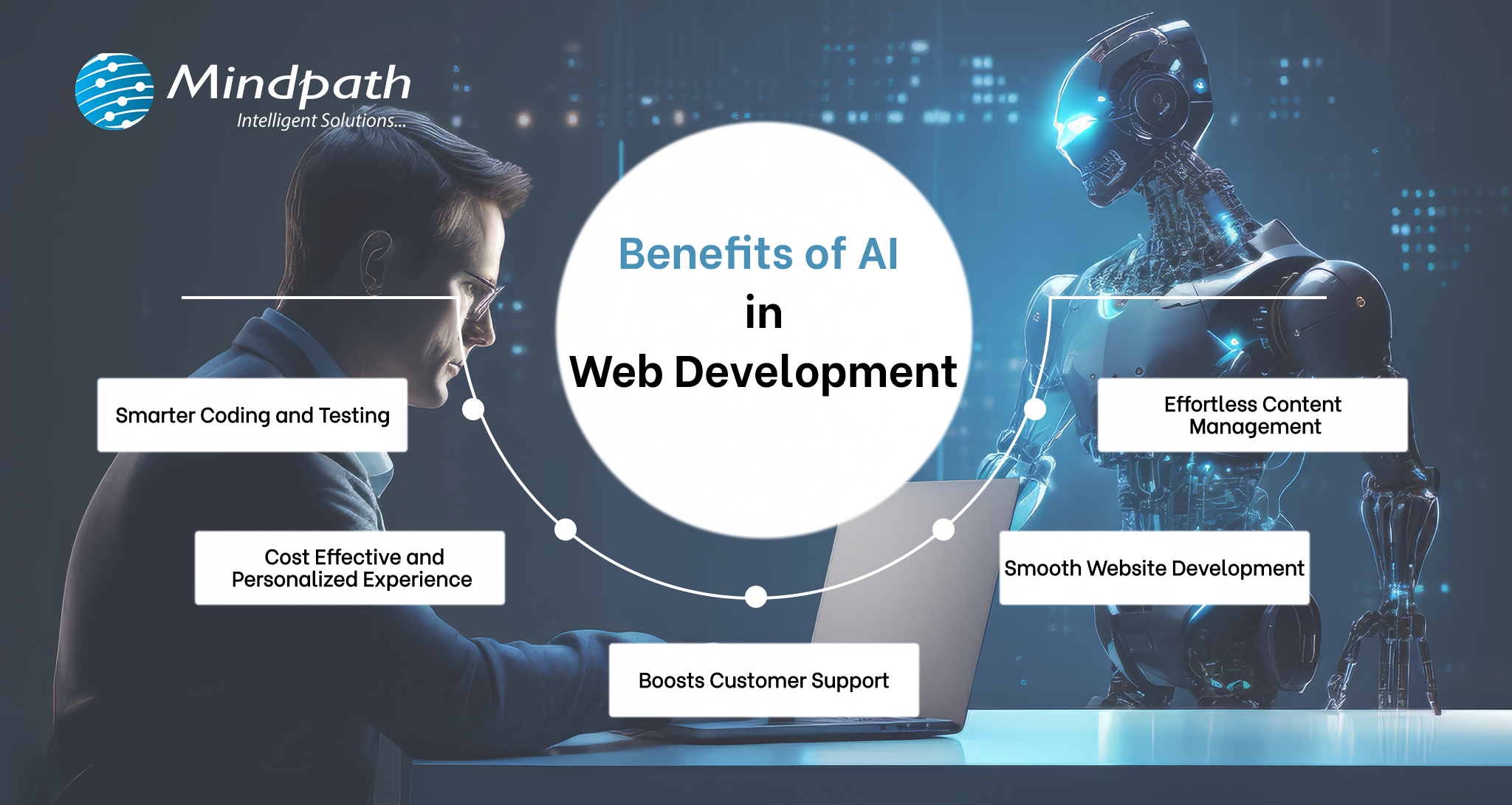
Benefits of AI in Web Development

AI is simplifying website creation for everyone. It assists with coding, designing, and even communicating with users. If you’re creating a website or just beginning, AI can help you save time and get things to work more efficiently. Here are some easy ways it can actually help.
Benefits of AI in Web Development

1. Smarter Coding and Testing

The powerful combination of AI and web development can help developers to write cleaner codes by spotting bugs early and improving how the code works. With deep learning, AI-based tools also facilitate automated testing, which assists quality assurance teams in verifying whether the website functions correctly. Although some problematic areas continue to require manual testing, AI streamlines the process and reduces costs. That’s one of the reasons why QA and testing budgets have declined over the past few years, and why more individuals are using AI websites for improved results. 

2. Smooth Website Development

AI in web development handles mundane and time-consuming work so developers can concentrate on the larger aspects of a project. With smart tools and data-driven choices, the entire web development process becomes more efficient and faster. This is incredibly useful, particularly if you’re new to it. By using AI to create websites, you save time and effort while building something awesome and making web development feel less stressful and a lot more efficient from the very start. 

3. Boosts Customer Support

AI in customer service makes it simple to integrate smart chatbots onto websites that are able to engage with visitors’ day and night. These virtual assistants comprehend questions and respond in natural, friendly terms. They provide instant answers, resolve issues rapidly, and never require breaks. This allows owners of websites to assist users without requiring a support team full-time. It’s an easy method to ensure visitors are satisfied and that they always receive assistance, even when there is no one present. 

4. Cost Effective and Personalized Experience

With the help of AI tools, websites are now able to provide customers with a more personalized and seamless experience at reasonable costs. Work that required time can now be processed automatically, saving time for both users and website owners. AI also assists in identifying fraudulent or toxic activities, protecting users. This is why many top AI websites utilize intelligent features to serve customers better. Ultimately, AI assists in providing more value to the customer at a low cost. 

5. Effortless Content Management

Website content management becomes a lot simpler with the assistance of AI. Through analyzing user behavior on a website, AI provides clear concepts regarding what type of content users like most. Website owners can develop improved posts, videos, or pages that genuinely interest visitors due to this. With the assistance of AI web templates and smart recommendation tools, you can lead users to whatever they require and retain them for a longer period. It’s an easy way to make content better and make each visit feel more personal.

Is your business making the most of AI to stay ahead of the competition? Explore how integrating AI in your business strategy can optimize processes, drive growth, and improve decision-making.

How to Use AI in Web Development?

Today, web development thrives on the partnership between AI and human expertise. While AI handles repetitive tasks and enhances efficiency, it still relies on human creativity and problem-solving. Here’s how you can use AI in web development to streamline your process and improve results. 

1. Artificial Design Intelligence (ADI)

Artificial Design Intelligence (ADI) assists you in creating a complete website by simply responding to a few simple questions. It selects the most suitable layout, design, and content depending on your requirements. It’s like having an intelligent assistant that designs a professional-looking site that reflects your style and objectives. This AI website generator makes the process fast and efficient, ensuring you get the site you want with minimal effort.  

2. Search Easier with Voice Assistants

Rather than typing and reading lengthy pages, users can simply speak their question. Voice AI listens, the correct answer quickly, and voices it back. Voice AI assists websites in providing rapid and clear responses, speeding up searches, making it easier, and more accessible to all. 

3. Coding Assistants

Developers can use smart coding assistants to speed up their work. These tools suggest code, spot errors, and help build websites faster. Even when working on big ideas, they take care of the small stuff. It’s like having a smart helper while writing your code. 

4. Personalize User Help with Chatbots

AI chatbots make it easy for users to get the info they need. They can ask questions in simple language, and the bot instantly provides answers or links. The benefit of chatbot is that it provides fast, accurate responses, making the experience more personal and efficient by using the website’s content.

5. Easy Search Engine Optimization (SEO)

AI can make SEO much easier by providing the best keywords, topics, and headlines for your content. It can even write parts of your text, ensuring the right keyword density for better search engine rankings. This helps your website attract more visitors without the hassle of manual research. 

AI is reshaping industries by automating the processes, empowering faster decision-making, and providing data-driven insights. Learn how AI is e-commerce is transforming the future of e-commerce sector.

Ready to Transform Your Website with AI?

AI is changing web development by making tasks faster and more efficient. From designing and coding to improving user experience, AI helps developers focus on what truly matters. By integrating AI, your website can become smarter, more personalized, and easier to manage for everyone involved. 

Mindpath offers top-tier AI development services and delivers high-performing artificial intelligence solutions that enhance your website’s design, performance, and functionality. Our expert team utilizes AI tools to streamline processes, boost user experience, and create custom solutions.  

Related Post

Discover the top Node.js trends shaping digital technology in 2024, from AI and TypeScript to IoT and cloud computing. Explore how Node.js drives innovation!
Discover the ultimate guide to hiring Node.js developers in London. Learn about the skills, benefits, and cost factors involved in finding the right talent for your project.

Related Post

AR and VR in Education

Imagine a classroom where history lessons transport you to ancient Rome, science experiments happen in a virtual lab, and geography lessons let you explore the Amazon rainforest from your desk. Sounds exciting, right? This is the power of Augmented Reality (AR) and Virtual Reality (VR) in education. T But how exactly do AR and VR reshape education? What benefits do they bring to students and teachers alike? Let’s explore how these innovative tools are transforming the way we learn and teach. 

What is Augmented Reality (AR)?

Augmented Reality (AR) is a technology that integrates digital content, such as images, sounds, or animations, into the physical environment. Instead of replacing the actual world, like Virtual Reality (VR) does, AR improves what you see and feel by mixing virtual features into your surroundings. AR works with smartphones, tablets, AR glasses, and headsets. For example, you might use your phone’s camera to display a map on the ground in front of you or a 3D model on a table. This makes the actual world more engaging and thrilling. Augmented Reality can be used for a variety of purposes, including learning and decision-making as well as producing enjoyable and engaging entertainment. It enables users to experience situations in new ways, supplementing what they perceive with useful or intriguing information. AR, which combines the actual and digital worlds, provides a new and immersive method to engage with our surroundings.  

What is Virtual Reality (VR)?

Virtual Reality (VR) is a technology that generates a fully digital environment in which users can explore and interact as if they were real. Instead of viewing your real surroundings, you are immersed in a 3D virtual environment that feels like you’ve entered another universe. To enjoy VR, you often require specialized equipment such as VR goggles, headsets, or even suits. These technologies help you shut out your actual surroundings while increasing the immersion in the virtual one. For example, you might find yourself walking on a virtual beach, floating through space, or playing games in an extraordinary place. The purpose of VR is to make you feel as if you are actually “inside” the virtual environment, regardless of how realistic or fictional it is. It is used for entertainment, training, education, and many more purposes, providing limitless opportunities to explore and experience things in completely new ways.

Benefits of AR and VR in Education

1. Cost Effective

One of the primary advantages of AR and VR in education is their cost-effectiveness. Traditional training approaches can include large investments in classroom layouts, resources, and instructors, which can be costly. In contrast, AR and VR lower these expenses by providing a more efficient method of training delivery. These technologies minimize the requirement for physical resources and decrease the need for expert trainers. AR and VR dramatically reduce training time by allowing learners to practice and repeat tasks at their own speed without continual observation. This allows for faster skill development, lower training expenses, and the opportunity to train more people in less time. Furthermore, AR and VR training programs are scalable, which means they can be utilized to teach a big number of people in several places without requiring expensive travel or equipment. This allows organizations to swiftly onboard new staff and upskill existing ones. AR and VR minimize both direct and indirect expenses by providing an interactive and efficient learning environment, making them an important answer for current education and training programs. 

2. Enhanced Immersive Learning

AR and VR training provide levels of immersion and engagement that traditional techniques cannot match. These technologies enable students to engage in realistic simulations, which increases memory and comprehension of the information. AR and VR, by immersing students in lifelike situations, help to strengthen links between the learner and the subject, resulting in improved knowledge retention and engagement. This immersive experience allows trainees to practice real-world events in a secure and controlled setting, increasing their confidence and readiness for genuine circumstances. As a result, AR and VR training frequently leads to increased expertise and better performance. The capacity to mimic difficult activities or high-pressure scenarios makes these technologies especially useful in businesses that need specialized skills or rapid decision-making. 

3. Building Essential Skills

In several industries, individuals operate in hazardous conditions where safety is essential. Traditional training for such high-risk employment is frequently time-consuming, costly, and can include hands-on experience in dangerous environments. AR and VR, on the other hand, allow workers to learn the essential skills in a safe, regulated, and realistic virtual environment. Virtual reality simulations, for example, allow trainees to practice operating equipment and managing operations in places such as refineries or chemical plants. These simulations replicate real-world situations, including realistic sounds and images, giving trainees the impression that they are on-site but without the hazards. This immersive training strategy guarantees that personnel obtain the expertise and competences required to properly operate complicated machinery and high-pressure circumstances. Additionally, VR training does not disrupt existing operations and allows staff to be job-ready upon completion, reducing the time and cost of traditional training methods. 

4. Mastering High-Risk Tasks Safely

Certain professions, particularly in healthcare, aviation, and manufacturing, need precise execution of high-risk operations. In healthcare, for example, medical treatments must be executed with extreme precision to achieve beneficial results. AR and VR are revolutionizing this process by allowing experts to practice and improve their abilities in a safe, virtual environment. For example, doctors can utilize virtual reality training to mimic complicated surgery, such as spine operations, on virtual patients. This allows them to practice each phase of the treatment and acquire confidence before attempting it on a real patient. Furthermore, AR can overlay important data right in the surgeon’s field of view, offering real-time advice during surgeries. This form of training improves accuracy, minimizes the likelihood of mistakes, and ultimately results in improved patient outcomes. It also reduces the danger of malpractice disputes, which benefits both healthcare providers and institutions. 

5. Tailored Training Solutions

AR and VR training allows you to personalize learning experiences based on the unique needs of each individual. These technologies enable training programs to be customized, allowing students to advance at their own speed and in a way that best matches their learning style. For example, in industries such as automobile production, firms may utilize augmented reality to tailor assembly line instruction to each technician’s skill level. This method guarantees that each worker receives the proper teaching degree, leading to faster learning, fewer mistakes, and better performance. By providing personalized training, AR and VR assist learners in developing the skills they require more effectively, saving time and money while increasing overall productivity. This customized approach guarantees that training is not just effective but also aligned with the learner’s unique needs and abilities. 

AR and VR Services at Mindpath

Mindpath provides innovative Augmented Reality (AR) and Virtual Reality (VR) technologies that enhance learning and training experiences. Our AR and VR services assist companies and educational institutions in creating realistic, interactive environments for their teams and students to practice skills safely and successfully. Our AR services provide immersive experiences by superimposing digital information over the actual environment, allowing users to interact with virtual content in real time. Whether for training or product presentations, augmented reality makes learning more interesting and practical. With our VR services, we provide completely simulated settings in which customers can practice high-risk activities or complex processes with no real-world implications. This helps students to acquire confidence, enhance their abilities, and carry out tasks with accuracy. Mindpath’s AR and VR solutions are customizable to fit your specific training needs. Whether you’re in healthcare, manufacturing, or education, we provide tailored services that help individuals learn faster, retain information longer, and perform with accuracy.  

Wrapping Up!

Mindpath is at the forefront of revolutionizing learning and training experiences with new AR and VR technology. By providing customized, immersive solutions, we assist companies and educational institutions in improving skill development, retention, and training costs. Whether you work in healthcare, manufacturing, or education, our AR and VR services offer a secure and effective approach to master complicated jobs and high-risk processes. Our custom solutions are tailored to your individual requirements, ensuring that learners get the confidence and competence they need to succeed. Partner with Mindpath to unlock the future of training and learning by leveraging cutting-edge technologies that not only produce results but also pave the road for smarter, more effective training.  

Ready to transform your training and education with AR and VR?

Partner with Mindpath today to discover customized solutions that enhance learning and boost performance.

Discover how AR and VR are transforming education with immersive, cost-effective, and tailored training solutions that enhance learning.
types of artificial intelligence  

Artificial intelligence is quickly becoming the backbone technology of our modern day, enabling a wide-ranging variety of advanced technologies, from smart assistants on our phones to an advanced analytics platform. AI enables machines to translate data into useful information by recognizing patterns in the data and eventually making decisions that once required human intelligence. Learning the different types of artificial intelligence is critical to understanding how such human-like systems function and advance from there. As innovation unfolds in real-time, AI is quickly becoming the key enabler of automation, personalization, and intelligent decision-making across industries.

At present, AI development aims toward systems that can reason, adapt, and improve efficiency in the real world. The advancement of these changing and evolving technologies is increasing limitations and changing the way we interact with digital systems. In this blog, we will cover the main types of AI that exist and how each level leads to the next generation of intelligent technology.

Want to step into the future of technology with AI? Mindpath’s  AI development services will help you provide smart and intelligent solutions tailored to your business demands.

Understanding the Types of Artificial Intelligence

Artificial intelligence uses data, logic, and algorithms to simulate human thought processing and action in machines, enabling computers to recognize patterns, make decisions, and learn from past experience. According to SAS, AI systems can manage vast amounts of data and apply logic in real time to intelligently and effectively handle functions like speech processing, visual analysis, image recognition, and natural language understanding.

It is important to understand the types of artificial intelligence, as they indicate how sophisticated a system is and what it can actually do. Knowing about the various AI classifications will provide clarity regarding what AI systems exist today, and what systems are theoretical at this point in time. This knowledge can help businesses select the proper technology, manage risk, and plan strategies more confidently in a world that is becoming increasingly unified through intelligent automation.

Here are the three types of artificial intelligence:

1. Artificial Narrow Intelligence (ANI)

2. Artificial General Intelligence (AGI)

3. Artificial Super Intelligence (ASI)

Ever wondered how AI systems focus on the most relevant information while processing massive datasets? Discover the attention mechanism to learn why it is foundational to deep learning models and advanced AI intelligence.

What is ANI AI?

Artificial narrow intelligence, or ANI artificial intelligence, operates within a specific functional role, or related functions, within a narrow field of inquiry. ANI does this very effectively, but it cannot go beyond what it has been programmed to do. Businesses use ANI to promote efficiency in work, and individuals employ ANI daily in ways such as digital assistants and recommendation systems to help them work more efficiently, quickly, and accurately.

ANI works by identifying data from prescribed sources and performing assigned tasks with accuracy. It improves business processes from manufacturing to services to customers. ANI also learns over time and employs machine learning and deep learning techniques. Businesses can rely on ANI to increase productivity, reduce risk, and support humans in executing rote or specialized tasks.

Here are the benefits of ANI AI:

1. Higher Efficiency

ANI automates repetitive tasks like data entry and scheduling. Employees can instead work on creative and complex work.

2. Faster Decisions

ANI analyzes large datasets quickly. Companies can confidently make decisions that are based on data.

3. Stronger Security

ANI monitors transactions and user activity in real time. It detects fraud faster than individuals can.

4. Better Customer Support

AI chatbots help customers with whatever they want 24/7. Human agents will manage more complex customer questions.

5. Smarter Marketing

Recommendation engines make intelligent suggestions around helpful products and content. This increases engagement and sales.

Want to see how ANI-powered chatbots deliver real business value? Discover AI chatbot examples to learn how intelligent automation boosts engagement and conversions.

What is AGI AI?

AGI artificial intelligence is a kind of system that can think, learn, and understand like a human being. It does not only refer to a system that is limited to specific tasks like ANI. AGI can reason logically, solve problems, and understand languages in varying contexts. It is significant progress in the domain of artificial intelligence types.

AGI uses information collected previously to create new experiences and applicability of information in a new experience. It can also make decisions relating to healthcare, finance, and technology without the need for detailed programming. AGI artificial intelligence is set apart by its adaptability and flexibility and gives a clear guide to the extent of sophistication apparent between different types of artificial intelligence in ability to cross over between a humanistic understanding of the world and efficiency of a machine.

Here are the benefits of AGI Artificial Intelligence:

1. Faster Research

AGI examines enormous datasets at incredible speeds. It speeds and improves advances in medicine, science, and technology.

2. Solve Big Problems

AGI can help tackle global challenges, including climate change and resource management. It may create sustainable or efficient solutions.

3. Boost Productivity

AGI can automate mundane or advanced activities. This will allow humans to focus their time on creative and strategic input.

4. Personalized Services

AGI can personalize education and healthcare for them. It can suggest educational paths and treatment plans based on specific personalized information.

5. Better Collaboration

AGI reads tone, intention, and context in conversations. It guides humans and gives insights about what is happening in real-time.

Wondering how advanced AI capabilities align with long-term business goals? Discover AI in business strategy to learn how organizations use intelligent systems to gain a competitive advantage.

What is ASI AI?

ASI, artificial intelligence, is a stage of AI that is beyond human intelligence. It is capable of thinking, learning, and solving problems in many areas independently. It handles complex tasks with superhuman speed and accuracy, unlike ANI and AGI, which have limitations. ASI sits at the top of the types of artificial intelligence levels.

ASI or Artificial Super Intelligence could create profound change in areas such as science, medicine, and the arts, by processing greater amounts of data, making choices, and understanding emotions greater than human capacity. Although ASI technology is still hypothetical, investigating the implications and possibilities prepares researchers and organizations for the next generation of artificial intelligence and its social benefits.

Here are the benefits of ASI Artificial Intelligence:

1. Smarter Decisions

ASI examines vast sets of data and simulates complicated systems. It can help solve problems like health, climate change, and poverty.

2. Faster Innovation

ASI automates research and experimentation. It brings breakthroughs in science, technology, and even space exploration.

3. Higher Productivity

ASI efficiently performs any cognitive task. While efficiency increases, humans can spend their time on more creative and strategic work.

4. Personalized Customer Experience

ASI is accurate in anticipating customer needs. ASI provides personalized marketing and services that are well-targeted.

5. Stronger Risk Management

ASI can quickly identify potential threats. It can protect against fraud and strengthen cybersecurity across operations.

Need efficient AI training without excessive computing costs? Discover Low-Rank Adaptation (LoRA) to learn how modern AI models are optimized while maintaining performance and scalability.

ANI vs AGI vs ASI: A Detailed Comparison

Comparing ANI, AGI, and ASI shows how these different forms of intelligence operate. This table explains their capabilities, learning ability, and impact within the types of artificial intelligence.

Category ANI (Artificial Narrow Intelligence) AGI (Artificial General Intelligence) ASI (Artificial Superintelligence)
Intelligence Level Performs specific tasks well Performs human-level tasks across all areas Performs tasks beyond human intelligence
Learning Ability Learns only in its trained tasks Learns and applies knowledge across multiple areas Learns independently and creates new knowledge
Capabilities Limited to single tasks Matches human reasoning and problem-solving Solves complex problems instantly and invents new methods
Development Status Already in use Theoretical, may take decades to develop Hypothetical, comes after AGI
Resource Needs Moderate computing power and data High computing power and advanced hardware Extremely high computing power and energy required
Applications Chatbots, recommendations, image recognition Scientific research, education, creative industries Global problem-solving, advanced research, innovation

Ready to Unlock Your Business Growth with the Power of AI?

Understanding types of artificial intelligence like ANI, AGI, and ASI helps businesses and individuals see the potential of AI in everyday life and industry. From improving efficiency and decision-making to driving innovation and solving complex problems, AI is transforming the way we work, create, and interact with technology in ways that were once unimaginable.

Mindpath offers professional AI development services to help companies implement ANI, AGI, and ASI solutions. Our team builds intelligent systems that enhance business productivity, automate processes, and deliver personalized experiences. With expertise in the latest types of artificial intelligence, Mindpath ensures your AI projects are efficient, scalable, and aligned with your strategic goals for measurable results.

What is devsecops

In the digital world of the 21st century, DevSecOps has undoubtedly become the backbone of secure software delivery. It has perfectly blended DevOps and security practices in order to protect applications from cyber threats without hampering innovation. With the surge in cloud DevSecOps organizations across diverse sectors are embedding automated testing and compliance, along with continuous monitoring, directly into CI/CD pipelines.

It is the right time for you to know how DevSecOps works and why it matters for DevOps cybersecurity. DevSecOps is now essential for resilience, whether you are developing cloud-native apps or securing your software supply chain. It is time to look at how businesses can implement DevSecOps in the real world.

Curious about how DevSecOps implementation helps businesses in achieving secure and scalable pipelines? Contact us and let our experts provide you with full guidance.

An Insight into DevSecOps

In recent times, DevSecOps has certainly surfaced as an innovative approach for Development, Security, and Operations. It combines security into every single phase of the software development lifecycle to create software efficiently while curbing vulnerabilities. 

DevSecOps solutions make sure that security is shared across the development and security teams, in addition to the operations team. It is achieved through the automation of security processes and practices within CI/CD pipelines. This approach has gained massive popularity in the past few years since it fosters collaboration while empowering business entities to deliver secure and high-quality software solutions. 

Also Read: Benefits of DevOps

Key Benefits of DevSecOps

The DevSecOps concept gives rise to a host of benefits for users, including professionals as well as businesses. Now that you know what is DevSecOps, it is time to get familiar with its key benefits. 

1. Faster Delivery of Software

DevSecOps creates the opportunity for you to integrate security into the development pipeline. Thus, it allows businesses to rapidly deliver highly secure code. It is capable of addressing issues early on and while streamlining the release process. 

2. Better Agility

Automation serves as a catalyst and reduces bottlenecks relating to manual security. It allows security teams to lay emphasis on high-value tasks. Moreover, they feel empowered to respond in a prompt manner to threats and risks.

3. Diminished Time to Market

The concept of cybersecurity DevOps is capable of catching as well as fixing vulnerabilities at an early stage. It therefore minimizes the requirement for expensive as well as time-consuming remedial actions at a later stage. It is good news for software developers since it accelerates software project timelines. 

4. Top-Notch Security 

You need to leverage DevSecOps so that you can strengthen the security posture when it comes to custom software development. Security gaps can be reduced exponentially as DevSecOps embeds security into each stage of the DevOps lifecycle.

6. Better Compliance with Laws and Regulations

You need to use DevSecOps tools since they ensure compliance at all stages of software development. With security checks that are automated and compliance tools, modern businesses can rest assured about their compliance requirements.

Curious about the latest shifts reshaping how software and websites are built and deployed? Check out our blog on DevOps trends to stay ahead of the curve and make sure your projects leverage modern best practices.

Steps to Implement DevSecOps

The implementation of DevSecOps means weaving security into each and every phase of the DevOps pipeline without compromising the delivery. At present, organizations face rising cyber risks along with stricter compliance standards, which makes a structured approach essential. You need to follow the steps below in order to effectively implement DevSecOps while developing a software solution.

Step 1 – Evaluate your Current Security Practices

While implementing DevSecOps, the very first step that you need to take involves the assessment of your current security practices. You need to do a careful and comprehensive evaluation of the security tools and processes that are in place. You also need to identify gaps along with appropriate areas of improvement while taking into account the organizational goals and context.

Step 2 – Establishment of Security Goals and Objectives

Now it is time to establish security objectives. You must keep in mind to define clear and well-defined security goals and objectives that are perfectly aligned with the vision of your organization. At this stage, you can even consider involving stakeholders from the development, security, and operations teams. It is vital to prioritize shared understanding along with unified commitment. 

Step 3 – Implementation of Security Training and Awareness Programs

You need to conduct training programs at this stage of the implementation process. These training programs can play a strategic role and help the staff members to cultivate essential skills and capabilities. It is also essential to promote security awareness while fostering an accountable security culture within the organization. 

Step 4 – Integration of Security into the Software Development Lifecycle

At this stage, you need to combine security practices and controls at every phase of the software development lifecycle. You must focus on implementing tools along with automation that are capable of facilitating secure code reviews as well as vulnerability scanning. The tools must also support threat modelling. 

Step 5 – Emphasizing Continuous Security and Automation

It is vital to prioritize automation when it comes to cybersecurity DevOps. So you need to automate security testing, such as dynamic analysis and static analysis. You must also consider automating software composition analysis so that you can get feedback on an ongoing basis. It is a wise decision to integrate security into the continuous integration and deployment pipelines, as it can help ensure security checks at every stage. 

Must Read: DevOps vs DevSecOps

Step 6 – Implementation of Infrastructure as a Code Security

You must also apply the security principles to Infrastructure as a Code (IaC) scripts and templates. It is undoubtedly a critical step when it comes to DevSecOps implementation. Businesses must ensure that they leverage version control for the Infrastructure as a Code template for maintaining traceability. You can even consider applying policy as code frameworks in order to enforce security baselines for cloud resources.

Step 7 – Fostering Communication and Collaboration

You need to encourage cross-team collaboration along with transparent communication. You can ensure this through regular meetings and by using shared tools. It is essential to prioritize joint decision-making. It is equally important to set up and maintain a DevSecOps culture so that it can promote trust along with accountability within the organization.

Step 8 – Implementation of Continuous Monitoring and Incident Response

It is critical at this stage to adopt continuous monitoring of applications and infrastructure. This is because such a practice can help in detecting as well as responding to security incidents in a prompt manner. You must also establish an incident response plan that can facilitate effective and efficient mitigation in case of a security breach.

Step 9 – Focus on Regular Assessment

One cannot overemphasize the importance of regular assessment and improvement while implementing DevSecOps. You must conduct assessments to evaluate the effectiveness of the implemented DevSecOps practices periodically. It is equally essential to improve the security processes and adjust to emerging threats on an ongoing basis. Businesses must also make sure to incorporate the feedback from the key stakeholders.

Step 10 – Remaining Abreast with the Latest Security Practices

It is imperative for modern businesses to stay updated with the latest security trends and industry standards. You need to bear in mind that your business needs to engage in continuous learning. So in your organization, you need to encourage security professionals to take an active part in training programs as well as online communities.

Facing hurdles in your deployment process? Read our guide on DevOps challenges and solutions to learn actionable strategies for smoother, more efficient workflows.

Best Practices While Implementing DevSecOps

There are a number of best practices that you need to keep in mind while implementing DevSecOps within your business. You need to adopt these practices so that you can derive optimum value from DevSecOps implementation. 

1. Emphasis on Security

You need to shift security to the left. It means that the security component has to be integrated at an early stage in the software development lifecycle. Several practices, such as threat modelling and secure coding practices, need to take place during the development stage in order to reduce the risk before the production stage. 

2. Automation

The role of automation is indispensable when it comes to DevSecOps implementation. You need to embed appropriate security controls into CI/CD pipelines and ensure static as well as dynamic code analysis. 

3. Importance of Continuous Testing

Continuous testing is an essential component of DevSecOps as it allows teams to identify security gaps and vulnerabilities. You need to test code on a continuous basis so that the number of security issues can be reduced before that may reach the production stage. 

Ready to modernize your tech operations and accelerate product delivery? Explore our blog on DevOps for Businesses to learn how DevOps helps businesses build, deploy, and scale with confidence.

Final Words

DevSecOps is no longer an optional thing for businesses when it comes to developing software solutions. It serves as the ultimate foundation for building secure and resilient software applications that are compliant in today’s world. Businesses need to integrate DevOps and security practices across the entire pipeline in order to reduce security risks and uncertainties. If DevSecOps implementation is done in the right manner, it can foster innovation and business resilience. 

The top-notch DevOps services of Mindpath can ensure that your business can successfully adopt DevSecOps. With the help of expert guidance and support, your business can achieve innovation, which can give it an edge in its operational domain.

Learn how to implement DevSecOps in the cloud to enhance security. Discover the key steps to safeguard your cloud infrastructure.