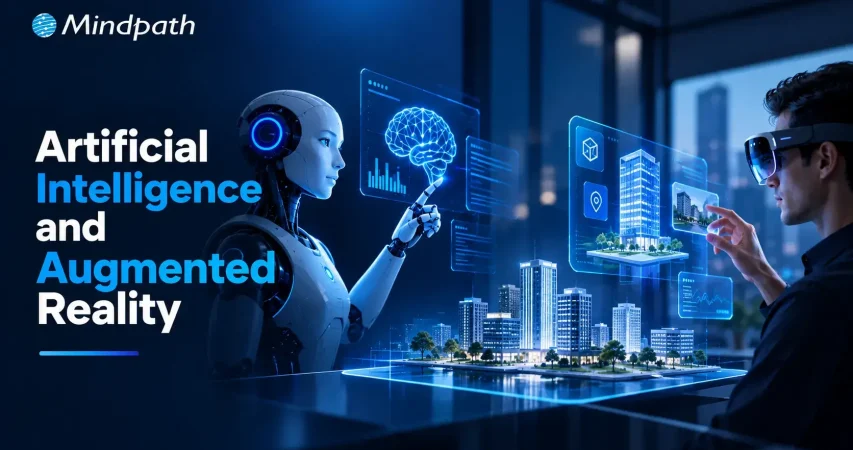
Artificial intelligence (AI) and augmented reality (AR) are complementary technologies that can make digital experiences more interactive and context-aware. AI helps systems interpret data, recognize patterns, and generate recommendations, while AR places digital information over a view of the physical environment. When combined, they can provide users with relevant visual guidance, interactive product experiences, and assistance during real-world tasks.
Key Takeaways
- 01
Artificial intelligence and augmented reality combine data-driven capabilities with digital information displayed in a real-world view. - 02
AI can support object recognition, personalization, contextual assistance, and interaction within AR applications. - 03
Healthcare, retail, manufacturing, education, entertainment, and navigation offer potential applications for AI-powered AR experiences. - 04
Successful AI and AR solutions depend on reliable data, suitable devices, responsive interfaces, privacy safeguards, and thorough testing. - 05
Businesses should select use cases with clear user needs and measurable outcomes before investing in more complex AI-powered AR experiences.
Businesses can apply artificial intelligence and augmented reality in areas such as healthcare, retail, manufacturing, education, and technical support. For example, AI can help identify an object or interpret a situation, while an AR interface presents instructions or contextual information to the user. The value of this combination depends on the quality of the underlying data, the accuracy of the AI system, and how well the experience fits the user’s needs.
Understanding Artificial Intelligence and Augmented Reality
What is Artificial Intelligence?
Artificial intelligence is a field of computing focused on systems that perform tasks such as recognizing patterns, interpreting language, making predictions, and generating content. Depending on their design and training, AI systems can process large amounts of information and produce outputs that help people complete tasks or make decisions.
AI technologies include machine learning, computer vision, natural language processing, and generative AI. These capabilities can support applications such as image recognition, voice interaction, recommendation systems, and intelligent assistance. For a broader overview, read our guide to AI models.
What is Augmented Reality?
Augmented reality is a technology that adds digital content to a view of the physical environment. Depending on the application and device, users may see virtual objects, labels, instructions, animations, or other information through a smartphone, tablet, headset, or smart glasses.
Unlike virtual reality, which typically immerses users in a computer-generated environment, AR adds digital elements to their view of the real world. Businesses can use it to present product previews, display maintenance instructions, support navigation, and create interactive learning experiences.
AR experiences may use cameras, sensors, spatial mapping, and tracking technologies to position digital content. The available capabilities depend on the device, application, and environment in which the experience is used.
How Do Artificial Intelligence and Augmented Reality Work Together?
AI and AR can work together by connecting intelligent data processing with a visual interface. AI can interpret information from images, sensors, user input, or connected systems. The AR application can then display relevant digital information within the user’s view of the physical environment.
For example, consider a technician repairing industrial equipment. A computer vision model may help identify a component from a camera image, while an AR application displays the corresponding maintenance instructions. The technician can use the information to guide the repair, subject to the accuracy of the recognition system and the suitability of the instructions.
The Main Steps in an AI-Powered AR Experience
1. Capture Environmental or User Data
The application receives information from a camera, device sensors, user commands, or connected business systems. The type and amount of data collected depend on the use case and the device’s capabilities.
2. Interpret the Information with AI
AI can help recognize objects, interpret spoken instructions, classify images, or identify patterns in the available data. The system uses these results to determine which information or action may be relevant.
3. Position and Display Digital Content
The AR application presents relevant content, such as labels, visual instructions, or three-dimensional objects. Tracking and spatial understanding help position the content appropriately within the user’s view.
4. Respond to User Interaction
Users may interact through touch, voice, gestures, or other supported controls. Depending on the application, AI can help interpret the interaction and update the information displayed.
5. Evaluate and Refine the Experience
Developers can evaluate recognition accuracy, tracking stability, response time, usability, and task completion. Feedback and testing results can guide improvements to the AI model, AR interface, and overall workflow.
Benefits of Combining Artificial Intelligence and Augmented Reality
Combining AI with AR can make digital information more relevant to the user’s surroundings and task. The benefits depend on the quality of the implementation, the environment, and whether the experience solves a real user problem.
1. Personalized User Experiences
AI can use permitted user preferences, interaction history, or contextual information to help tailor the content displayed in an AR application. For example, a shopping application could prioritize product information based on a user’s selected preferences, while a training application could adjust the sequence of guidance based on task progress.
Personalization should be transparent and respect user privacy. Businesses should collect only the information needed for the intended experience and provide appropriate controls over data use.
2. Improved Object Recognition
Computer vision models can help AR applications recognize objects, components, signs, or visual features. This can make it easier to display relevant information in context, such as product details in a retail environment or component labels during equipment maintenance.
Recognition accuracy can vary with lighting, camera quality, object appearance, and environmental conditions. Applications should be tested under realistic conditions and provide suitable alternatives when the system cannot confidently identify an object.
3. More Natural Interaction
AI-powered speech recognition and language processing can enable users to interact with some AR applications through voice commands. Gesture recognition may also support hands-free control when the device and application provide that capability.
These options can be useful when a user is working with equipment or needs to keep their hands available for another task. However, voice and gesture controls should complement accessible alternatives rather than become the only way to use an application.
4. Contextual Assistance
AI can help determine which information is relevant to a user’s current task, while AR can present that information directly within the user’s view. In a maintenance setting, this could mean displaying a component label, a safety instruction, or the next step in an approved procedure.
Contextual guidance can reduce the need to switch between screens or search through documents. Its usefulness depends on the accuracy of the underlying information and whether the instructions are appropriate for the specific situation.
5. More Efficient AR Content Development
AI tools can assist content teams with tasks such as generating draft text, organizing product information, creating concept assets, or preparing variations of digital content. These capabilities may help teams develop and maintain AR experiences more efficiently.
Generated content still requires review for accuracy, visual quality, licensing considerations, and suitability for the target device. AI-assisted creation does not remove the need for AR design, development, optimization, and testing.
6. Interactive Training and Learning
AI-powered AR can combine visual instructions with interactive exercises. For example, learners could view a simulated equipment assembly, receive contextual prompts, and access explanations when they encounter a difficult step.
Training applications may adapt guidance based on task performance, where appropriate data and reliable evaluation methods are available. Businesses should assess learning outcomes and task accuracy rather than assuming that an immersive experience automatically improves retention.
7. Scalable Personalization
AI can help organizations adapt AR content for different products, users, or operating contexts. A manufacturer, for instance, could maintain a shared library of equipment instructions while displaying the relevant version for a particular model or maintenance task.
Scaling such experiences requires consistent content, dependable data integrations, device compatibility, and a clear process for updating information. Personalization should improve usability without introducing unnecessary complexity.
Real-World Applications of Artificial Intelligence and Augmented Reality
AI and AR can support a range of business and consumer experiences. The following examples describe practical application scenarios. The exact capabilities available in a deployed solution depend on its design, data sources, hardware, and implementation.
1. Healthcare and Medical Training
Healthcare applications can combine AI-based image analysis or information processing with AR-based visualization. Depending on the system, medical professionals may use visual overlays to review anatomical information, plan procedures, or support training and simulation.
For example, a training application could display anatomical structures in a three-dimensional learning environment and provide explanations through an AI-enabled interface. Clinical use requires appropriate validation, reliable source information, privacy safeguards, and professional oversight. AI-generated guidance should not be treated as a substitute for clinical judgment.
2. Retail and Virtual Product Experiences
Retailers can use AR to let customers preview products in their surroundings or visualize selected items before purchasing. AI can support related functions such as product recognition, recommendation, and personalization when suitable data is available.
For example, a home furnishings application could allow a customer to place a virtual representation of a product in a room. AI may help recommend compatible items or organize product suggestions based on stated preferences. Product dimensions, appearance, and compatibility should be represented accurately to avoid misleading customers.
3. Manufacturing and Equipment Maintenance
Manufacturing teams can use AR to display assembly instructions, component labels, and maintenance procedures. AI can support visual inspection, anomaly detection, or the retrieval of relevant technical documentation.
For example, a technician could view step-by-step repair instructions through a supported AR device while an AI system helps identify the equipment model or locate a relevant maintenance document. The instructions should come from approved technical sources, and safety-critical work must follow established procedures.
4. Entertainment and Interactive Experiences
AI and AR can be combined in interactive games, camera effects, and digital experiences that respond to a user’s surroundings. AI may help recognize faces, objects, gestures, or scenes, while AR adds virtual elements to the camera view.
Developers can use these capabilities to create responsive effects and interactive environments. They should also consider device performance, accessibility, age-appropriate design, and consent when applications process images or other personal information.
5. Navigation and Remote Assistance
AR navigation can display directional cues over a camera view, while AI can support the interpretation of surroundings or the retrieval of relevant information. In workplace settings, similar capabilities may help technicians follow instructions or receive remote assistance.
For example, a field service worker could view the next inspection step on a supported device and access relevant technical information without repeatedly switching applications. Navigation and remote assistance systems should account for positioning errors, changing conditions, and situations where users need to focus on their physical surroundings.
6. Education and Skills Development
Educational applications can use AR to present three-dimensional models, interactive demonstrations, or visual explanations. AI can help answer questions, provide additional explanations, and organize learning content based on a learner’s needs.
For example, a science lesson could use AR to visualize a complex structure while an AI-enabled assistant explains its parts. Educators should review the generated explanations and ensure that the experience supports the learning objectives instead of distracting from them.
Artificial Intelligence and Augmented Reality Compared
AI and AR serve different primary purposes, even when they are combined in the same application. Understanding their roles helps businesses decide which capabilities are necessary for a particular solution.
| Aspect | Artificial Intelligence | Augmented Reality | Combined AI and AR |
|---|---|---|---|
| Primary role | Processes information, recognizes patterns, and generates predictions or content. | Adds digital content to a view of the physical environment. | Connects intelligent processing with contextual visual information. |
| Typical inputs | Text, images, audio, sensor data, or structured records. | Camera feeds, device sensors, spatial data, and user input. | Relevant data and environmental information, depending on the application. |
| Typical output | Predictions, classifications, recommendations, or generated content. | Visual overlays, virtual objects, labels, and interactive content. | Context-aware visual guidance or interactive experiences. |
| Example | Recognizing a component in an image. | Displaying a label over a component. | Recognizing a component and displaying relevant instructions in context. |
| Key considerations | Model accuracy, data quality, privacy, and evaluation. | Tracking, device compatibility, usability, and performance. | Integration reliability, end-to-end testing, privacy, and user safety. |
Challenges of Combining AI and AR
Although AI-powered AR offers useful possibilities, businesses need to evaluate the technical and operational challenges before deploying it. A successful implementation requires more than connecting an AI model to an AR interface.
1. Data Quality and Recognition Accuracy
AI results depend on the quality and relevance of the input data. Poor lighting, unfamiliar objects, incomplete records, or changing environments can reduce recognition accuracy. Solutions should be tested with representative conditions and provide clear fallback behavior when the system cannot produce a reliable result.
2. Device and Performance Limitations
AR applications need to maintain responsive tracking and stable visual placement while managing processing, battery, and connectivity constraints. Businesses should evaluate whether the intended devices can support the required AI workloads and whether processing should take place locally, in the cloud, or through a combination of both.
3. Privacy and Security
Applications that use cameras, microphones, location information, or user interaction data may process sensitive information. Organizations should minimize data collection, secure connected systems, define access controls, and clearly explain how information is used and retained.
4. Integration Complexity
AI models, AR frameworks, enterprise systems, and content platforms may use different data formats and interfaces. Teams need to plan how information moves between components, how errors are handled, and how content and models will be updated over time.
5. User Experience and Accessibility
Visual overlays can obscure important information or become difficult to use in bright, crowded, or physically demanding environments. Designers should test readability, interaction methods, accessibility, and the placement of content so that digital elements do not interfere with the user’s primary task.
How Businesses Can Get Started with AI-Powered AR
Businesses should begin with a defined problem rather than adopting AI and AR simply because the technologies are available. A focused use case makes it easier to evaluate feasibility, estimate costs, and determine whether the experience provides practical value.
1. Identify the User Need
Choose a task where contextual visual information could help users work more effectively. Examples include product visualization, guided maintenance, interactive training, or access to information while working with physical equipment.
2. Select the Necessary Capabilities
Determine whether the solution needs object recognition, speech processing, recommendations, spatial tracking, or other capabilities. Not every AR application needs AI, and not every AI application benefits from AR. Select only the components that support the intended outcome.
3. Evaluate Data and Devices
Confirm that the required data is available and suitable for the use case. Assess device compatibility, connectivity, processing requirements, privacy considerations, and the conditions in which the application will be used.
4. Build and Test a Focused Prototype
Develop a limited version that demonstrates the core user journey. Test recognition accuracy, visual tracking, response time, usability, and failure scenarios before expanding functionality or integrating the solution into critical business workflows.
5. Measure Business Outcomes
Define success measures based on the problem being solved. A training application might measure task completion and assessment results, while a maintenance solution could evaluate task duration, error rates, and the need for repeat assistance. Use the findings to decide whether to improve, expand, or reconsider the implementation.
Build More Contextual Digital Experiences with AI
Artificial intelligence and augmented reality can work together to connect intelligent data processing with useful information displayed in the physical environment. Applications in healthcare, retail, manufacturing, education, and technical support show how the combination can help people interact with information in more contextual ways.
Businesses considering AI-powered AR should start with a clear user need, select appropriate capabilities, and test the experience under realistic conditions. Attention to data quality, privacy, device performance, accessibility, and measurable outcomes can help teams determine whether the solution is suitable for wider adoption.
Mindpath provides AI development services to help businesses evaluate and build intelligent digital solutions. Discuss your requirements with the team to identify an approach that aligns with your product goals and technical needs.