Home

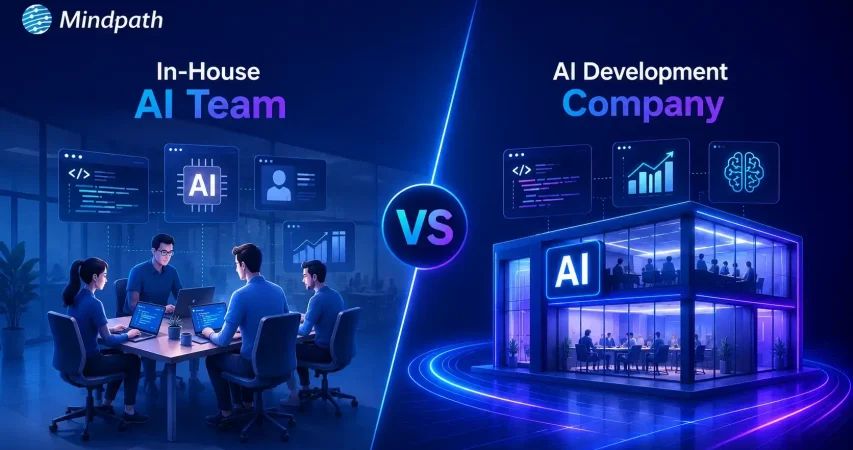
In-House AI Team vs Hiring an AI Development Company: Which Is Best for Your Business?  

In-House AI Team vs Hiring an AI Development Company: Which Is Best for Your Business?  

Join our Newsletter!

in-house vs outsourcing AI development

Businesses increasingly adopt AI to improve operations, customer experiences, and decision-making across industries. Many leaders now hire AI development company partners to access specialized expertise, reduce implementation risks, and accelerate AI projects without lengthy recruitment or infrastructure investments.

Key Takeaways

  • 01
    Evaluate business goals before choosing in-house or outsourced AI development approaches.
  • 02
    AI development companies accelerate delivery while reducing hiring and infrastructure challenges.
  • 03
    In-house AI teams offer stronger control, ownership, and long-term organizational expertise.
  • 04
    Compare total ownership costs instead of focusing only on initial development expenses.
  • 05
    Select the approach that best supports scalability, innovation, and measurable business outcomes.

Choosing between in-house vs outsourcing AI development depends on your budget, technical expertise, project complexity, and long-term goals. Each approach offers distinct advantages for different business needs. In this blog, we compare both options, explain their key differences, and help you choose the right approach for your business. So, let’s keep reading further!

Need a reliable partner to accelerate your AI initiatives? At Mindpath, we offer AI Development Services to design, develop, and deploy scalable AI solutions.

What Does an In-House AI Team Mean?

An in-house AI team consists of full-time professionals who design, develop, and maintain AI solutions within your organization. Companies that build in-house AI team capabilities gain direct control over development, workflows, and long-term technology planning.

These teams typically include machine learning engineers, data scientists, AI developers, and product managers with specialized expertise. They collaborate closely with internal departments, understand business objectives, and continuously improve AI systems as organizational needs evolve.

Here are the core benefits of in-house AI team:

1. Strategic Alignment

Internal teams understand business goals and operational priorities. AI initiatives support long-term company growth strategies.

2. Ownership of Intellectual Property

Your organization retains complete control over AI assets. Proprietary models remain protected from external competitors.

3. High Customization and Control

Teams adjust solutions for unique business workflows. You control timelines, priorities, and implementation decisions.

4. Stronger Data Security

Sensitive information stays within company infrastructure securely. Compliance requirements become easier to manage internally.

5. Long-Term Capability Building

Internal expertise grows stronger with every AI project. Knowledge remains within the organization for future innovation.

Challenges at a Glance

1. Talent Shortages

Finding experienced AI professionals remains difficult in a highly competitive market.

2. High Operational Costs

Infrastructure, hiring, and retention significantly increase long-term AI expenses.

3. Data Readiness Issues

Poor data quality delays development and reduces AI model accuracy.

4. Legacy System Integration

Older systems complicate AI deployment and slow implementation timelines.

5. Security and Compliance

Managing privacy, governance, and regulations requires continuous internal oversight.

What Does It Mean to Hire an AI Development Company?

Businesses hire AI development company experts to design, develop, and deploy custom AI solutions for specific operational needs. These companies provide specialized technical expertise, proven development processes, and experienced professionals without requiring businesses to build large internal AI teams.

AI development companies create tailored solutions such as intelligent automation, predictive analytics, machine learning models, and computer vision applications. They align every solution with business goals, accelerate project delivery, and provide ongoing support to ensure long-term performance and scalability.

Here are the core benefits of hiring an AI development company:

1. Specialized Expertise

Access experienced AI professionals with specialized technical knowledge. Solve complex challenges using proven development expertise.

2. Cost Efficiency

Avoid expensive hiring and infrastructure investments. Reduce overall AI development costs significantly.

3. Accelerated Time to Market

Launch AI solutions faster with experienced teams. Streamlined processes shorten overall development timelines.

4. Process Automation

Automate repetitive tasks using intelligent AI solutions. Improve productivity while reducing operational effort.

5. Enhanced Customer Experience

Deliver personalized interactions across customer touchpoints. Increase engagement through AI-powered experiences.

Challenges at a Glance

1. Data Quality Challenges

Poor-quality data reduces AI accuracy and overall project performance.

2. Limited AI Expertise

Inexperienced teams may struggle with complex AI development requirements.

3. Legacy System Integration

Older systems delay seamless AI deployment and business scalability.

4. Cost Overruns

Unexpected infrastructure and maintenance expenses increase total project costs.

5. Business Alignment Issues

Unclear objectives reduce AI effectiveness and expected business value.

In-House vs Outsourcing AI Development: Key Differences

Every AI development approach offers different advantages depending on your business requirements and available resources. The comparison below highlights the key differences across cost, expertise, scalability, security, and long-term management.

1. Cost and Initial Investment

In-House AI Team: Building an internal AI team requires significant hiring and infrastructure investments. Ongoing salaries, training, and technology expenses increase long-term costs.

Hiring an AI Development Company: AI development outsourcing reduces upfront hiring and infrastructure expenses. Businesses pay for specialized expertise without maintaining a permanent AI workforce.

2. AI Expertise and Talent

In-House AI Team: Internal teams develop deep knowledge of company processes and goals. However, hiring experienced AI professionals can take considerable time.

Hiring an AI Development Company: Development companies provide immediate access to experienced AI specialists. Their teams bring expertise from delivering diverse AI projects.

3. Development Speed

In-House AI Team: Building the team and setting up infrastructure extends project timelines. Initial development often progresses slower during the hiring phase.

Hiring an AI Development Company: Experienced teams begin development quickly using established workflows. Faster execution helps businesses launch AI solutions sooner.

4. Scalability and Flexibility

In-House AI Team: Expanding internal teams requires additional recruitment and training efforts. Scaling projects often increases operational complexity and costs.

Hiring an AI Development Company: External teams scale resources according to changing project requirements. Businesses can quickly increase or reduce development capacity.

5. Data Security and Control

In-House AI Team: Organizations maintain direct control over sensitive business information. Internal governance simplifies compliance with company security policies.

Hiring an AI Development Company: Trusted partners implement secure development practices and compliance measures. Clear agreements help protect business data throughout development.

6. Long-Term Maintenance and Support

In-House AI Team: Internal teams continuously monitor, improve, and maintain AI systems. Long-term ownership supports ongoing innovation and optimization.

Hiring an AI Development Company: Development companies provide continuous maintenance and technical support services. Regular updates help keep AI solutions reliable and scalable.

In-House AI Team vs Hiring an AI Development Company: Quick Comparison

Here’s a quick comparison of an in-house AI team and hiring an AI development company. This table highlights the major differences to help you compare both approaches at a glance.

Factor In-House AI Team Hiring an AI Development Company
Initial Cost High upfront investment required. Lower initial project costs.
Time to Start Longer hiring and setup. Faster project onboarding.
AI Expertise Depends on hired talent. Access to experienced AI specialists.
Development Speed Slower initial development cycle. Faster delivery with proven processes.
Scalability Hiring required for scaling. Easily scale development resources.
Technology Access Requires separate infrastructure investments. Ready access to modern AI tools.
Flexibility Limited by internal capacity. Adapts quickly to project needs.
Maintenance Managed by internal teams. Continuous expert support available.
Business Control Complete internal project control. Shared oversight with expert execution.
Data Security Full internal data control. Strong security with compliance standards.
Best For Long-term internal AI initiatives. Faster, cost-effective AI implementation.

When Should You Build an In-House AI Team?

  • Your business has long-term AI goals.
  • AI supports core business operations.
  • You require complete project control.
  • Sensitive data must remain internal.
  • You have budget for AI hiring.
  • Continuous AI innovation is a priority.

When Should You Hire an AI Development Company?

  • You need faster AI implementation.
  • Specialized AI expertise is unavailable internally.
  • Project budgets require greater flexibility.
  • You want lower upfront investments.
  • Your team needs external AI support.
  • Rapid project scaling is essential.

How to Choose Between In-House and AI Development Outsourcing?

Every business has different AI goals, budgets, and technical capabilities. Use this checklist to identify which approach aligns better with your project requirements and long-term strategy.

Business Requirement Recommended Approach Reason
Need an AI solution within weeks Hire an AI development company Faster project delivery.
Building AI as a long-term capability Build an in-house AI team Greater long-term ownership.
Limited AI expertise internally Hire an AI development company Access specialized AI professionals.
Large budget for hiring and infrastructure Build an in-house AI team Supports permanent AI operations.
Want lower upfront investment Hire an AI development company Avoid hiring and infrastructure costs.
AI workload changes frequently Hire an AI development company Scale teams as needed.
AI is central to daily operations Build an in-house AI team Better internal collaboration.
Need niche AI skills temporarily Hire an AI development company Experts available immediately.
Strict internal governance requirements Build an in-house AI team Maintain direct operational control.
Launching your first AI initiative Hire an AI development company Reduce risks with experienced guidance.

Ready to Choose Between In-House vs Outsourcing AI Development?

Selecting the right approach for in-house vs outsourcing AI development depends on your business objectives, available resources, budget, and implementation timeline. A well-informed decision helps reduce risks, improve efficiency, and create a stronger foundation for long-term AI success.

Mindpath supports businesses with expert AI consulting services and flexible staff augmentation solutions for every stage of AI adoption. Our specialists help you plan, develop, and scale AI initiatives with confidence. Contact us to discuss your business requirements and find the right AI solution.
Frequently Asked Questions

Yes. Many businesses combine internal teams with external AI specialists. Internal employees manage business priorities, while the development company provides specialized expertise, accelerates delivery, fills skill gaps, and supports complex AI projects without expanding permanent headcount.
Review the company’s AI project portfolio, technical expertise, security practices, communication process, industry experience, and post-deployment support. Clear project scope, measurable milestones, and transparent pricing also indicate a reliable long-term development partner.
Not necessarily. Businesses retain ownership of project goals, requirements, and approvals while external teams manage technical execution. Regular progress reviews, defined milestones, and transparent communication ensure visibility throughout the entire development lifecycle.
Compare recruitment expenses, salaries, infrastructure, software licenses, cloud services, maintenance, training, and long-term operational costs. Evaluating the total cost of ownership provides a more accurate comparison than considering initial development expenses alone.
A hybrid approach works well for businesses that need long-term internal ownership while accessing specialized AI expertise. Internal teams guide strategy and business priorities, while external experts accelerate development, solve technical challenges, and support future scalability.

Support Is One Click Away

Featured Posts

Related Post

Benefits of IT Staff Augmentation vs. Traditional Hiring 

IT staff augmentation offers a flexible, scalable, and cost-effective alternative to traditional hiring models. It enables businesses to quickly access specialized talent, adapt to changing project needs, and optimize resource allocation without long-term commitments. This approach enhances operational efficiency, speeds up hiring processes, and supports strategic growth in dynamic markets.

Are you struggling to find the right talent for your IT projects or facing challenges with traditional hiring processes? Traditional hiring could take months, but what if there was a faster, more flexible solution? Now, with IT staff augmentation, you may satisfy your project goals fast and effectively without the long-term commitment and expense associated with traditional employment. This blog will explore the key benefits of IT staff augmentation compared to traditional hiring models, helping you make an informed decision for your business. 

Staying competitive in today’s changing business world frequently requires the capacity to expand quickly and adapt. Businesses must make crucial choices about how best to find and retain talent to satisfy the needs of IT projects. IT staff augmentation boosts your current workforce with additional workers that have specialized skills or knowledge. In contrast to traditional hiring, which usually entails long-term employment contracts, staff augmentation provides the freedom to scale resources up or down in accordance with project demands. 

Let us dig deep and explore the primary benefits that IT staff augmentation services offer compared to traditional hiring models. Understanding these benefits allows firms to make educated decisions in line with their strategic goals and operational requirements. Additionally, recognizing the power of remote development teams can further enhance flexibility, access to global talent, and cost-efficiency, enabling businesses to scale their projects effectively. 

What are the traditional hiring models?   

Traditional hiring models cover a range of techniques used by businesses to onboard new staff members. Here’s a short breakdown: 

  • Direct Hiring: This is the most popular approach used by businesses to hire people directly for full- or part-time jobs. It includes posting job positions, evaluating applications, setting up interviews, and choosing job applicants.


  • Temporary Hiring: Businesses employ people to do certain tasks or for a set amount of time. Temporary hires are made by the company itself or through employment agencies to cover short-term positions like project-based labour or seasonal labour.


  • Contractual Hiring: Contractual hiring is employing individuals or businesses under a formal contract to do certain activities or projects. Contractors may labour for a certain amount of time until the project is finished, and they are normally compensated for their services in accordance with the conditions specified in the contract.


  • Freelancers or Independent Contractors: Businesses employ independent contractors or freelancers on a project-by-project basis. They work for themselves and supply specialized knowledge or services on demand, frequently from a distance. They are not employees.


Drawbacks of traditional hiring models    

Despite being frequently employed, traditional employment strategies include several drawbacks that businesses need to consider:  

  • Time and Resource Inefficiency: It might take a while and a lot of resources to advertise job positions, evaluate applications, hold interviews, and decide who gets hired. This inefficiency frequently leads to protracted spells of unemployment, which affects output and pushes back project deadlines.


  • Cost Implications: Conventional hiring includes indirect costs like pay, benefits, and overhead related to permanent workers in addition to direct expenditures like advertising, onboarding charges, and recruiting agency fees (if applicable). Budgetary constraints may be strained by these costs, especially if turnover rates are significant or if highly skilled personnel require premium pay.


  • Rigidity in Staffing: In traditional models, once employed, workers usually commit to long-term jobs that might not match project-specific requirements or changing corporate demands. This lack of adaptability may cause resources to be overextended during peak hours or underutilized during off-peak hours, which would reduce overall operating efficiency.


  • Skills and Expertise Gaps: Access to the knowledge or abilities required for specialized projects or cutting-edge technology could not always be ensured by traditional recruiting practices. Talent with specialized skills may be difficult for organizations to find and keep, which might impede innovation and competitiveness in quickly changing sectors. 

Overview of IT Staff Augmentation    

Businesses use IT staff augmentation services, a dynamic outsourcing approach, to improve internal skills and meet project objectives. This strategy entails hiring outside experts, frequently through direct contracts or staffing firms, to assist and enhance current internal teams. Staff augmentation, which provides temporary or project-based solutions, enables flexibility in workforce management in contrast to traditional recruiting, which involves bringing on board individuals for permanent employment. The first step in the process of augmenting IT professionals is to determine exactly what knowledge and abilities are required to carry out a specific project or cover a void in the organization. Then, using a range of channels, such as independent contractors, freelancers, and specialized recruiting agencies, companies look for people or teams with the necessary training and expertise.  

Key Benefits of IT Staff Augmentation  

  •  Flexibility and Scalability   

Two important benefits of hiring more IT professionals are flexibility and scalability, which enable companies to modify their workforce in response to shifting demands and market dynamics. Through the on-demand availability of specialized skills and knowledge, IT staff augmentation provides organizations with flexibility in response to a wide range of project needs. For a new campaign, for example, a marketing agency may add digital advertising professionals to its team to ensure they have the requisite knowledge without having to commit to long-term hiring. This flexibility improves the way projects are carried out by utilizing outside resources just how projects are carried out by utilizing outside resources to when they are specifically needed. Scalability in IT staff augmentation allows companies to efficiently allocate resources. Compared to keeping a set, full-time staff, organizations may control expenses more effectively by expanding to match expanded project scope or by shrinking following project completion. Because it may be expanded geographically or into new markets, its scalability also helps strategic objectives by offering flexible workforce options that are customized to local needs. 

  • Cost-Effectiveness   

Cost-effectiveness gives companies effective ways to manage project budgets and acquire specialized talents. In contrast to traditional recruiting, which entails high upfront expenditures such as onboarding and recruitment fees, staff augmentation lowers these costs. Since agencies find and screen candidates, businesses may save money on hiring expenses. Additionally, firms save money on long-term costs like benefits, office space, and equipment because augmented workers are not full-time employees. Because of this flexibility, businesses may minimize expenses during downtime by allocating staff in accordance with project phases. 

  • Access to Specialized Talent   

access to specialized talent enables companies to swiftly and effectively obtain knowledge that might not be present internally. Through agencies or direct contracts, companies may hire outside experts and access a wide range of specialized talents and industry-specific information. This strategy works especially well for projects needing specialized technical skills or temporary requirements that don’t warrant hiring people on a long-term basis. Businesses may improve project outcomes, innovate successfully, and tackle difficult problems with specialized knowledge by utilizing the experience and skill of augmented workers. IT staff augmentation guarantees operational excellence and competitiveness in quickly changing sectors by giving businesses access to specialized expertise when and when it’s needed. 

  • Faster Hiring Process   

One clear benefit of contracting IT staff augmentation over traditional recruitment techniques is that it allows firms to integrate qualified individuals more quickly. Employing agencies with pre-screened applicants or directly engaging with appropriate contractors can help companies find contractors more rapidly. This expedited procedure shortens the time it takes to fill roles, jumpstarts projects, and improves flexibility in meeting market needs. IT staff augmentation helps companies to achieve project deadlines, deploy workers quickly, and keep up operational momentum without sacrificing quality or knowledge. It does this by reducing administrative delays and expediting onboarding procedures. 

Choosing Between IT Staff Augmentation and Traditional Hiring   

Criteria IT Staff Augmentation Traditional Hiring 
Flexibility High – Can scale up/down as needed Low – Fixed, long-term commitments 
Cost Cost-effective, reduced overhead Higher costs, including benefits and office space 
Time to Hire Fast – Quick onboarding with pre-vetted candidates Slow – Lengthy recruitment and onboarding process 
Access to Talent Access to specialized, global talent quickly Limited to available local talent 
Project Adaptability Easily adapt to changing project needs Rigid, less adaptable to project changes 
Commitment Short-term or project-based Long-term employment contracts 

Conclusion 

Lastly, IT staff augmentation provides a new answer for firms facing the problems of old employment strategies. It gives businesses unmatched scale, flexibility, and access to specialized personnel, enabling them to successfully and economically satisfy project requirements. Businesses may boost agility, optimize resource allocation, and sustain competitiveness in volatile market settings by utilizing on-demand external knowledge.  

Whether you’re expanding for a new project or looking for specialized expertise, Mindpath provides flexible hiring solutions without the long-term obligations of traditional recruitment. With Mindpath, you can streamline your processes and provide better outcomes. Get in touch with us right now to talk about your IT staffing needs and see how our solutions may benefit your company. 

Get in touch! 

Discover the advantages of IT staff augmentation over traditional hiring. Learn how it offers flexibility, cost savings, and quick access to specialized talent for your projects.
prototype vs. proof of concept

Businesses have to come up with new products to maintain their competitive edge and expand market share alongside meeting new user expectations. You may have an exciting idea for a new digital product or an application and still not be able to find how to translate the idea into a real solution. This is where you must know about the prototype vs. proof of concept debate and how to use them to validate your product ideas. 

As the competition and challenges for businesses continues growing, you need more than a brilliant idea to be successful. Business owners must understand that the transition of an idea into a full-fledged product is not a process to complete in one step but a journey. The proof of concept or POC and prototype are two distinct milestones in product development that offer methodical validation. Understanding the differences between them will empower you to navigate the journey of product development with ease.

Wondering how to validate your idea before building a full product? Mindpath offers Proof-of-Concept (POC) development services to help businesses test concepts quickly and reduce risk of investing in ideas that may not succeed.

Unraveling the Best Explanation for Proof of Concept

The most common assumption that business owners share is that a proof of concept is the same as a prototype. This assumption arises from the lack of a clear understanding of the definition of both terms. The easiest way to draw out a proof of concept vs. prototype comparison is to reflect on an ideal explanation of their definitions. Proof of concept or POC is a feasibility study that helps businesses in validating new product ideas. The primary goal of developing a POC revolves around testing the general assumptions associated with the idea and verifying whether it can be executed in the real world.

You should know that a proof of concept is not a basic version of the product you want to build with minimal features. On the contrary, it is a standalone project tailored specifically to validate a product idea. If the proof of concept delivers a negative result, then businesses can avoid spending time and money on the project. In the case of a positive result, you can have the assurance of building the complete product. The proof of concept works like an experiment where you find out whether your product idea can be technically feasible. 

Wondering how you can translate a validated concept into a full software solution? Check out MVP for software development to efficiently move from POC to a functional product.

Why Do You Need a Proof of Concept?

Many business owners may believe that investing in a proof of concept is a waste of time and resources. The difference between proof of concept and prototyping tells otherwise as there are many reasons to start a POC project. Every business owner should know that a proof of concept offers more than technical validation for their product ideas. It plays a major role in saving resources and reducing development concepts while pushing your potential for competition and innovation. 

The data and feedback obtained for your proof of concept can provide strong reasons to attract initial investment and stakeholders. Your proof of concept also serves as a useful resource to help your team understand how the product works. At the same time, it enables easier identification of bugs and risks in early stages of development. The proactive identification of risks helps you prepare the most effective mitigation strategies and accelerates time-to-market for new products.

Looking to bring your idea closer to the market while reducing risks? Learn how MVP development helps startups and businesses build products quickly after validation.

Understanding the Actual Meaning of a Prototype

Business owners are also likely to think that a prototype is similar to the minimum viable product or MVP. Even though they share some similarities, a prototype is not exactly the minimum viable product you would introduce to target users. The comparison between a proof of concept and prototype becomes easier when you know that a prototype is a visualization of how your product would look like. It is a preliminary version of your product that helps in testing the user interface and user experience with different functionalities of the product. 

The primary objective of creating a prototype for your product is to determine whether your users are having a positive experience with the product. You can rely on a prototype to understand how users will navigate your product and identify its utility. In simple words, you can think of a prototype as the first draft for your product after you validate an idea with proof of concept. Business owners should know that prototyping is a more complex and iterative process than developing a POC. The proof of concept offers technical validation for your product idea and a prototype helps you obtain initial feedback on how users feel about your product.

Curious how to transform your prototype into a product that users can interact with? Discover how to build MVP to bridge the gap between prototypes and final products.

Why Do You Need a Prototype?

People who don’t know the difference between proof of concept and prototype are likely to think that a prototype is not necessary when you have proof of concept. On the contrary, a prototype is a critical milestone in product development journeys as they help in determining potential flaws in product design. Prototyping offers immediate feedback on the reaction of your target users to the UX of a product. You can draw a similarity between POCs and prototypes in the fact that both of them save your time and resources by identifying issues in early stages of product development.

One of the significant reasons for every business owner to build a prototype is the ability to attract more early adopters and investors. The prototype serves as a better representation of how your final product will look like. As a result, investors and stakeholders can gain confidence in the market potential of your product. You can rely on a prototype to refine the product design before you move to the next step or developing the MVP.

Want to create a minimal version of your product to test in real conditions? Check out MVP for startups to validate market fit and gain early adopters efficiently.

Decoding the Differences between Proof of Concept and Prototype

The definitions of proof of concept and prototypes provide a lot of clarity on the differences between them. You can achieve a seamless shift from concept to prototype only by learning how a POC is different from prototype. Any confusion between the two terms can land you up with wasted resources and lack of direction for product development. Business owners, startup founders, development teams and product managers must know the unique role of POCs and prototypes.

1. Objectives

The foremost line of comparison between POCs and prototyping is evident in their objectives. The primary objective of a proof of concept is to validate the technical feasibility of a product idea. On the other hand, a prototype aims to test the product design and its user interface and user experience. The primary goal of a prototype is to show you how a product will look and feel.

2. Target Audience

You can expand the POC vs. prototype comparison by looking at the target audience they are intended for. The proof of concept is created for the technical stakeholders, investors and internal teams of an organization. However, the prototype is exposed to stakeholders, investors and early adopters.

3. Cost and Resources

Another critical point of difference between proof of concepts and prototypes revolves around the cost and resources required for them. In the case of a proof of concept, a business will have to incur limited expenses due to low coding and resource requirements. Developing a prototype requires more costs and resources as it involves coding and expenses on product design.

4. Expected Outcomes

The next notable aspect in the difference between POC and prototype is about the outcomes expected from them. A proof of concept will offer technical validation for a product idea and help in determining the ideal technology stack. The POC provides a clear demonstration of the feasibility of the concept you have for a product. Upon completing prototype development, you will have a visual representation of the product and a first draft for your MVP. The prototype showcases the working of a specific functionality and the UI/UX of your product.

Planning to stay ahead of design trends while developing prototypes and MVPs? Learn about the latest UX/UI design trends to enhance user experience and engagement in your product.

Here is an overview of the differences between proof of concept and prototype in a table.

Criteria Proof of Concept Prototype
Objectives Validating technical feasibility of product ideas. Testing the design and UI/UX of the product.
Target Audience Internal teams, stakeholders and investors. Stakeholders, investors and early adopters.
Cost and Resources Low costs due to limited coding and resource requirements. Higher costs than POC development due to expenses on product design and coding.
Expected Outcomes Technical validation for product idea and identifying relevant technology stack. Visual representation of the product design and its user interface and user experience.

Final Thoughts

If you want to shape your next big idea into a product that drives sustainable business, then you need a proof of concept and prototypes. Most important of all, you should understand the notable points in a prototype vs. proof of concept comparison to learn about their significance in the product development journey. An overview of their objectives, target audience and expected outcomes can help you capitalize on their value efficiently.

Mindpath is your best option when it comes to developing proof of concept and prototypes for your brilliant product ideas. We leverage years of experience and the most relevant tools to help you determine whether your idea can transform into a profitable product. Our POC development services and experts will guide you through the different stages of product development with clear roadmaps and continuous support. Reach out to us for your first consultation and turn your ideas into reality now.

top digital transformation trends

In the digital world, new digital technologies are emerging at a rapid pace. It is imperative for business entities operating in diverse industries and sectors to familiarize themselves with the top digital transformation trends in 2026. The global spending on digital transformation is likely to touch USD 3.9 trillion by the year 2027. It highlights the bright future of digital transformation.

In order to stay ahead in the competitive business space, you need to keep a tab on the key trends that contribute to digital transformation for businesses. The insight into these trends can surely guide your business towards a path of innovation and creativity. Let us explore some of the chief trends that can influence the trajectory of your business in 2026.

Looking to use the digital transformation trends practically in your business operations to enhance performance? Contact us to get personalized advice on how to implement these trends successfully.

Major Digital Transformation Trends in 2026

Businesses need to familiarize themselves with major digital transformation trends that are dominating in 2026. Such trends can create new opportunities for businesses to stay ahead in their industries. The top digital transformation trends include:

1. Rapid Adoption of Generative AI

The emergence of generative AI has certainly broadened the boundaries of Artificial Intelligence. In fact, you cannot ignore AI and automation in digital transformation today. By leveraging generative AI for business, they have the amazing opportunity to redefine personalization. Moreover, by making use of generative AI capabilities, it has become possible for businesses to automate the content creation process.

It is undoubtedly among the top trends that are catching up among businesses. You can strategically integrate generative AI elements to showcase your commitment to innovation. In the future, as generative AI further matures, businesses can transform their existing workflows as well as processes.

2. Boosting Efficiency through Cloud Computing

Cloud computing is certainly among the top enablers of digital transformation for businesses at present. Businesses need to keep track of the latest cloud computing trends in 2026 so that they can improve their productivity. Moreover, it can also create an opportunity for businesses to minimize their overall costs.

Businesses can consider adopting a hybrid cloud infrastructure. It will enable them to ensure high portability, IT agility, and vendor-related flexibility. Businesses cannot ignore the strategic relevance of cloud computing technology in their digital transformation journey. It can play a catalytic role by fostering innovation for businesses.

3. Rising Adoption of Mobile Technologies

While discussing the topic of digital transformation, one cannot omit mobile technologies. Instead, it is among the top digital transformations in IT that one can come across. Today, the reliance on mobile is expanding among customers. This trend has automatically been driving digital transformation initiatives among businesses today.

Regardless of the industry in which businesses operate, it is essential for businesses to develop mobile apps. By doing so, the communication between businesses and their potential and existing customers can be simplified. It can certainly redefine the overall experiences of customers. It can even give rise to new opportunities for businesses to transform the customer journey.

4. Increased Focus on Cybersecurity

In the highly dynamic and volatile cyberspace, businesses have started refocusing on cybersecurity aspects. The rapid adoption of new types of technologies has automatically escalated cybersecurity concerns for businesses as well as customers. This is because malicious actors such as cybercriminals and online hackers have been using sophisticated techniques to compromise the security of legitimate users online.

To prepare themselves in the evolving cybersecurity space, businesses have started prioritizing their cybersecurity preparedness. Modern businesses are adopting new cybersecurity measures and interventions to strengthen their cybersecurity posture. This specific trend is likely to gain further prominence in the evolving digital landscape.

Wondering how artificial intelligence is reshaping security in the digital era? Check out AI in cybersecurity to learn how intelligent threat detection and automation are transforming protection strategies in 2026.

5. Shift Towards Data-Driven Business

In the contemporary business world, the role of emerging technologies in digital transformation is surely instrumental. It has also created an opportunity for businesses to shift towards a data-driven approach. Today, businesses are relying on concrete data and facts to make decisions. Such a shift has undoubtedly shown the high value of rich and insightful data for businesses.

By relying on real-time and accurate data, it has become possible to respond to the evolving needs of customers promptly. Furthermore, it has also empowered businesses to adapt to the dynamic business climate and make cautious and well-informed decisions. It is definitely a major source of competitive advantage for businesses in the current times. This particular trend certainly holds the promise to redefine the journey of businesses as well as their customers.

6. Growing Popularity of Agentic AI

Although the concept of Agentic AI is in its nascent stage, it has captured the attention of one and all. In fact, this novel technology holds the promise to become a cornerstone of digital transformation for modern businesses. By integrating agentic AI, businesses can automate repetitive tasks. Furthermore, this technology can enable businesses to optimize their overall decision-making process.

Even though Agentic AI is still evolving, it has started to impact several industries and businesses. As such systems have a high degree of autonomy, they can make important decisions with little human intervention. It is certainly among the top emerging technologies in digital transformation that businesses must focus on.

7. High Expansion of Edge Computing

Edge computing is a novel concept where data processing and data storage are brought closer to the source of data. This approach has been gaining considerable momentum in the business world today. This is because it can give rise to a host of benefits for businesses in the form of reduced latency, better real-time responsiveness, and reduced use of bandwidth.

In the competitive business landscape, edge computing certainly acts as a vital source of advantage for businesses today. By leveraging the novel technology, businesses can carry out their operations in a more reliable manner. Moreover, it also creates the opportunity for businesses to save costs by reducing the amount of data that is transmitted to the cloud.

Strategic Importance of Digital Transformation

In the prevailing business environment, it is imperative for businesses to familiarize themselves with the latest digital transformation trends for 2026. By being aware of the emerging technologies, you can strategically deploy appropriate digital technologies to advance towards your digital transformation journey.

Digital transformation is of high strategic importance for entities since it can boost efficiency, promote automation, and improve the experience of customers. Moreover, it can foster innovation, which is a must for contemporary businesses today. By leveraging digital transformation for business growth, you can ensure that your business can effectively adapt to the evolving business climate. It can serve as the ultimate pathway that can help businesses achieve sustainable growth in the digital age.

Wondering how digital trends drive real business impact? Discover digital transformation for businesses to see how companies are evolving in 2026.

Final Words

In the 21st century, digital technologies have been influencing how business entities operate. In order to adapt to the rapidly evolving business setting, it is a must for businesses to keep a tab on the top digital transformation trends. A broad range of trends has been identified, including the rapid adoption of Generative AI, leveraging cloud computing, rising use of mobile technologies, increased focus on cybersecurity, and a shift towards data-driven business. Similarly, businesses are also focusing on novel technologies like Agentic AI as well as edge computing to boost their capabilities.

As the strategic relevance of digital technologies is immense, businesses must choose a top service provider that can help them advance in their digital transformation journey. Businesses must consider the innovative solutions of Mindpath to stay ahead in the digital transformation race. The modernization and digitalization of solutions can surely help businesses thrive in the technology-driven business world.