How to Convert HTML to WordPress? (Step by Step Guide)

Join our Newsletter!

Featured Posts

Support Is One Click Away

Home

How to Convert HTML to WordPress? (Step by Step Guide)

convert html to Wordpress

How to Convert HTML to WordPress? (Step by Step Guide)

The transition from purely text-based web experiences to interactive websites has been possible due to WordPress. It is the most powerful content management system that has made it easier for anyone to create and manage websites. Therefore, businesses want to convert HTML to WordPress websites and capitalize on its benefits. Does that mean an end to the dominance of HTML in website development?

HTML is still here, with HTML5 offering a promising tool to build high-quality websites without a content management system. However, the rising adoption of WordPress indicates that more people are switching to the CMS platform for its diverse advantages. You have arrived at the right place if you want to switch your HTML website to WordPress. 

Want to convert your HTML site to WordPress but don’t know where to start? Hire expert WordPress developers from Mindpath who assist every step of the way to ensure a smooth HTML to WordPress conversion.

Is it Right to Convert Your Website to WordPress?

The thought of converting your HTML website into WordPress might have given you sleepless nights. You can overcome all doubts regarding the utility of WordPress for your website by learning about its benefits. With a HTML to WordPress converter service, you can transition to a dynamic web presence. WordPress offers more flexibility for modifying the content and design of your website without coding skills. You have the final say in deciding the appearance and functionalities of your website with complete control over design and features.

The biggest strength of WordPress is dynamic content management which removes the burden of writing markups for each page. On top of it, you will find an extensive library of themes and plugins that allow you to change designs and introduce new features in your website. Another prominent reason to embrace WordPress over HTML is the support for search engine optimization with different SEO plugins. As a result, you can not only create and manage websites with WordPress but also ensure that they rank well on search engines.    

How Can You Switch to WordPress from HTML?

Once you have decided to convert your HTML website to WordPress, you have three options. The primary objective in each process revolves around changing your HTML design to WordPress theme, which will give it the look and experience of a WordPress website. You can choose any process depending on the time you have, personal preferences, coding skills and amount of money you want to invest. 

1. Manually convert HTML websites to WordPress themes.

2. Use the WordPress Child Theme to convert HTML to WordPress.

3. Import content to WordPress from HTML sites with plugins.

Before finding the best HTML website to WordPress converter tool, you must keep some prerequisites in mind. The foremost things you need to take into account are the time and budget you have for the conversion process. If you want quick results, then hiring professional developers will help albeit with a burden on your budget. 

The other important requirements for the transition from HTML to WordPress include a code editor and hosting service. You must choose a suitable code editor that can help in modifying HTML code of your website according to WordPress guidelines. Similarly, you should pick a hosting service that fits your requirements and delivers credible services. 

Converting Your HTML Website to WordPress Manually

You are a traditionalist if you want to create a WordPress site for your HTML website from scratch. The traditional approach to converting HTML to WordPress may seem intimidating to many people. However, it is not that difficult once you know each step of the process, and you can get things done without advanced technical knowledge.
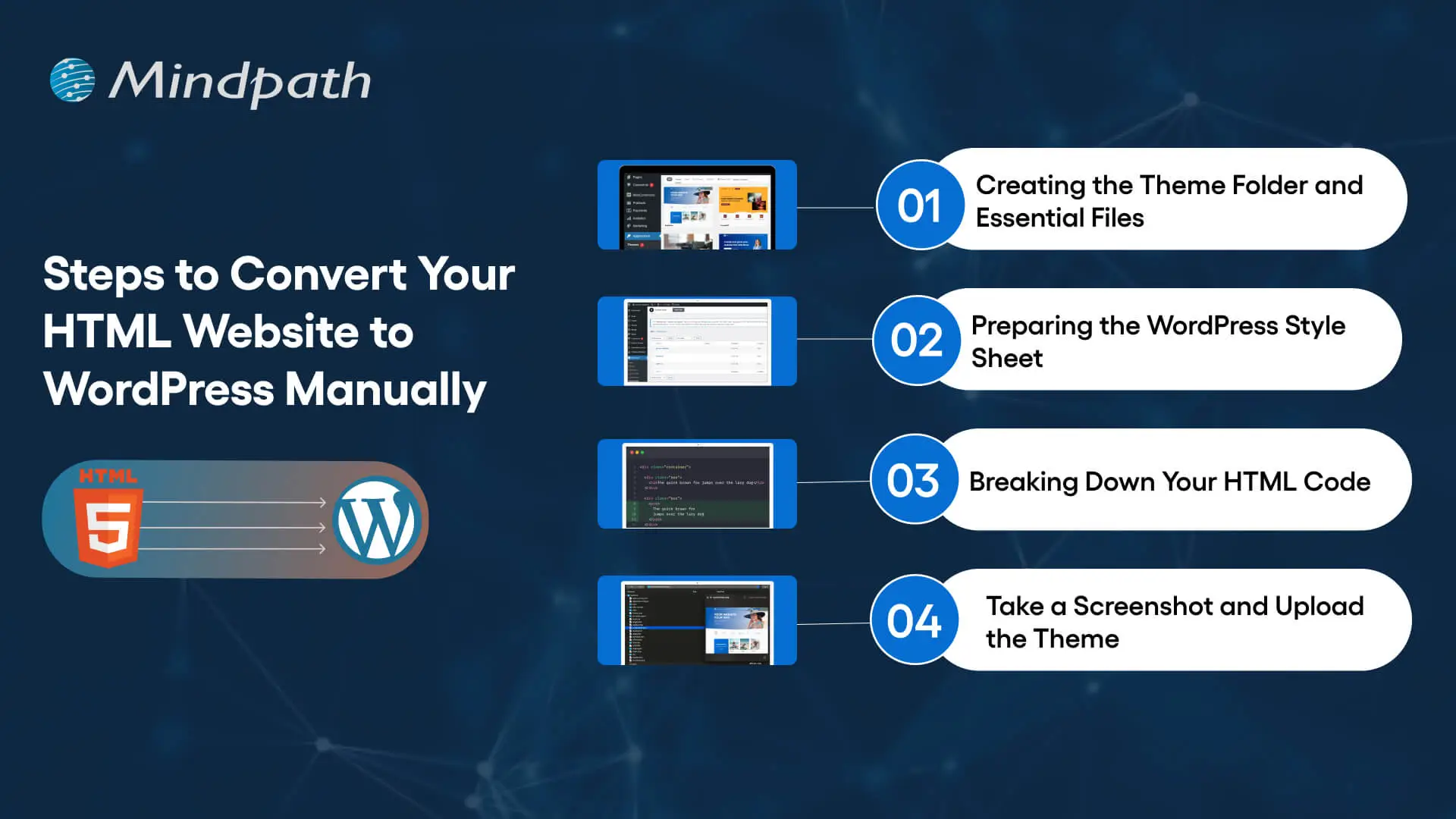
Steps to Convert Your HTML Website to WordPress Manually

Step 1: Creating the Theme Folder and Essential Files

You can begin the conversion process by creating a new theme folder on your desktop. You can follow the same process as you would for creating another directory on your system. Once you have created the theme folder, you can give it a specific name as per your requirements. 

After creating the theme folder, you must open the code editor and create different text files. You can name them as ‘style.css’, ‘index.php’, ‘sidebar.php’, ‘footer.php’, and ‘header.php’. 

The number of files you have to create in this step will depend on the features and design you want in the WordPress theme. You don’t have to do anything else with the files in the code editor now and keep the code editor open as we will need the files in the next step.

Step 2: Preparing the WordPress Style Sheet

You can start the actual preparations for converting your HTML website to WordPress with the WordPress style sheet. Do you remember the ‘style.css’ file you left open in the code editor in the first step? Open it and paste the important details in the style sheet header enclosed within “/*” and “*/”. 

Any guide on HTML to WordPress converter online will focus on the details provided in the style sheet header. The important information included in the style sheet header includes the theme name, theme URI, author name, author URI, description and version. In addition, the style sheet header must also specify license details and tags, which are crucial requirements to add your theme to the WordPress theme directory. 

After providing the essential details in the header, you have to copy and paste the CSS of your HTML website. Make sure that you save the ‘style.css’ file in the theme folder you have created and then close it. 

Step 3: Breaking Down Your HTML Code

One of the most important things you must know about WordPress is that it leverages PHP to extract information from its database. Therefore, you have to break down the existing HTML of your website into different pieces. It will help WordPress put them together in the right way. 

This part of the process of converting HTML to WordPress may seem challenging to beginners. However, it is extremely simple as you have to copy different parts of the HTML document and paste them into different PHP files. Do you remember the PHP files created in the code editor in the first step? They will play a crucial role in this step of the HTML to WordPress conversion process.

You have to open the main file of your HTML website, or ‘index.html’, and copy its content into different PHP files. After copying, you must save the ‘index.php’ file and close it to add the theme to your WordPress website.

Step 4: Take a Screenshot and Upload the Theme

The theme screenshot is a valuable resource that offers a preview of the backend of your WordPress website. It is also important to note that the theme screenshot will also include information from the style sheet header. You cannot convert HTML site to WordPress without knowing how your website works in the WordPress backend. 

Contrary to your assumptions, you don’t have to follow a complex process to take the theme screenshot. You can open the existing HTML site in a browser and take a screenshot with any method you want. After taking the screenshot, you can use an image editing software to crop the screenshot image to 880×660 pixels. Once you save the screenshot as a ‘screenshot.png’ file in the theme folder, you can upload the theme. 

The process to upload your WordPress theme starts with the WordPress Admin Dashboard. You should access the “Appearances” section, where you will find the “Themes” option. Now, you must click on “Add New” and then choose the “Upload Themes” option. Find the theme folder and click on “Install Now,” followed by activating the theme. 

How Will Your WordPress Theme Become More Responsive?

Switching your HTML website to a WordPress theme alone is not enough to get the best results. Anyone who knows how to download WordPress can follow the manual process and get their website on the CMS platform. However, you must also ensure that your website will look good and function seamlessly across all devices. The solution to such problems lies in creating a responsive design, and you can make it happen with a few crucial steps.

First of all, you should choose a responsive framework like CSS or Bootstrap. These frameworks not only save your time but also ensure an effective design that aligns with tested principles. You should also use flexible images to ensure that they don’t pop out of the boxes on mobile devices. In addition, CSS media queries can help you detect small screen sizes, and you should use a mobile menu that offers clean navigation on mobile screens. 

Final Thoughts

You have decided to convert an HTML website to WordPress to capitalize on the benefits of the most popular CMS platform. With big brands choosing WordPress for their websites, it is reasonable to pick the platform for revamping your website. The manual process of converting HTML-based websites to the WordPress theme is extremely simple and easy to follow. At the same time, you must also ensure that your new WordPress website features a responsive design and works effectively on all devices.

Mindpath has been a pioneer in helping businesses transition to WordPress from outdated formats. We are the trusted specialists in WordPress development with a successful record in empowering websites for the modern business landscape. Our expert WordPress developers conduct comprehensive site analysis and develop custom themes that align with your design needs. With Mindpath at your service, you don’t have to worry about content integration or CMS integration. Consult with our experts and switch to WordPress right now.
Related Post

Discover the basics of Large Language Models (LLMs) and how Mindpath can help you build a customized AI solution to enhance efficiency and drive innovation.
Discover the ultimate guide to hiring Node.js developers in London. Learn about the skills, benefits, and cost factors involved in finding the right talent for your project.

Related Post

Build MVP

The success of every business revolves around the products and services they offer to their target customers. Do you know what it takes to build a product that your customers will love and recommend to others? This is where every business, especially startups, must build a MVP to create the best products for their target audience. Building a minimum viable product provides a lean and targeted solution to gain market validation.

Many people must not be familiar with the fact that only one out of ten startups survive beyond ten years. The primary reasons for failure of startups include lack of research, presence in the wrong market and shortage of funds. You can leverage a MVP to find the feasibility of your product idea and strategically transform it into sustainable business. An overview of a step-by-step framework to create a MVP will help you see how simple it is to build one. 

Planning to turn your product idea into a testable MVP? Mindpath offers MVP development services to help startup businesses design and develop MVPs that deliver real user insights.

Why Should You Build a Minimum Viable Product?

The biggest reason for which businesses fail to create a successful product revolves around diving directly into product development. If you invest almost all of your resources in creating a full-fledged product and your customers don’t like it, then you end up with a disaster. Most of the business owners who don’t know the answer to ‘what is an MVP?’ end up facing such situations. The MVP is a primary or the most basic version of the product you want to offer to your customers. It includes only the essential features and functionalities that will help you gain feedback from real users.

Businesses can use their MVP to identify the demand for their product in the target market. The minimum viable product also helps in identifying features that your customers love. As a result, you can ensure that the final product reaches the right market and aligns with your customer’s requirements. Every business owner should create a MVP or minimum viable product to reduce risks and establish the foundation for long-term growth. It not only helps you validate your product ideas but also facilitates efficient resource allocation and earns the trust of investors and stakeholders. 

Ready to launch your MVP without delays? Visit our blog on hiring full-stack developers for MVP to learn how to find developers who can handle both front-end and back-end tasks with ease.

Unraveling the Ideal Framework to Build Your MVP

Any business owner with a product idea must follow a strategic approach to create their minimum viable product. You may assume that developing a MVP might come with a lot of technical complexities that are difficult to navigate. On the contrary, you can use the following steps to find the perfect roadmap to develop a minimum viable product for your business.

1. Identify Your Target Audience and Their Problems

The first step in building your MVP involves knowing your target audience and their requirements. It is important to remember that you are creating an MVP to identify whether your customers will like your product. Therefore, you should start with an understanding of the demographics and pain points of your target customers. 

The insights from market and user research can provide the foundation for developing a product that meets the needs and preferences of your customers. Once you have identified the problems of your target audience, you can decide how you want to solve them with your product. Understanding the requirements of your target customers will help you create a product that provides real value.

2. Leverage the Benefits of Market Research

You can successfully complete the first step of building a MVP by using the most effective approaches for market research. Businesses cannot just guess the problems their target customers might have and build a product based on assumptions. A review of the different examples of minimum viable product will show you that market research is a critical tool in MVP development. Comprehensive market research offers a granular view of the demographics and problems of your target audience. 

The more information you gain from market research, the more accurate your product idea will be. Market research not only helps you come up with the most effective product idea but also shows you what your competitors are offering. As a result, you can find different ways to make your product stand out from the crowd. Business owners should also know that having a strong product idea will help in attracting investors for their product.

3. Establish an Outline of Core Features of Your Product

After finalizing a product idea, you should start defining the core features and functionalities you need in your MVP. All the minimum viable product examples show how you should begin with an outline of basic features that your target market needs. The definition of core features for your MVP provides the ideal start to the process of creating a minimum viable product.

Once you have decided on the core features you want in the MVP, you should think about additional features. At this point of time in MVP development, you must also prioritize the features that you want to include immediately and the ones you can add later. Feature prioritization helps in enhancing the flexibility to define the optimal scope for your MVP development project. 

Must Read: MVP for Startups

4. Develop the Prototype and Your MVP

Many of you might be thinking about the necessity of building a prototype when you can build the MVP directly. The prototype serves as an early version of the minimum viable product and offers a clear impression of how it would work. The basic prototype will help you find how the user interface will look and how users will experience your product. You can also leverage the prototype for early testing and feedback, thereby allowing room for refining the design and functionality of the MVP before full-scale development. 

The successful testing and improvement of the prototype will lead you to your MVP. It is important to ensure that your MVP does not have any bugs and offers the best quality of customer experience. You should know that you have to introduce the MVP to your target users so that they can perceive the core value your product has to offer. During the development of the MVP, you must also specify the timeline and distinct milestones for the project.

5. Introducing Your MVP to Early Adopters

The most crucial step in the process of developing a MVP revolves around introducing it to the target users. Early users of the product can be regular customers or industry experts who represent your target audience and know your target market. Any guide on how to build a minimum viable product emphasizes the need for feedback from early adopters. The feedback from real users helps you determine whether your product is an ideal fit in the target market.

The best approach to ensure that your MVP reaches early adopters is through identifying communities of users. Professional networks, niche forums or social media communities are the top places where you can find the first users for your MVP. You should create open channels, such as dedicated forums or in-app surveys to gain feedback for your minimum viable product.

6. Collecting and Evaluating the Early Feedback

The feedback from early adopters for your MVP serves as a crucial resource to ensure that your product meets the expectations of users. You should use different types of feedback collection methods for your MVP product to obtain qualitative and quantitative data. The notable methods to collect feedback for your minimum viable product include surveys, usability tests and user interviews. 

Once you have collected the feedback, you should categorize it into different aspects of your product. You can use the feedback to learn about usability, performance and functionality of the MVP and identify areas for improvement. Your development team should analyze feedback data comprehensively to understand user preferences and challenges. The insights gained from feedback analysis will guide you through the process of iterative product development.

7. Continuous Iteration and Improvement

Understanding the feedback from early users provides the ideal ground to start refining your MVP according to user expectations. You cannot learn how to build an MVP without focusing on iteration or repeating the development process again. It involves planning, development, testing and reviewing the product repetitively by using feedback from real users. 

Developers can rely on user feedback to address the notable issues in the MVP and enhance its functionality. As a result, iteration serves as a valuable component in the MVP development process to improve the user experience. You should remember that engaging regularly with your target audience and using their feedback can help you achieve the right product-market fit.

Looking to bring your software idea to life without unnecessary delays or costs? Read our blog on MVP in software development to learn how to build, test, and refine your product efficiently.

Final Thoughts

The process to create a minimum viable product for your next big product idea follows a common set of steps. Irrespective of the industry, you can rely on professional MVP development services to translate your ideas into sustainable products. You can start by identifying your target audience and their problems, followed by comprehensive market research, to define the core features of the MVP. Subsequently, your development team can create the MVP and leverage feedback from early users to introduce necessary improvements.

Mindpath is one of the most popular platforms for providing MVP development services, with a successful record in helping various businesses. As a reliable MVP development company, we have helped startups and large corporations test their product ideas before full-scale development. Reach out to us for a free consultation and build your minimum viable product now.

Hiring NodeJS Developers
When hiring a NodeJS developer it’s essential to ensure they possess key technical skills that are fundamental to the role. Here are the core skills to look for:

1. Proficiency in JavaScript

A strong grasp of JavaScript fundamentals is crucial. This includes understanding core concepts like syntax, functions, and event handling, along with modern JavaScript features such as ES6+ (e.g., arrow functions, promises) that improve code readability and efficiency.

2. Asynchronous Programming Knowledge

NodeJS excels in handling multiple tasks concurrently, so developers need to be skilled in asynchronous programming. They should be comfortable using techniques like callbacks, promises, and async/await to perform non-blocking tasks, improving app performance.

3. Understanding of RESTful APIs

NodeJS excels in handling multiple tasks concurrently, so developers need to be skilled in asynchronous programming. They should be comfortable using techniques like callbacks, promises, and async/await to perform non-blocking tasks, improving app performance.

4. Database Handling Expertise

NodeJS developers must be familiar with various database technologies such as MongoDB, PostgreSQL, and MySQL. They should be capable of designing efficient data structures and querying the database effectively to meet the project’s data requirements.

5. Experience with Node.js Frameworks

Experience with NodeJS frameworks, like Express.js, NestJS, or Koa, is valuable. These frameworks streamline development by offering built-in solutions for routing, middleware, and handling HTTP requests, making it easier to build scalable applications.

6. Knowledge of NPM (Node Package Manager)

NPM is essential for managing third-party packages in NodeJS projects. A proficient developer should be familiar with using NPM to install and manage dependencies, ensuring the project remains organized and up-to-date with necessary tools.

7. Effective Error Handling

Proper error handling is essential for maintaining app stability. Developers should know how to catch and manage errors effectively, using techniques like try/catch blocks and logging, ensuring that the application remains reliable and easy to troubleshoot.
At Mindpath we offer a team of expert Node.js developers ready to take on your most challenging projects. With years of experience in building fast, scalable, and efficient applications, our developers specialize in leveraging Node.js to deliver top-tier web solutions. Whether it’s creating real-time applications, managing APIs, or integrating with various databases, we ensure your project is completed on time and within budget. Looking for skilled Node.js developers who can bring your ideas to life? Mindpath offers top-tier Node.js development services, ensuring high-performance, scalable, and reliable applications. Ready out now  to discuss your project needs and see how we can help you succeed!
How much does hiring a ReactJS developer cost? Learn about factors affecting rates, and how to find the best talent within your budget.
AI Safety

Have you ever wondered how artificial intelligence (AI) could impact our lives if left unchecked? As AI continues to evolve, ensuring its safe and responsible use has become a major concern. What exactly is AI safety, and why is it so important for the future? In this blog, we’ll explore what AI safety means and why it’s needed to protect both humanity and technological progress. So, let’s dive in! 

What is AI Safety?

AI safety is the act of ensuring that artificial intelligence (AI) systems function properly without causing damage or creating unexpected risks. It entails developing rules and policies that govern how AI is created, developed, and used. The objective is to avoid mistakes, safeguard customers, and guarantee that AI works as developers planned. AI safety entails ensuring that algorithms are dependable, data is secure, and systems adhere to ethical and legal guidelines. This helps ensure that AI benefits society while posing minimal hazards. 

Why is AI Safety Important?

AI safety is particularly essential because as AI grows more powerful, it will have an impact on many aspects of our life, including how we work, interact with computers, and make decisions. Without adequate safeguards, AI can worsen inequality by favoring specific groups or making unjust decisions based on biassed data. Another important reason for AI safety is to keep AI from being used harmfully, such as distributing misleading information or compromising privacy. By prioritizing safety, we can ensure that AI contributes to the improvement of our environment rather than creating difficulties. This makes AI safety essential for creating a better, more equitable future for everyone. 

Best Practices for Ensuring AI Safety

AI Safety Best Practices

1. User Education and Training

Teaching individuals responsible AI development is essential for ensuring their safety and effectiveness. This training should include how to use the AI appropriately, identify possible hazards, and learn how to prevent them. When consumers understand how AI works, they can use it responsibly and promptly identify any concerns that require reporting. Trained users are also better able to offer useful feedback, which can aid in the AI’s effectiveness. They can offer improvements, report errors, and confirm that the AI is operating properly. This produces a cycle of continual development, gradually increasing the AI’s reliability.  Furthermore, user training fosters a sense of responsibility and awareness, lowering the risk of unintentionally abuse or security breaches. Organizations that engage in user education guarantee that their AI systems are not only appropriately utilized, but also safer and more effective in the long term. 

2. Comprehensive Incident Response Strategies

Developing robust incident response procedures is essential for dealing with AI safety problems promptly and efficiently. These strategies should contain specific actions for recognizing, reporting, and responding to any events or breaches that occur. A well-defined response strategy enables organizations to quickly isolate and resolve problems, limiting potential harm while preserving the system’s security and reliability. Organizations can secure their AI systems while still maintaining user confidence by being prepared.   

A thorough incident response plan should also include frequent team training and simulations to ensure that everyone understands their roles and responsibilities during an event. This proactive attitude promotes confidence and readiness to deal with unanticipated problems successfully. 

It is also important to evaluate and update response plans on a regular basis, taking into account new threats and learning from previous catastrophes. Organizations can improve their reaction tactics over time by taking feedback into account and adjusting to the changing environment of AI hazards. 

Furthermore, good communication throughout an event is crucial. The strategy should contain procedures for notifying stakeholders, users, and regulatory organizations of any breaches or safety issues. Transparent communication promotes confidence and reassures users that the organization is treating the matter seriously. 

3. Frequent Audits and Compliance Reviews

Conducting frequent audits and compliance checks is essential for guaranteeing AI safety. These audits should evaluate Artificial Intelligence systems to ensure that they meet established safety standards, ethical norms, and regulatory requirements. By completing these assessments on a regular basis, organizations can find possible hazards and areas where they may not be compliant, allowing them to make required modifications and improvements swiftly. 

These audits not only assist in detecting flaws, but they also encourage accountability and openness inside the organization. They urge teams to take AI safety seriously and make sure that everyone understands the necessity of following standards. 

4. Data Confidentiality

Data confidentiality is a crucial strategy for ensuring privacy in AI operations. This method entails eliminating personally identifying information (PII) from data sets, rendering it hard to link data back to people. Techniques like k-anonymity, differential privacy, and synthetic data creation are frequently employed to safeguard individual privacy while still making the data relevant for training and analysis. 

Organizations can use anonymized data to build AI models while protecting user privacy. Users will feel more confident knowing their personal information is secured, which helps to create trust. Furthermore, anonymized data can comply with numerous privacy standards, allowing organizations to avoid legal concerns while still gaining important insights. 

5. Secure Development Lifecycle

A secure development lifecycle (SDL) is essential for assuring AI safety. This strategy incorporates security precautions into all stages of AI development, from planning and design to implementation, testing, and deployment. This lifecycle’s key practices include undertaking security risk assessments, adhering to secure coding standards, and thoroughly testing to find and fix vulnerabilities. 

Organizations that include security throughout the development process can spot possible concerns early and mitigate risks before the AI system goes live. Furthermore, security measures must be updated on a regular basis to respond to new threats and technological advancements. This proactive strategy not only contributes to the development of safer AI systems, but it also improves general technological reliability and confidence. 

6. Cross-Disciplinary Teams

Utilizing cross-disciplinary groups in AI research is essential for improving AI safety by providing a varied variety of viewpoints and experience. These teams should include professionals from a variety of domains, including ethics, psychology, law, and particular industrial areas, as well as AI experts. This variety is essential for addressing the difficult issues of AI safety because it assures that the systems built are not just technically strong, but also socially responsible and ethically sound. 

Cross-disciplinary groups can detect possible concerns that people focused primarily on technical elements might have ignored. This collaborative approach fosters a more thorough grasp of the implications of AI systems, resulting in better decisions and more deliberate solutions. 

AI Safety with Mindpath

Mindpath is committed to ensuring the safety and security of AI. Our approach is focused on ensuring that AI systems function effectively and do not cause harm. We take significant precautions to secure users and data, ensuring that everything is handled appropriately. We give training to users to assist them understand how to utilize AI safely. Our teams comprise specialists from several domains, including ethics and technology, to ensure that we cover all elements of AI safety. 

We periodically check our systems to detect possible hazards and enhance our procedures. We also employ techniques such as data confidentiality to safeguard people’s personal information. By following a secure development methodology, we ensure that safety is included in every stage of the AI creation process. 

Final Thought!

In a society dominated by artificial intelligence, understanding and prioritizing AI safety is essential for establishing a responsible technology environment. As previously discussed, successful AI safety measures include user education, robust incident response techniques, frequent audits, data confidentiality, a secure development lifecycle, and collaboration among cross-disciplinary teams. 

At Mindpath, we are committed to following these guidelines, ensuring that AI systems not only function well but also adhere to the highest safety and ethical standards. We hope to increase trust and confidence in artificial intelligence technology by taking proactive actions to reduce risks and secure user data. As we traverse the difficulties of AI development, our dedication to safety will play an important part in defining a future in which AI serves as a beneficial force for society, empowering individuals and promoting equitable progress. 

Curious about how Mindpath can enhance your AI safety?

At Mindpath, we prioritize responsible AI development to protect users and data.

Discover the significance of AI safety and best practices for responsible development, including user training and data privacy measures.