10 Signs Your Business Needs a Custom Web Application 

Join our Newsletter!

Featured Posts

Support Is One Click Away

Home

10 Signs Your Business Needs a Custom Web Application 

Custom web application development

10 Signs Your Business Needs a Custom Web Application 

A growing business often reaches a point where off-the-shelf solutions no longer match its unique needs. Right? This is where custom web application development comes in. It gives you the web applications that work exactly the way you want them to, based on your specific requirements. Think about how much easier your daily operations would be if every feature were custom-made based solely on how your team works day to day, rather than trying to adapt to a generic application. It happens when technology becomes more than just a tool or a utility and partners with you to scale with your business.

Over time, certain changes in daily operations start to hint that your business might benefit from such a tailored solution. While these changes often seem subtle, they show up as your team performs operations, handles data, or relates to customers. When the shifts appear, it is highly likely that operational efficiency, productivity, or growth will be impacted. Understanding these signals can help you determine the proper time to invest in a strategy that is specifically built to suit the needs of the business.

Every business challenge needs a custom solution. Look how Mindpath’s custom web app development services resolve the issues and support businesses to convert unique needs into powerful digital tools.

What are Custom Web Applications?

Custom web application development for business means you’re building software that is specific to a business’s needs. This means instead of general tools that are often not specific to the goal of the software, you can tailor the application to a business’s workflows and goals, thus providing better efficiency and customer experience. In short, a custom web application for business will be able to manage data, create automation, provide reporting, and centralize operations. This process will result in a secure, scalable solution that supports the overall growth of the business.

Developers choose programming languages, frameworks, and tools relevant to particular project requirements. They communicate with the business to understand the challenges while integrating within the existing systems. During the web application development, the team regularly checks for progress and verifies if everything is aligned, keeping the cost, time, and risk to an acceptable level. The result is a working, well-designed, reliable application that the business finds intuitive, enhances the business, and can adapt as the business grows.

Also Read: Web Design Company

Benefits of Custom Web Application Development

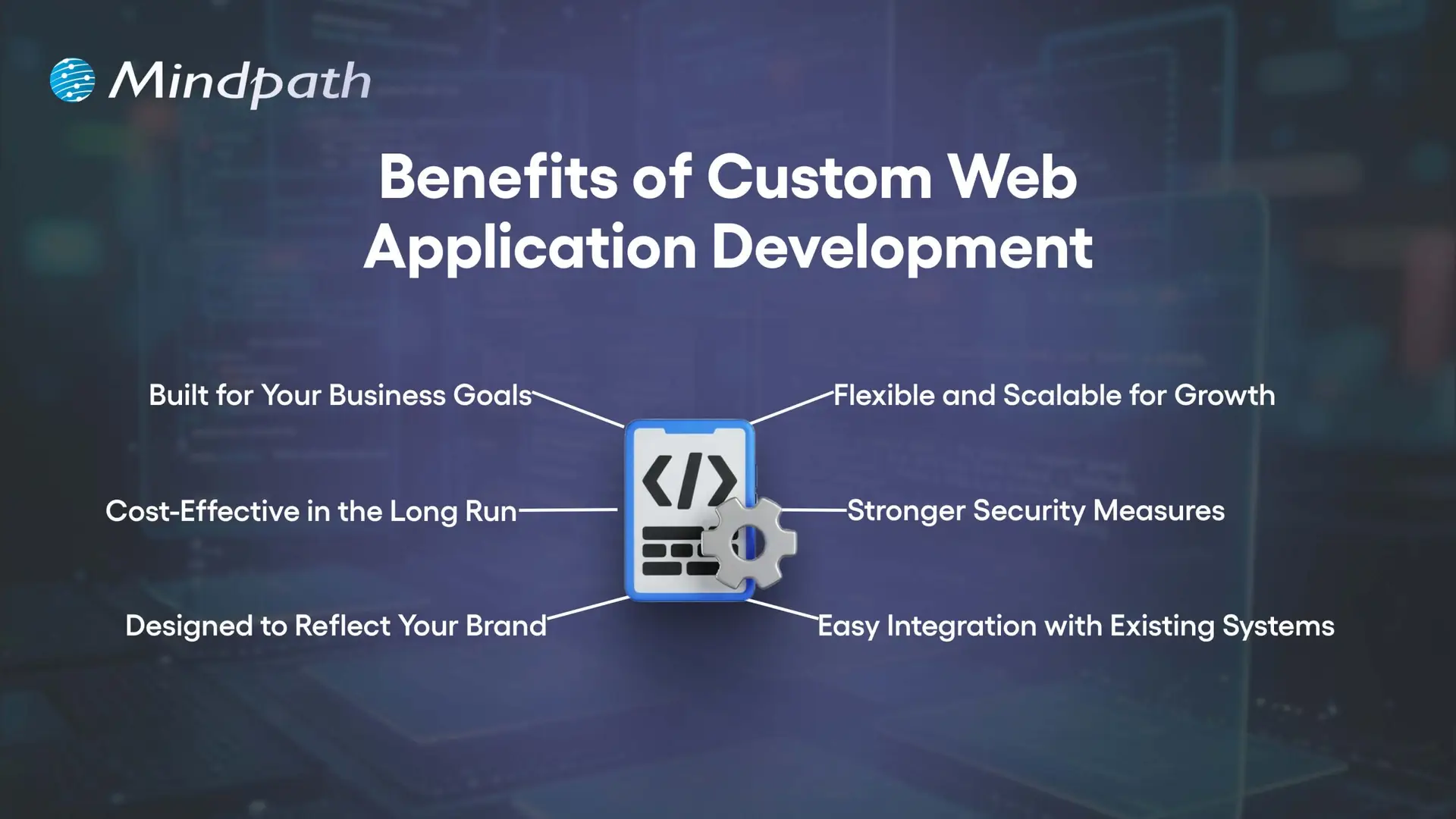
Knowing the custom web application benefits can help you understand how the proper solution can have an impact on how you work. When considering why to build a custom web application, it is usually due to the fact that it can fit your precise requirements, allow you to work more efficiently, and facilitate growth. It is a strategic investment that will provide a return reflecting your investment and your growth aspirations.
Benefits of Custom Web Application Development

1. Built for Your Business Goals

When you use Custom web application development, you have every feature custom development to suit your needs. This makes integrating workflows easier and an easier experience for your employees.

2. Cost-Effective in the Long Run

A custom solution takes out the licensing fees and unnecessary features, which will save you in the long run. You can also reduce some infrastructure and hardware costs if you are going to outsource the development, too.

3. Designed to Reflect Your Brand

Custom web app development allows you to create every aspect of the application, to your brand’s identity. It can give your application a customized, professional, and unique identity that users will definitely recognize.

4. Flexible and Scalable for Growth

Custom-built applications will grow with your business and meet new demands. You will be able to add new features, accommodate increased traffic and usage, and still have a smooth performance.

5. Stronger Security Measures

Security is a key feature of Custom web application development, ensuring that your business is safe from common cyber threats. Custom apps will be fun to breach and take over than commercial apps found on the market.

6. Easy Integration with Existing Systems

Custom web applications will integrate easily with your current systems and databases. This allows you to keep data synchronized, accurate, and consistent across all platforms.

Choosing a custom web application is a strategic business decision! Discover web development trends to ensure your development strategy aligns with current and future digital demands.

10 Signs Your Business Needs a Custom Web Application

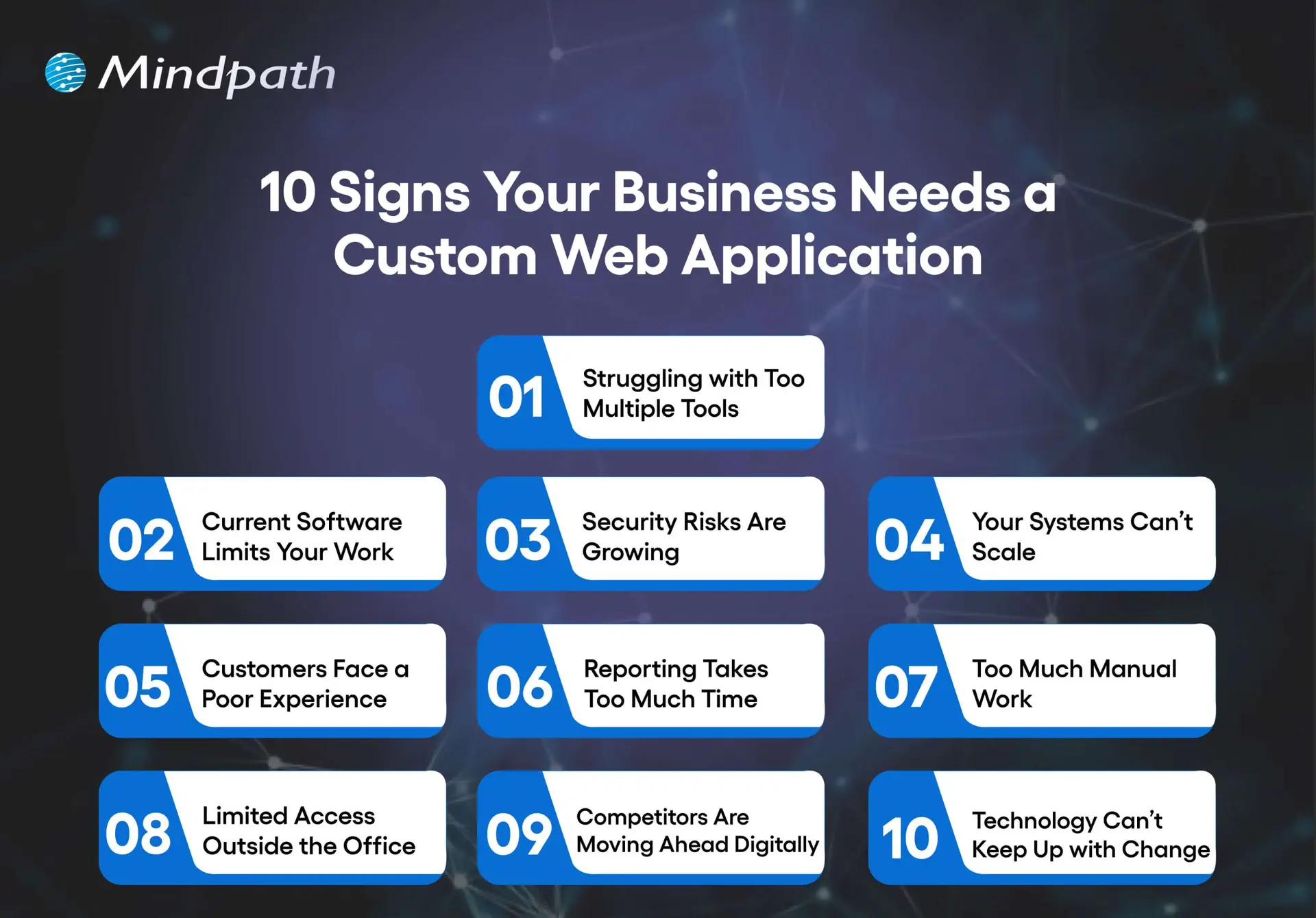
As businesses change, many times their needs exceed what generic software can deliver. Knowing the signs that you need a custom web application will allow you to reduce the damage that can happen before inefficiencies grind your business down.
10 Signs Your Business Needs a Custom Web Application

1. Struggling With Too Many Tools

Switching between spreadsheets, emails, and multiple apps slows work and causes mistakes. A custom web app centralizes your operations in one platform for better efficiency.

2. Current Software Limits Your Work

Generic software forces you to adjust your process to fit its features. Custom web application development creates solutions that match your exact workflows.

3. Security Risks are Growing

Using outdated systems leaves sensitive data exposed. A custom web app includes strong security controls, encryption, and adheres to all industry standards.

4. Your Systems Can’t Scale

Organizations evolve. As your business grows, so should your tools increase their users, data, and functionality. Custom software is built to scale without performance issues.

5. Customers Face a Poor Experience

Using slow, outdated, or limited platforms can leave users frustrated. A custom web app will provide users with modern interfaces, fast service, and customized experiences.

Also Read: Custom Website Development Services

6. Reporting Takes Too Much Time

If your reporting is done manually, or it takes too long to collect and analyze, it will limit your decision-making. Custom web apps will provide real-time dashboards and allow for instant self-serve reporting.

7. Too Much Manual Work

When staff are tied up with repetitive data entry or repetitive tasks, it is hard to be productive. A custom application can be built with automation features to allow staff to concentrate on high-value opportunities or higher-skilled work.

8. Limited Access Outside the Office

If your employees can’t easily access your systems while off-site or, even worse, don’t have access to them at all, your flexibility is limited. A custom web application can be secured and hosted in the cloud, allowing staff to work from anywhere.

9. Competitors Are Moving Ahead Digitally

If you’re used to out-of-date tools and systems, keeping up will mostly be impossible. Custom web application development will give you the opportunity to develop useful features that are unique to your organization.

10. Technology Can’t Keep Up with Change

If your business pivots, expands, or introduces new services, the old systems won’t accommodate this change. Custom applications allow you to adapt to these opportunities, adding integrations, and are designed with flexibility.

Wondering what comes next after deciding to build a custom web application? Explore the web app development roadmap to gain clarity on development stages, timelines, and technology choices.

Ready to Build a Solution That Fits Your Business?

A growing business needs tools that adapt to its pace, processes, and vision. Custom web application development delivers tailored solutions that improve efficiency, strengthen security, and enhance customer experience. Recognizing the signs early allows you to invest in a platform that aligns perfectly with your goals and supports sustainable growth.

At Mindpath, our Custom web application development services create secure, scalable, and user-friendly platforms that integrate seamlessly with your operations. We focus on understanding your unique workflows and delivering features designed to simplify tasks, automate processes, and empower your team. The result is technology that becomes a true partner in your business journey.

Related Post

Discover how AutoML simplifies machine learning for businesses. Learn about its benefits, including cost savings, accuracy, and faster deployment.
Explore how digital transformation reshapes businesses, boosts efficiency, enhances customer experiences, and drives sustainable growth for success.

Related Post

Web performance with Nodejs

For many organizations that are seeking speed, scalability, and smooth user experiences, improving web performance with Node.js has become a top priority. Users today expect web applications and websites to be fast, responsive, and dependable. Users expect applications and websites to basically load instantaneously, be able to process many requests at the same time, and to be reliable during sudden traffic spikes. If an application lags or is slow, the user is quick to move on. In today’s modern development landscape, this is precisely why Node.js can be a game-changer.

Node.js is unique because it combines performance, flexibility, and real-time capabilities all in one environment. Developers can create performant applications while maintaining speed and availability, all at a lower cost to the business, which improves customer satisfaction. Isn’t that exactly the target for every brand today? When speed meets stability, natural growth occurs. Therefore, Node.js development could be a wise way to improve overall web performance. We will elaborate on how it can help you gain results in this blog.

Looking to enhance your web application performance to deliver speed and scalability? Mindpath’s Node.js development services will help you achieve business goals by developing high performing solutions.

How Node.js Powers High Web Performance?

Web performance with Node.js is optimal due to its structure and technical advantages. Node.js operates using a non-blocking, event-driven I/O model that allows applications to handle many requests at once and is able to execute tasks without waiting for one to complete before the next begins. When unauthorized, the single-threaded event loop cycles through the tasks, executing code sequentially while managing multiple or concurrent tasks. The V8 JavaScript engine makes Node.js fast by compiling JavaScript into machine language, allowing user more response to real-time tasks in their application. With the speed, responsiveness, and efficiency of Node.js, it is best suited for I/O-heavy and data-driven applications.

A second important reason why Node.js drives web performance optimization is that its ease of scalability, combined with real-time capabilities, handles thousands of concurrent connections seamlessly, which leads to the development of fast and interactive solutions. Developers can scale their application both horizontally and vertically and develop features and solutions while obtaining the best performance possible. Node.js supports real-time applications that incorporate instant messaging, gaming, and webpages that require live updates. The ability to provide immediate responses provides users with reliable experiences and, in turn, could effectively lead to stronger performance results.

Key Benefits of Enhancing Web Performance with Node.js

Enhancing the performance of web applications is critical for providing an experience that is fast, scalable, and reliable. Node.js has unique benefits that make it a strong candidate for crafting optimized solutions.

Key Benefits of Enhancing Web Performance with Node.js

1. Speed Drives Results

Node.js provides unparalleled speed with its event-driven, non-blocking I/O model, which allows applications to handle multiple requests simultaneously. This means faster response for multiple incoming requests, despite how much traffic the application will be dealing with. Companies that rely on real-time interactions benefit from significant overall web app performance.

2. Productivity Boost for Developers

The single-threaded, event-driven design of Node.js is incredibly fast, efficient, and allows for development to move quickly. Teams can build fully interactive solutions like chats, live streams, and collaborative tools in one simple app, as opposed to other methods that are more complicated. When businesses hire Node.js developers, they can create productivity advantages that let them get the products into the market faster, hence improving web performance with Node.js.

3. Smarter Error Management

Node.js offers robust error-handling mechanisms for developers built into its framework. Developers can readily catch and process errors during runtime. This allows applications to be much more stable, thus improving reliability; all of this while enhancing the user experience regardless of the environment.

4. Cost-Effective Development

Node.js lowers the needed infrastructure with lower resource needs, while still accommodating high load needs. Business savings include operating costs such as licenses, maintenance contracts, and hardware upgrades. Such cost mitigation makes Node.js development services appealing to enterprises that prioritize long-term value.

5. Faster Development Cycles

Developers let you quickly create applications with Node.js, especially when developers are creating modular and reusable code. Node.js is normally used in conjunction with Node.js micro services, allowing smaller microservices to work well together as part of larger systems. This allows for quicker launches of applications and provides for easier updates to accommodate changing business requirements, while enhancing web performance with Node.js.

6. Strong in Low Network Conditions

Node.js handles slow or unstable networks efficiently. The asynchronous nature of Node.js allows each request to be immediately started without waiting, which results in helping to get rid of lags. This particular stability allows organizations to focus on delivering the best possible digital experience to users under various conditions.

7. Scalable Applications Made Simple

One of the primary benefits of Node.js is scalability, which is suitable for applications where demand is unpredictable. Developers can grow horizontally by using more instances or vertically by using better resources. A model of growth with both horizontal and vertical scaling provides growth where sustainability is the framework for implementation, resulting in Node.js performance.

8. Full-Stack Flexibility

JavaScript provides the opportunity for end-to-end development and client-side and server-side programming with Node.js. With good performance, full-stack developers can build responsive and dynamic web applications. Using Node.js allows organizations to realize efficiencies in their processes and provide similar experiences across their clients’ ecosystems.

Want to enhance your web performance with full-stack development? Learn how to build fast and reliable applications by reading our blog on Mastering Full-Stack Development with Node.js.

Role of Node.js in Increasing Web Performance

Node.js contributes significantly to building applications that are fast, scalable, and dependable. Its architecture allows developers to build solutions that are responsive and can handle a high volume of requests and traffic.

Role of Node.js in Increasing Web Performance

1. High Request Handling

Node.js accepts multiple requests simultaneously and does not wait for one request to finish before handling another. These attributes contribute to fast and responsive applications, especially important in real-time services like chats and streaming.

2. V8 Engine Speed

The platform utilizes the Google V8 engine to compile JavaScript into machine code. This improves performance by optimizing execution speed, which also indirectly improves the performance of web apps.

3. Efficient Event Loop

Node.js utilizes its event loop to manage asynchronous tasks, such as a file read or a database query. In this way, the server will never get stuck while waiting, which keeps applications smooth and seamless.

4. Unified Language Stack

Using JavaScript for both the front and back end simplifies the development process. In addition, it allows for improved code optimization and helps with better web performance with Node.js.

5. Scalable Microservices

Node.js allows for microservices, which break large applications into smaller, independent parts. Microservices make applications easier to scale and makes it easier to optimize for specific components.

6. Real-Time Power

For applications that need live updates, such as analytics tools or online games, Node.js is a great choice. It improves overall web performance with Node.js because it can handle multiple connections simultaneously.

Boost your Node.js application speed and efficiency by using the right tools. Check out the Top 25 Node.js Libraries in 2025 and take development to the next level.

Ready to Boost Your Web Performance with Node.js?

Node.js has shown its strength by improving speed, scalability, and reliability in modern applications. Through real-time features, effective architecture, and even inexpensive scalability, it can build digital experiences that users actually enjoy. Organizations that want to improve customer satisfaction can invest in Node.js to improve their chances of long-term success in competitive markets today.

At Mindpath, we are known to provide professional Node.js development services across globe, designed to develop scalable, high-performing solutions. When you hire Node.js developer teams with us, you tap into dedicated professionals who specialize in faster, secure, and business-ready apps. Our approach is to combine technical skills with business goals to ensure our clients achieve seamless performance, making meaningful growth with Node.js.

Unlock the power of Node.js to boost web performance and scalability. Learn how Node.js development services can transform your web app.
Generative AI Use Cases in Diverse Industries

“Necessity is the mother of invention.” We have all encountered this phrase in our science textbooks or while reading about most scientific innovations. Be it the invention of the cell phone, the internet, or the World Wide Web, each of these has brought a paradigm shift in the world of technology.  

While technology is rapidly expanding its horizon, Artificial Intelligence remains the buzzword that every business can’t stop gushing about. Generative AI, a subfield of artificial intelligence, has gained massive momentum post the launch of ChatGPT by OpenAI in 2022. Since then, generative AI use cases have found their way in some of the major industries, including healthcare, banking & finance, gaming, and supply chain, to name a few, marking the beginning of the Gen AI revolution.

But what is Generative AI? Is it only limited to text or image generation, or can it help in other fields as well? In this blog, we will be answering some of the burning questions around Generative AI and generative AI use cases across industries.  

Want to implement cutting-edge GenAI solutions in your company? Mindpath offers end-to-end AI Development Services for deploying generative AI applications efficiently.

Introduction to Generative AI 

Let’s start with the basics: what is Generative AI? A magic lamp that fulfils all your wishes; well, almost! Generative AI uses a pool of data that includes text, images, code, etc., amongst other data types.  

With the help of machine learning models and neural networks, this large sum of data gets analyzed, patterns are discovered, and output is delivered. Generative AI, as it says, is not limited to analyzing the data, but creates new information such as content, images, videos, and even code.  

Also Read: Top GenAI Trends 

Here are some of the key components of Generative AI:  

key components of Generative AI

  1. Data: Raw data such as documents, eBooks, ledgers, images, videos, codes and a lot more that Generative AI uses to learn.  
  2. Neural Network Models: They work just like a human brain; they help AI models to make sense of all the raw data we have put in the model.  
  3. Training and Model Parameters: There are some parameters that help AI models fine-tune the information, cut the noise and generate accurate output.  
  4. Input: When you ask a Gen AI model to create a cover letter for a job, create a report based on Excel data, generate a Ghibli image to roll with the current trends, that’s categorized as an “input”.  
  5. Output: Whatever results a Gen AI model, such as ChatGPT, MidJourney, Bart, delivers for your query is the output.  

Generative AI is gaining momentum, with a global market valued at USD 37.89 billion in 2025 which is projected to reach USD 1,005.07 billion by 2034 at a CAGR of 44.20%. (Source: Precedence Research)

Generative AI Use Cases Across Industries 

While Gen AI is growing, curating a business-first roadmap for its adoption is important for those seeking to leverage it to its fullest advantage.  Now that we have explored what Generative AI is, let’s move on to some prominent generative AI use cases in different industries, proving that it’s more versatile than we know!  

1. Healthcare 

According to a recent survey by Deloitte Center for Health Solutions, 75% of leading healthcare companies across the globe are either currently experimenting with generative AI or planning to scale Gen AI in the near future.  

In what area, you may wonder? Generative AI healthcare is being used to maintain patient records, drug discovery, interpreting and analyzing medical images such as X-rays, CT scans, MRIS, to mention a few.  

Scientist are using generative AI for modelling molecular structures that can help not just in creating new drug compounds but also in predicting their effectiveness.  

92% of healthcare leaders see a promising future of generative AI in improving efficiency as well as speeding the decision-making in critical scenarios.  

2. Banking  

Next up is the banking and finance industry. Generative AI in banking is fueling the fintech revolution in more ways than one. Generative AI is currently being leveraged for detecting fraud, assessing the credit score or credit risk based on the creditworthiness of an individual or an entity, customer support, automating routine tasks and compliance checks, creating investment strategies, among others.  

A recent report by KPMG revealed that around 76% of banking executives in the United States are planning to implement Gen AI for fraud detection and prevention, while 62% want to leverage it to improve their customer service, followed by 68% of professionals that believe Gen AI can be best used for regulatory compliance.  

3. Gaming  

One of the most exciting areas for generative AI applications could be gaming. According to Statista, over one-third of game developers across the globe are already using Gen AI tools in their studios. PCG, which stands for Procedural Content Generation, is the largest segment of the gaming industry where almost 30% gen AI is being used currently. PCG helps game developers create larger than life game world, environment and universe that intrigues the players and gives them a more immersive experience.  

Other than PCG, some other significant generative AI use cases in gaming include developing characters, detecting bugs, generating real-time content like new levels and challenges, and detecting any kind of irregularities or security breaches or threats.  

Wondering how AI can help your business to reach the exceptional level of growth? Read our blog to learn about the importance of generative AI for business.

4. Supply Chain 

When it comes to adopting Gen AI, the supply chain industry is no stranger to it. In fact, McKinsey’s survey revealed that a third of global businesses are effectively using generative AI in business areas, including operation processes automation (66%), production planning and scheduling (47%), quality control and inspection (44%), and inventory management (43%).  

Gen AI can support the supply chain industry with better demand forecasting, optimizing day-to-day operations, assessing and controlling supplier risks,  quality control, fraud detection, and much more!  

 5. Other Industries 

Apart from the above-mentioned industries, use cases of generative AI are prevalent in other industries such as sales and marketing, insurance, legal and compliance, human resources, product development, and many more.  

While many still utilize gen AI for content, image and code generation, the applications are certainly above and beyond. However, leveraging gen AI comes with its own set of challenges. Being AI-ready is in demand for every industry and business seeking to adapt and leverage AI to its advantage. There’s no one-size-fits-all guidebook or roadmap for AI adoption; rather, each business and industry needs to understand its niche and create a roadmap that generates true value.  

Wondering how generative AI is influencing content creation and design strategies? Check out our blog generative AI changing creative industries  to see how AI-driven creativity is shaping the future of industries.

Ready to Embrace Innovation with Generative AI?

Generative AI is expanding its horizon, and businesses have started to realize its true potential. While Gen AI continues to grow, it’s critical to assess all of its aspects that involve data security, lack of information, and overdependence.  

Businesses looking to adapt AI must look beyond the hype and create a strategy that works for them. At Mindpath, we help businesses create solutions that are based on their real pain points rather than creating just another software. When you talk to us, we attempt to understand your operations and what may work to make them more efficient.  

Our customer-first approach helps us identify gaps and curate a solution that works for you. Thus, if you’ve been wanting to adopt AI, the right time is now! Let’s discuss how our AI development services can help you make the best of up-and-coming technologies and get your business future-ready!  

Frequently Asked Questions

1. Why are generative AI use cases expanding so quickly across industries?

Generative AI use cases are expanding because businesses need faster innovation, better decision-making, and automation at scale. The technology can process vast datasets and generate meaningful outputs, helping industries respond quickly to market changes while improving efficiency, accuracy, and customer experience.

2. How can companies identify the right generative AI use cases for their industry?

Businesses should start by analyzing operational challenges, repetitive workflows, and data-heavy processes. The most effective generative AI use cases solve real business problems rather than following trends. A clear roadmap, measurable goals, and strong data infrastructure help ensure successful adoption.

3. Is generative AI suitable for regulated industries?

Yes, but with caution. Regulated industries like healthcare and finance must ensure data privacy, compliance, and transparency. Proper governance frameworks, human oversight, and secure infrastructure are essential to safely implement AI solutions without violating regulatory standards.

4. What skills are required to implement generative AI in an organization?

Organizations need a mix of AI engineers, data scientists, domain experts, and cybersecurity professionals. Beyond technical roles, leadership must understand strategy and change management. Training employees to collaborate with AI tools is equally important for long-term success.

5. What risks should businesses consider before scaling generative AI solutions?

Key risks include data bias, security vulnerabilities, inaccurate outputs, and overdependence on automation. Businesses should validate AI-generated results, maintain human supervision, and establish ethical guidelines. A balanced approach ensures innovation without compromising reliability or trust.

Node.js Developers in Canada

Are you looking for a skilled Node.js developer in Canada to bring your project to life? Do you need a reliable expert who can build fast, scalable, and high-performing applications? Finding the right developer can be challenging, but with the right approach, you can hire a top Node.js professional who fits your needs perfectly.  

Hiring a skilled Node.js developer in Canada is essential for businesses looking to build fast, scalable, and efficient applications. With its non-blocking architecture and real-time capabilities, Node.js is a powerful choice for web and software development. Whether you’re developing a dynamic website, an API-driven platform, or a complex enterprise solution, finding the right developer ensures seamless performance and long-term success. Understanding the key factors in hiring a Node.js expert will help you make an informed decision and achieve the best results for your project. 

Let’s explore how you can make the best choice! 

Steps to Hire Node.js Developers in Canada

1. Define Your Project Requirements

To hire the right Node.js developer, you must first define your project’s technical and business needs. Outline the core functionalities, expected performance, and scalability requirements of your application. Identify the frameworks and tools you want to use, such as Express.js, Nest.js, or MongoDB, and specify whether the role requires front-end expertise alongside back-end development. Additionally, determine the level of experience required—junior developers handle basic tasks, mid-level developers work on feature-rich applications, while senior developers manage architecture and complex integrations. Having a well-documented project scope ensures that candidates understand your expectations from the start. A detailed job description outlining skills, responsibilities, and project goals will help attract the right talent. Without clarity, the hiring process can become inefficient, leading to mismatches in skills and expectations. A structured approach helps filter candidates early and ensures that only those with relevant expertise apply.

2. Source Qualified Candidates

Finding skilled Node.js developers in Canada requires using multiple recruitment channels. Start by posting job listings on platforms like LinkedIn, Indeed, and Glassdoor, which are popular among Canadian job seekers. Consider using tech-specific job boards such as Stack Overflow Jobs or GitHub Jobs to target professionals with strong development experience. Additionally, networking within Canada’s growing tech community can help you connect with skilled developers—attend industry conferences, local meetups, and online forums to discover potential candidates. If you prefer a more streamlined approach, working with tech recruitment agencies can save time by providing pre-screened candidates. Another option is hiring freelancers through platforms like Toptal or Upwork but ensure that remote hiring aligns with your business needs and legal considerations. A strong sourcing strategy increases the likelihood of finding a developer who meets both your technical and cultural requirements, ensuring a smoother hiring process. 

3. Conduct Technical Screening

After gathering applications, the next step is to assess candidates based on their technical skills and experience. Start with a resume review, focusing on past projects, relevant experience, and familiarity with the required Node.js frameworks. Candidates should demonstrate hands-on experience in building scalable applications, working with APIs, and optimizing back-end performance. To ensure technical proficiency, conduct coding assessments through platforms like HackerRank or Codility. These tests evaluate problem-solving abilities, efficiency in writing clean code, and understanding of Node.js fundamentals. Additionally, assess candidates’ experience with database management, security best practices, and cloud-based deployments. An effective screening process filters out underqualified applicants early, allowing only the most capable developers to move forward. By implementing structured assessments, you can streamline hiring and ensure that your chosen developer has the technical expertise necessary to contribute effectively to your project. 

4. Assess Technical and Problem-Solving Skills

Once candidates pass the initial screening, conduct in-depth technical interviews to evaluate their problem-solving abilities. Ask questions about key Node.js concepts such as asynchronous programming, event-driven architecture, API development, and database management. Provide real-world scenarios related to your project and assess how they would approach challenges. A practical coding exercise or take-home assignment can help evaluate their thought process and coding efficiency. In addition to technical expertise, consider their ability to design scalable solutions and optimize application performance. Discuss their experience with DevOps practices, cloud computing, and microservices architecture if relevant to your project. Soft skills are equally important—effective communication, adaptability, and teamwork play a significant role in long-term success. The goal is to hire a developer who not only writes efficient code but also collaborates well with your team and adapts to evolving project needs. 

5. Make the Right Hiring Decision

After evaluating technical skills, problem-solving abilities, and soft skills, the final step is making an informed hiring decision. Compare candidates based on performance in technical interviews, problem-solving assessments, and cultural fit. Strong communication and teamwork are crucial, as developers often collaborate with designers, project managers, and other team members. Additionally, check references to validate past work experience and reliability. When making an offer, consider industry-standard salaries in Canada and ensure compliance with local labor laws. Offering a competitive package, including professional development opportunities and flexible work arrangements, can help attract top talent. If hiring full-time isn’t feasible, explore freelance or contract-based options. A well-structured hiring process ensures you bring in a skilled Node.js developer who aligns with your technical needs and business goals, setting your project up for long-term success. 

Looking to hire top Node.js developers in Canada? At Mindpath, we provide skilled developers who specialize in building high-performance, scalable applications tailored to your business needs. Whether you need full-time developers or project-based support, our experts ensure seamless development with industry-leading technologies. 

Let’s bring your vision to life! Contact Mindpath today to hire the best Node.js talent for your next project. 

Read our next blog: Factors to Consider While Hiring NodeJS Developers in Canada 


Hire skilled Node.js developers in Canada with our step-by-step guide. Learn how to source, screen, and hire top talent for your project.