
Latest Insights On
GenAI, Tech, and Digital Transformation
Stay updated with expert insights, success stories, and real-world applications of cutting-edge technology.
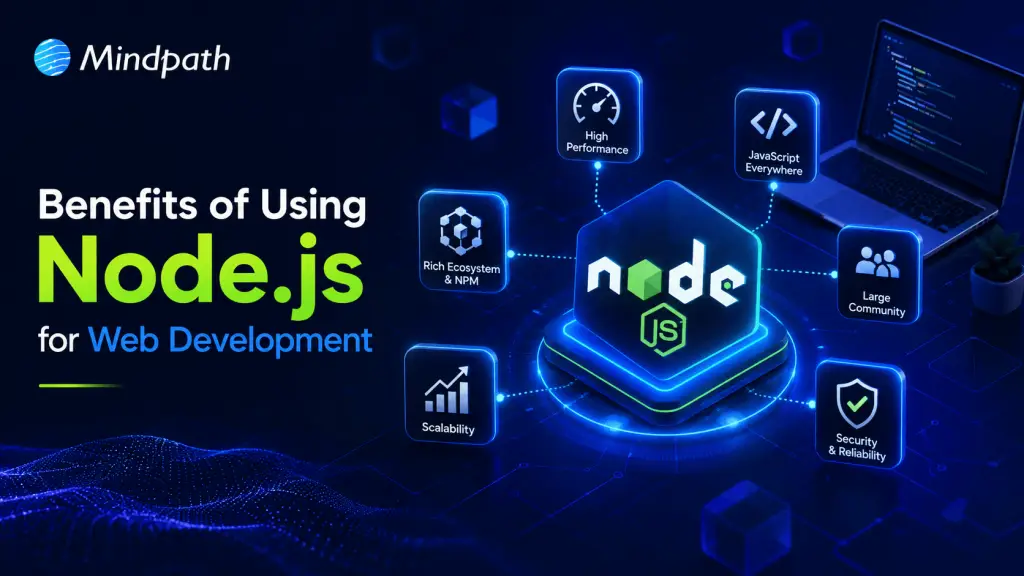
Node.js stands at the forefront of web development, seamlessly integrating frontend and backend tasks with its JavaScript foundation. Its event-driven architecture and expansive npm ecosystem enable rapid development of scalable applications. Backed by a thriving community, Node.js continues to redefine digital landscapes, making it the premier choice for innovative, high-performance web solutions.
Are you curious about the tools that power some of the most efficient and dynamic web applications today? If you’re in the web development space, you have probably heard of Node.js. But what makes Node.js stand out among the myriads of options available? Let’s explore why Node.js might just be the game-changer you’ve been searching for.
In this blog, let’s dive deep into the advantages of Node.js to uncover how it enhances application performance, scales seamlessly to meet growing demands, and streamlines development processes.
An Overview of Node.js
Node.js is a web development platform that is revolutionizing the way applications are developed and distributed on the internet. It is a standout force in the dynamic field of online development. Node.js, which leverages the widely used JavaScript language, enables developers to easily integrate the frontend and backend development processes. Node.js development services benefit from its lightweight, event-driven design, which is very useful in the modern digital environment.
It makes it possible to develop scalable, highly responsive apps that can manage several connections at once. Because of its effectiveness, Node.js is the best option for real-time applications where responsiveness is crucial, such chat platforms, online games, and collaboration tools. Additionally, Node.js encourages creativity by streamlining the development process. Its robust package and library ecosystem, made possible by npm (Node Package Manager), speeds up development and enables programmers to take advantage of pre-existing tools for a range of features. This feature improves web applications’ scalability and maintainability while also saving time and resources.
Key Benefits of using Node.js
1. High Performance
Node.js development services achieves great performance because of its non-blocking, event-driven architecture, which enables it to handle several requests concurrently without waiting for prior actions to finish. In real-time applications where responsiveness is essential, this efficiency is crucial. Node.js translates JavaScript straight into machine code by using the V8 JavaScript engine, which is well-known for its speed and optimization. This leads to quicker execution times.
The core of Node.js’s ability to provide great performance across a range of applications is this Google-developed engine. For example, Node.js is used by PayPal and LinkedIn because it can easily handle large amounts of traffic and provides real-time updates.
2. Scalability
Node.js excels in scalability because of its unique architecture and features designed for large-scale applications. Because of its event-driven, non-blocking architecture, Node.js servers can process several requests at once without experiencing I/O operation blocking. Applications that need to manage massive data streams in real-time or serve a high number of concurrent users must have this capacity.
Node.js is lightweight and efficient, allowing it to scale horizontally across multiple cores or servers, enhancing its scalability. Because Node.js is an asynchronous programming language, developers may leverage its ease of deployment across distributed systems to maximize resource consumption and maintain excellent performance even under severe loads.
3. Efficient Development Process
By using JavaScript for both frontend and backend development, Node.js streamlines the development workflow and lowers the learning curve for developers who are already familiar with JavaScript, enabling an efficient development process.
By writing code for the complete stack using a single language, developers can increase code reuse and reduce the amount of time they spend moving between multiple programming languages.
The strong npm (Node Package Manager) module ecosystem of Node.js is another element that makes development easier. A sizable collection of reusable tools and libraries that make typical development tasks easier are provided by npm. Third-party modules are simple for developers to incorporate into their projects, which shortens development timeframes and eliminates the need to create essential features from scratch.
4. Rich Ecosystem
Node.js has a rich ecosystem, which increases its attractiveness and usability in modern web development. The largest open-source library ecosystem in the world, npm (Node Package Manager) is at the center of this ecosystem. With more than a million packages, modules, and tools covering almost every facet of application development, npm provides developers with an extensive repository.
With the help of this large library of npm packages, developers may speed up development processes by using pre-made solutions for typical tasks like database integration, testing frameworks, UI components, and authentication.
5. Strong Community Support
Strong community support is one of Node.js’s greatest assets and is essential to its expansion, uptake, and continuous improvement. This dynamic group of contributors, enthusiasts, and developers works together to enhance Node.js, exchange information, and offer helpful resources to other developers.
The accessibility and inclusion of the Node.js community is one of its main advantages. Developers of all skill levels, from beginners to seasoned professionals, are welcomed and encouraged to participate. A large number of people contribute to the ecosystem by making npm packages, frameworks, tools, and instructional materials. This collaborative effort ensures that Node.js remains innovative, responsive to industry trends, and capable of addressing evolving development challenges.
Case Study and Success Stories
Node.js development service has shown its mettle in a number of well-known applications, showcasing its adaptability and reliable performance in a variety of sectors.
Walmart, a massive retailer, is the subject of an interesting case study. The company used Node.js to improve its online shopping experience. By choosing to hire Node.js developers for their backend services, Walmart improved page load speeds and overall site performance, which raised consumer happiness and increased sales conversions
Similarly, Netflix has streamlined its content delivery systems with Node.js, guaranteeing millions of consumers globally a flawless streaming experience. These triumphs demonstrate the tactical benefit of working with a professional Node.js development services firm. Through these collaborations, companies may efficiently utilize Node.js’s capabilities, utilizing its event-driven, non-blocking design to create scalable, high-performance apps that satisfy the demands of the contemporary digital landscapes.
How to Hire Node.js Developer
1. Define Project Requirements
Clearly outline the skills and experience needed, such as JavaScript proficiency, knowledge of asynchronous programming, and experience with frameworks like Express.js. Understanding why hire NodeJS developers can help ensure you bring in the right talent to leverage these skills for your project’s success.
2. Draft a Detailed Job Description
Highlight the required technical skills and any additional qualifications, including database management or API development experience.
3. Conduct Thorough Technical Interviews
Assess problem-solving abilities, Node.js knowledge, and hands-on skills through technical interviews and coding challenges.
4. Evaluate Cultural Fit and Communication Skills
Ensure candidates can collaborate effectively and fit well with your team dynamics, especially if working in a remote environment.
5. Check References and Past Work
Validate reliability and performance by checking references and reviewing past work experiences.
Conclusion
Conclusively, Node.js emerges as a key component of contemporary web development, presenting unmatched advantages including high performance, scalability, a productive development process, an extensive ecosystem, robust community support, and proven performance in the real world. Node.js stays ahead of the curve as web development patterns change over time, adding new features and developing its ecosystem. Adopting Node.js enables companies to develop and prosper in a cutthroat online marketplace while also ensuring reliable and scalable systems.
At Mindpath, we specialize in leveraging Node.js to drive transformative solutions for businesses of all sizes. Whether you’re looking to optimize performance, scale your applications, or innovate with new features, our expertise in Node.js development services can empower your digital journey. What are you waiting for? Contact us today to explore how we can help you harness the full potential of Node.js.

Do you ever wonder what’s the secret sauce of creating a perfect website or web application? It is the right framework! The success of your project depends on the framework you choose in the ever-changing world of web development. ReactJS is a framework that has been more popular among developers because of its comprehensive features, adaptability, and efficiency.
ReactJS is a part of the wide JavaScript library and is quite popular amongst the developer community for its versatility. With large numbers of frameworks available and new ones coming every single year, it could be a tricky decision to choose the right one for your web project.
In this blog, we will take a deep dive into the origins of ReactJS, its key features, and ten compelling reasons to consider ReactJS for your web development needs.
Origin of ReactJS Framework
Facebook invented ReactJS, also referred to as React, in 2011 and made it available to the public in 2013. The framework was created to help developers overcome the difficulties they encountered when creating intricate, high-performing user interfaces.
The component-based design that React introduces makes development easier by enabling developers to create modular and reusable components. ReactJS is one of the most widely used web development frameworks nowadays, maintained by Facebook in collaboration with a sizable developer community.
Features of ReactJS
ReactJS is a great option for web development because of its many capabilities. Important characteristics consist of:
- Component-Based Architecture: React makes it possible to create independent components that are capable of independently managing their state, which makes it easier to create intricate user interfaces.
- Virtual DOM: React reduces rendering overhead by simply updating the UI elements that have changed, as opposed to re-rendering the entire page, thanks to the use of a virtual DOM.
- JSX Syntax: This JavaScript syntax extension makes it possible for programmers to write HTML-like code inside JavaScript, improving the debugging and readability of the code.
- Unidirectional Data Flow: Applications are simpler to debug and maintain because to React’s one-way data binding, which guarantees a consistent data flow.
- Rich Ecosystem: React boasts a vast ecosystem of libraries and tools that extend its functionality and streamline the development process.
10 Benefits of Using ReactJS
1. Enhanced Performance
The virtual DOM in ReactJS ensures fast and efficient updates, enabling your web application to handle high-user interactions smoothly.
2. Reusable Components
Because of React’s component-based architecture, developers may quickly and consistently create new areas of an application by reusing components across them.
3. Ease of Learning
Learning ReactJS is not too difficult, especially for people who have experience with JavaScript. It is accessible to novice and seasoned developers because of its straightforward syntax and wealth of internet resources.
4. SEO Friendly
React’s server-side rendering features make it possible to greatly improve your web applications’ SEO, which will raise their visibility and search engine ranks.
5. Strong Community Support
With a large and active community, ReactJS developers can easily find solutions, share knowledge, and stay updated with the latest developments, providing valuable support for troubleshooting and skill enhancement.
6. Rich Ecosystem
The extensive ecosystem of tools, libraries, and extensions available for React makes it highly versatile, with solutions available for state management, routing, and testing.
7. Mobile App Development
React Native, derived from ReactJS, allows developers to build mobile applications using the same principles and components, facilitating seamless extension of web projects to mobile platforms.
8. Scalability
React’s modular structure makes it highly scalable, enabling the addition of new features and components without rewriting existing code, ensuring long-term maintainability.
9. Developer Tools
React offers powerful developer tools, such as React Developer Tools for Chrome and Firefox, which help developers inspect component hierarchies, debug applications, and enhance productivity.
10. Backed by Industry Leaders
Supported by Facebook and used by major companies like Instagram and Airbnb, ReactJS is a reliable and future-proof choice, continuously evolving with strong backing from industry leaders.
Hire ReactJS Developers with Mindpath
Now that we have established that ReactJS can benefit your web project in numerous ways, the next question is where you can hire qualified ReactJS developers. Well, look no further as Mindpath can help you hire the best ReactJS developers!
At Mindpath, we understand the importance of skilled developers for the success of your web project. Our team of experienced ReactJS developers is adept at leveraging the full potential of the React framework to create dynamic, responsive, and user-friendly web applications.
Whether you’re starting a new project or enhancing an existing one, our developers can help you achieve your goals efficiently and effectively.
We are committed to delivering high-quality solutions tailored to your unique needs. Contact us today to learn more about how our ReactJS developers can contribute to the success of your web project.
So you can end your search for React developers today with Mindpath. To know more.
Looking for a ReactJS Developer for your next project?

The world is changing rapidly and so is the technology spectrum across the globe. We are stepping into a digitally advanced world with new technologies like Generative AI, Web3, Blockchain, etc. Today’s businesses constantly seek innovative technologies to gain a competitive edge and drive strategic decision-making.
With the flood of technologies coming every year, some of them remain truly essential for modern-day businesses to thrive. Therefore, in this blog, we’ll explore ten upcoming technologies poised to transform business decision-making in the near future.
So let’s get started!
8 Upcoming Technologies To Drive Business Decision
1. GenAI
GenAI or generative AI is already making strides with popular tools like ChatGPT, Dall-E, Midjourney, etc. Generative AI, as the name suggests, is able to generate content like text, images, codes, designs, etc., based on “prompts” given by the users.
ChatGPT, a hot example of GenAI took the world by storm as soon as it was introduced. Many software have been launched since. In the coming years, GenAI is expected to play a crucial role in helping business leaders with decision making. GenAI empowers businesses to automate creative processes and deliver hyper-personalized experiences at scale, from creating personalized marketing content to designing custom products.
2. GenAI-Powered Chatbots
The next notable technology is Gen-AI-powered virtual assistants or chatbots which are becoming increasingly popular amongst users. GenAI-powered virtual assistants leverage natural language processing and machine learning algorithms to understand and respond to user queries and requests intelligently.
Virtual assistants include chatbots, voice assistants like Alexa & Siri, language-based assistants like ChatGPT & Bard, etc. GenAI and conversational AI are taking the customer experience to the next level. By harnessing the power of conversational AI, businesses can provide personalized customer support, streamline internal processes, and enhance productivity.
3. Digital Twins
Another trailblazing technology that’s going to assist businesses in making the best of their resources in the coming time is Digital Twins. Digital Twins are digital copies or replicas of real-world physical assets, systems, machines, tools, processes, etc.
To put simply, imagine you have a toy car that you want to understand better. You create an exact digital copy of this toy car on your computer, including all its parts and how they work together. This digital copy is called a digital twin. Now, whenever you want to experiment with or understand how the toy car behaves in different conditions, you can use the digital twin instead of the actual toy. For example, you could test how it moves on different surfaces, how it performs with various modifications, or how it reacts to changes in speed.
By creating a digital twin of products, equipment, or infrastructure, businesses can gain valuable insights into performance, predict maintenance needs, and enhance operational efficiency.
4. Multimodal User Interfaces (UIs)
User Interfaces (UIs) play a key role in delivering optimal customer experience. But most UIs till now have confined users to interact with machines in a monotonous way like typing on keyboard. That’s not the case with Multimodal User Interfaces (UIs). Multimodal UIs combine various interaction modalities such as voice, gesture, touch, and gaze to provide more intuitive and immersive user experiences.
To put it simply, multimodal user interfaces are like having multiple ways to talk to your computer or device. It’s not just typing on a keyboard anymore. You can use your voice, touch the screen, wave your hand, or even look at something to interact with it. By accommodating diverse user preferences and accessibility needs, multimodal UIs enhance engagement and usability across different devices and platforms.
5. Intelligent Applications
Intelligent applications support advanced analytics, machine learning, and automation capabilities to deliver context-aware insights and recommendations in real time. Think of intelligent applications as smart helpers. These apps use AI/ML along with advanced analytics to understand what you need and help you out.
These intelligent apps can serve as a golden opportunity for businesses to better predict customer behavior, optimize supply chain operations, as well as automate decision making process.
6. Tokenization
Have you heard of digital tokens? Tokenization allows the conversion of physical assets and contracts into digital tokens. Wondering how? Here’s an example! When you make a purchase online, you might use your credit card. Instead of giving the website your actual credit card number, which could be risky if the site gets hacked, tokenization replaces your card number with a unique token. This token acts as a placeholder, representing your card securely without exposing your real information.
Tokenization is all set to enable secure and transparent payments without any third-party intermediaries.
7. Quantum Processors
Quantum processors, as complex as they sound, are actually going to simplify the complex procedures and provide fast results. These are superfast computer processors aimed at delivering faster results for any problem. For example, quantum processors can handle the complex calculations needed to understand how molecules behave and interact with each other, which is crucial for developing new medicines.
While still in the early stages of development, quantum processors have the potential to revolutionize fields such as cryptography, optimization, and drug discovery, enabling businesses to tackle previously intractable problems with unprecedented speed and efficiency.
8. Web3
Lastly, let’s talk about Web3. It represents the next generation of the internet. Web3 is all about creating an immersive user experience and creating a decentralized platform. Technologies like blockchain, decentralized finance (DeFi), and decentralized apps (DApps), are at the core of Web3.
It will give more control to users over their data and provide transparency in transactions. With Web3, instead of going through a centralized payment processor like PayPal, you can use a decentralized cryptocurrency like Bitcoin or Ethereum to make the purchase directly, without any intermediaries.
Business leaders need to adapt themselves to provide a customer experience that is democratize and free from intermediaries.
These were the 8 new technologies 2024 that will become crucial for business owners for making business decisions.
Wrapping Up
In today’s digital world, businesses need to use new technologies to stay competitive and grow. These technologies, like GenAI, digital twins, smart virtual assistants, Web3, etc., can help them make better decisions and be more innovative. By keeping up with these changes and being open to trying new things, businesses can succeed in the digital age.
As a leader in upcoming technologies, Mindpath Tech is well-positioned to guide businesses through this journey of adaptation and innovation. With our expertise and commitment to staying ahead of the curve, we can help businesses harness the power of transformative technologies and thrive in the digital landscape.
So are you ready to become future-ready? Get in touch!
Businesses are constantly looking for smarter ways to improve customer experience, reduce operational costs, and deliver faster services. This is where conversational AI is becoming increasingly important. From answering customer questions to automating business workflows, AI-powered conversations are changing how companies interact with customers.
Key Takeaways
- 01
Agentic AI is helping businesses automate multi-step tasks beyond answering questions. - 02
AI chatbots are becoming more personalized and context-aware. - 03
Voice AI and multilingual assistants are improving customer communication. - 04
Multimodal AI enables systems to understand text, voice, images, and documents. - 05
Data privacy, human supervision, and reliable responses remain essential for successful AI adoption.
The conversational AI trends for 2026 focus on more intelligent, personalized, and action-oriented experiences. Unlike traditional chatbots that follow predefined scripts, modern conversational AI solutions can understand natural language, use business information, and support more complex requests.
Want to automate workflows, improve decision-making, and accelerate business growth with AI? At Mindpath, our AI development services help businesses build intelligent, scalable solutions aligned with their goals.
For example, an AI assistant can help a customer compare products, check an order status, and initiate a support request within the same conversation.
Let’s explore seven conversational AI trends businesses should understand in 2026.
7 Major Conversational AI Trends for 2026
1. Agentic AI Is Moving Beyond Traditional Chatbots
One of the biggest conversational AI trends in 2026 is the growing use of agentic AI. Traditional chatbots mainly answer questions, while AI agents can work toward a goal by completing multiple connected tasks.
For example, an AI agent in an e-commerce business could check product availability, recommend alternatives, retrieve order information, and initiate a return request.
Businesses can use agentic AI to automate customer support, sales assistance, appointment scheduling, and internal operations. However, sensitive actions should include appropriate permissions, verification, and human approval.
2. Personalized AI Conversations Are Becoming More Important
Customers expect businesses to understand their needs instead of providing generic responses. AI-powered virtual assistants can use permitted customer information, conversation history, and preferences to deliver more relevant support.
For example, an online shopping assistant can recommend products based on a customer’s stated budget and preferences. A banking assistant can explain relevant account services after securely verifying the customer.
This trend can improve customer engagement, satisfaction, and conversion opportunities. Businesses should use personalization responsibly, follow data protection requirements, and avoid collecting unnecessary personal information.
3. Voice AI Assistants Are Improving Customer Support
Voice AI assistants are making it easier for customers to interact with businesses without typing messages or navigating complicated menus.
Modern voice AI can recognize spoken language, understand requests, and generate spoken responses. Depending on the system, it can also transfer conversations to human agents when necessary.
Businesses can use voice AI for appointment booking, frequently asked questions, order updates, and after-hours customer support.
As speech recognition and response generation improve, companies can create more natural voice experiences. However, accuracy, background noise, accents, and response delays still need careful testing.
4. Multimodal Conversational AI Is Expanding
Multimodal AI allows systems to process different types of information, including text, voice, images, and documents. This makes conversational AI more useful for situations where customers need to share more than a written question.
For example, a customer can upload a product image and ask for similar items. A technical support assistant could analyze a screenshot of an error message and suggest troubleshooting steps.
These conversational AI applications can support retail, healthcare administration, education, manufacturing, and IT services.
Businesses adopting multimodal AI should evaluate data accuracy, file security, accessibility, and the limitations of AI-generated answers before deploying it at scale.
5. Generative AI Chatbots Are Becoming More Context-Aware
Generative AI chatbots use large language models (LLMs) to understand questions and produce natural-language responses. In 2026, businesses are increasingly interested in connecting these systems to approved company information.
One useful approach is retrieval-augmented generation (RAG). It retrieves relevant information from trusted sources before generating an answer.
For example, a customer support chatbot can use a company’s product documentation, return policies, and FAQs to answer questions more accurately.
This approach can reduce unsupported answers, provided the underlying information is reliable and the system retrieves the correct sources. Regular content updates, testing, and monitoring remain essential.
6. Multilingual Conversational AI Is Supporting Global Businesses
Businesses serving international customers need to communicate across different languages and regions. Multilingual conversational AI can help customers receive support in their preferred language.
For example, an online service provider can use an AI assistant to answer common questions in English, Hindi, Spanish, or other supported languages.
This can improve accessibility and help businesses provide consistent support across markets.
However, translation quality, cultural context, regional terminology, and language-specific testing are important. Human review may be necessary for legal, financial, medical, or other high-impact conversations.
7. AI Security and Human-AI Collaboration Are Becoming Priorities
As conversational AI becomes more closely connected to business systems, security and accountability become increasingly important.
Organizations need to protect customer data, control system access, monitor AI responses, and establish clear escalation processes. Human supervision is especially important when an AI system handles sensitive information or makes decisions that could significantly affect customers.
For example, a customer service chatbot can answer routine questions automatically while transferring billing disputes or unusual requests to a human representative.
The most effective conversational AI strategy is not always full automation. It is a balanced approach that combines AI efficiency with human judgment, transparent processes, and measurable business outcomes.
How Can Businesses Prepare for Conversational AI in 2026?
Businesses should begin by identifying repetitive customer interactions and workflows that could benefit from automation.
A practical implementation approach includes:
- Identify use cases: Start with FAQs, lead qualification, appointment booking, or order tracking.
- Choose the right technology: Evaluate conversational AI platforms based on integration, accuracy, scalability, and cost.
- Connect reliable data: Use approved company information to provide relevant answers.
- Protect customer information: Implement access controls, privacy safeguards, and appropriate human oversight.
- Measure performance: Track resolution rate, response time, customer satisfaction, qualified leads, and cost per interaction.
Starting with a focused use case makes it easier to measure results before expanding conversational AI across the organization.
Conclusion
The conversational AI trends for 2026 highlight a shift from simple question-answering chatbots toward intelligent assistants that understand context, support multiple communication channels, and help complete business tasks.
Agentic AI, voice assistants, personalization, multimodal capabilities, and secure AI integration offer businesses new opportunities to improve customer experiences and operational efficiency.
However, successful implementation depends on more than choosing an advanced AI model. Businesses also need reliable data, thoughtful workflows, strong security, and clear performance goals.
Eliza, the first ever publicly demonstrated chatbot, was created using a rule-based approach in the 1960s. With the onset of artificial intelligence and big data, these chatbots have now become advanced with capabilities like providing information and feedback, clear doubts, etcetera, and are transforming the face of education in the best possible way.
Artificial intelligence (AI) provides advanced education solutions and is being leveraged at scale by various institutions to achieve their digital transformation goals. This is evident with the growing demand for AI-driven online learning platforms with AI in education market revenue unanticipated to cross $20billion by 2027.
AI Chatbots In Education – The Need Of The Hour.
In a 2016 interview, Microsoft founder Bill Gates pointed out the relevance of AI in improving the quality and effectiveness of personalized teaching approaches.
“The idea that you could talk to an [virtual] advisor that would understand different misconceptions and arbitrary linguistics around it, that’ll certainly come in the next decade. And they’ll be a very nice supplement”– Bill Gates.
Truly so, after almost half a decade, AI chatbots are being instrumental in helping institutions provide interactive, streamlined, and personalized learning environments for students.
Conversational AI or AI chatbots are a subset of AI solutions. It is constantly explored to fill the gaps between teaching and learning, and achieve seamless education at all levels.
How do AI Chatbots Help In Teaching And Learning?
AI chatbots use natural language processing(NLP) to decode the intent and keywords according to a specific algorithm, and perform a set of functions.
NLP is among the most promising branches of AI which uses data science to facilitate interaction of humans and computers. The effectiveness of NLP in making computers as smart as people, fueled its growth, with the NLP market anticipated to reach $28.6 billion in 2026.
The AI chat bot processes a set of commands to understand the questions and offer appropriate answers to the same. It can either be in the form of text, or audio-video, pictures, etc. In the educational realm, this proves to be an interactive way for institutions, both online and offline, to create intuitive and interactive classrooms.
Impact of AI Chatbots on Education
The new-age technology has seemingly replaced the physical library with search engines and created virtual classrooms that have students from different parts of the world.
Apart from these visible technological advancements, conversational AI is also driving the future of eLearning and has already shown signs of transformation in the education realm. As students gain more easy access to high-speed internet and mobile devices, the use-cases of such modern technology also increase.
Let us now look at how AI chatbots are changing the landscape of the traditional education system.
1. Enhanced Personalized Learning
Personalized learning promotes self-advocacy skills in students. It helps them to focus on their flaws and empower their skills. It involves creating a learning structure that is tailored to each student’s abilities in a way that motivates them. This way, teachers can ensure every student learns together but at their learning rate.
However, in a traditional classroom, providing such assistance can be an excruciating task for the teachers. With AI-enabled chatbots, it is easy to optimize teaching as per the learning abilities of each student. It ensures every student continues to follow the curriculum but at their own pace.
AI chatbots interact with students and understand their specific needs via a set of standard text, audio, and video messages. These chatbots use their inference to create a personalized curriculum that matches their needs.
2. Smart And Quick Feedback
Feedback whether from a student or a teacher is effective only if it specifically addresses the areas of improvement. Conventionally, feedback would be in the form of written applications or online forums that take time to process and produce relevant results.
With the power of AI, an interactive way to understand the point of view of a student or teacher through surveys is now possible. The AI chatbot automatically cumulates and analyses the responses and publishes the results, making the whole process simple and fast. It provides results on time which the institutions can use to amend their teaching or administrative ways.
For students, detailed feedback from teachers is a comprehensive way to explore their inner strengths and flaws as a learner. For teachers, such feedback is an effective means to understand their student’s expectations and improve their teaching methods accordingly.
3. Improved Student Engagement
Effective student engagement involves developing the knowledge absorbing skills of students by imbibing a positive thirst to learn new things. AI chatbots break the long lectures into small text or interactive media messages so that it looks like a virtual chat room. This way the tedious lecturers transform into an interactive learning experience.
Many universities have deployed chatbots to streamline student-teacher communication.
For instance, the University of Murcia, Spain rolled out AI chatbots to answer queries from students regarding matters of campus and field of study. The chatbot successfully answered with 91% accuracy to around 38,708 questions.
4. Better Teaching Assistance
AI chatbots are dedicated virtual teaching assistants that are available 24/7 to help students with clearing the concepts. It also helps teachers to evaluate test papers and detect plagiarism and grammar issues.
With AI chatbots, teachers can optimize their tasks and leverage the time in creating strategies that impart quality education to their students.
5. Better Student Support
As technology advances, AI chatbots are being trained to provide more personalized counseling sessions to students and guide them to choose the best course. The AI chatbots mainly focus on three factors responsible for higher student persistence as perceived by Vincent Tinto, University Professor of Sociology (emeritus) at Syracuse University- students’ self-efficacy, sense of belonging and perceived value of the curriculum.
AI chatbots with human monitoring can also be used for improving on-campus mental health counseling, and help students manage their stress efficiently.
Bottom Line
The education industry is now witnessing a major paradigm shift from traditional ways of teaching. Even though no AI chatbot can replace a passionate and dedicated teacher, it can surely improve the quality of the overall learning experience.
Choosing the right chatbot is crucial in determining the effectiveness of AI-based tutoring. eBotify has all the elements that make it a perfect choice to deploy as a virtual administrative, teaching, and student assistant.
Contact us with your requirements and our technical team will provide the solutions for you right away!
Join our Newsletter!
categories
Join the world's largest training library and unlock new opportunities!
Featured Posts

Turn Insights Into
Real Business Solutions
Exploring trends is only the beginning. Whether you’re planning AI adoption, modernizing legacy systems, or building scalable software, our experts help transform ideas into practical business outcomes.