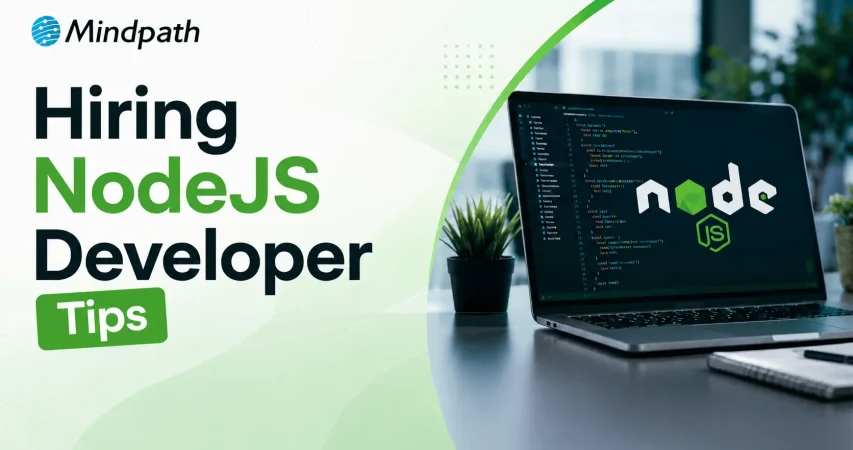
Best Tips for Hiring NodeJS Developers

Home

Best Tips for Hiring NodeJS Developers

Best Tips for Hiring NodeJS Developers

Join our Newsletter!

nodejs developers hiring tips

In today’s fast-paced digital world, hiring the right backend developers can have a direct effect on how well your product works, how scalable it is, and how successful it will be in the long run. Node.js is the most popular modern backend technology because it has an event-driven architecture, a non-blocking I/O model, and can handle a lot of concurrent workloads quickly.

According to Statista, Node.js is one of the most popular web frameworks because about 42% of developers around the world use it. It’s important to hire NodeJS developers because so many people use it and it’s also a competitive field.

This guide gives you useful, real-world tips on how to hire NodeJS developers that will help you avoid common hiring mistakes and make good decisions.

Looking to simplify your hiring process while ensuring you choose the right developers? Mindpath provides professional services to help you hire expert NodeJS developers with the right skills and experience.

Understanding Why Hiring NodeJS Developers Matters

Why You Should Know Why You Should Hire NodeJS Developers

Before you start looking for a Node.js developer, you should know why they are so important.

Node.js is great for making:

  • Apps that work in real time, like chat apps and notifications that pop up right away
  • Microservices and RESTful APIs
  • Queues of messages in event-driven architectures
  • Backend systems that can handle thousands of users at once and grow as needed

You can use JavaScript on both the front end and the back end. This makes development faster and the team more productive.

Start With Clear Project Requirements

One of the most important but often overlooked steps in the guide to hiring NodeJS developers is to be clear about what you need.

You should ask the following before hiring someone:

  • Do you need a developer who is just starting out, in the middle of their career, or at the top of their game?
  • Are APIs, real-time data, or microservices the building blocks of your project?
  • What frameworks do you need, like Express and NestJS?

You will waste time and hire the wrong people if you don’t set these. One of the most common reasons why hiring processes don’t work is that the expectations aren’t clear.

Also, being clear about the scope of your project makes sure that everyone, including candidates, is on the same page.

Identify Core Technical Skills

When hiring expert NodeJS developers, you should look for more than just basic skills.

Must-Have Skills Checklist

A good Node.js developer should have:

  • A lot of experience using JavaScript (ES6+)
  • Understanding the main ideas behind Node.js and the event loop
  • Knowing how to use promises and async/await in code that runs at the same time as other code
  • Knowing how to create RESTful APIs
  • Connecting to databases such as PostgreSQL and MongoDB
  • Authentication systems (JWT, OAuth) 
  • Git for keeping track of versions

Knowing how to set up the backend and deploy to the cloud is also very useful.

Evaluate Real-World Problem-Solving Skills

One of the best ways to find NodeJS developers is to look for people who can do the job instead of people who know a lot about it.

Instead of asking syntax-based questions:

  • Assign real-world coding tasks (under 2 hours)
  • Test API development or debugging scenarios
  • Evaluate error handling and async logic

Top developers demonstrate:

  • Clean code structure
  • Efficient async handling
  • Scalability thinking 

This method helps you tell the difference between regular developers and real backend engineers.

Don’t Confuse Full-Stack With Backend Expertise

A lot of people think that all JavaScript developers are also experts at Node.js, which is not true.

In the real world:

  • Full-stack developers often use simple APIs.
  • Backend Node.js engineers are experts in performance, architecture, and scalability.

If you don’t get this right, you might make bad decisions about how to design your system later.

Choose the Right Hiring Model

The engagement model is another important thing to think about when hiring NodeJS developers.

Options for Hiring

  • Freelancers (affordable and adaptable)
  • Developers who work in-house (for long-term stability)
  • Agencies (for full service and faster hiring)

There are pros and cons to each model when it comes to cost, control, and scalability.

People are hiring people from farther away because:

  • They can hire people from anywhere in the world
  • Hiring cycles that go by faster
  • Cost-effectiveness

Build an Effective Hiring Process

If you have a well-organized hiring process, you are much more likely to succeed.

Standard Hiring Workflow

  1. Define job requirements
  2. Create a compelling job description
  3. Source candidates (LinkedIn, GitHub, job boards)
  4. Conduct technical assessments
  5. Evaluate soft skills and cultural fit 

Structured hiring phases make it less likely that a company will hire the wrong person, and their teams work better.

Focus on Both Technical and Soft Skills

You need more than just technical skills.

When you hire Node.js developers, you should also think about the following:

  • The ability to speak to people
  • The ability to understand things
  • Being able to work with others
  • Being able to adapt quickly in fast-paced situations

A developer who knows how to talk to people can make a big difference in how well a project goes and how well the team works together.

Assess DevOps and Scalability Knowledge

Developers who know how to deploy and scale modern backend systems are needed.

Look for someone who has worked with:

  • Balancing the load
  • Putting in more servers
  • Environments in the cloud 
  • CI/CD pipelines

Developers who have been trained in DevOps can fix problems in production more quickly.

Define Budget and Salary Expectations

The cost changes depending on:

  • How long you’ve been doing it
  • Where it is
  • How hard the project is

For instance:

  • Developers with a middle level of experience make between $62,000 and $113,000 a year.
  • Senior developers make more money because they know a lot about how to build things.

If you clearly say how much money you have, it will be easier to find and hire the right people.

Create a Strong Developer Evaluation Checklist

Make a good list of things to look for when judging developers.

Here are a few quick things to think about when hiring NodeJS developers:

1. Technical Checklist

  • The main ideas behind Nodejs
  • Learning how to do asynchronous programming well
  • Knowing how to create APIs
  • Being able to use a database
  • Skills for finding and fixing problems

2. Practical Checklist

  • Being able to solve problems in the real world
  • Knowing how systems can grow
  • Knowing how to set up the cloud

3. Behavioral Checklist

  • The ability to talk to people
  • Being able to work well with others
  • Being a good fit for the culture

A structured checklist makes sure that everyone is judged in the same way.

Avoid Common Hiring Mistakes

Even companies that have been around for a while still make mistakes when they hire Node.js developers.

  • Job descriptions that aren’t clear
  • Not paying attention to async programming skills
  • Not doing tests in real life
  • Hiring someone too quickly without doing a thorough background check

If you don’t make these mistakes, you’ll have a better chance of hiring the right people.

Take the Next Step: Hire Smarter, Build Better

When you hire Node.js developers, you’re not just filling a job; you’re building a backend team that can grow with your business and do a great job. To make sure everything goes smoothly, it’s very important to do every step of the process, from figuring out what you need to testing your skills in the real world.

You can do the following by following these best practices for hiring NodeJS developers:

  • Make hiring less risky
  • Make it easier for products to grow
  • Build a development team that is ready for what comes next

In a market where there is a lot of competition, the companies that hire smarter, not faster, do better. Contact us

If you’re ready to take the next step in hiring Node.js developers or have any questions, feel free to reach out to us. Our team is here to assist you in finding the right talent that fits your project needs.

FAQs

1. What are the key things to consider before hiring a NodeJS developer?

You should evaluate technical skills (JavaScript, async programming), experience level, project requirements, and communication abilities before hiring.

2. How do I test a Node.js developer’s skills?

Use real-world coding tasks like API development or debugging exercises instead of theoretical questions to assess practical ability.

3. Should I hire a freelance or full-time Node.js developer?

It depends on your project. Freelancers are ideal for short-term tasks, while full-time developers are better for long-term projects.

4. What skills should a Node.js developer have?

Core skills include Node.js fundamentals, API development, database management, and asynchronous programming expertise.

5. Why is Node.js popular for backend development?

Node.js is fast, scalable, and efficient for handling real-time applications due to its event-driven, non-blocking architecture.

Related Post

AI in Cybersecurity

Imagine being in a world where each online action gets monitored, analyzed, and at times, even targeted. In this world, safeguarding digital data is one of an organization’s biggest challenges. This is where AI in cybersecurity takes effect because it brings intelligence and speed to the way we identify and halt a threat. It allows the system to learn, adapt, and respond in real time, creating a more intelligent defence against an ever-evolving threat environment.

As cyberattacks become more sophisticated, companies are searching for solutions that can think faster than the attackers can. AI accomplishes this by providing a way to leverage raw data into insights that drive security improvements. AI is changing cybersecurity from a reactive to a predictive process. In this post, we will discuss how AI is improving cybersecurity and helping organizations to secure themselves in today’s digital world.

In today’s digital world, cyber threats are evolving fast. Our AI development services will help you in building smarter defenses that will protect against attacks and keep your data and system safe.

Understanding the Concept of AI in Cybersecurity

AI ‍‍in cybersecurity means the application of AI technologies such as machine learning, deep learning, and data analytics to security issues that result from evil actors on the net. By doing so, the systems become capable of going through a huge volume of security logs, finding the abnormal patterns, and foreseeing the potential attacks with a much higher level of accuracy and in less time as compared to conventional security‍‌‍ ‍‍‌measures.

When AI and cybersecurity combine, they create intelligent defense systems that detect and adjust to continuously evolving threats. These defense systems continuously learn from every new piece of data, becoming increasingly smart, adaptive, and flexible with each new piece of data. Organizations are able to utilize human judgment in conjunction with AI-enabled data analysis to develop defenses that are stronger, faster, and more dependable to protect their networks and digital ecosystems.

Concerned about securing applications against evolving cyber threats? Explore application security best practices for web and mobile apps to discover proven methods for strengthening digital defenses.

Benefits of Using AI in Cybersecurity

With AI, cybersecurity is changing the manner in which enterprises are protecting their digital systems. One of the key features of this technology is that the introduced intelligent tools are capable of quick thinking, learning, and acting, thus they can be a great support to the overall protective measures against cyber risks which keep on ‍‌evolving.

1. Smarter Threat Detection

AI in cybersecurity expedites the identification of threats by utilizing enormous amounts of data from multiple sources. It will find strange behaviors and advanced attacks that humans would not normally be able to put together. With AI detection, organizations are then better prepared to make timely decisions and strengthen cybersecurity.

2. Adaptive Learning Against New Threats

AI tools are distinct from conventional tools in that they also learn from recent data and attacking behaviours. Ongoing learning enables a rapid adaptation to new and unknown threats, even before they spread. With this flexibility, the effectiveness of AI cybersecurity and reliance on it will only grow in the future.

3. Automated Processes with Fewer Errors

Artificial Intelligence takes over the tedious security tasks that are usually done wrong by humans. It will handle monitoring, scanning, and alerting in a more timely and accurate manner. This allows security teams to shift their attention towards the strategy and high-priority security decisions.

Also Read: AI Consulting

4. Stronger Vulnerability Detection

AI in cybersecurity examines systems and applications to uncover vulnerabilities before an attacker can exploit them. It points out anything that may require immediate action, and can help avoid problems down the line. When issues are detected and resolved in real-time, organizations can better protect their digital environments.

5. Faster Incident Handling

AI decreases response time through automation, performing alerting and preliminary analysis, increasing recovery time through threat prioritizing and assisting the expert in additional fast decision-making. Rather promptly, taking action reduces the potential for damage or disruption while helping mitigate the impact on systems.

6. Deeper Behavioral Insights

AI’s examination of ordinary usage and activity behavior leads to the detection of deviant behaviour patterns. A change in behaviour can indicate an insider threat, or a compromised account and/or device. AI’s behavioural insights give organizations the ability to respond quickly and maintain a higher level of control over their digital assets.

How can organizations respond faster to security threats using intelligent insights? Read about AI in decision-making to understand how AI improves cybersecurity decisions.

Use Cases of AI In Cybersecurity

The intersection of cybersecurity and AI technologies will change the way businesses identify, prevent, and respond to digital attacks. Through the utilization of intelligent systems which learn and adapt, organizations can construct greater and more proactive security strategies for the contemporary digital environment.

Use Cases of AI In Cybersecurity

1. Automated Response Systems

With AI, security incidents can be detected and acted instantly by taking actions such as isolating devices, or blocking malicious IPs, which mitigates attack impact and time to respond.

2. Smart Threat Detection

Artificial intelligence will scan data in near real-time, detect abnormal patterns, and uncover hidden, discreet threats that traditional tools may miss, such as phishing or network intrusions.

3. Predictive Threat Intelligence

AI will analyze behaviors and outside factors related to threats around the world and can predict and potentially prevent the next attack by turning data into actionable and meaningful defense-in-depth.

4. Intelligent Vulnerability Management

To help organizations stave off attacks, AI in cybersecurity finds all system vulnerabilities and ranks them based on severity, so that teams can manage the top-priority vulnerabilities and patch the most critical ones first.

5. Behavioral Security Monitoring

Cybersecurity and AI combine security monitoring with tracking users and better monitoring for suspicious behavior, stopping insider attacks and credential-based attacks before damage occurs.

6. Data-Driven Security Improvement

AI in cybersecurity changes data into usable intelligence based on the data, helping organizations improve detection, prevention, and overall protection.

Struggling to manage cybersecurity risks with limited visibility? Explore the importance of data-driven decision-making for businesses to discover how data strengthens security strategies.

Ready to Strengthen Your Cybersecurity with AI?

Artificial intelligence in cybersecurity is transforming the methods by which organizations protect their digital systems. It adds intelligence, speed and agility to security operations enabling organizations to proactively identify, prevent and respond to threats in real time. Given the growth of cyber risks, AI helps organizations be prepared, proactive, and resilient in the digital age.

At Mindpath, we offer advanced AI development solutions that help businesses enhance security and efficiency. Our expert team builds intelligent systems that detect risks, automate responses, and strengthen digital protection. With innovative AI-driven strategies, Mindpath helps organizations stay ahead of threats and achieve a safer, smarter, and more secure future.

Frequently Asked Questions

1. Can AI completely replace human cybersecurity experts?

No, AI works best when combined with human expertise. AI can quickly detect threats and automate repetitive tasks, but human professionals are still needed for strategy, investigation, and handling complex security situations that require judgment and

experience.

2. Is AI cybersecurity only useful for large enterprises?

Not at all. Small and medium businesses also face cyber threats every day. AI-powered security tools are becoming more accessible and affordable, helping businesses of all sizes improve protection, monitor risks, and respond to attacks more efficiently.

3. How long does it take to implement AI in cybersecurity systems?

The timeline depends on the size of the organization, existing infrastructure, and security goals. Some AI security tools can be integrated within weeks, while more advanced enterprise-level implementations may require several months for proper setup and training.

4. Can AI help prevent ransomware attacks?

Yes, AI can identify unusual behavior patterns linked to ransomware before major damage happens. It can detect suspicious file activity, unauthorized access attempts, and abnormal network behavior, helping security teams respond faster and reduce the impact of attacks.

5. What industries benefit the most from AI in cybersecurity?

Industries handling sensitive data benefit greatly from AI-powered security. Healthcare, banking, e-commerce, government, and education sectors use AI to protect customer information, detect fraud, secure networks, and manage growing cybersecurity risks more effectively.

Discover how AI enhances cybersecurity with smarter threat detection, faster responses, and proactive vulnerability management to protect your business in the digital age.
cloud native development

Cloud-native development is redefining the way organizations are evolving in the digital-first world. It enables teams to develop applications that are resilient, can be easily updated, and allow sophisticated scaling without compromising development speed. An increasing number of organizations are gravitating towards a cloud-native approach to meet the modern-day demands for agility, innovation, and customer experience. If your organization values being competitive and evolving at the speed the digital world enables, but not constrained by legacy solutions, cloud-native development could be the evolution opportunity you are seeking.

This method of breaking up large applications into smaller constituents via microservices allows organizations the opportunity to manage and improve everything much easier. With new technologies enabling containers and automation, organizations with the right supporting tools are able to deliver, test, and fix features faster than ever. It is no longer just about trying to keep pace; it is about leading a system that embraces change. In this blog post, we will discuss how cloud-native development enables organizations to scale up their businesses with greater control, pace, and certainty. So, let’s explore!

Looking to elevate your business with Cloud-Native Development? Contact us, and our experts will turn your ideas into high-performing cloud-native solutions.

What Is Cloud Native?

Cloud-native computing is a way of building and running applications that are built for the cloud. Cloud-native development provides developers with a way to build software that is flexible, adaptable, and able to handle dramatic change without breaking the overall architecture. Instead of building one huge system or application, the developer builds the application in independent pieces called microservices that work together. This approach allows for building and testing in more manageable pieces over time.

According to MarketsandMarkets, the cloud native applications market is expected to grow from USD 5.9 billion in 2023 to USD 17.0 billion by 2028. This shows that more companies are choosing this method to stay competitive and meet user demands. Tools like containers and automation help developers launch updates quickly without stopping the service. Cloud native makes it possible to move faster, reduce costs, and build stronger, more reliable software.

Must Read: Multi Cloud vs. Hybrid Cloud

Components of Cloud-Native Development

Cloud-native relies on a set of modern tools and practices that work together to build fast, flexible, and reliable applications. Here are the key components that make this approach effective:

1. Containers

Containers bundle code with everything it needs to run, making apps work smoothly across different environments. Tools like Kubernetes and Amazon ECS manage these containers to help with deployment, scaling, and maintenance. They are a key part of cloud native technologies, ensuring consistency and efficiency.

2. APIs

APIs, or Application Programming Interfaces, allow different software parts to communicate with each other. In cloud native development, microservices rely on APIs to share data and functions. This setup is lightweight and uses fewer resources compared to traditional systems.

3. Microservices

Microservices are small, independent parts of an application that work separately but communicate with each other using APIs. They are easy to update without affecting the whole system, which makes the app more stable. This structure supports cloud native development by making applications easier to build, test, and scale.

4. CI/CD Pipelines

CI/CD pipelines are used to automate the process of building, testing, and deploying code. They allow developers to work faster and reduce errors by using shared code repositories and automated workflows. This approach plays an important role in the cloud native landscape.

5. DevOps

DevOps brings together development and operations teams to automate and streamline the app development process. It helps in delivering software quickly and reliably with a focus on collaboration. DevOps practices are essential in the cloud native landscape to keep up with modern development needs.

Struggling with speed, collaboration, or automation in DevOps? Our DevOps Challenges and Solutions blog explains how modern businesses address these issues.

Benefits of Cloud Native Development

Cloud-native approach offers clear advantages that go beyond just building applications differently. These benefits are helping businesses improve the way they deliver, manage, and scale digital solutions across industries.

1. Reduced Operational Costs

Using open-source tools and serverless models helps cut down infrastructure and licensing costs. Businesses only pay for what they use, saving money and resources.

2. Effortless Scaling and Deployment

Cloud-native workflows automate how apps and infrastructure are deployed. With container orchestration, apps scale easily based on real-time demand.

3. Modernized Legacy Applications

Older apps can be updated to work better with modern cloud systems. Cloud-native development makes it easier to improve and connect them with new projects.

4. Greater Development Flexibility

Containers package apps with everything they need to run across different setups. This gives developers the freedom to build without being tied to one system.

5. Efficient Microservice Management

Kubernetes helps manage and scale container-based apps more efficiently. It simplifies deploying microservices while ensuring better performance.

6. Improved Application Stability

Cloud systems stay available even when one part fails. Microservices architecture ensures the app keeps working smoothly without full downtime.

7. Aligned Tech and Business Goals

A product-based approach aligns tech efforts with business goals. It boosts teamwork and supports faster responses to changing needs.

8. Boosted DevOps Efficiency

Cloud-native practices help speed up development, testing, and deployment. This leads to quicker, more reliable updates with fewer manual steps.

9. Low-Code and No-Code

Low-code and no-code platforms allow more people to build apps with simple tools. This makes development faster and less dependent on technical teams.

10. Minimized Vendor Lock-In

Cloud-native applications can run across multiple cloud platforms. This gives businesses the freedom to switch providers and avoid getting locked in.

Want to know what’s next for the cloud in 2025? Read our blog on Cloud Computing Trends to discover the technologies and innovations shaping the future of business.

Best Practices for Cloud-Native Development

To get the most out of cloud-native development, it’s important to follow proven methods that support speed, reliability, and scalability. These best practices help teams build stronger applications while keeping systems flexible and efficient.

1. Use Containers Effectively

Containers package apps with their dependencies, making them easy to run across different environments. This boosts reliability and simplifies deployment, helping teams work faster and more efficiently.

2. Take Ownership of Products

Following a product-focused mindset gives teams control over development from start to finish. It encourages innovation and quality, aligning with the goals of the cloud native foundation.

3. Automate CI/CD Pipelines

Continuous Integration and Continuous Deployment (CI/CD) automate testing and delivery, reducing errors and saving time. This helps teams release updates faster with higher confidence.

4. Build with Microservices

Microservices divide the application into smaller, focused services that can be built, deployed, and managed independently. This structure improves fault tolerance, speeds up development, and supports scalable cloud native solutions.

5. Apply Infrastructure as Code (IaC)

IaC lets teams manage infrastructure with code, allowing easy updates, version control, and automation. It brings consistency and reduces the chances of manual errors during setup or changes.

6. Focus on Resilience and Fault Tolerance

Design apps to handle failure using retries, timeouts, and automated recovery. This ensures your cloud native applications stay stable and available during unexpected problems.

Want to cut costs and speed up app deployments? Read our blog on Serverless Architecture in Cloud Computing to see how your business can scale efficiently.

Unlocking the Power of Cloud-Native Development

Cloud-native development is helping businesses move faster, scale smarter, and build more resilient applications. From modernizing legacy systems to enabling flexible and efficient operations, it’s shaping the future of digital transformation. By adopting the right strategies and tools, organizations can respond to change with greater confidence and deliver value to customers more effectively.

At Mindpath, we help businesses transform their software approach with our expert cloud-native development services. From planning architecture to seamless deployment, our team supports every step. We simplify operations, modernize infrastructure, and create scalable applications that align with your goals. With Mindpath, you build software that’s fast, flexible, and ready for what’s next.

Frequently Asked Questions

1. How is cloud-native development different from traditional application development?

Cloud-native development focuses on building applications specifically for cloud environments using microservices, containers, and automation. Traditional development often relies on monolithic systems that are harder to scale and update. This modern approach allows faster releases, better resilience, and easier scalability across environments.

2. What kind of businesses benefit the most from cloud-native development?

Businesses that require scalability, frequent updates, and high availability benefit the most. This includes startups, SaaS companies, and enterprises handling dynamic workloads. It is especially useful for organizations aiming to innovate quickly and deliver consistent digital experiences across multiple platforms.

3. Is migrating to cloud-native architecture a complex process?

Migration can be complex depending on existing systems and architecture. It often involves breaking down monolithic applications, adopting new tools, and retraining teams. A phased approach, starting with smaller components, helps reduce risk and ensures smoother transition without disrupting ongoing operations.

4. How does cloud-native development improve application reliability?

Cloud-native systems are designed with fault tolerance in mind. If one microservice fails, others continue to function without affecting the entire application. Features like automated scaling, monitoring, and self-healing systems help maintain performance and ensure minimal downtime for users.

5. What skills are important for teams working with cloud-native technologies?

Teams need skills in containerization, microservices architecture, cloud platforms, and automation tools. Knowledge of CI/CD pipelines, DevOps practices, and infrastructure as code is also important. Continuous learning is essential as cloud-native technologies evolve rapidly and require up-to-date expertise.

Discover the power of cloud-native development! Learn its benefits and how it helps businesses enhance security, efficiency, and performance.

Support Is One Click Away

Featured Posts

Related Post

Discover how to choose the right ReactJS development company with our step-by-step guide and learn about Mindpath’s expert services.