Most Popular Web Programming Languages in 2026

Join our Newsletter!

Featured Posts

Support Is One Click Away

Home

Most Popular Web Programming Languages in 2026

Most popular web programming languages

Most Popular Web Programming Languages in 2026

The realm of Web Programming Languages is full of dynamism. In the year 2026, it is most likely to undergo further evolution and change. In fact, the domain of web development languages is likely to blend innovation with stability. The most popular web programming languages that remain at the core of the software ecosystem are Python and JavaScript. 

Both individuals and businesses need to be aware of the most popular web programming languages. The insight is essential since these languages are key when it comes to developing applications and websites. If you wish to create your own app or site, choosing the best website programming languages is a must. It is the perfect time to explore the top Web Programming Languages in 2026.

Planning to use the latest web programming languages to get your website ready for better growth and performance? At Mindpath, we provide tailored web development services built with the technologies your business needs to succeed.

An Insight into Web Programming Languages

Web development involves a number of programming languages for both front-end and back-end development. You can use programming languages in order to give computer systems instructions that they can properly understand. A programming language refers to a human-readable programming code. 

Programming Languages can be in the form of general-purpose languages and domain-specific languages. You need to bear in mind that domain-specific languages function within specific programming environments. On the other hand, in the case of general-purpose languages, it is possible to interpret or compile them without having any knowledge of the platform. Developers make use of website programming languages in order to build dynamic web pages. You can choose the programming language for website development based on whether it can be used for front-end or back-end development.

Also Read: AI Programming Languages

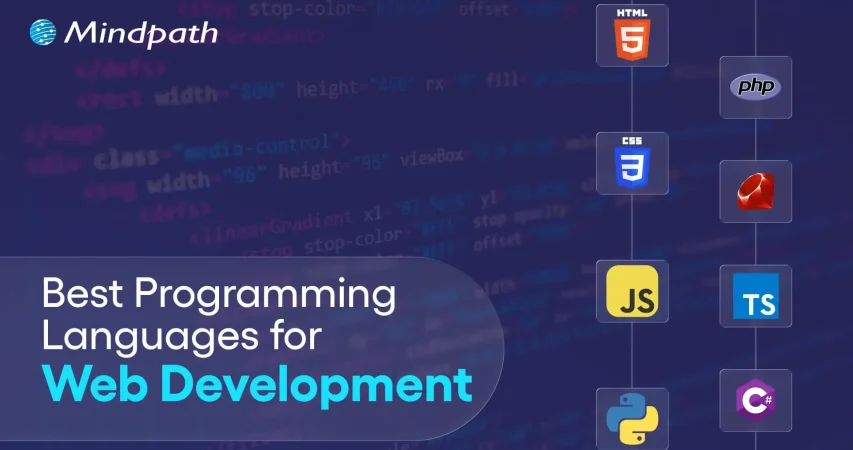
Best Programming Languages for Web Development

In the rapidly evolving programming language setting, a wide variety of programming languages have come into existence. You need to have an insight into these languages so that you can choose the ideal language that can help develop apps and sites based on your needs and goals. The best programming languages for web development include:

1. HTML

When it comes to web development, HTML certainly serves as the ultimate cornerstone. This is because it offers a standardized approach to creating web pages. Thus, if you wish to have a career as a web developer, it is fundamental to master HTML. It is considered by many to be the best programming language for web development. The straightforward syntax of HTML makes it quite easy for beginners to understand. 

HTML not only dictates the visual presentation on a web page, but it also defines its overall structure. It offers semantic elements such as a header and a footer, which can give proper meaning to your content. As a result, it improves accessibility along with search engine optimization. HTML even enables the creation of hyperlinks for the purpose of linking different web pages together. It even supports responsive design through elements such as media queries and meta tags. 

Want to modernize your website using popular web technologies? Learn how to convert HTML to WordPress and keep your site aligned with current development trends.

2. JavaScript

When it comes to web development programming languages, one cannot miss out on JavaScript. JavaScript is a high-level interpreted language that is widely used. Developers use this specific language in order to create and manage dynamic content on sites.  It has gained massive popularity over the years since it works in conjunction with HTML as well as CSS.

JavaScript is mainly utilized for the creation of dynamic content that you find on web browsers. Since it is a high-level programming language, it is easy to write and understand code. This automatically simplifies the job of developers and programmers. It is known for its high versatility. You can use the specific website development programming language for developing mobile applications and working on server-side development. You also need to bear in mind that the rich library ecosystem streamlines the entire web development process. 

3. CSS

Cascading Style Sheets, commonly known as CSS, is among the top web development programming languages today. CSS is a stylesheet language that web developers can use for describing the presentation of a document that has been written in XML or HTML. This programming language is responsible for controlling how elements must be rendered on screen or other forms of media. 

CSS enables web developers to develop web pages that are highly visually engaging. You can develop web pages with diverse layouts, fonts, and colors. One of its unique features is related to visual styling. You can have control over a plethora of visual properties if you use CSS, such as alignment and spacing. Thus, developers can have proper control over the look as well as feel of web pages. You can also use CSS to add interactive elements in web pages, such as animations, which can enhance the experience of users. 

4. Python

Python is an immensely popular open-source programming language. It is mainly used for back-end web development. Many believe it to be the best language for website development because of its ease of learning. Moreover, the extensive libraries of Python support novel technologies such as Machine Learning and Artificial Intelligence. This makes Python a highly versatile language in the web programming context. 

As Python is a high-level language, it enables you to write complicated logic in fewer lines of code. If you use the language, the process of debugging can get easier. This is because Python is capable of executing code line by line. Within a short span of time, the programming language has gained massive popularity because of its versatility and usability. Individuals who wish to have a career in the IT domain must definitely consider mastering a specific programming language. 

Planning to build or maintain WordPress sites with confidence? Explore WordPress and PHP compatibility to understand how they work together to support modern web applications.

5. PHP

PHP is a general-purpose scripting language that has gained high popularity in the web development setting. You can utilize the open-source language in order to create dynamic types of websites. PHP does not require compilation because it is an interpreted language. As a result, developers can directly embed PHP within HTML. This language allows the streamlined integration of server-side logic with online web pages. 

One of the main advantages of the PHP programming language is related to the user-friendly syntax. This user-friendliness makes it relatively simpler for beginners who are into web development. Due to the open source feature of PHP, it acts as a cost-efficient option for modern firms. The elimination of licensing fees automatically reduces the development costs for users. 

Over the past few years, a diverse range of web programming languages has emerged. While some have strengthened their presence, there are others that are gradually fading. You need to always be aware of the most popular web development languages. This is because their popularity as well as demand keeps on fluctuating. The future of web programming languages is certainly full of high potential. 

Wondering how to build modern web applications in 2026? Discover how a web development company helps you use popular technologies effectively.

Final Words

The web programming language landscape is flourishing currently, and it is likely to do so in the future as well. In the year 2026, it is necessary for you to know the top languages so that you can make the right selection. Some of the most popular languages include HTML, JavaScript, Python, and many more. You need to bear in mind that the popularity of these programming languages may fluctuate in a dynamic environment.

Mindpath’s experts have high expertise in providing web development services. Businesses can reach out to our experts if they wish to leverage the most popular language to develop their web pages. Our highly skilled developers will leverage their skills and prowess so that you can have a highly interactive and engaging website.
Related Post

Discover the benefits of offshore development, including cost savings, access to skilled talent, and enhanced flexibility.
Discover the ultimate guide to hiring Node.js developers in London. Learn about the skills, benefits, and cost factors involved in finding the right talent for your project.
Explore emerging technologies like robotics, AI, and cybersecurity innovations and driving future success for businesses.

Related Post

custom software development benefit

Imagine this: your company is moving so fast, but your off-the-shelf software can’t keep pace. There are bottlenecks in your processes, your teams are slowing down, and your customers can feel the gulf. Here’s where the custom software development benefits can make a difference. You get tools that will be designed and built for your business goals. No extra features that you don’t need, and no limits that constrain you. It’s like you’re developing a system that scales with your growth, not against it. It’s smart, flexible, and designed for your journey.

As more organizations acknowledge the value of custom technology, businesses are increasingly demanding custom solutions to meet their specific requirements and functionality. Custom software solutions enable consistency and quality for your operational tasks, enhance the experience for your customers, and increase productivity for your team. Unlike off-the-shelf software, which offers limited flexibility and options for your business, custom solutions not only evolve with your organization but can reduce loss of time and expense in the long run. The benefits are real and tangible. In this blog, we will examine the top ten benefits of custom software development for growing businesses.

At Mindpath, our custom software development services are designed to help growing businesses build scalable, secure, and high-performing software solutions.

What is Custom Software Development?

Custom software development refers to the process of developing software solutions that are specifically designed to suit the needs of a particular business or user. It is different than commercially available software that is sold to a wide audience. A custom software solution is custom-built to fit important workflows, overcome specific challenges, and exceed business goals. This overall process includes planning, designing, developing, testing, deploying, and maintaining to ensure long-term continued use.

Interestingly, Grand View Research reports substantial growth in the custom software development market. According to the reports, its market value was USD 43.16 billion in 2024, and it is projected to grow to USD 146.18 billion by 2030 at a CAGR of 22.6%, from 2025. This growth in market size represents an increase in demand for digital solutions that are flexible and designed for the unique needs of organizations. The enterprise software segment represented over 60% of the market, while cloud deployment comprised 57%, all showing a movement toward systems that can be scaled and accessed remotely. Large enterprises made up more than 60% of the total revenue in the market.

Must Read: Types of Software Development

Top 10 Benefits of Custom Software Development

Picking the right software that meets the needs of your business is becoming increasingly important. If you are considering custom software development benefits for businesses, here are some of the greatest advantages that make it a brilliant and future-proof solution.

Top 10 Benefits of Custom Software Development

1. Scales with Your Business

One of the important custom software development benefits is that it grows as your business expands. Whether you open new locations or add services, customized software can easily adapt to your changing needs. It removes the limitations of ready-made tools that often require costly upgrades. With flexible and scalable features, your software stays aligned with your business goals.

2. Custom-Built for Your Business

Custom software is designed to match your specific workflows, goals, and daily operations. It helps avoid the inefficiencies that come with generic tools that don’t align with how you work. From logistics to finance, every feature is built to support what your business truly needs. This leads to better performance, less waste, and smoother processes across teams.

3. Seamless System Integration

Custom software works smoothly with your current tools and platforms. It helps different systems share data without the need for manual updates. This reduces errors and saves time across departments. The result is a more connected and efficient business operation.

4. Cost-Effective in the Long Run

A major custom software development benefit is reduced long-term costs. Unlike off-the-shelf tools, there are no ongoing license fees or expensive upgrades. You pay for what your business needs, and it stays efficient as you grow. Over time, this leads to better value and lower total cost of ownership.

5. Gives a Competitive Edge

Using custom software for a small business helps you create unique features that set you apart from others. It allows you to offer better user experiences and services tailored to your audience. This can increase customer loyalty and build a stronger brand. Staying ahead with the right technology gives your business a clear competitive advantage.

Wondering what it really takes to develop software that perfectly aligns with your business’s unique needs and goals? Explore the detailed custom software development process to see how thoughtful steps provide smooth execution and successful outcomes.

6. Boosts Team Productivity

Custom software streamlines your workflows by removing repetitive tasks and simplifying daily operations. It helps each team work faster and with fewer errors. When tools are designed for specific roles, employees can focus more on results than on fixing problems. This leads to better performance and a more efficient workplace.

7. Reliable and Responsive Support

With custom software, you get direct support from the team that understands your system inside out. This ensures quick responses and accurate fixes when issues arise. This custom software development benefits results in reduced downtime and improved reliability. Your business stays on track with expert help tailored to your specific setup.

8. Complete Ownership Rights

With custom software, your business has full control over features, updates, and improvements. You don’t have to rely on outside vendors or wait for scheduled upgrades. You can make changes anytime to match your growing needs. This gives you the freedom to make fast decisions and stay in control.

9. Adapts to Market Changes

Custom software allows your business to respond quickly when market demands shift. You can add new features or make changes without delay. This helps you stay competitive and meet customer expectations in real time. Being able to adapt fast keeps your business strong and relevant.

10. Enhances Customer Experience

Custom software allows you to create features that match your customers’ needs, making their experience smoother and more personal. This leads to higher satisfaction and stronger customer loyalty. It lets you design every interaction to reflect your brand and serve your audience better. It turns regular experiences into memorable ones that keep customers coming back.

Trying to understand the common pitfalls in creating custom software? Check out our blog to learn the essential custom software development dos and don’ts that every business should follow for a smooth process.

Looking to Build Software That Fits Your Business?

Custom software brings real value by helping your business grow, cut costs, and work more efficiently. It supports your goals with flexible tools that fit how you operate. Every custom software development benefit contributes to improving your team’s workflow and customer experience. Choosing the right solution now means fewer challenges and better results in the future.

At Mindpath, we offer expert custom software development services tailored to your business. As a trusted custom software development company, we build tools that match your goals and grow with you. From design to long-term support, our team works closely with you to deliver strong, flexible, and reliable solutions that keep your operations smooth and ready for the future.

staff augmentation trends

The digital revolution has been empowering itself rapidly, and this is leading to a need for complex tech in business management. This is why organisations are dealing with hiring issues while keeping the prices minimal. Staff augmentation has turned out to be a strategic approach to deal with such risks.

The IT staff augmentation service is growing drastically and is ready to touch USD 857.2 billion by the year 2032. Further, it is growing at a rate of 13.2%. So, instead of being a niche workforce strategy, staff augmentation has become a mainstream model. In this blog, we will go through some reliable IT staff augmentation trends and why your business should acknowledge them.

Looking for a reliable partner to power your IT initiatives? Mindpath delivers premium IT staff augmentation services tailored to help you scale with confidence and drive project success.

What is the Meaning of Staff Augmentation?

Staff augmentation meaning is simple and viable for everyone. It is a flexible outsourcing strategy that allows your company to elevate their in-house with external professionals on a temporary or specific-period project basis. Traditional hiring can be time-consuming and rigid for many professionals. On the other hand, staff augmentation enables your business to quickly bring on experts with specific skills as per your requirements.

This is just like empowering your existing workforce with in-time talent. This approach can help you fill in the expertise gaps while managing seasonal demands. Most importantly, it can accelerate your strategic initiative.

  • Staff augmentation allows you to add or reduce team members as per the needs of your projects.
  • It can reduce the overhead charges of full-time hiring like taxes, benefits and long onboarding cycles.
  • You can be assured of skill-specific resourcing like cloud computing, AI and cybersecurity.

What are Some Top IT Staff Augmentation Trends to Leverage in 2026?

Let us go through some leading and meaningful IT staff augmentation trends that can make your hiring process viable in the current competitive landscape.

1. Hybrid Workforce Models

As per the recent research of ISACA, around 75% percent of employees prefer hybrid work practices. This has made many organisations leverage hybrid models. This is not only a smart recruitment approach, but a cost-efficient deal. Such Staff augmentation models can improve your team’s collaborative mediums.

Further, hybrid setups are essentially beneficial for companies that handle complicated development cycles. Around 25% of employers in the US are delivering a hybrid work culture to their workers.

2. AI and Modern Tech Implementation

AI-rich recruitment is no longer an option. It has become a mainstream necessity for employers. With the integration of AI-led tools, you can give rise to a faster and better screening assessment. Further, you can recruit skill sets that match your project requirements.

Such tools can also predict your future workforce needs. Additionally, automation and chatbots can enrich your team’s communication.

3. Adoption of Offshore and Nearshore Professionals

One of the incredible IT staff augmentation trends in the recent scenario is the hiring of offshore and nearshore experts. Nowadays, organisations are prioritising balancing factors like time zone compatibility, risks and cultural efficiency. Many organisations have claimed a reduction in operational charges due to such a viable option.

4. Cybersecurity Staff Augmentation

The trends and patterns of cyber threats have been increasing drastically. So, staff augmentation should be your foremost priority. Companies are willing to hire specialised compliance experts or security engineers through staff augmentation models to protect their infrastructure. This is becoming possible without even creating large in-house teams. Further, this approach can help you work within a regulated environment.

Must Read: AI in Cybersecurity

5. Communication-Oriented Hiring

No doubt, technical skills are important. But along with this, it is important for you to prioritise skills like collaboration and better communication. Staying in sync can help your team work towards a better goal without any mishaps.

With the rise in remote work, soft collaboration skills can facilitate better operations across multiple nations.

6. Changing Skill Advancement

As per the recent IT staff augmentation trends, organisations are valuing systems to facilitate continuous upliftment. So, IT teams are generally going through multiple training programs. Manpower is getting updated with the development of modern technologies. So, your preparation of future-rich teams can diminish your dependency on outside hiring.

7. Cloud Infrastructure Staffing

With the growth of cloud adoption, cloud infrastructure staffing is becoming prominent. Businesses are majorly augmenting teams with DevOps engineers, cloud architects and platform specialists. Such a trend can align seamlessly with DevOps staffing and cloud-centric strategies.

Wondering how companies stay flexible while scaling their teams quickly? Learn more about what is staff augmentation and why it’s a game-changer for modern businesses.

What are the Major Types of Staff Augmentation Models?

Understanding the different types of staff augmentation models can help you choose the right approach while keeping your decisions intact. Here, you can go through some main models that work potentially.

1. Short-term Augmentation

This type of process is appealing for quick turnarounds and urgent technical fixes. It generally lasts from a few weeks to several months.

2. Long-term Augmentation

When your company requires ongoing support for extensive projects, long-term augmentation can offer you continuity. Such types of staff augmentation can help you with deeper integration with your internal teams.

3. On-demand Augmentation

This model values hiring talent when your business requires it. The process remains flexible and mainly adopted in agile development criteria.

4. Team Augmentation

Instead of hiring individual talent, you can hire an entire team that can match your internal workflows.

Every types of staff augmentation vary in commitment and integration approaches. The choice completely depends on your project needs and workforce maturity.

Not sure which AI advancements are shaping staff augmentation trends? Explore the top AI models helping businesses stay competitive.

What are the Potential Benefits of IT Staff Augmentation?

The benefits of IT staff augmentation generally remain unmatched. Starting from saving your costs to hiring top talent, it can help your workflow remain streamlined. Let us discover some of the most essential benefits of staff augmentation in this section.

1. Minimal Hiring Uncertainty

With the help of staff augmentation, your company can approach top talent when you require it instead of being worried about long-term commitments. Moreover, there will be fewer chances of hiring inefficient profiles, as you are going for specialised individuals for specific tasks or projects.

2. Manageable Administrative Workloads

If your organisation is considering the help of staff augmentation providers, you can remain unburdened about the extra administrative work. Further, the providers can handle your payroll and other HR centric works. This approach can prevent you from extreme charges while saving your resources.

3. Adoption of New Technologies

With the usage of staff augmentation models, businesses can explore and experiment with advanced technologies without being tense about investing in large-scale solutions. As a result, you can hire experts to try out technologies when you require them.

Want to know how AI can enhance recruitment efficiency and strengthen your extended workforce strategy? Read our insights on Generative AI in HR to see how HR teams are leveraging intelligent automation.

What are Some Challenges of Adopting Staff Augmentation?

While staff augmentation can make you aware of many benefits, it also highlights certain challenges, as given below.

  • Your augmented teams might struggle to understand your internal work culture.
  • Misalignment can occur when the external workers are not completely informed. So, use structured communication channels.
  • External access to systems can give rise to compliance risks.
  • Your team might prioritise their skill development.

Conclusion

As IT staff augmentation trends have been shifting rapidly, your business needs a strategic augmentation partner to fulfill the hiring requirements. Starting from your remote workforces to data scientists, your augmented teams can help your companies navigate complicated digital transformations.

Partnering with professional providers ensures your organisation can pick the right expertise at the right time without compromising quality or alignment. Here, Midpath can be your ultimate preference. Experts in this company can understand your changing needs while helping you leverage the right talent solutions.

FAQs

1. What is technology staffing?

Technology staffing generally refers to the hiring of skilled IT professionals with the help of flexible models to meet project-specific requirements.

2. How is staff augmentation different from outsourcing?

Staff augmentation mainly supplements the internal team with external talent as per your company’s directions. On the other hand, outsourcing transfers responsibility for entire functions.

3. What are some eminent models of staff augmentation?

Some of the common staff augmentation models include long-term, short-term, and on-demand team augmentation.

4. How can IT staff augmentation be beneficial for you?

Through IT staff augmentation, you can have faster access to expertise while reducing the hiring team. Further, it can support your strategic initiatives without any long-term commitments.

5. Which roles are majorly augmented in businesses?

Frequently augmented roles include software developers and cloud engineers. Business also augments data scientists and cybersecurity experts for better alignment.

Explore how IT staff augmentation trends are reshaping the tech industry, from cybersecurity to AI, and discover Mindpath’s expert solutions.
Multimodal Generative AI

Have you ever wondered how AI can generate text, images, and even music? What if a single AI model could understand and create across multiple formats? This is where Multimodal Generative AI steps in. In this blog, we’ll dive into the fascinating world of Multimodal Generative AI and explore how it’s shaping the future of AI. 

What is Multimodal Generative AI?

Multimodal generative AI is an advanced form of AI that can comprehend and generate several types of data, including text, images, audio, and video. These systems can combine and analyze several types of input to process data from multiple sources and produce new content. Multimodal AI combines various sources of data to accomplish more complicated tasks and call for a greater understanding of the data. Although there is a lot of potential for this technology in fields like accessibility, education, and content creation, there are also issues to be resolved, like preserving accuracy and relevance and handling ethical concerns about privacy and authenticity. 

Benefits of Multimodal Generative AI

1. Improves Accessibility

Through the creation of various kinds of content, these systems improve accessibility and facilitate information access for all. By ensuring that people with different abilities can interact with content in ways that best meet their requirements, they contribute to promoting inclusion and understanding on various platforms. By offering substitute formats, these systems seek to remove obstacles and make the user experience more inclusive for all users.  

2. Creates High-Quality Content

Multimodal generative AI can lead to more complex and intelligent content by mixing several forms of data. It can include text, graphics, audio, and other components to provide interesting content. This skill enables the creation of a wide range of instructional materials or media that deepen comprehension and spark users’ interests. For everyone, it makes for a more engaging and educational experience by combining different forms. This method not only grabs the interest of individuals but also accommodates various learning styles, which makes it simpler for people to understand difficult ideas and concepts. This results in more effective and richer content that appeals to a larger audience.  

3. Boosts User Experience

Multimodal generative AI can adapt content in user interfaces to the context and the demands of the user. When voice isn’t possible, it can provide visual explanations to make sure customers receive information most conveniently. It also improves interactive experiences, like video games, by producing lifelike people and language that react differently to human input. 

Because of its versatility, technology becomes more user-friendly and accessible and creates a more engaging experience. Multimodal generative AI can offer tailored suggestions by comprehending the context, which raises customer satisfaction and facilitates more seamless, pleasurable interactions with digital material. 

4. Combines Data Effectively

These systems are capable of smoothly fusing data from many sources to deliver a more thorough and coherent knowledge of intricate circumstances. Their ability to integrate text, audio, and visual data improves analysis and decision-making. This capacity is especially useful for security, since it can improve threat identification and monitoring by combining textual, auditory, and visual analysis. 

These algorithms can find patterns and relationships by combining several kinds of data that would not be apparent when looking at a single source. By using a holistic strategy, organizations can improve their ability to respond to possible hazards and improve operational safety and efficiency.  

5. Improves Understanding and Insights

These models can get a better knowledge of both content and context than single-mode AI systems by combining many sources of data, such as text, pictures, and sound. With the capacity to understand both verbal and non-verbal aspects of a user’s question, this feature makes replies in applications such as virtual assistants more accurate and relevant. 

These systems improve communication and engagement by considering several factors, giving users a more efficient and natural experience. This enhanced comprehension leads to deeper interaction and more significant conversations, which eventually boosts the efficiency of AI applications as a whole. 

6. Drives Creative Marketing and Advertising

By combining consumer data from several sources to create personalized advertising material, multimodal generative AI can enhance marketing initiatives. These technologies can offer customized advertising materials that engage consumers on several sensory levels by analyzing interactions across various forms. Using this strategy, companies can generate ads that are more relevant and engaging for their target demographic, which improves consumer engagement and boosts the efficiency of marketing efforts.  

Use - Cases of Multimodal Generative AI

1. Human-Computer Interaction

Multimodal AI enables more natural and intuitive human-computer interactions by processing inputs from several sources, including voice, gestures, and facial expressions. This feature facilitates more seamless communication and allows customers to interact with technology in a more comfortable and familiar way. Multimodal AI improves user experiences and opens technology to a larger audience by comprehending various input formats. 

2. Healthcare

Multimodal models are essential for medical image analysis in the healthcare sector because they integrate data from several sources, including written reports, medical scans, and patient records. The capacity of medical professionals to diagnose patients accurately and create efficient treatment programs is improved by this integration. These technologies eventually enhance patient care and results by offering a greater understanding of a patient’s state. 

3. Multimedia Content Creation

Multimodal AI can generate multimedia material by mixing data from a variety of sources, such as text descriptions, audio recordings, and visual references. This feature makes the process of creating content more efficient and enables the automatic production of interesting and rich content. These systems improve efficiency and creativity by combining several modalities, which makes it simpler to create varied content that meets the tastes of various audiences.  

4. Sensory Integration Devices

Multimodal artificial intelligence (AI) improves augmented reality, virtual reality, and assistive technology user experiences by combining touch, visual, and audio inputs into one device. These gadgets build settings that are more interactive and immersive by merging many sensory inputs. This integration allows for a more thorough and pleasurable experience across a variety of apps while also improving user engagement and accessibility to technology. 

Multimodal artificial intelligence (AI) Services at Mindpath

Our AI development services help organizations better understand their requirements and make decisions by utilizing text, photos, audio, and other inputs. Our ability to integrate data from several sources gives us a full understanding of your initiatives and objectives. Our AI models make interactions more relevant and engaging by producing personalized information and responses based on your unique needs. By utilizing a variety of input methods, technology is made easier to use and more pleasurable for the user overall.  

Our services also provide valuable insights that assist businesses in making better decisions, leading to more effective strategies. At Mindpath, our aim is to harness the power of multimodal AI to empower your business and improve outcomes through innovative solutions. 

Final Thoughts

Multimodal generative AI is transforming the way humans engage with technology and consume content. It improves user experiences across a range of industries, increases accessibility, and fosters creativity by mixing diverse sources of data effortlessly. This technology has enormous potential to change industries and improve our daily lives as it develops further. At Mindpath, we’re thrilled to take the lead in applying multimodal AI to develop cutting-edge solutions that enable companies and improve user engagement. Unlock countless opportunities for development and innovation by embracing the AI of the future with us. 

Ready to unlock the potential of your projects?

At Mindpath, we harness the power of advanced AI solutions to elevate your business.

Discover how Multimodal Generative AI enhance creativity, accessibility, and user experiences across industries.