Home

Top Reasons to Hire ReactJS Developers for Your Next Web Project

Top Reasons to Hire ReactJS Developers for Your Next Web Project

Join our Newsletter!

hire reactjs developers

The significance of a robust online presence for any business extends beyond just adapting to new trends. Businesses that offer intuitive and dynamic user interfaces in their web and mobile apps stand out of the crowd. You can hire React JS developers and capitalize on the power of the most popular open-source JavaScript library in the world. The extensive ecosystem and innovative features of React JS have made it one of the top favorites of developers for creating high-performance web applications. Let us learn why React JS developers are the best picks for your next web project.

If you are looking for ReactJS experts for your next project, Mindpath ReactJS development services will assist you in achieving business goals.

Unraveling the Importance of ReactJS

The first thing that you might want to know before you hire React developers is the reason to choose React. You can find multiple libraries and frameworks for web projects with various features to craft responsive and dynamic applications. What makes React JS a special choice? React JS offers a wide range of benefits for creating robust web applications, whether it is a single-page website or a comprehensive enterprise-level solution.

The popularity of ReactJS web development has increased due to its features, such as virtual DOM, declarative nature and component-based architecture. Developers can work on individual components without continuity issues and reusable code ensures cost-effectiveness. Furthermore, the ease of use in ReactJS makes it easier to learn for developers as compared to other frameworks.

Another reason to trust ReactJS for your next web project is the flexibility for mobile development. You can hire React Native developer and create mobile apps to attract more users for your web project. React developers can use their expertise to work with React Native easily and offer the advantage of cross-platform development.

Want to understand how much your business should invest in skilled ReactJS talent? Learn the real cost of hiring ReactJS developers to make informed financial decisions.

Discover the Reasons to Hire ReactJS Developers

The rapidly evolving domain of web development calls for special attention to selecting the right technology stack. ReactJS is one of the most powerful tools in web development with a diverse array of features. On top of it, you should hire react developer because you need the right talent to help you make the most of the advantages of ReactJS. The following advantages of working with ReactJS developers can help you understand why you need to hire one now.

1. Faster and Efficient Development

The best thing about hiring React developers is the assurance of faster development with precision. ReactJS developers can use their knowledge of the component-based architecture of the JavaScript library to create reusable component for web applications. The ReactJS developer job description does not focus on reinventing the wheel for every new feature or update. On the contrary, ReactJS developers can utilize a library of carefully designed components to reduce development time.

The focus on speed in ReactJS does not imply that you might have to compromise with efficiency. On the contrary, you can find more efficient development lifecycles with the consistency in different areas of web applications. ReactJS developers can harness these features of React to help you transform promising ideas into tangible applications at faster pace.

2. High-Performance Applications

Businesses should actively seek React developer hiring platforms to seek the best talent for creating high-performance web projects. Users need lightning-fast applications which load within seconds and offer a seamless user experience. React developers can use the virtual DOM feature of ReactJS to create high-performance applications. The virtual DOM is a virtual representation of the UI of an application that helps in identifying the minimum changes required before updates to the actual browser DOM.

React developers can use the virtual DOM feature to ensure that only the relevant parts of a web application are updated rather than the entire application. As a result, the web app can offer higher responsiveness and performance. Users can experience fluid interactions and seamless transition even in complex and data-intensive applications. With applications that offer higher performance, any business could rely on ReactJS developers to achieve higher user retention and lower bounce rates.

Also Read: ReactJS Trends

3. New Prospects for Scalability

Scalability has been one of the biggest challenges for any business that works on web projects. It is important to remember that every business is a constantly evolving and growing entity. As your business grows, your web applications must also reflect the changes. The biggest reason to trust a React JS developer in 2025 is their ability to build scalable web applications. React developers can leverage features like the modular structure and efficient state management to enhance scalability of your apps.

Developers can use ReactJS to create applications that can manage increased traffic and accommodate new features without affecting their performance. As a result, your web application powered by ReactJS can cater to an expanding user base without a complete makeover. React developers have the talent to build applications with a long-term vision to ensure that the apps deliver desired returns as the business grows.

4. Code Quality and Maintenance

Some business owners might assume that they can use the services of React developers to create web applications and be done with them. However, the best platforms for React JS development services not only focus on creating high-performance apps but also pay attention to their maintenance. Professional React developers follow an organized approach to development of your web application. The developers comply with best practices for writing clean and modular code with clear documentation.

Apart from ensuring high code quality, React developers also take care of maintenance for your web applications. Interestingly, the commitment to code quality plays a vital role in enhancing maintenance and long-term health of your application. Cleaner code is easier to debug and offers new developers an advantage by helping tem catch up with the project easily. The emphasis on maintenance reduces future technical debt and enhances the agility of web applications.

Want to ensure your React apps run smoothly even under heavy traffic and complex operations? Learn the best techniques to optimize ReactJS performance for scalable and efficient development.

5. Capitalize on New Technologies

Another crucial reason to choose experienced React developers is their ability to capitalize on new technologies. You must know that the domain of web development is expanding and evolving with the rise of new methodologies and technologies. The advantage of choosing developers from platforms that offer ReactJS services is the ability of the developers to navigate through emerging advancements.

As you come across new updates in the React ecosystem, experienced developers can help you make the most of them for your web project. For example, the React ecosystem has recently introduced the Context API and Hooks. On top of it, ReactJS has also introduced the Next.js framework for server-side rendering and generating static sites. Developers from trusted React development companies can work with these new technologies due to their continuous efforts in upskilling.

6. Art of Creating Unique User Experiences

You cannot miss the capabilities of React developers to create unique and appealing user experiences while creating web applications. Businesses know that a good web application does not boast of a lot of features. On the contrary, an expert ReactJS developer will aim to offer the best feeling and experience to users. React developers can leverage their skills to create visually stunning and intuitive user interfaces that capture the attention of users.

The ability of developers to understand subtle nuances of user interaction helps them translate design ideas into dynamic components for web applications. As a result, the web apps created by React developers can respond seamlessly to different user actions. The intuitive user experiences feel natural and establish the foundation for stronger connection between users and a business.

7. Knowledge of a Large and Growing Community

The general assumption while hiring React developers is that you will hire only one developer. Interestingly, you bring a lot more to the table when you hire React developers as they have the power of collective intelligence. ReactJS has one of the biggest and most active developer communities with an extensive network of developers constantly involved in sharing knowledge, solutions and best practices.

The strength of the community empowers React developers to tackle complex challenges or special requirements in web projects. With the assurance of faster problem-solving and continuous innovation, React developers can offer cutting-edge solutions and the wealth of collective intelligence and experience.

8. Focus on Core Activities

While the web application project is one of the priorities for a business, it is not the only activity business owners should be worried about. Hiring the best React JS development services ensures that business owners get more time for core business activities. If you manage an in-house team of developers, then you will have to take out some time to supervise their work. On the other hand, a professional development company can take the burden off your shoulders.

ReactJS developers can help you have the peace of mind you need while creating a new web application. With experts on the job, you can worry about other things such as marketing and sales strategies for web applications. The expertise of a React developer can help you capitalize on emerging innovations and architectural patterns to create modern and secure apps. That’s something every business owner will want while beginning a new web project.

Looking to future-proof your web applications with a technology that scales as your business grows? Discover the strategic top reasons to choose ReactJS for Progressive Web App development for business owners.

Final Thoughts

The decision to choose a professional developer from a ReactJS development company might be the best one for business owners. Experienced developers working with professional development companies can bring a treasure trove of knowledge and skills to your web project. Learn more about the best practices to pick a React developer to translate your ideas into high-performance web applications.

Frequently Asked Questions

Expert ReactJS developers build fast, scalable, and interactive web applications using modern development practices, ensuring high performance, maintainability, and excellent user experiences.
Look for expertise in ReactJS, JavaScript, TypeScript, HTML, CSS, state management, REST APIs, Git, testing frameworks, and responsive web development.
ReactJS offers reusable components, virtual DOM, fast rendering, strong community support, and flexibility, making it ideal for building modern, scalable web applications.
Review their portfolio, technical expertise, problem-solving abilities, communication skills, client feedback, and experience delivering projects similar to your business requirements.
Yes. Experienced ReactJS developers create scalable, secure, and high-performance applications that integrate seamlessly with APIs, cloud services, and modern backend technologies.

Support Is One Click Away

Featured Posts

Related Post

Agile Methodology

In today’s rapidly evolving digital world, agile methodology is changing how businesses plan, build, and deliver projects. Rather than drawn-out timelines with large cycles of progress, teams are able to move steadily through short sprints with defined goals. This process allows leaders to maintain visibility at every stage of the project while maintaining a firm hold on customers’ needs. Isn’t that what every business wants, speed with flexibility? Using this process makes projects feel lighter, more reactive and adaptive, and easier to navigate and manage, thus transforming work into a journey of growth and learning.

Key Takeaways

  • 01
    Agile breaks large projects into short sprints for faster, flexible delivery.
  • 02
    Continuous customer feedback keeps development aligned with real business needs.
  • 03
    Regular testing within each sprint improves product quality and reduces risks.
  • 04
    Agile works best for complex projects with evolving or unclear requirements.
  • 05
    Transparency and self-organizing teams build stronger trust and accountability throughout projects.

At its core, agile emphasizes collaboration, transparency, and continuous improvement. Because everyone knows what to expect and when, the flow of work stays uninterrupted. There is a connection between teams and their clients that helps decrease surprises and strengthen trust. Small changes are easier to accommodate after the fact than big changes once the project is underway. In this blog, we will unpack Agile in extraordinary detail, illustrating why it is more than a method and how it leads to sustainable success.

Are you looking to achieve sustainable success for your business? Contact us to choose the right direction in this fast-paced digital world, and we will guide you on how you can enhance your business performance.

What is Agile Methodology?

The agile development meaning is simple and strong: it consists of a project management approach that splits the total work into smaller pieces we can manage as sprints. Each sprint focuses on delivering a usable output in which we can be flexible and adaptive to the process. Upon completing the sprint, we review where we have gone, gather feedback, and improve the next cycle. This way we are progressing, while having clarity, with a greater velocity, while getting closer to what customers want.

The agile methodology exists with the guidance of the Agile Manifesto, a guiding document of values and principles established in 2001 by software professionals, where the key aspects of collaboration, working software, flexibility, and customer satisfaction are prioritized over formalized processes. The Agile Manifesto lays out the values, which consist of 12 principles that teams can follow to help ensure consistent efforts to deliver value.

Below are the 4 values of Agile:

1. Individuals over Processes

Agile prefers a team working together, rather than strict processes.

2. Software over Documentation

Working software is more important than paper.

3. Customers over Contracts

Customers provide feedback to the development more than the details described in the contract.

4. Changeover Plans

Adapting to change is valued more than sticking to fixed plans.

Not sure which software development approach fits your Agile project goals and business needs? Explore the key types of software development and how choosing the right path can help your Agile teams deliver better, more tailored results.

What are the 12 Principles of Agile?

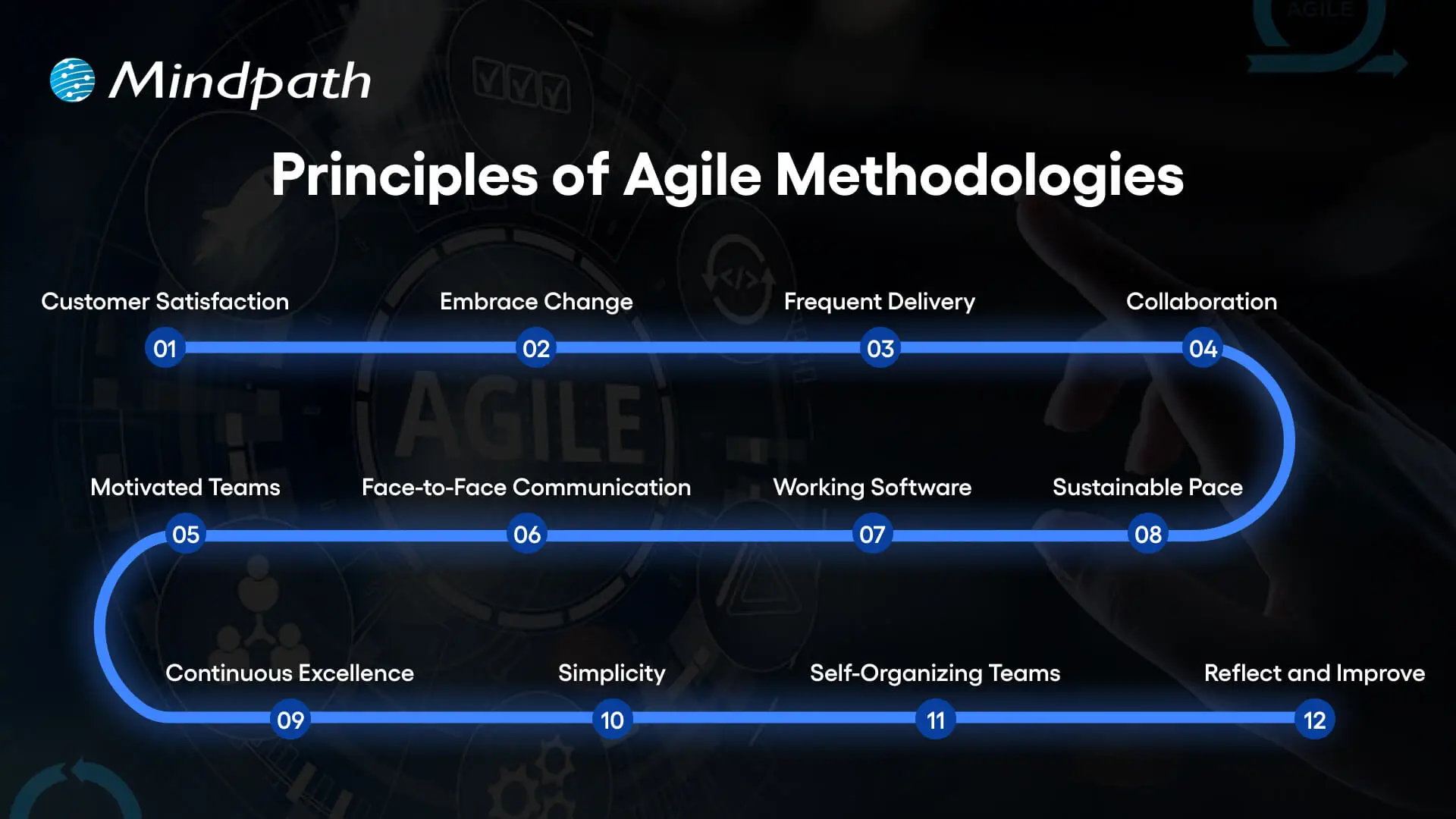
The 12 Principles of Agile methodology build on the 4 core values and are used to help put them into practice in real-world projects. They provide a key for teams to focus on collaboration and flexibility, and continuously deliver value to customers.

Principles of Agile Methodologies

1. Customer Satisfaction

Customers should be satisfied by receiving value sooner rather than later.

2. Embrace Change

Adopt the mindset that the most valuable features might change and keep an open mind toward new needs, even late in a project.

3. Frequent Delivery

It’s important to deliver and share updates frequently to make sure that you’re showing consistent value to customers.

4. Collaboration

Remove silos and work together as a team.

5. Motivated Teams

Organize work around motivated individuals, people who are ready to work hard and have a commitment to their work.

6. Face-to-Face Communication

Conversations will make for a quicker, clearer understanding.

7. Working Software

Demonstrate progress with working software.

8. Sustainable Pace

Progress can continue if a sustainable speed is possible so that the team goes home and rests and comes back tomorrow.

9. Continuous Excellence

Strive to be smarter & faster by raising the quality.

10. Simplicity

Opt for the simplest & most effective solutions rather than the complicated & ineffective ones.

11. Self-Organizing Teams

Allow teams to organize themselves and provide real value.

12. Reflect and Improve

Regularly stop and reflect to learn and improve for value.

Curious about how Agile fits into real software build workflows from idea to launch? Learn the custom software development process to understand how Agile practices help teams stay flexible and aligned with business goals.

Advantages of Agile Methodology

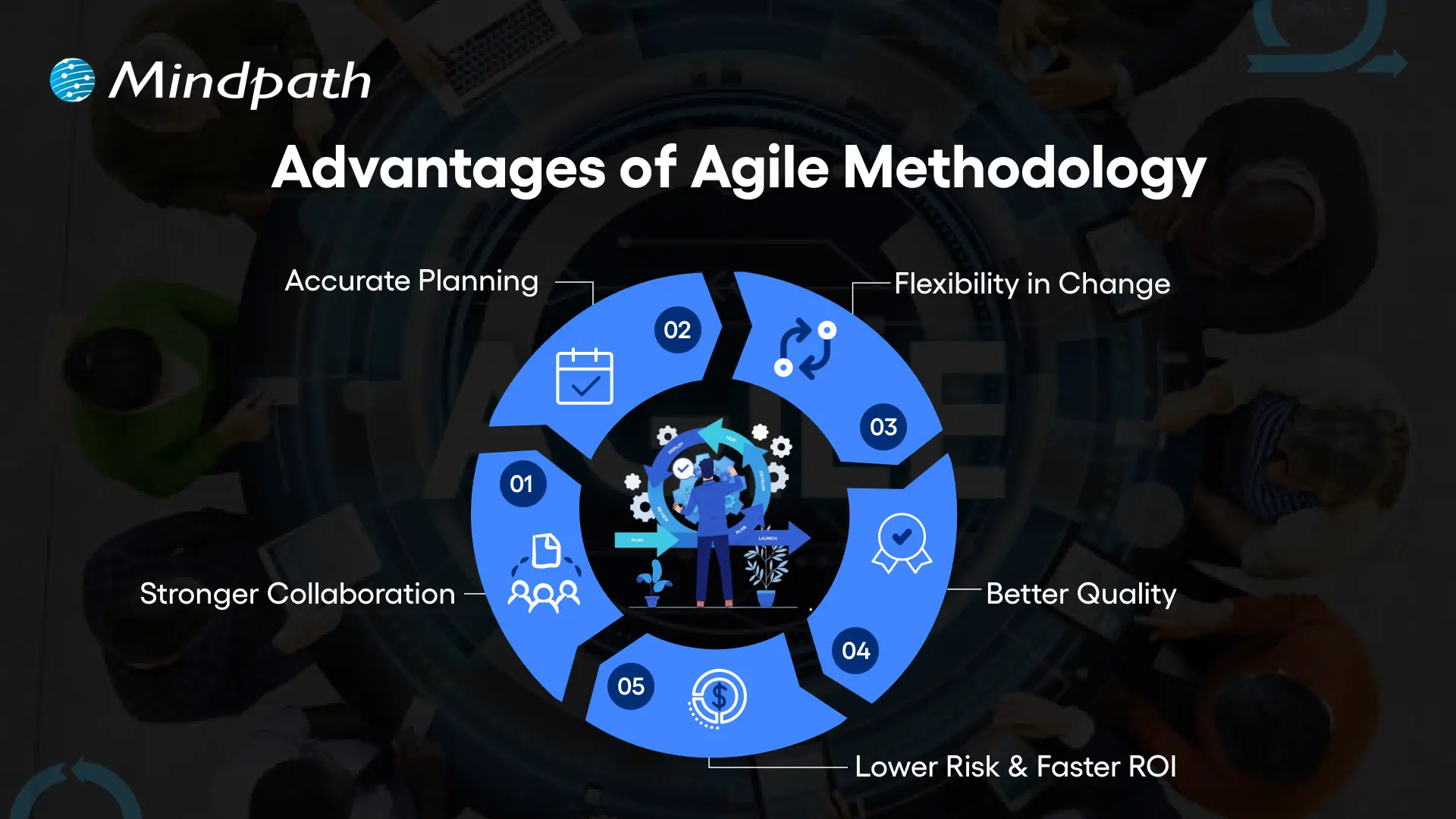
Agile methodology provides a flexible approach to project management that keeps customer needs first. These are the main advantages that make it a highly-sought after strategy for modern development.

Advantages of Agile Methodology

1. Stronger Collaboration

The agile methodology creates constant client involvement, building transparency, and ensuring developers stay aligned with real needs.

2. Accurate Planning

With agile, project managers can estimate costs and timelines more precisely through short, iterative sprints.

3. Flexibility in Change

Agile methodology project management allows quick adjustments to market shifts or client requirements without slowing progress.

4. Better Quality

Agile integrates continuous testing, which helps identify issues early and deliver reliable, high-performing products.

5. Lower Risk, Faster ROI

By following agile methodology practices, teams reduce risks with frequent feedback and deliver faster returns through incremental value.

Not sure how development structure impacts long-term ROI? Explore how Agile-driven SDLC models reduce rework, control costs, and deliver measurable business value.

What is the Process of Agile Methodology?

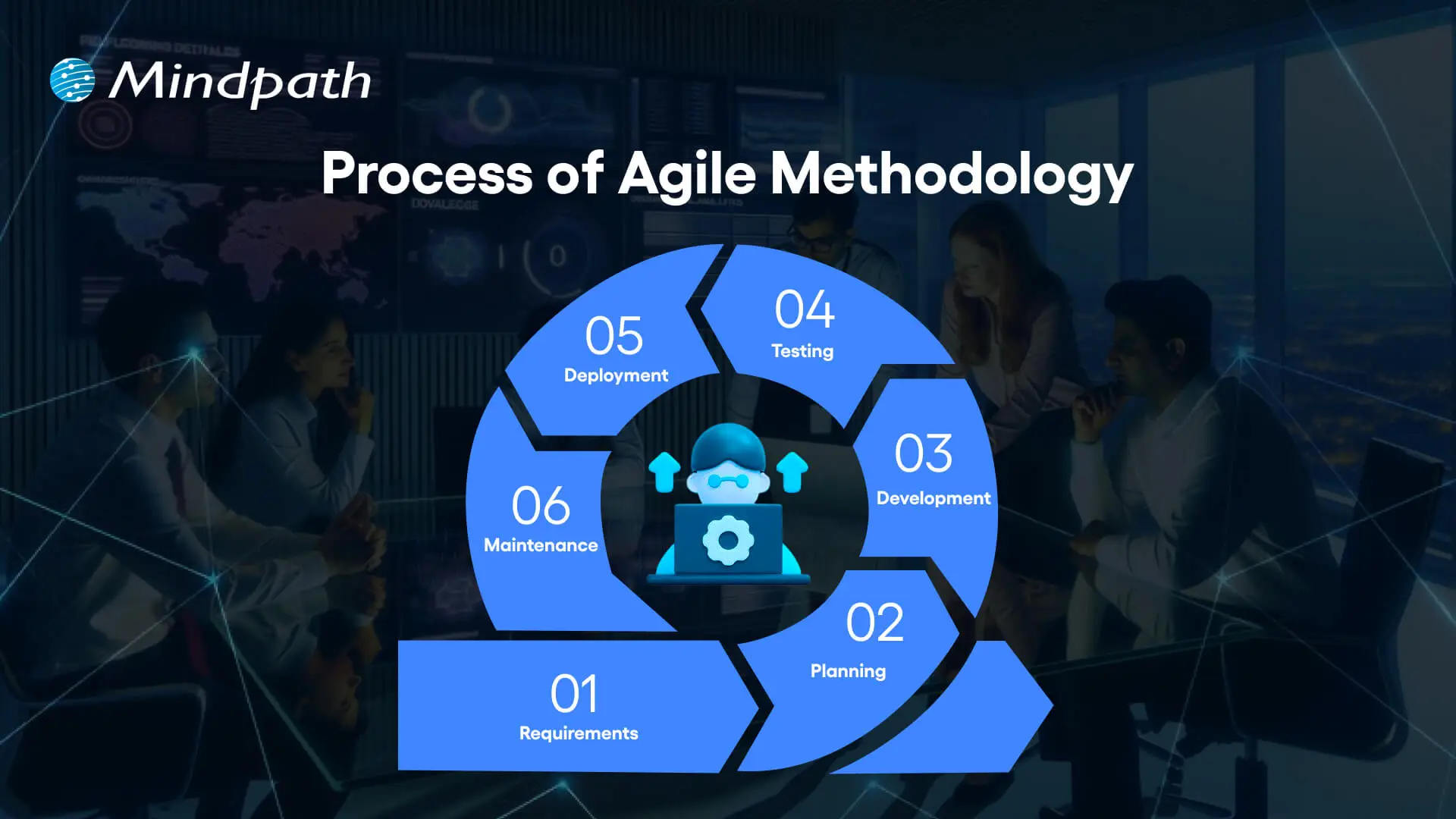
The agile methodology process emphasizes looking at projects in smaller, more manageable steps to create quick, flexible progress. The agile project methodology has teams working because of different cycles, quickly adapting to changes and delivering value in every step.

Process of Agile Methodology

1. Requirements

Teams root through customer requirements and prioritize them against business objectives and user needs. It’s a liberation activity that sets the course of the project and a solid base for the later phases.

2. Planning

The planning phase creates a roadmap for development and delivery. Teams agree on the schedule, sprint goals, and resources within the confines of the agile framework to maintain flexibility.

3. Development

Developers develop features in short iterations using Agile methodologies. The aim is to deliver working software quickly across agile techniques; collaboration and adaptability are important.

4. Testing

Once a feature is built, the team immediately tests the feature. Testing is performed to ensure the software works properly and meets the quality expected by the customer.

5. Deployment

The product or feature is launched for actual use. Early releases will enable users to provide feedback that can inform future improvements in the agile methodology process.

6. Maintenance

Teams constantly maintain and enhance the software to meet customer requirements. In agile methodology, the maintenance step of the product becomes an evolving process within the context of ongoing agile system development.

Worried that Agile alone won’t prevent costly mistakes in your software delivery? Explore common mistakes in custom software development projects and how proper planning and Agile practices can help avoid them.

When Does Agile Deliver the Most Value?

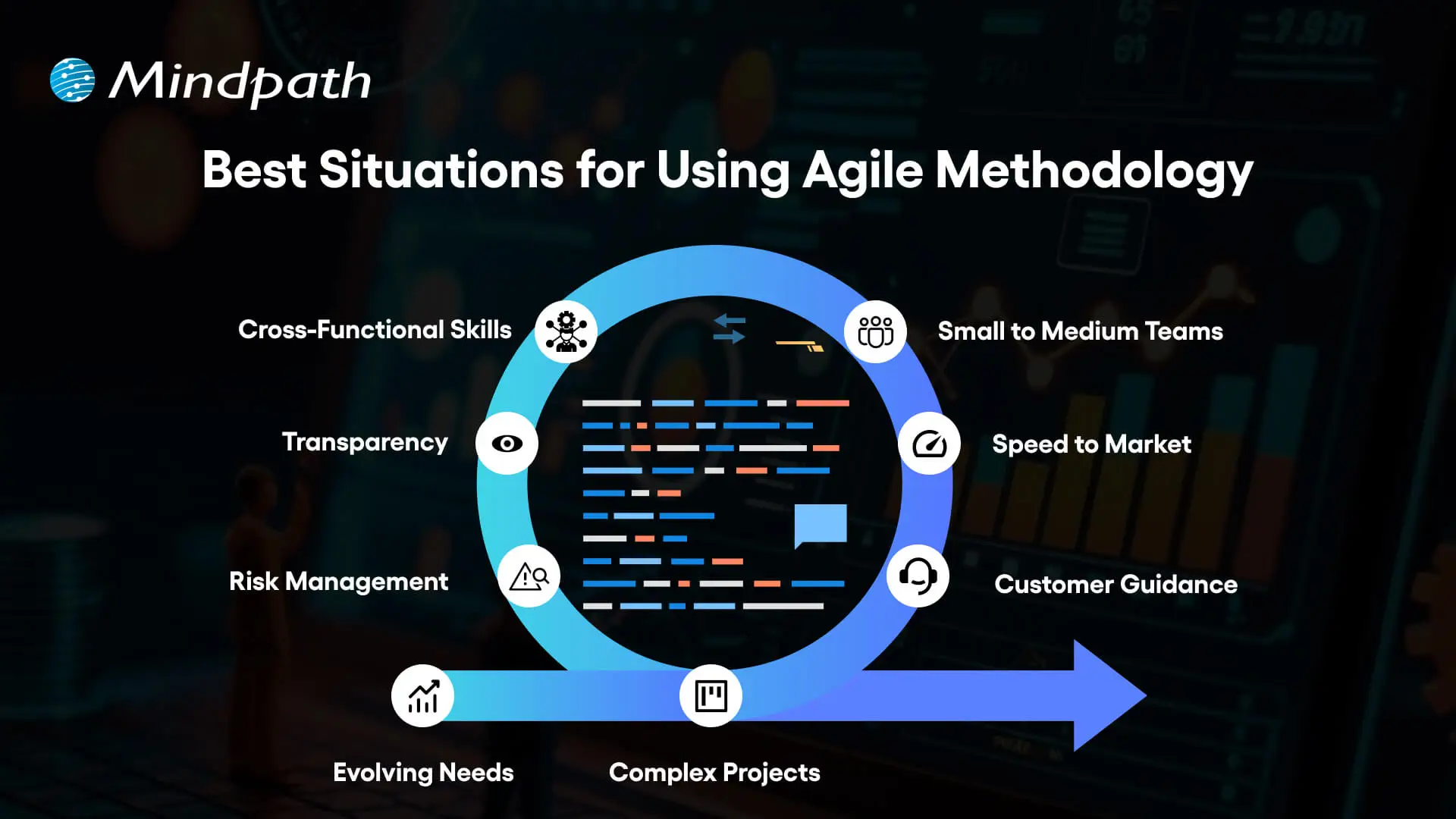
The agile style works best for projects that need flexibility and constant advancement. Here are several examples of where it offers the most value.

Best Situations for Using Agile Methodology

1. Evolving Needs

The agile methodology is the best option for projects with changing or ambiguous requirements because it allows teams to shift focus quickly while still maximizing delivery.

2. Complex Projects

Large and complex projects become easier to handle when broken into smaller, manageable parts. This approach reduces errors and improves coordination.

3. Customer Guidance

Regular customer feedback ensures the product meets actual needs. It creates a strong link between users and the development team.

4. Speed to Market

Short sprints make it possible to release working features quickly. This helps businesses gain a competitive edge faster.

5. Small to Medium Teams

Agile methodology works best for teams of a few to a few dozen people. It keeps communication simple and collaboration effective.

6. Cross-Functional Skills

Teams with developers, testers, and designers working together achieve higher quality. This collaboration reduces dependency on outside resources.

7. Transparency

Everyone involved can see the project’s progress clearly at all times. This openness builds trust and accountability.

8. Risk Management

Teams detect issues early and resolve them before they grow bigger. This approach reduces delays and prevents unexpected problems.

Struggling to justify the business case for investing in custom development alongside Agile practices? Discover the top benefits of custom software development and see how Agile can help you unlock scalable, tailored solutions that grow with your company.

Want to Unlock Success with Agile Methodology?

The agile methodology has transformed how businesses manage projects, deliver value, and respond to change. Focusing on flexibility, collaboration, and continuous improvement, it gives teams the tools to adapt quickly while keeping customers at the center. Its principles and processes ensure projects move smoothly, delivering higher quality outcomes and long-term success in a competitive digital landscape.

At Mindpath, we use the agile methodology to design and deliver custom software that evolves with your business. Our approach blends speed, adaptability, and technical expertise to create solutions that meet real needs. With strong collaboration and a focus on innovation, we help businesses reduce risk, accelerate growth, and achieve sustainable results through high-performing, tailored products.

Frequently Asked Questions

1. How is agile methodology different from traditional project management approaches like Waterfall?

Waterfall follows a fixed sequential process where each phase must finish before the next begins. Agile works in short cycles with continuous feedback and adjustments. This makes Agile far more flexible and responsive to change, especially in projects where requirements are likely to evolve during development.

2. Can agile methodology work effectively for non-software projects outside of technology?

Yes, Agile principles apply well beyond software. Marketing campaigns, product launches, and even operational projects benefit from iterative planning, regular feedback, and flexible execution. The core idea of delivering value in smaller steps and adapting quickly translates effectively across many different industries and project types.

3. How does agile methodology actually help reduce project costs over time?

By catching issues early through continuous testing and frequent feedback, teams avoid costly rework later. Shorter sprints also mean problems surface quickly before they grow. This combination of early detection and incremental delivery keeps budgets more predictable and reduces the financial risk of large project failures.

4. What team size works best when applying agile methodology to a development project?

Agile works best with small to medium sized teams, typically between five and fifteen people. Smaller teams communicate more easily, make faster decisions, and stay better aligned. Larger groups can still use Agile but may need additional coordination frameworks to maintain the collaboration and transparency the methodology depends on.

5. How do businesses measure whether their agile methodology implementation is actually working?

Track sprint velocity, delivery consistency, customer satisfaction scores, and defect rates over time. If teams are delivering working features regularly, adapting to feedback without major disruptions, and maintaining team morale, those are strong indicators that the Agile process is functioning well and delivering real business value.

Discover how Agile methodology transforms web and app development with flexibility, collaboration, and faster delivery.
Wordpress vs workflow

In the year 2025, the debate of WordPress vs Webflow is hotter than ever. This is because business entities and content creators are looking for the best platform to build secure as well as SEO-friendly websites. It is true that WordPress has been dominating the CMS market thanks to its vast plugin ecosystem coupled with high flexibility. But it is essential to bear in mind that Webflow has been gaining momentum with designers as well as startups, thanks to its no-code visual editor along with built-in hosting. 

In case you are wondering, is Webflow better than WordPress? You need to look at the main difference between these tools. You need to know which one is better so that you can choose the tool that perfectly aligns with your needs. The guide breaks down everything you need to know while choosing Webflow or WordPress.

Choosing the right platform makes all the difference when it comes to performance and growth for your online presence. Explore Mindpath’s WordPress development services for expert guidance on what your business needs.

A Deep Dive into WordPress

WordPress is the most popular content management system (CMS) in the world, currently powering over 40% of all websites on the internet. It lets you create, build, and manage your own website without needing coding knowledge. WordPress has gained massive popularity thanks to its ease of use coupled with flexibility, making it an ideal tool for beginners, professionals, and businesses alike.

At its core, WordPress is a free, open-source content management system. This means anyone can use, modify, or distribute it at no cost, and it’s continually improved by a global community of developers. One of the biggest strengths of WordPress is its SEO-friendly structure. The novel platform generates clean and crawlable code that adds value to search engines’ index content efficiently. Users can even leverage useful plugins such as Yoast SEO and Rank Math for optimizing titles and meta descriptions that can improve the visibility in search results.

An Insight into Webflow

Webflow is a cloud-based visual web development platform that lets you design, build, and launch responsive websites without writing code. It bridges the gap between design and development by letting users design visually on a canvas while the platform automatically generates clean, production-ready HTML, CSS, and JavaScript in the background. This makes Webflow a favorite among designers who want creative freedom without relying on developers.

A standout feature of Webflow that you need to be aware of is related to its design flexibility. Users have the option to create fully custom layouts as well as animations without having to write a single line of code. Webflow basically combines the best of graphic design tools with the functionality of a content management system (CMS), generating clean HTML, CSS, and JavaScript behind the scenes as you design. For businesses that need more tailored solutions, custom WordPress development offers similar flexibility with the added power of plugins, themes, and scalability, allowing organizations to build websites that precisely meet their unique requirements. It serves as a valuable tool for businesses and startups that wish to leverage its ability to deliver professional and responsive websites effectively and efficiently.

Comparison Between WordPress and Webflow

Now that you have an insight into Webflow and WordPress, it is time to look at the difference between these novel tools. Developers as well as businesses need to understand the difference between WordPress and Webflow so that they can make a wise selection. The core differences have been presented by focusing on specific areas such as ease of use, design, customisation, and many other features. 

1. Ease of Use

Webflow offers a visual no-code editor. It is highly appealing to designers as well as marketers. In fact, it is great for rapid prototyping along with pixel-perfect layouts. On the other hand, WordPress requires setup with a theme or page builder. So beginners may take some time to learn how to use the tool. However, developers with proper knowledge and experience can get full control over the tool. Thus, while discussing Webflow vs WordPress, a major difference between them revolves around the ease of use.  

2. Design and Customization

Webflow serves as an ideal tool for making custom designs without requiring any coding. The responsive control built in can ensure that users can derive optimum value from the tool even if they have limited coding-related skills. On the other hand, WordPress has a large ecosystem of themes as well as plugins. These elements make it highly customizable in nature. But this maturity also makes it plugin-dependent at times.

3. SEO Features

Webflow provides built-in SEO tools such as meta tags and schema options. It even delivers strong performance when it comes to integrated hosting. However, WordPress relies on plugins such as Yoast SEO for advanced SEO control. Thus, this feature makes WordPress extremely powerful, which is capable of precise optimization. You need to bear in mind that, starting from Webflow to WordPress, the role of top SEO features is a must for users.

Stuck deciding whether WordPress or Drupal is a better match for your business? Our WordPress vs Drupal guide breaks down key differences to help you pick the perfect solution.

4. Security

While talking about WordPress vs Webflow, it is a must to take into account the security aspects. Webflow is certainly more secure by default in comparison to WordPress. This is mainly because it offers built-in security features such as DDoS and SSL protection. The top-notch security feature of Webflow acts as its major strength. When it comes to WordPress, the security mainly depends on users. You need to manage separate security plugins and carry out frequent maintenance in order to prevent vulnerabilities. In order to boost the level of security, you need to make sure that you, as a user, maintain cybersecurity resilience while developing your website. 

5. Performance

Webflow is capable of offering better out-of-the-box performance. This is mainly because of integrated hosting coupled with a global Content Delivery Network and clean code. On the other hand, when it comes to WordPress, its performance mainly depends on the chosen hosting and plugins. The selected theme can also impact the performance that is delivered by the tool. If you use Webflow, your website can load faster by default. But if you choose WordPress, you can rest assured about the site performance if you choose appropriate hosting. 

6. Pricing

If you are wondering – is Webflow similar to WordPress in terms of pricing, the answer is no. The pricing of WordPress is variable in nature. You may have to incur separate costs for different things, such as hosting and a domain. Similarly, the price also depends on the chosen plugins and themes. So it may seem cheaper initially, but its price may increase with additional functionality. When it comes to Webflow, the pricing is based on the all-inclusive subscription model. It can become expensive for you if you opt for higher-tier plans.  

Want to make sure your WordPress site is accessible to everyone? Check out our post on improve WordPress web accessibility to learn practical steps for making your site more inclusive and user-friendly.

WordPress vs Webflow – Comparison Table

The difference between WordPress and Webflow has been presented in the table below. You need to understand how Webflow and WordPress are different from each other so that you can choose the ideal tool wisely. The insight can surely guide you to decide which platform you intend to use to fulfil your specific needs. 

Features Webflow WordPress
Ease of Use  No Coding Knowledge needed  Coding knowledge is not strictly needed but can help for advanced customization
Design and Customization Highly flexible in nature  Availability of extensive themes for customization
SEO Features Built-in SEO tools Availability of SEO friendly structure 
Security  High security  Low security 
Performance High optimization for speed Performance depends on hosting 
Pricing Subscription-based pricing model Variable pricing model

Final Winner Between WordPress and Webflow

You must choose Webflow if you prioritize visual design control along with built-in hosting. Webflow is the better choice if you need to manage your website in a simple way. It is well-suited for small business entities as well as startups that want to launch their site quickly with a clean and modern design.

WordPress is an ideal choice for you if you are looking for scalability and advanced SEO capabilities, along with flexibility through plugins. In such cases, WordPress can certainly act as a stronger platform that can meet your needs perfectly. The platform is best-suited for enterprises and e-commerce stores that wish to have full control over SEO as well as integrations. 

Therefore, both Webflow and WordPress serve as useful tools. You need to choose between WordPress and Webflow by considering your needs. In case you are wondering – Does Webflow work with WordPress? The good news is, yes! Webflow can definitely work along with WordPress if you utilize the official Webflow Pages plugin. It will certainly allow you to build pages in Webflow while serving them on your WordPress site.

Worried about security risks and vulnerabilities on your WordPress site? Read our guide on safeguarding WordPress vulnerabilities to learn how to protect your site and keep it secure against threats.

Final Words

The emergence of WordPress and Webflow has been transformational in the prevailing business world. Both these platforms have their unique strengths and advantages. The ultimate choice between WordPress and Webflow in the year 2026 mainly depends on the goals of your website and your budget. You also need to take into consideration the long-term growth plan before making the choice between WordPress and Webflow.

If you wish to derive optimum value from WordPress, you need to partner with a reliable partner. Mindpath’s top-grade WordPress development services can certainly help you develop a world-class website. It can offer the ultimate go-to solution in terms of scalability as well as limitless customization. You can also take advantage of the advanced SEO-friendly structure in order to boost the online visibility of your website. It can certainly give an edge to businesses in the competitive business world.

Frequently Asked Questions

backend vs frontend

The most common words that you will find in any web development cheat sheet are frontend development and backend development. These are the two critical components that make up a web application and work in unison to deliver desired functionalities. The backend vs frontend comparison is one of the essential points every web development beginner must learn before diving into practice. 

With more than a million live websites running all over the world right now, learning about frontend and backend development can be a huge advantage. Frontend developers work on the visual aspects of a website, including its layout, design, styling, and buttons. On the other hand, backend developers work on the things that drive a website behind the scenes, including its database, logic, and security. With this post, let us dive deeper into the differences between frontend development and backend development.

Want to hire developers who can handle both front and backend development? At Mindpath, we provide full-stack development services where you get versatile solutions to accelerate your project success.

Understanding Frontend Development

Before exploring the differences between frontend and backend development, you must know their basic definition. Frontend development, often called “client-side” development, is the creation of the visual and interactive elements of a website or application that users directly see and interact with. It acts as the bridge between design concepts and digital technology, ensuring a seamless, responsive, and engaging user experience. Most of the work of frontend developers revolves around converting innovative design ideas into functional elements on web pages. Frontend developers rely on programming languages like JavaScript and HTML to create visually appealing user interfaces with elements that offer the best user experience. 

At first glance, one would imagine that frontend developers focus only on the aesthetics of web applications. However, the backend vs frontend comparison should also focus on the fact that frontend developers also implement the website’s architecture, pick the CSS styling option, set up build tools, and organize files and directories. Frontend development also involves the use of frameworks like React and Angular to optimize the performance of a website. 

Understanding Backend Development

The next player in the discussions on “What is frontend and backend development?” or Backend development is the server-side of software development. It focuses on the invisible “behind-the-scenes” mechanisms that power websites and apps, including databases, server logic, and APIs (application programming interfaces), which process data and deliver responses to the user. Backend development also includes bridging the gap between the backend and frontend of web applications to facilitate the seamless flow of data. 

You must know that backend developers work on scripting, website architecture, database management, server management, and API management. The search for answers to “What is front-end and back-end programming?” will show that backend developers use different frameworks like Django and Ruby on Rails. Backend developers capitalize on these frameworks to accelerate the development process with better efficiency. One of the overarching objectives of a backend developer is to create and implement an architecture that aligns with the project goals. 

Identifying the Differences in a Backend vs Frontend Comparison

The first thing that you should know while comparing frontend development with backend development is that they both are significant aspects of web development. Most of the discussions about “What is backend and frontend?” focus on how they help you make better web apps. However, an overview of the differences between them will offer valuable insights on how to use both effectively for your next web project.

1. Goal of the Development Process

The definitions of frontend development and backend development give a clear impression of their goals. Many people assume that frontend development emphasizes solely on creating the user interface. Frontend development focuses more on creating a positive user experience and optimizing web apps for better performance and accessibility. Frontend developers ensure that users can easily interact with an application that is accessible on different platforms and devices. 

The goal of backend developers is to create and maintain the server-side architecture of web applications. One of the notable aspects in a frontend vs backend developer comparison is the complexity of responsibilities that fall on backend developers. The responsibilities in backend development involve creating a reliable architecture that delivers efficiency and accuracy in its results. Backend developers must also accommodate all user requirements, alongside addressing the concerns in security and reducing costs.

2. Technologies Used in the Process

Another significant point of comparison between frontend development and backend development is the list of technologies used in them. The most common languages used in frontend programming are HTML, CSS and JavaScript. Frontend developers also work with frameworks like React, Vue, and Angular to make the apps more intuitive and responsive.

You can notice a stark difference between the programming languages used in frontend and backend development. The most popular additions in a backend language list include Java, Ruby and Python, which help in writing the server-side code. Backend developers use frameworks like Ruby on Rails and Django to capitalize on diverse tools for faster and efficient development. The list of technologies used in backend development also includes database management systems, API technologies, and storage technologies.

Want to upgrade your digital operations and improve development efficiency? Explore our blog on full-stack development benefits to learn how a unified skill set can cut costs, speed delivery, and elevate your product quality.

3. Security

The next prominent aspect that differentiates frontend development from backend development is the element of security. How do frontend and backend developers safeguard the components of a web application from threats? The backend vs frontend comparison must shed light on how frontend security focuses on client-side scripts, input forms, and user authentication. Some of the general strategies for frontend security include disabling the settings for typing code in the text boxes, multifactor authentication workflows, and input validation. On the other hand, users also share some responsibility for frontend security with password and device protection.

The primary target of backend security is the data in transit and storage. Backend developers have to manage everything from authentication to session control and access controls. Backend security encompasses all the backend programming languages, connected databases, and APIs. The notable best practices for backend security include secure systems for authorization and authentication, secure coding practices, and data encryption.

4. Concurrency

The differences between frontend development and backend development also bring the limelight towards the issue of concurrency. The difference between a backend and a frontend developer is that frontend development has nothing to do with concurrency. In the case of the frontend of an application, every user has a copy of the application on their mobile app or browser. Therefore, frontend developers don’t have to think about concurrency issues.

On the other side of the project, the backend has to deal with multiple requests at a time. How will the backend manage thousands of requests within seconds? The solutions to concurrency issues in backend programming include asynchronous programming, multi-threading, and event-driven programming.

Looking to elevate your tech strategy this year? Explore our blog on full-stack development trends to discover what’s driving innovation and how these trends can give your business a competitive edge.

Here is a brief summary of the backend vs frontend comparison.

Criteria Frontend Development Backend Development
Goals of the Process Frontend development focuses on creating a positive user experience and optimizing web apps for better accessibility, visual appeal, and responsiveness. Backend development aims to develop and implement a reliable web application architecture that ensures enhanced efficiency and performance. 
Technologies Used Frontend developers use languages like JavaScript, HTML, and CSS, and frameworks like Angular and React. Backend developers use Ruby, Python, and Java to write server-side code and frameworks like Django and Ruby on Rails.
Security Frontend security emphasizes multifactor authentication workflows, input validation, and password protection. Backend security revolves around security coding, stronger authentication and authorization, and data encryption.
Concurrency Frontend developers don’t have to worry about concurrency. Backend developers use different strategies, such as multi-threading and asynchronous programming, to manage concurrency.

Ready to strengthen your tech capabilities with minimal complexity? Explore our blog on hiring full-stack developers to see why professionals are the most strategic choice for speed, innovation, and cost-effective growth.

Build Better Web Applications with Full-Stack Development

The comparison between frontend development and backend development revealed that both components must work cohesively to create better web applications. If you want to build a web app, then you must know how the backend frontend relationship helps you translate ideas into functioning web apps. Frontend development is different from backend development in terms of security strategies, concurrency issues, and technologies used in the process. 

We specialize in both frontend and backend development with years of experience in the industry. We have been delivering end-to-end IT solutions with our full-stack development services, which include both frontend and backend development. Our experts at Mindpath work with different frontend and backend languages and frameworks to create web apps that help you achieve your business goals. Consult with our experts to find the ideal solutions for your next web development project now.

Frequently Asked Questions