

AI Governance Platforms: Empowering Ethical and Transparent AI

Join our Newsletter!

Featured Posts

Support Is One Click Away

Home

AI Governance Platforms: Empowering Ethical and Transparent AI

AI Governance Platforms

AI Governance Platforms: Empowering Ethical and Transparent AI

Have you ever wondered who’s keeping an eye on the rapid advancements in AI? As artificial intelligence grows more powerful, so does the need for systems that can ensure its responsible and ethical use. This is where AI governance platforms enter. But how exactly do these platforms work, and why are they becoming essential for businesses and societies alike? Let’s explore how AI governance platforms are shaping the future of trustworthy AI. 

What is AI Governance?

AI Governance ensures that artificial intelligence (AI) is utilized safely, responsibly, and equitably. It contains rules, processes, and tools that bring together professionals from many fields like data science, engineering, law, and business. The objective is to assist these teams in collaborating to guarantee that AI systems are developed and maintained in ways that are beneficial to humans and do not cause damage. 

AI Governance also assists firms in ensuring that their AI systems adhere to crucial guidelines and fulfill commercial and ethical standards. This implies that the system is verified and led at every point, from developing the AI model to using it in real-world scenarios, to ensure that it is appropriate, fair, and helpful to all parties involved. 

Why are AI Governance Platforms Important?

AI Governance platforms are essential tools for helping businesses employ artificial intelligence (AI) in a safe, fair, and ethical manner. By establishing rules and checks, these platforms avoid errors and defend against possible AI dangers, ensuring that AI systems are utilized responsibly. They assist businesses in adhering to crucial legal standards, preventing potential complications that can arise if AI is utilized improperly. 

These platforms help foster confidence among clients and the public by making AI more transparent, demonstrating how it works, and addressing any concerns about fairness or prejudice. They bring together specialists from many fields such as data science, engineering, and law to collaborate on ensuring AI matches ethical, business, and legal objectives. 

Features of AI Governance Platforms

1. Risk Assessment

Risk assessments are an important aspect of AI governance platforms, ensuring that AI systems function fairly, safely, and responsibly. These assessments are aimed at identifying possible issues early on, such as biases in how the AI makes judgments, threats to users’ privacy, or any negative effects on society. For example, an AI tool can accidentally favor one group over another, or it may gather and use sensitive data without consumers completely comprehending how it is utilized. 

By doing these risk assessments, AI governance systems assist businesses in avoiding situations that could lead to harm or unfair results. They examine the AI’s procedures and data to determine whether any hidden biases or unexpected consequences could arise. This proactive approach not only helps prevent misuse of AI but also builds trust by making sure the AI systems align with ethical standards. 

2. Accountability

Accountability in AI governance platforms establishes explicit accountability for governing and supervising AI systems. These platforms assist in identifying the essential tasks and teams responsible for ensuring that AI is created and deployed responsibly. They facilitate cooperation among many stakeholders, including engineers, data scientists, compliance specialists, and legal teams, who work together to create, test, and enhance AI systems. 

By establishing accountability, AI governance platforms guarantee that everyone participating in the development process understands their responsibility in maintaining ethical AI practices. This helps to avoid possible misuse, ensuring that ethical standards are followed, and fosters openness. The platform also analyzes and monitors AI systems over their entire career to ensure that they continue to operate fairly and ethically.  

3. Compliance Management

Compliance management in AI governance platforms includes tools for monitoring and ensuring that AI systems adhere to legal and ethical norms. These platforms monitor current legislation, such as GDPR (General Data Protection Regulation) and CCPA (California Consumer Privacy Act), and automatically update when laws change. The platform assists organizations in avoiding legal risks and penalties by ensuring that AI systems are in compliance with these standards. 

In addition to regulatory compliance, these technologies guarantee that AI systems are utilized responsibly, with data management and decision-making procedures that are transparent and fair. The platform continually analyzes AI systems to detect possible infractions, assisting enterprises in remaining compliant with both existing and upcoming legislation.  

4. Lifecycle Management

Lifecycle Management in AI governance platforms entails monitoring the development of AI models at each stage and implementing the appropriate checks and controls. These platforms guarantee that ethical issues are incorporated at every stage, from basic design to deployment and maintenance. Platforms use these restrictions to enable teams to build AI models that are fair, transparent, and ethical at scale. 

Furthermore, these tools guarantee that AI models follow engineering best practices, making them trustworthy, safe, and efficient. The objective is to maintain high standards throughout the model’s lifespan, ensuring that it not only performs well but also operates responsibly over time. This ongoing oversight helps prevent issues like bias or unethical decision-making, allowing businesses to scale their AI systems while staying aligned with ethical guidelines and industry standards. 

5. Responsible AI Methods

Responsible AI Methods in governance tools aim to ensure that AI systems are transparent, ethical, and reliable. These solutions incorporate responsible AI principles directly into the development and deployment processes, ensuring that AI models perform properly and without prejudice. By enabling transparency, these platforms enable enterprises to explicitly demonstrate how AI choices are made, fostering confidence among users and stakeholders. 

Transparency also promotes accountability by allowing organizations to track and audit AI choices. This guarantees that the AI system follows ethical norms and meets regulatory criteria. Furthermore, with a comprehensive understanding of how AI works, decision-makers may make educated decisions, ensuring that AI systems are employed responsibly and in the best interests of society.

Also Read: AI in Hyperpersonalization: A New Era of Tailored Customer Solutions  

AI Development Services at Mindpath

Mindpath provides high-quality AI Development Services to assist organizations in developing clever, efficient, and dependable artificial intelligence systems. Our team collaborates with you to develop AI solutions that match your unique requirements, whether you want to automate operations, improve decision-making, or enhance customer experiences.  Our services range from creating and constructing AI models to testing and deploying them. We employ cutting-edge AI technology and best practices to ensure that your AI system operates efficiently and responsibly. This involves ensuring that it is fair, transparent, and adheres to ethical standards. 

Final Thought!

AI governance platforms play a crucial role in ensuring that AI systems are developed and used responsibly, ethically, and transparently. By providing essential tools like risk assessments, compliance management, and lifecycle oversight, these platforms help businesses navigate AI complexities while maintaining trust and legal compliance. At Mindpath, we offer AI development services that focus on building efficient and ethical AI solutions tailored to your needs. Let us help you create reliable AI systems that align with both your business goals and ethical standards. 

Looking for a trusted partner in AI development?

Partner with Mindpath to create ethical, transparent, and innovative AI solutions tailored to your business needs.


Related Post

Related Post

Remote Development Teams

Managing a remote development team can feel like a unique challenge, right? With team members spread across different locations, how can you ensure everyone stays connected, motivated, and productive? What strategies can you implement to keep your team engaged and aligned with project goals? In this blog, we’ll explore practical tips to help you navigate the complexities of remote team management.  

Managing a remote development team is essential because it allows everyone to collaborate effectively even when they are separated by a long distance. Good management ensures that everyone understands their responsibilities and feels connected to the team. When developers are well-managed, they are more productive and satisfied with their job, which leads to better project outcomes. Furthermore, excellent management facilitates issue resolution and keeps the team focused on their objectives. In today’s environment, when many individuals work from several places, qualified management is essential for success. 

So, let’s dive into the tips for managing a remote development team! 

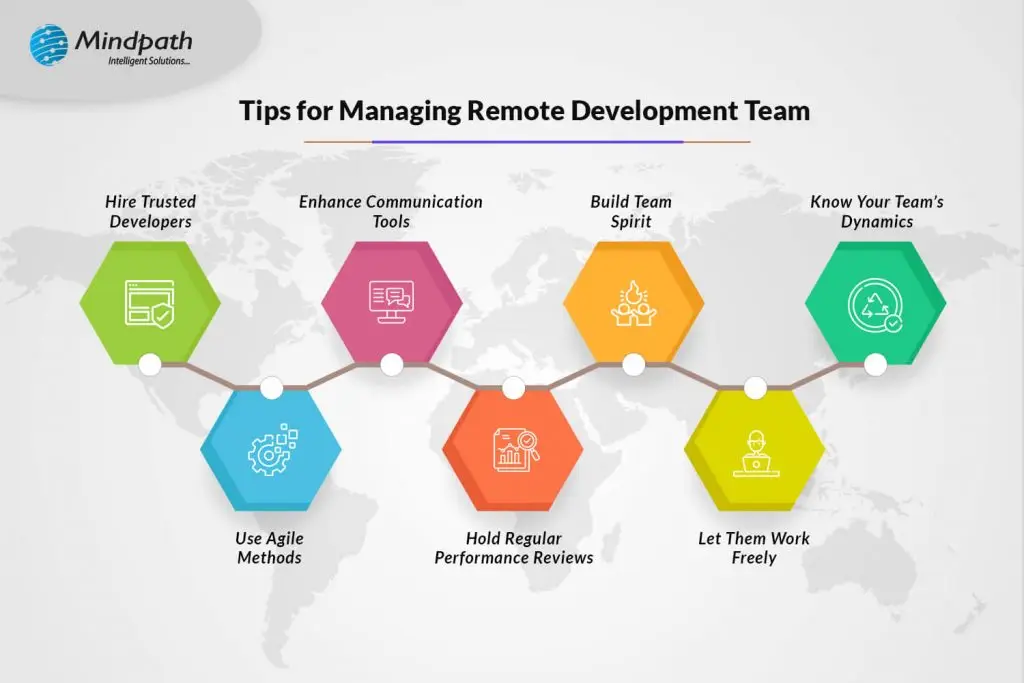
Tips For Managing Remote Development Team

1. Hire Trusted Developers

The first and most significant recommendation is to hire folks that you can trust. Remote work can assist teams become more productive, decrease stress, and save money for the business. However, hiring the wrong individuals might cause serious consequences. When working remotely, it is impossible to manage the team in person. Trust is crucial; team members must be dependable and provide outstanding outcomes. If someone doesn’t appear capable, they can check in regularly via Slack, Zoom, or other methods, which might cause tension and pressure for them. Constant inspection can have an adverse effect on team performance. Establishing a robust recruiting process is crucial for identifying people with the necessary abilities. 

2. Use Agile Methods

One of the most effective approaches is to use the Agile Methodology. This strategy improves communication, cooperation, and project delivery by incorporating market input. Agile works by establishing a flat team structure, eliminating needless hierarchies. It focusses on identifying key aspects of the program to be built based on real-world scenarios. Agile also promotes brief daily meetings known as stand-ups, in which all team members can offer their ideas and updates. Furthermore, the team examines each project update collectively to determine what could be improved, added, or eliminated. Teams that plan and work together can launch a Minimal Viable Product (MVP) as soon as feasible. This ensures that the final product properly fits the demands of the users. 

3. Enhance Communication Tools

An important principle for good communication is to never assume; instead, ask questions and speak out when in doubt. This idea can assist in avoiding misunderstandings within a remote collaboration. Misunderstandings are common while working remotely, so it’s essential to resolve them early with the correct tools and procedures. For example, a team can use Zoom for meetings and special events, Slack for fast reminders and announcements, and Google Drive or Coda for document sharing. These technologies can significantly enhance communication and eliminate misunderstanding. Regular video conferencing is vital for interacting with teammates and fostering collaboration. They let you discuss project progress, identify areas for improvement, and check in on personal problems. These discussions serve to foster trust and transparency in communication. 

4. Hold Regular Performance Reviews

It is essential to schedule frequent performance evaluations to assess both individual and group performance. These appraisals give helpful feedback and assist in identifying areas for development. Setting a constant timetable, whether biweekly or monthly, enables developers to expect comments and focus on improving their performance. These sessions also provide a fantastic chance to acknowledge and appreciate their accomplishments. Encouraging 360-degree input is another great method. This entails getting feedback not only from managers, but also from colleagues and stakeholders. This technique provides a more comprehensive understanding of a developer’s strengths and opportunities for improvement. Developing future action plans is a key component of performance evaluations. Work with each developer to create customized development plans based on the input obtained.  

5. Build Team Spirit

Developing a strong business culture in a remote workplace can be difficult, especially when many people imagine coworkers celebrating birthdays with cake or enjoying themselves after work. However, the essence of workplace culture lies not only in the activities themselves but also in the relationships that they build among team members. It takes purposeful effort to foster a team spirit that boosts everyone’s spirits. Consider organizing virtual team-building events, celebrating accomplishments, or simply checking in with team members. These actions can assist in establishing relationships and foster a positive remote work environment. 

6. Let Them Work Freely

It’s essential to provide engineers with enough room to complete their work. Clients frequently express their worry about how to closely monitor their developers’ work, which can lead to ambiguity regarding progress. The remedy is straightforward: avoid micromanaging. The results speak louder than words. 

While it is essential to analyze performance data, one of the most common mistakes that drive great engineers to quit is attempting to regulate their every move. Developers don’t spend their whole day coding; they frequently require time to think about answers and devise new solutions to challenges. 

The easiest method to evaluate their work is to focus on the results they produce, rather than continually watching their everyday actions. Trusting them to work autonomously leads to a more productive and motivated team. 

7. Know Your Team’s Dynamics

Different teams have distinct meeting and communication requirements. Some teams may benefit from regular meetings to keep focused on project specifics, particularly if their job requires a lot of cooperation. Others might thrive better with fewer, less frequent encounters. To properly manage a development team, you must first learn how each person works best. Recognizing the team’s speed, choosing the most effective tools, and calculating the appropriate number of meetings may all assist to minimize burnout and undue stress. By identifying and respecting individual work preferences, you may foster a productive and peaceful workplace that benefits the whole team’s performance. 

Hire Remote Developer at Mindpath

At Mindpath, we understand that hiring remote developers is a crucial step in bringing your project to life. Our streamlined process is designed to ensure you find the right talent while receiving the support you need throughout the development journey. Whether you’re building a new application or enhancing an existing one, we’re here to help you achieve your goals efficiently. Here’s how our process works: 

1. Gather Your Requirements

Start by reaching out to Mindpath to discuss your project goals and needs. We will review all details and create a comprehensive plan that outlines our approach, timeline, and estimated costs. 

2. Select the Right Talent

We’ll identify remote developers who are the best fit for your project. You will have the opportunity to interview candidates and choose developers who meet your specific requirements. 

3. Kick Off the Project

Once your development team is assembled, we’ll kick off the project with a clear plan and timeline. Our team will maintain regular communication, providing updates to ensure everything aligns with your vision. 

4. Receive Ongoing Support

Mindpath is committed to supporting you throughout the development process and even after project completion. Our goal is to ensure that all your objectives are met and that the project runs smoothly. 

Final Thought!

A remote development team has to be managed effectively using a combination of communication, trust, and culture-building techniques. By prioritizing these characteristics, you can create an environment in which developers feel respected and encouraged to do their best work. Remember that hiring the proper developers is only the beginning. Maintaining an open channel of communication, holding frequent performance evaluations, and cultivating team spirit are essential for keeping your team on track with project objectives. At Mindpath, we streamline the recruiting process to ensure you locate the perfect people for your unique need. We are here to help you throughout your development journey, ensuring that your goals are met and that your projects run smoothly. 

Ready to elevate your project with top-notch remote developers?

Partner with Mindpath for seamless collaboration and expert support.

Discover effective strategies for managing remote development teams, from hiring trusted developers to enhancing communication.

Have you ever wondered to yourself what the future of AI is going to look like? AI will affect how people will live and interact with technology. AI is incorporated in all daily activities, whether that is assisting in a task, giving suggestions, or helping create a seamless process. As technology advances and matures, it will change the way people think, the way people work as well as the decisions people make.  

The future with artificial intelligence certainly has the potential to transform everything from how we communicate and learn, to problem-solving and creativity. The benefits of AI are enabling people to make better decisions, manage time, and explore scenarios like never before. So, what does this growing presence of AI mean for how the world operates? And how might the future of artificial intelligence cultivate the future we are heading towards? In this post, we will explore how AI in a whole new way is changing how we operate in the world. 

Curious how AI can revolutionize your business? At Mindpath, we deliver cutting-edge Artificial Intelligence Development Services to help you innovate and grow. 

The Evolution of Artificial Intelligence (AI)

Artificial Intelligence (AI) refers to the work of developing computer systems that can carry out human-like functions that usually require human intelligence, like learning, problem-solving, and decision-making. In the end, it is making machines that work like people. In today’s world, the use of AI has become normal. You can see the impact of artificial intelligence in homes, schools, and workplaces.  

The artificial intelligence story began in the 1950s as a result of Alan Turing and his idea about machine thinking. In the 1960s, research and early AI development continued to evolve with John McCarthy’s work on the LISP programming language, a powerful language that increased early AI research. During the 1970s and 1980s systems were developed based on rules (known as expert systems), which set the stage for the eventual widespread use of AI.  

By the 1990s, AI began data-driven learning instead of following a strict set of rules. This transformation indicated the beginning of machine learning and neural networks made AI accessible to new areas like language processing and robotic applications for personal and industrial use. Therefore, using models such as GPT-3 and GPT-4, people are currently using AI in more creative and practical ways which generates powerful representations of what artificial intelligence means to us. 

Must Read: AI for Customer Services

The Impact of AI on Future

Artificial intelligence is becoming a key part of the future, with its growing role in daily life and global progress. As technology advances, we can already see AI transforming the future through smarter systems, faster decisions, and improved services. Here are some important areas where artificial intelligence is shaping what comes next.

1. Empowering Human Creativity

AI is taking over routine and repetitive tasks, giving people more time to focus on creative thinking and emotional intelligence. This leads to more meaningful jobs and greater fulfillment at work. Generative AI tools now help writers, designers, and developers move faster with fresh ideas. RAG techniques also improve the quality of AI-generated content. This marks a powerful shift in how people work and innovate.

2. Smarter Decision-Making Ahead

AI in decision-making helps process large amounts of information quickly, offering insights that humans might overlook. This leads to better decisions in areas like personal finance, education, and health. AI agents are becoming more advanced, supporting real-time choices with logic and learning. They’re able to adapt and respond in changing environments. This is a glimpse into how artificial intelligence will change the world.

3. Personalized Education Experiences

AI systems can customize educational paths for each student, improving learning outcomes. These platforms offer real-time feedback, progress tracking, and tailored content. With multimodal AI, students can now learn through text, images, audio, and even interactive content. This enhances understanding and makes learning more engaging. These smart tools are clear future of AI examples already reshaping classrooms.

4. Building a More Inclusive World

AI is helping people with disabilities by providing real-time support tools like voice commands and screen readers. Multimodal AI systems enhance accessibility by understanding both speech and visual cues. This leads to more independence and easier access to services. Inclusive tech design is becoming a priority across sectors. These innovations reflect a growing bond between artificial intelligence and future equity.

Ready to stay ahead of your competitors to build a unique identity in the market? Explore how conversational AI is helping businesses to achieve smarter operations, stronger customer engagement, and sustainable growth.

5. Driving Sustainable Innovation

AI in business strategy plays a growing role in protecting the environment by predicting climate patterns and reducing waste. Digital twins are being used to test and simulate sustainability strategies safely. These models help industries make smarter, more eco-friendly decisions. AI systems also support energy efficiency and cleaner production. Technology is becoming a vital part of building a sustainable planet. 

6. Advancing Safety and Security

AI helps monitor public areas, detect threats, and respond to emergencies. In cybersecurity, it can identify unusual behavior and stop attacks in real time. AI-powered tools work constantly to secure data and systems. As digital threats grow, AI’s role in safety becomes more critical. These AI trends will shape safer environments both online and offline. 

7. Making Services Instantly Accessible

AI assistants and chatbots are helping people access answers and services instantly. These tools are improving with better voice understanding and faster responses. AI literacy is becoming important as users interact more with these systems. The trend is helping people become more confident using technology daily. This also marks a major step in the future of AI in business.

8. Redefining Innovation Through Collaboration

AI is evolving into a true partner in creativity and problem-solving. Generative AI and AI agents now work side-by-side with humans on design, research, and product development. This leads to faster innovation and new discoveries. These collaborations go beyond automation; they spark new ideas. This is the heart of innovation powered by smart technology. 

Curious to know how Gen AI is transforming multiple sectors? Explore our blog on generative AI use cases to discover how businesses are evolving, growing, and creating opportunities in the fast-paced world.

Strategic Approaches to an AI-Driven Future

Artificial intelligence is rapidly reshaping the way we live and work. To stay ahead, it’s essential to adopt smart, forward-looking strategies that align with this evolving landscape.

1. Set a Clear AI Vision

Identify where AI can add the most value to your goals, such as customer service or analytics. Create a step-by-step plan, prioritize key areas, and communicate the strategy clearly across teams.

2. Promote Innovation at Every Level

Encourage different teams to work together and explore new AI ideas through small test projects. Support a culture that treats both success and failure as part of learning and progress.

3. Build and Grow AI Skills

Offer training to help your current team understand and work with AI. Hire skilled professionals and promote continuous learning to stay updated with AI trends.

4. Embed Ethics into AI Use

Create clear guidelines to keep your AI systems fair and transparent. Regularly check for bias and support responsible AI use through proper oversight.

5. Evolve with AI Advancements

Keep up with new AI technologies and adjust your strategy as things evolve. Make sure your data is organized, and AI is integrated into key business activities. 

Aiming to leverage the power of artificial intelligence, understanding the technologies that drive it has become a crucial advantage. To dive deeper into the tools and technologies behind AI innovation, explore our detailed guide on the AI programming languages.

Ready to Shape the Future with AI?

Artificial intelligence is not just changing how we work and think; it is shaping the world around us in powerful ways. As AI continues to grow, it brings smarter tools, more creative opportunities, and better decision-making for individuals and businesses. The future will belong to those who embrace these possibilities early.

At Mindpath, we offer expert AI development services to help you harness the power of artificial intelligence in your business. Our team builds smart, scalable, and ethical AI solutions that drive growth and innovation. Whether you’re starting small or scaling big, Mindpath is your trusted technology partner for an AI-ready future. 

Frequently Asked Questions

1. What makes AI a long-term transformative technology rather than just a trend?

AI continuously evolves by learning from data and improving its performance over time. Unlike static technologies, it adapts to new information and use cases. This ability to scale, learn, and integrate across systems makes it a foundational technology shaping long-term global progress.

2. How does AI balance automation with the need for human involvement?

AI handles data-intensive and repetitive processes, while humans provide judgment, context, and ethical oversight. This balance ensures decisions remain accurate yet responsible. The combination strengthens outcomes by merging computational efficiency with human reasoning and accountability.

3. Why is data quality important for the future success of AI systems?

AI systems rely heavily on data to learn and make predictions. Poor or biased data can lead to inaccurate or unfair outcomes. High-quality, well-structured data ensures reliable insights, better performance, and trustworthy results, making it a critical factor in successful AI adoption.

4. How is AI contributing to more sustainable and efficient systems?

AI improves efficiency by optimizing resource use, reducing waste, and predicting outcomes more accurately. It enables better planning and smarter operations, which support sustainability goals while maintaining productivity. This makes AI an important tool for long-term environmental and operational balance.

5. What role does continuous learning play in adapting to AI advancements?

As AI technologies evolve rapidly, continuous learning helps individuals and organizations stay relevant. Keeping up with new tools, methods, and ethical practices ensures better adoption and usage. This approach builds confidence and supports long-term success in an AI-driven environment.

Explore how is AI transforming future, impacting data privacy, job markets, and business automation. Learn about Mindpath’s AI Services.
node js development company

Imagine you need to create a high-speed, scalable web or mobile app, what technology do you think you should use? Well, most companies will opt for Node.js since it has emerged as one of the leading options in providing high-performance digital solutions. Whether you are starting a new startup or refactoring an existing platform, the success of your project usually begins with selecting the right Node.js development company. But with so many Node.js companies out there, isn’t it difficult to make the right choice? Don’t worry, we’ve got you covered!

This blog offers a nicely constructed checklist through which you can be guided in choosing the optimal Node.js development agency. By following this checklist, you will have some idea and direction during the selection process and also be assured of being aligned with a company that not only meets your technical needs but also comes with you through your long-term success. 

Need professional assistance with your upcoming project? Hire Node.js developers from Mindpath to make sure your application is highly scalable, faster, and high performing.

Understanding Node.js

Node.js is a technology that helps developers create the back end of websites and applications using JavaScript. It is server-side and open source, so programmers can use the same language, JavaScript, on both the front end and back end. It makes the development process easier by making it faster and simpler.

Node.js can handle real-time apps, single-page apps, and applications with a lot of users at the same time. It is used in mobile app development because it has a strong system and beneficial tools. With frameworks like Nest.js, the developer can make elegant, well-structured apps using Node.js. 

Wondering why NodeJS is the preferred choice for modern business applications? Read our blog on advantages of NodeJS for business to discover how it boosts performance, scalability, and development efficiency.

Benefits of Choosing Node.js Development Company

Selecting a Node’s web development company, which is trusted, can make your project faster, smoother and more scalable. With the abilities of Node.js, your app can handle high traffic and real-time updates with ease. Let us look at some of its benefits: 

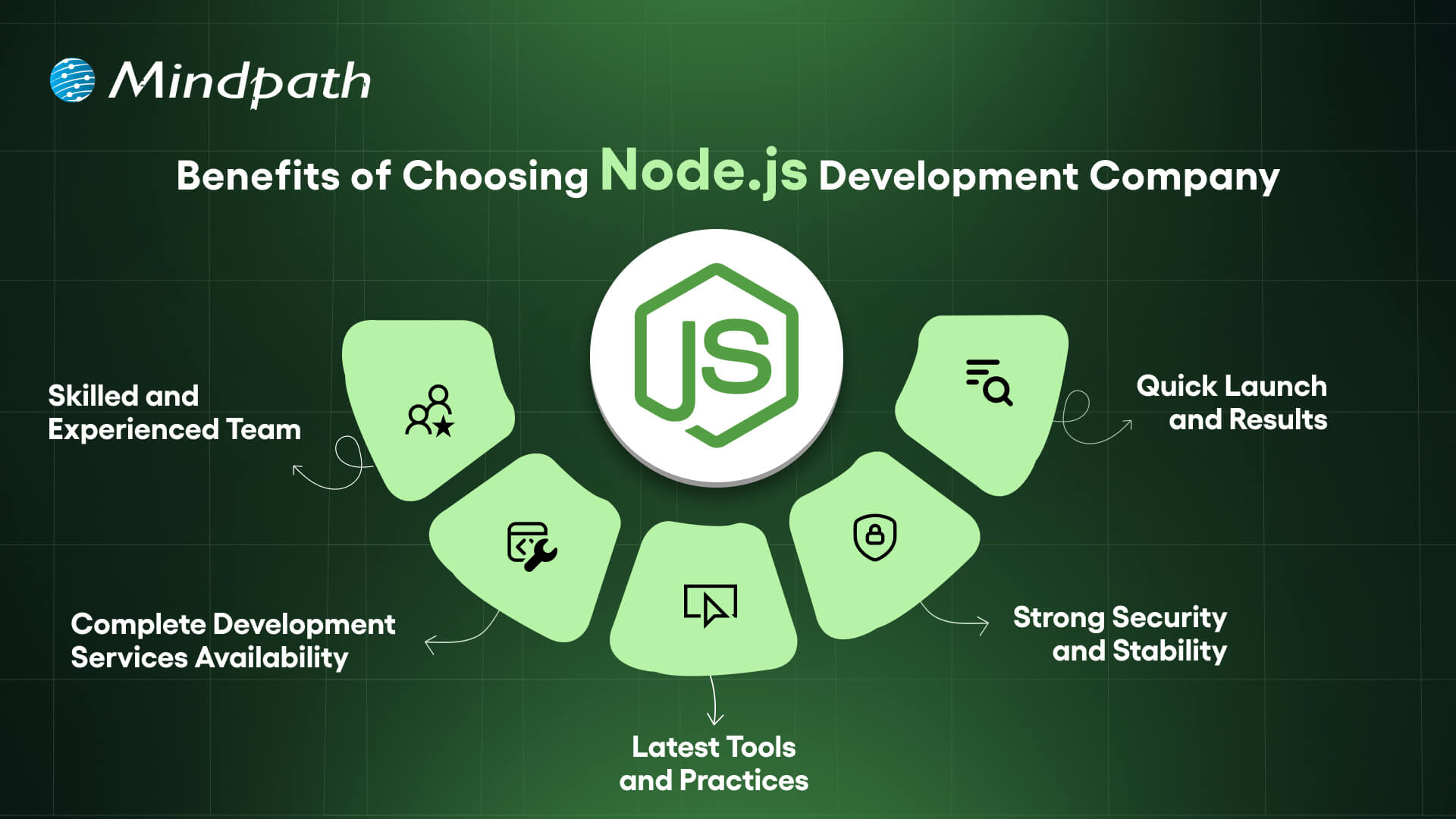
Benefits of choosing nodejs development

1. Skilled and Experienced Team

A Node.js development firm can bring a team of experts who know how to build strong and flexible applications. They have hands-on experience with different types of projects and can offer smart, custom solutions and their knowledge can also help to avoid mistakes and deliver better results from the start. 

2. Complete Development Services Availability

A Node.js development services provider takes care of everything, starting from the discussion to launching and maintaining your app. You don’t need to work with different teams for each part, which can save a lot of time and effort.  Having all the services in one place keeps your project organized and moving forward smoothly. 

3. Latest Tools and Practices

A trusted Node.js web development company always works with the latest tools, updates, and frameworks as they follow modern development practices to build fast, secure, and scalable applications which means your app will be future-ready and can perform well under changing user needs. 

4. Strong Security and Stability

Security is a top priority for a professional Node.js development agency, and they take steps to protect your app from threats by using tested methods to keep your data safe and your app stable. You can count on them to deliver a secure and reliable product that works smoothly. 

5. Quick Launch and Results

When you hire a Node.js development firm, your project moves quickly from idea to launch as their process is streamlined, so that you can get your product out to users much faster which helps you stay ahead of the competition and respond to the market more effectively. 

Looking to supercharge your applications with AI capabilities? Explore our blog on NodeJS Libraries for AI Integrations to learn which NodeJS libraries can simplify and enhance your AI-powered applications.

By now, you must have had a clear idea about Node.js, so let us learn about the most important topic: 

Key Considerations While Choosing the Right Node.js Development Company

When you are looking for the right company, keep in mind that not all software development companies providing Node.js services are the same. Understanding the following key factors can help you find a team that delivers quality and meets your specific needs: 

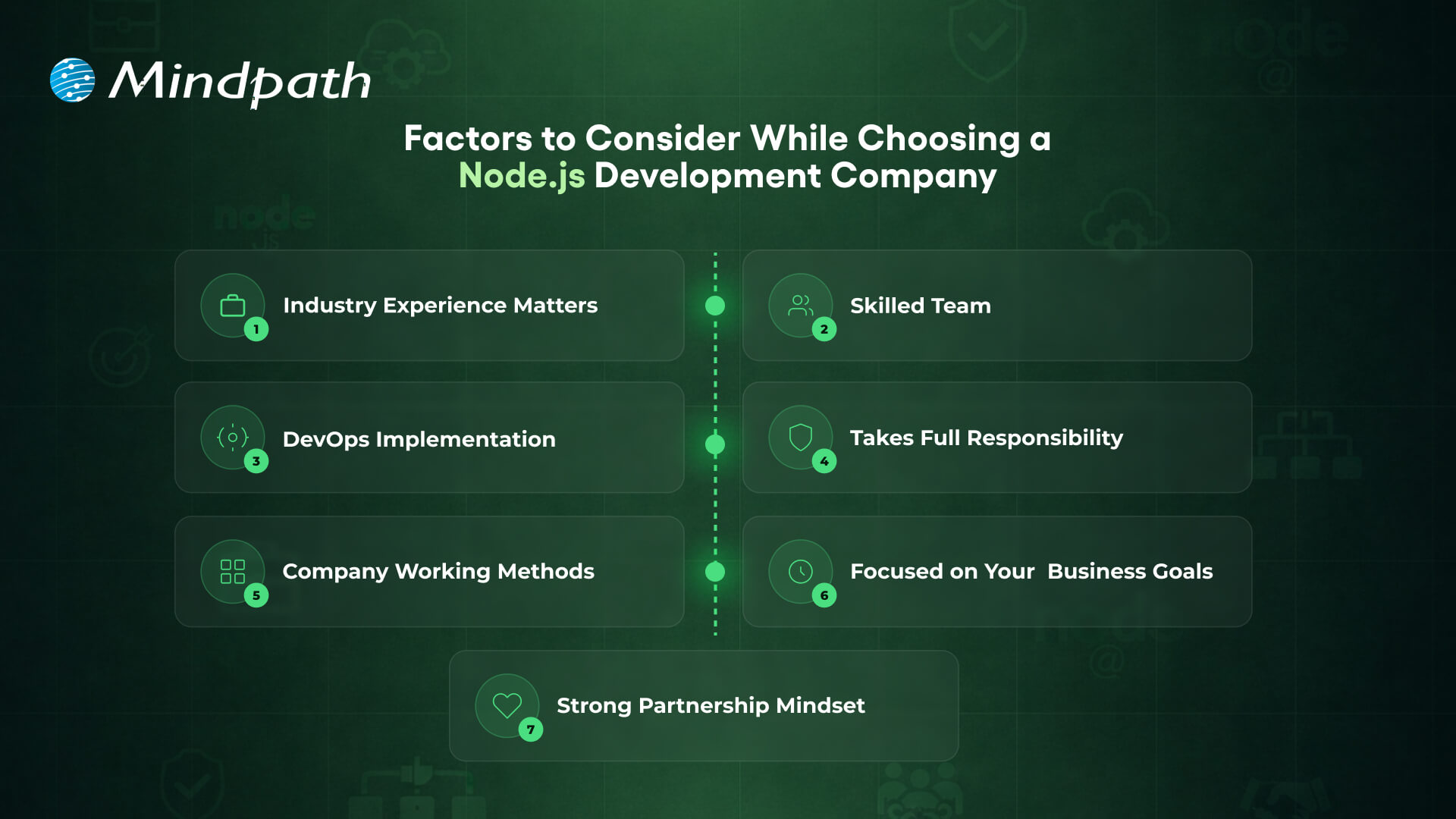
Factors to consider while choosing a Nodejs development company

1. Industry Experience Matters

How long a company has been working in software development shows their reliability and knowledge. Experienced Node.js companies know the best ways to work with clients and handle projects smoothly. They are familiar with popular Node.js tools and frameworks and use proven methods like Agile and DevOps to deliver projects on time and with quality. 

2. Skilled Team

A good Node.js company has a strong team with different skills, so they can start your project quickly and build exactly what you need. A team that understands micro services in Node.js can divide tasks smartly and deliver results faster. Having experts like project managers, DevOps specialists and cloud professionals makes the process smoother and more efficient. 

3. DevOps Implementation

Using DevOps helps a company build software faster and more smoothly. It brings developers and operations teams together, so everyone works closely and avoids delays. This way of working also makes the project more secure and organized. A company that follows DevOps can handle changes better and deliver a high-quality product with fewer issues. 

Also Read: Benefits of DevOps

4. Takes Full Responsibility

A good Node.js company takes full responsibility for the work they do. If something goes wrong, they don’t hide it or blame others. Instead, they fix it and learn from it. This honest attitude builds trust, improves communication, and shows they truly care about the success of your project. 

5. Company Working Methods

The way a Node.js company handles projects says a lot about them. It’s not just about good reviews, but also how they talk to you and what value they bring. You can learn more by checking their website, blogs, case studies and social media to see how they share ideas and show their work to the world. 

6. Focused on Your Business Goals

The right Node.js development firm takes time to understand what your business wants to achieve. They work in a way that supports your goals and helps your business grow. With the right knowledge and experience, they can build a strong and future-ready project that fits your budget and timeline. 

7. Strong Partnership Mindset

A trusted Node.js company doesn’t just build your project and leave. They work with you like a real partner, staying connected and involved at every step.  They provide clear communication, teamwork, and support, even after the project is done which helps make everything run smoothly and lead to better results for your business. 

Want to ensure your NodeJS applications run efficiently and reliably? Explore our blog on hire expert NodeJS developers for high-performance apps to learn how skilled developers can boost performance and scalability.

Ready to Choose the Right Node.js Development Company?

Selecting the right Node.js Development firm plays a big role in how fast, secure, and scalable your project becomes. By focusing on experience, team skills, DevOps culture, and a true partnership approach, you can ensure you’re working with a reliable team. A trusted Node.js development company will not only build a great product but support your long-term success too. 

At Mindpath, we offer end-to-end NodeJS development services that are designed for speed, performance, and future scalability. From building real-time apps to using micro services in Node.js, our team brings deep experience and modern practices. As a top-rated Node’s web development company, we ensure your product is secure, stable, and ready for the market. 

Looking to hire Node.js developers who understand your goals? At Mindpath, our experts bring strong technical skills, creativity, and a collaborative mindset. Startups and enterprises trust us for quality, future-ready solutions. Connect with Mindpath and let’s build something great together. 

Frequently Asked Questions

1. How to know if a Node.js development company is the right fit for a project?

A good fit depends on how well the company understands your goals, communicates clearly, and shows relevant experience. Reviewing past projects, technical expertise, and their approach to problem-solving can help ensure they can handle your requirements effectively.

2. What should be expected when working with a Node.js development company?

A professional company usually offers a structured process, including planning, development, testing, and support. Clear communication, regular updates, and a focus on performance and scalability are common expectations when working with an experienced development team.

3. Is Node.js suitable for handling high-traffic applications?

Yes, Node.js is designed to handle multiple requests at the same time without slowing down. Its non-blocking architecture makes it ideal for applications that need to manage high traffic, real-time updates, or large numbers of users efficiently.

4. How does a Node.js development company support long-term project growth?

A reliable company builds applications with scalability in mind, allowing easy updates and expansion. They also provide ongoing support, performance monitoring, and improvements, helping the application adapt to changing business needs over time.

5. Why is communication important when choosing a Node.js development company?

Clear communication ensures that project requirements are understood correctly and reduces the chances of errors. Regular updates, feedback, and transparency help keep the project on track and build trust between the business and the development team.

Discover key factors for choosing the right Node.js development company. Learn how Mindpath ensures success!