
Why Sustainable Technology is Becoming Essential for Modern Businesses

Join our Newsletter!

Featured Posts

Support Is One Click Away

Home

Why Sustainable Technology is Becoming Essential for Modern Businesses

sustainable technology

Why Sustainable Technology is Becoming Essential for Modern Businesses

Ever wondered why many businesses are rushing into sustainable tech? Why is it so crucially important in today’s fast-changing world? In this blog we will explore how sustainable technology is changing business, and why it is essential. Understanding how these technologies work and the value they can bring to business enterprises can help in meeting regulatory requirements, enhancing brand reputation, and enhancing environmental performance. We can learn how embracing sustainable technology is already helping companies meet today’s needs while positioning themselves for a successful and responsible tomorrow. 

So, let us dive in! 

What is Sustainable Technology?   

Sustainable technology is the design and use of technology to benefit the environment, society, and the economy. This means two things: creating technology with eco-friendly processes and materials and using technology to help solve environmental and social problems. Other examples include solar panels, which provide clean energy, and software enabling businesses to trace their environmental footprint.  

While developing sustainable technology, companies are very considerate about the resources used, their origin, and how to reduce the negative effects in the form of pollution or electronic waste. Businesses use sustainable technologies to realize some of the desired environmental targets, such as reducing fossil fuel use or source reduction of waste.  

For example, they can work on an electric car or initiate projects that reduce carbon emissions. Businesses can also make use of technologies such as Artificial Intelligence to find areas where it can slash down on waste and reduce emissions, thus switching over to renewable energy sources and decreasing their carbon footprint. 

Sustainable Technology Solutions That are Revolutionizing Modern-day Businesses    

1. AI-Powered ESG Reporting 

AI-powered ESG reporting is the intelligent and faster way for a business to track its efforts toward sustainability. In sharp contrast to manual methods of ESG reporting, AI-driven methods are not only far more accurate but also have the dexterity to bring out results within a remarkably short time, incomparably faster than human ability. Using the AI, businesses would be updated in real time—basically, companies can directly see what effect any sustainability change they make will have. Such technology can scan documents, analyze keywords against them, and store important data from relevant files for easy retrieval at reporting time. This automation not only saves time and money but also gives the accuracy of the ESG data. 

2. Embracing Digital Documentation 

The digital revolution makes it easy and secure for businesses to create, share, store, and edit important documents. The shift to digital can reduce office waste by a potential 70% since the average office worker uses around 10,000 sheets of paper yearly. The switch from paper to digital can be challenging, but with OCR technology, it allows the user to quickly scan physical pages and digitize them into documents. This reduces the burden of using too much paper and makes files accessible to all. Additionally, file storage in the Cloud is another area that companies should consider. Cloud computing uses less energy compared to running many different servers for companies, and the amount of storage space can increase as required with less hassle. 

3. Remote Work Technology 

Most of the business units have adopted work from home throughout the pandemic and closed doors to offices for good. It saves the carbon print left if one must commute to their workplace every day. Such a change is made possible with the help of technologies that include workflow technology, tools for integration, e-mail, apps for screen recording, and instant messenger applications. The use of this technology has reduced significantly the need to travel to conferences and other business events, which means a concurrent reduction in carbon emissions. However, the sustainability benefits of remote working depend on the set-up of the home office by the employee. For example, the carbon footprint of an employee may be considerably reduced when the job requires driving more than 6 km to work. In contrast, when the driving distance is less or if public transport is used, home-working may increase CO2 emissions because of the additional use of energy in the home. Hence there is a need to encourage employees to be green at home. 

4. The Internet of Things (IoT) 

The IoT is the network of connected devices, including smart home devices and sensors. Businesses can apply IoT in PACE dimensions related to understanding their ecological footprint and emission reduction. IoT makes workspaces more energy-efficient through monitoring and controlling devices. Some companies that deliver products have the potential to reduce their environmental impact with smart fleets. IoT-enabled fleets send vehicle data back to the office through telematics, which will enable managers to plan efficient routes that can save fuel and be more effective. This data might underline the best driving practices that would help further cut fuel use and boost sustainability. 

Sustainable Technology Use Cases    

1. Decreasing Carbon Footprints 

Sustainable technologies help companies transition from a linear economy, where the use of raw materials is very high, to a circular economy, which is based on leasing, recycling, refurbishing, repairing, re-using, and sharing products as far as possible. This space, therefore, helps companies lower their carbon footprints while serving the interests of both the people and the planet. Sustainable technologies now assist companies in keeping track of crucial ESG metrics, including energy use, emissions, and water consumption. This will enable businesses to understand their position in trends of sustainability, beef up actions to cut emissions, and, as a result, help in answering healthy regulatory requirements and improving the environmental performance of the company. 

2. Improving Brand Reputation 

Sustainability is important for reputation and success. It attracts a workforce and investors sensitive to environmental and social issues in the world. Sustainable technologies attract environmentally aware talent and meet the needs of investors who value transparency of information. Sustainable technologies help businesses keep track of and improve their efforts in sustainability. For example, IoT devices track energy consumption, allowing them to benchmark and, therefore, report on progress, demonstrating commitment to sustainability. 

3. Meeting Regulatory Requirements and Global Standards 

Regulations are constantly changing, with laws like the Corporate Sustainability Reporting Directive (CSRD) requiring companies to report on their environmental impact. Even without mandatory rules, companies are encouraged to follow the United Nations’ Sustainable Development Goals (SDGs), which promote environmentally friendly technologies. To stay ahead, organizations should use sustainable technologies that track, measure, and report their ESG performance. This helps them meet current and future regulatory requirements and global standards. 

4. Visualizing Supply Chains 

One of the ways in which sustainable technologies make a difference is through complete transparency, which can be used to improve supply chains. For instance, AI can trace carbon emissions to identify ESG opportunities and risks. Machine learning is applied in demand forecasting and fleet management to avoid waste and achieve higher energy efficiency. Moreover, with the help of such technologies, companies can be kept updated with their partners and suppliers, which is useful in ESG reporting. Tools like GRI or TCFD require reporting on Scope 3 emissions, which are related to operations outside the company’s direct influence. This helps businesses to be ahead and give a cleaner picture of the supply chains. 

Curious About How Mindpath Can Transform Your Tech?

Find out how our bespoke solutions in modernization and AI can benefit your business.

Mindpath: A Leader in Innovative IT Solutions 

Mindpath is a forerunner in IT innovation and offers customized solutions for your business. We are an Innovation Centre focused on staff augmentation—bringing experienced and qualified professionals to integrate with your team for any short- or long-term project. Our modernization services upgrade legacy systems and optimize processes for better efficiency, security, and long-term growth. We are leaders in digitization. Therefore, we have State-of-the-Art Web Development and App Solutions to enhance your presence online. In addition, with our excellence in bespoke chatbot development and artificial intelligence, your business will harness the very latest technology available to help give you that edge.  

Conclusion 

In the current world complexities, businesses have found sustainable technology to be central to their way of growth and competitiveness. Evermore, innovations that businesses embrace these days are the ESG reporting powered by AI, digital documentation, remote work technology, and the IoT, which help these companies in the reduction of their environmental impacts and bring about an increase in operational efficiency and reputation. These technologies are pivotal for organizations to meet regulatory requirements, visualize their supply chains, and, of course, their sustainability targets. The commitment to sustainability practices is not a fad but a strategic edge, one that imbibes the global norm of standards and sets the pace toward long-term success.  Mindpath leads in IT innovation and can help your business grow. Staff augmentation by Mindpath deals with the integration of top professionals in your team for the implementation of various short- and long-term projects. Besides that, our modernization services update your legacy systems and aid in enhancing your company’s efficiency and security. Advanced web and application development with bespoke chatbot and AI solutions complete the comprehensive services in ensuring our business stays at the cutting edge of technology. 

Ready to Innovate?

Discover how Mindpath’s tailored IT solutions can transform your business.

Related Post

Discover how IT staff augmentation can optimize costs, enhance flexibility, and access specialized talent to boost your organization’s success.
Discover how AI and AR combine to revolutionize industries, enhance user experiences, and drive innovation. Read to explore the impact.
Enhance your WordPress site’s inclusivity with our expert tips and services. Discover how to improve accessibility and explore our comprehensive WordPress solutions.

Related Post

Mindpath's Healthcare Software Development Services
The right healthcare software development company holds prime factors of efficiency, security, and compliance with regulations. Evaluate their experience, proven experience, good communication skills, scalability, and cost factors, so that all of this will offer you customized solutions that will blend well with the existing systems while supporting future growth. Are you looking for the right healthcare software development company? Choosing the perfect one can feel like navigating with a maze because, with so many options out there, it’s easy to get overwhelmed. But don’t worry, our goal is to make this procedure easier for you. In this blog, we will talk about the approach to choose the right healthcare software development company.  Healthcare software acts like a smart assistant in running the daily tasks and interactions between patients, doctors, and health administrators. It helps in keeping records of the patients in an organized way, improves the quality of care provided, and health information is kept private yet accurate. Such software is expanding at a tremendous pace with the advent of new technologies like machine learning, which makes diagnosis and record-keeping easier. It’s an important industry, running into almost $600 billion in revenue alone, and has grown as an integral part of modern medicine. The spurting of technologies like AI and IoT has further helped ease the process of information sharing across diverse systems and has fueled the need for seeking better solutions. Telemedicine—consultation of doctors from home through the internet—is in great demand and projected to make a profit of $240 billion by 2032. Choosing a good healthcare software development company means reliable and secure software. It will ensure that the software works perfectly, safe keeping all data of the patients, and the healthcare regulations are properly followed.  Let us drill down the things to keep in mind while choosing the right healthcare software development company.  

Things to Keep in Mind While Choosing Healthcare Software Development Company   

Things to Look for While Choosing Healthcare Software Development Company

1. Healthcare Technology Expertise 

While looking for a company to handle your health app development, consider their health technology expertise. The thing is that healthcare software must abide by strict rules under HIPAA, HITECH, and GDPR; therefore, developers need to know them well. You’ll want to partner with a company that really knows the inner workings of healthcare and how doctors and patients’ interface with the software. This is important in as much as it needs to integrate well with other existing systems like EHRs and telehealth services. Choosing experience in developing medical platforms makes the process effective and smooth. 

2. Proven Experience & Portfolio 

A successful healthcare platform depends on its features. To assess a company’s capability, review their portfolio and case studies of past projects. Ask for healthcare technology providers who make custom healthcare solution development in their portfolio. Then, you can judge the idea about their healthcare platform development process, and check if they can do the software you need. These will show you their experience and help you understand if they can create the software you need. Checking client testimonials can also provide valuable insights into their work. 

3. Effective Development Process & Communication 

While choosing the platform development company in healthcare, understand what their development process is. The majority use either a waterfall or agile approach. Make sure they adhere to best practices for healthcare software, and the method applied suits your needs. Ask the company about their approach toward development and choose one that is transparent and flexible. A good company will have only one dedicated team for your project: developers, designers, and project managers. You will be updated regarding all procedures with regular communication with them, and the project is on track. 

4. Scalability & Security 

Choose custom healthcare software that will grow as your practice does. It should handle increased use as your needs expand. And then there’s security which is very important. Be sure that the company has strong security in place to keep patient data safe. Regular security audits and tests are particularly critical in ensuring the safety and compliance of your software. 

5. Cost & Timeline Factors 

Development of a healthcare app can be quite expensive, so getting quotes from several companies will help in understanding the real cost and, hence setting a realistic budget. Some major factors which govern the price of the work include ownership rights to the product, features and integrations required, level of customization and maintenance, and continuous support needed.  Also, an agreement on the timeline for the project’s completion is important. Some may promise to deliver within the quickest time but eventually miss the deadlines and cause a disturbance in workflow for your practice. 

How Can Mindpath Help Provide Software Development for Healthcare   

Mindpath offers a comprehensive healthcare software development lifecycle, serving the exact needs of healthcare providers, patients, and other stakeholders. 

1. Healthcare Software Development Consultation 

 We always start with expert advice that outlines the goals and requirements necessary in your software development project in healthcare. Our consulting services take you from the initial brainstorming to detailed planning, ensuring that you have a very clear roadmap to success. 

2. Healthcare Software Development 

We develop all kinds of healthcare software, from electronic health records and practice management systems to patient portals. We design them secure, scalable, and compliant with industry regulations to optimize patient care and operation efficiency. 

3. UI/UX Development

Our design team will orient towards the creation of intuitive and user-friendly interfaces. We ensure your software is easy to use, visually appealing, and accessible for every user to make it engaging and user-friendly in function. 

4. AI Chatbot for Healthcare 

We develop AI chatbots for healthcare that handle activities like answering patients’ queries, making appointments, and dissemination of medical information. Such chatbots enhance patient interaction and reduce workload from your healthcare staff. 

5. Healthcare Software Modernization  

We upgrade and modernize previously existing software systems. This would involve migration from an outdated platform to a new one, adding new features to your present software, and ensuring that your software remains updated and effective amidst the changing landscape of healthcare. 

6. Maintenance & Support 

Our team will also be there to provide ongoing maintenance and support to keep your software running smoothly. We resolve any issues and deploy updates that need to be done to your system.  

We deliver top, effective healthcare software solutions using cutting-edge technologies like Artificial Intelligence, Machine Learning, and Data Science with tools such as React, JavaScript, Node.js, Python, and MongoDB to help you reach your goals. 

Ready to Transform Your Healthcare Practice? 

See how our cutting-edge solutions at Mindpath help in enhancing healthcare operations to improve patient care. 

Why Choose Mindpath? 

Mindpath stands as one of the major choices for healthcare software development because of our vast experience in the industry and our commitment to excellence. Years of experience in understanding the intricacies of the healthcare sector, coupled with knowledge of compliance, data security, and challenges to patient care, help set us apart from other solution providers. We give tailored solutions to satisfy your organization’s needs, driving up operational efficiency and patient outcomes. We deliver cutting-edge solutions to drive innovation in healthcare by leveraging advanced technologies such as AI, Machine Learning, and Blockchain. On the security front, we are pledged to ensuring that each of our solutions is designed to the greatest standards of data protection and, above all, comply with healthcare regulations like HIPAA and GDPR. Added to this is the support from our end for your technology initiatives, from the first consultation to continuous maintenance. 

Conclusion 

Choosing the right healthcare software development company would, therefore, mean ensuring that your healthcare organization runs efficiently and effectively. This ranges from adhering to regulations in this field to building scalable and secure platforms—the right company should be able to handle all your needs and promote better patient care and operational efficiency. From consultation to support and maintenance, Mindpath delivers end-to-end healthcare software development services that ensure your technology initiatives are a success. Our team of experts works with you to understand your unique requirements and provides solutions tailored precisely to your objective. 

Looking for a Healthcare Software Developer for Your Next Project?

Discover how to choose the best healthcare software development company with insights on expertise, experience, scalability, security, and cost factors.
generative ai for business

Ever imagined a machine that could produce articles, logos, and new content to power your business? Sounds intriguing, isn’t it? Well, that is what generative AI can do for your business. This new-generation artificial intelligence is transforming future of businesses by generating new content, images, product designs and even strategy concepts from patterns it has acquired by analyzing the existing data. In this blog, we are going to discuss how generative AI for business can create innovation and give a competitive advantage.

So, before we learn about how generative AI can transform businesses, let’s understand what is generative AI.

Looking for ideas to reshape your business with generative AI? Unlock smarter growth, faster innovation, and personalized customer experiences with Mindpath’s AI-powered solutions

What is Generative AI?  

In simple terms, generative AI is an artificial intelligence that takes huge datasets and algorithms to learn the pattern and then generates new outputs based on its understanding. While AI is all about recognizing data, classifying it, or predicting, generative AI takes it a step further—it produces new content. For instance, it can author customer emails, create social media posts, produce product descriptions, and even assist in designing user experiences. 

Generative AI has the ability to provide enterprises with numerous benefits like enhancing innovation and creativity, enhancing productivity and reducing expenses. Generative AI also facilitates original idea creation, speed in product development, and custom-built customer experiences. In addition, it has the potential to enable workers to focus on more critical activities and reinforce security and raise the satisfaction levels of customers. 

Also Read: Generative AI Revolution

Let’s dive in how generative AI can drive business innovation and creativity for businesses. But before that have a quick look at the Google Trends for Generative AI for Business.

generative ai for business trends

How does Generative AI Drive Innovation for Businesses? 

In today’s fast-moving digital world, innovation is the key to staying ahead. Generative AI in business is assisting companies in igniting new ideas, enhancing content, and accelerating processes. Let us see how generative AI for innovation is changing the way companies think and create. 

1. Personalization Fuels Innovation 

Building a strong customer connection helps in driving business growth and personalization plays a major role in it. Companies can deliver tailored content and better user experiences with the help of smart tools that can understand customer behavior. This is precisely where generative AI for innovation can make a huge difference by helping businesses personalize at a scale which is much faster and more accurate than manual efforts.  

2. AI Creativity and Human Creativity: A New Partnership 

There is much discussion circulating about AI creativity vs. human creativity. It shouldn’t be about who is superior, but how they can both contribute to success. Humans can provide emotion, context and novel ideas to which AI can provide structure and new insights based on data. Merging the two can assist businesses to work more smartly. For example, how generative AI can augment human creativity is seen when it rapidly produces ideas or content, and humans are able to edit and make them work for the brand’s voice and objectives. This also ties into how AI is redefining job roles in tech, showing the evolving collaboration between human expertise and AI capabilities.

3. Unlocking Potential through Data-Driven Creativity 

Generative AI for business enables companies to convert information into intelligent ideas through analysis of customer behaviors, market patterns, and performance outcomes to develop valuable content, product layouts, or advertising campaigns. Humans contribute creativity, passion, and profound meaning, while AI contributes pace, logic, and the capacity to process vast volumes of data rapidly. When combined both, companies are able to develop meaningful experiences that connect with people and result in improved outcomes. aligning with the latest Gen AI trends in business intelligence.

4. Streamlining Operations 

When used properly, Generative AI in business enables companies to save time by automating routine work and processing large sets of data. This allows teams more time to come up with new ideas and more efficient ways of working. When businesses apply this type of thinking, they can grow more quickly, plan more smartly, and stay ahead of market change. That’s how generative thinking helps businesses innovate smarter because it provides them with the space, tools, and insights to grow more smartly. 

5. Securing Financial Transactions 

Generative AI is becoming a necessity for securing financial systems and mitigating risks. It enables companies to identify potential financial risks by processing vast amounts of data efficiently and accurately. The technology also helps in forecasting market trends, enhancing decision-making. Additionally, generative AI is improving fraud and suspicious activity detection in real-time. It’s transforming trading by offering insights from enormous data sets, ensuring smarter and safer transactions. 

Wondering how generative AI is influencing content creation and design strategies? Check out our blog generative AI changing creative industries  to see how AI-driven creativity is shaping the future of industries.

Use Cases of Generative AI for Business Growth 

Generative AI for business is revolutionizing the way companies develop by enhancing customer experience, increasing productivity of employees, and accelerating innovation. From conversational tools like ChatGPT, Bard, and Midjourney to live business applications, the effects are tangible. Here are some simple yet impactful generative AI use cases that fuel business growth today:

Use Cases of Generative AI for Business Growth 

1. AI-Driven Product Ideas

With tools such as Midjourney, businesses are able to create product ideas, packaging, and graphics. It illustrates how AI can be applied in innovation, by assisting teams to come up with creative ideas quicker and validate what is effective with actual audiences.

2. Smarter Customer Support

Tools like ChatGPT help companies create AI-powered chatbots that answer customer questions instantly. This improves response time and frees up human agents to focus on complex issues. It’s a simple way to offer 24/7 support and boost customer satisfaction.

3. Streamlining Employee Workflows

According to the McKinsey Generative AI Report, generative AI can automate tasks that take up 60–70% of employees’ time today. This includes writing emails, summarizing reports, and generating presentations—especially helpful for knowledge workers and high-skill roles.

4. Personalized Marketing Campaigns

Generative AI technology assists companies in crafting customized ads and suggestions based on user data. This renders marketing more precise and efficient, enabling more engagement and sales while saving time for marketers.

5. Fast Content Generation

With platforms like Bard, teams can quickly write blogs, product descriptions, and emails. This saves time and allows employees to focus on strategy. It’s one of the most practical generative AI examples used daily across industries. 

Looking to leverage generative AI for smarter, more adaptive app solutions? Explore our blog on Generative AI in App Development highlights practical applications, transformative benefits, and strategies to stay ahead in the digital landscape.

Ready to Make Your Business AI-Ready? 

Generative AI is changing the way businesses work, think, and grow. It’s not just about automation, it’s about helping teams be more creative, make faster decisions, and offer better experiences to customers. Be it creating content, improving support, or building new ideas, generative AI for business is making every day work smarter and more efficient. 

At Mindpath, we specialize in delivering cutting-edge AI development services tailored to meet the unique needs of modern businesses. Our expertise in generative AI enables companies to streamline operations, boost productivity, and create intelligent solutions that drive real value. Whether you’re looking to implement AI-powered automation, enhance customer engagement, or accelerate innovation, Mindpath is your trusted technology partner for consistent business growth! 

woocommerce vs shopify

In the e-commerce landscape, businesses need to make a number of critical decisions. In case you are planning to venture into the e-commerce space, it is imperative to choose the right platform. This decision can certainly influence the success of your business in the dynamic e-commerce arena. 

The platform that you choose for your e-commerce store can undoubtedly influence the overall performance and success of your business. The top names that are ruling the e-commerce platform setting are Shopify WooCommerce. You need to dive into the world of WooCommerce Shopify so that you can make a proper comparison between these platforms. You need to know how these e-commerce platforms differ from one another so that you can make the ideal selection.

Planning to grow your online business and make a real difference in sales and customer experience? At Mindpath, we provide expert web development services that create user-friendly online stores designed to boost conversions and engage your customers.

An Insight into Shopify

Shopify refers to a cloud-based e-commerce platform. It offers a diverse range of tools for business entities so that they can sell their offerings online as well as in person. It is undoubtedly considered to be one of the most popular platforms that empowers entrepreneurs and large brands to not only create but also manage their online store. It has a diverse range of features that you can capitalize on in order to give an edge to your business in the competitive space. 

You must get a holistic insight into Shopify and its features to understand its true capabilities as an e-commerce platform. One of its distinguishing features is related to the creation of a store. Businesses can also use their selling tools and payment processing features to streamline their practices and operations. 

An Insight into WooCommerce

WooCommerce is an open-source e-commerce plugin for WordPress. It is completely free for users. WooCommerce enables users to transform a WordPress website into an entirely functional online store. It offers a diverse range of tools so that you can add products and set up payment options for your target audience. 

A unique thing about WooCommerce is that it is ideal for experienced sellers in the e-commerce domain. You can extend its functionality with the help of a number of add-ons and themes. Businesses need to familiarize themselves with the core features of WooCommerce so that they can make use of the platform in an optimal manner. Its key features that you need to know about include the availability of a large library of themes and high extensibility.  

Must Read: AI in E-commerce

Difference Between WooCommerce and Shopify

Now that you have a basic understanding of Shopify and WooCommerce, it is time to look at them at a closer level. Businesses that plan to establish themselves on the online platform need to know the key differences between these platforms so that they can have clarity on WooCommerce vs Shopify. The insight into this area is crucial to choosing the suitable platform and thriving in the market. 

1. Cost

While talking about WooCommerce vs Shopify, one of the key differences between the two options revolves around their cost. WooCommerce and Shopify have entirely different pricing structures. WooCommerce is entirely free for users, so you do not have to pay anything to use it for your online business. Thus, it offers ample flexibility with variable costs for users. 

On the other hand, when it comes to Shopify, it has a subscription model for its users. WooCommerce vs Shopify pricing is a major point of difference that you need to take into consideration for your e-commerce business. The ultimate budget of businesses can play a catalytic role in choosing their ideal e-commerce option.  

2. User-Friendliness

The ease of use or user-friendliness is a key dimension that you need to bear in mind while selecting between WooCommerce and Shopify. You must keep in mind that both these e-commerce solutions offer a diverse user experience. As WooCommerce is an open-source plugin for WordPress, which is self-hosted, it requires manual setup. 

Every aspect has to be handled separately by businesses while using the plugin. Moreover, businesses should know that it requires ongoing management as well. When it comes to Shopify, it has an all-in-one dashboard that users can use for their needs.  Thus, users can have a hassle-free experience if they choose Shopify. 

Not sure which technologies will give your e-commerce business the best performance and scalability? Explore our blog tech stack for your web app success to learn how to choose the right tools for long-term growth.

3. Themes as well as Templates

While talking about shoplift vs WooCommerce, it is key to understand how they differ in terms of available themes and templates. WooCommerce offers a humongous library of premium as well as free WordPress themes. You can choose the specific theme that is ideal for your business. The good news for users is that there is an opportunity to customize the themes on WooCommerce. 

When it comes to Shopify, businesses can use professionally designed themes. Such themes can certainly give an edge to your business. But you have to bear in mind that there are limited options to customize the themes. You need to take into account WooCommerce vs Shopify themes while choosing the ideal option out of the two options.

4. Scalability

Scalability is an important dimension that every e-commerce business needs to prioritize. You need to make sure that your online store grows in a seamless manner as your business expands. Your store must be able to handle additional product offerings and additional users. WooCommerce serves as a highly flexible option for e-commerce businesses. 

However, in order to leverage the flexibility that it offers, businesses must be aware of how to use the available tools. Shopify undoubtedly simplifies the degree of flexibility by offering built-in tools for businesses. You can leverage these tools as they will handle most of the work for your business. 

5. Security

Security is undoubtedly a non-negotiable element you need to look at while understanding the difference between WooCommerce and Shopify. If you plan to use WooCommerce, you need to know that, since it is a self-hosted solution, the onus of security lies with you. Although it offers certain security features, most of the security depends on elements such as the hosting environment and plugins. 

Similarly, the manner in which businesses maintain their websites also influences the quality of security. On the other hand, Shopify offers robust security to e-commerce businesses. This specific platform has in place holistic security measures that can safeguard both customer and store-related data. 

Concerned about keeping your online store and customer data secure? Read our blog application security best practices for web and mobile apps to learn proven methods to protect your business.

6. Payment Gateway 

As a majority of online customers are making online payments, it is essential for e-commerce businesses to have in place a robust payment gateway mechanism. Both Shopify and WooCommerce offer a diverse range of payment gateway options that you need to be aware of. As WooCommerce is integrated with WordPress, it offers a high degree of flexibility when it comes to payment gateways. 

It is possible to integrate almost any gateway. But the particular process may require additional setup for businesses. When it comes to Shopify, it comes with built-in options. The built-in payment option offered by Shopify makes it simpler for businesses to accept payments from customers without requiring additional setup. Moreover, it supports international payments, thereby creating value for modern businesses. 

7. Customization

The difference between WooCommerce and Shopify arises when looking at the customization dimension. You can look at WooCommerce as a blank canvas. It offers high power to businesses to customize their online store based on their needs and requirements. On the other hand, Shopify keeps things simple for businesses. 

It offers limited customization ability as a business. Without having to do much customization, businesses can have a professional-looking online store. You can take advantage of the drag-and-drop editor to build your store. However, this feature limits the ability to customize for users. 

Looking for innovative ways to stand out in the crowded e-commerce space? Learn from our blog, augmented reality in e-commerce, and see how AR technology can transform your online store.

The table presented below gives an overview of the main differences between Shopify and WooCommerce. Businesses can certainly refer to it while making the selection between WooCommerce or Shopify.

Basis WooCommerce Shopify
Cost Free  Monthly subscription model 
User-friendliness Not beginner-friendly and requires manual setup Beginner-friendly and intuitive
Themes and Templates Offers a large library of WordPress themes and high customization ability Offers professionally developed themes and low customization ability
Scalability Flexible but requires good hosting and optimization Effortless scaling with business
Security Security level depends on hosting and manual updates Security is fully managed and comprehensive 
Payment Gateway Multiple payment gateways with no additional charge Shopify payments and external payments with applicable fees
Customization High customization Limited customization

Selecting Between WooCommerce and Shopify

It is crucial for businesses to remember that the ultimate choice of WooCommerce and Shopify depends on the goals as well as the needs of businesses. You need to keep in mind your budget and WooCommerce vs Shopify payments while choosing the ideal platform for your e-commerce business. You must remember that both platforms offer a unique set of advantages for businesses. 

As the pros and cons of each of these options vary, you need to carefully consider them while making your choice. WooCommerce empowers businesses to customize their online stores. On the other hand, Shopify offers a professional-looking store thanks to its drag-and-drop option. 

Struggling to make informed platform decisions for your e-commerce business? Explore our blog on the  importance of data-driven decision-making for businesses to learn how data insights can guide your choices.

Final Words

In the cut-throat competitive business space, it is mandatory to choose the ideal platform for e-commerce success. In order to make the right choice, you need to have clarity on your basic requirements. This insight can guide you to choose the best platform that perfectly meets your needs and expectations. 

Mindpath provides web development services that understand the need to choose the right platform for e-commerce businesses. Businesses can undoubtedly rely on our experts to make use of high-quality WooCommerce and Shopify solutions. These high-quality solutions can make sure that your business can thrive in the unpredictable e-commerce realm and gain an edge over its competitors. 

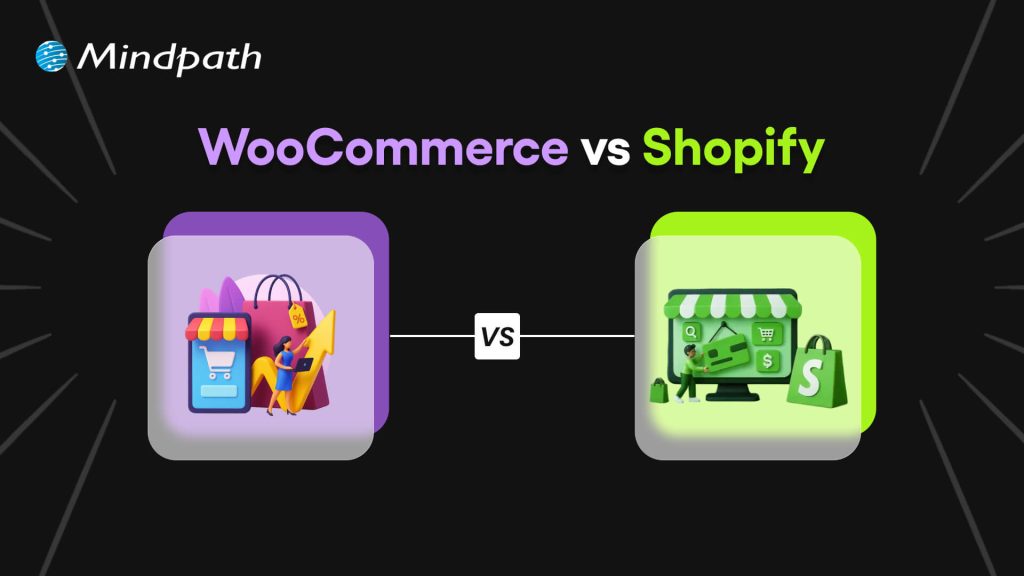
The ultimate eCommerce showdown: WooCommerce vs. Shopify! Explore their features, benefits, and which platform is right for your business.