Building a Powerful Web App: Combining React and WordPress

Join our Newsletter!

Featured Posts

Support Is One Click Away

Home

Building a Powerful Web App: Combining React and WordPress

wordpress-react-combine project

Building a Powerful Web App: Combining React and WordPress

Are you curious about how to elevate your web app to the next level? Imagine combining React’s cutting-edge user interfaces with WordPress’s robust content management. Interesting right? In this blog, we’ll guide you through the process of merging these technologies to build a web app that’s both visually stunning and highly functional. So, let’s dig in! 

Overview of React 

React is a JavaScript library that enables the building of user interfaces, mostly single-page applications. It gives a possibility to create interactive elements and dynamic web pages by breaking their content into smaller, re-usable components. It helps in managing updates to the user interface and hence makes applications faster and more responsive. React is essential to today’s digital makeup since it will help in the creation of a much faster, interactive, and dynamic web application that would go a long way in enhancing user experience. Due to its component-based architecture, React simplifies the development process and supports complex applications with high performance, making it a preferred choice for modern web development, where user engagement and responsiveness count the most. 

Overview of WordPress 

WordPress is an extremely popular content management system, and millions of websites are running on it worldwide. Its user interface is very simple, so users can easily create, edit, and manage website content without needing to know how to code. With high flexibility in themes and various plugins, WordPress can be put to any purpose—from personal blogging to the most complicated business sites. WordPress is important due to the flexibility and user-friendliness in creating and managing websites efficiently for any kind of user. It provides access to unlimited customization because of its extended base of themes and plugins, hence becoming a mainstay tool in the modern world for web developers and content creators. 

Why Combining React and WordPress Can Be Beneficial for Developers.   

Integration of React with WordPress enriches development by putting the power of both together. React is empowered for reusing the components, which means simplicity in terms of coding and speed in development. Fast rendering with efficient state management means web applications work harmoniously and respond as the user expects. JSX syntax, with its combination of JavaScript and HTML, enables easier writing and readability of codes. WordPress complements React by taking care of the content and providing a clear user interface. The fact that React can keep data away from the presentation and manage it nicely helps not to lose data under any conditions. Taken together, React and WordPress make the building process much faster and more convenient for creating powerful and extremely dynamic web apps. 

Key Considerations When Building Your Web App with React and WordPress    

1. Existing Infrastructure  

Your existing infrastructure does affect how well React and WordPress work together. If your current system is compatible, the integration of React will go through smoothly and more quickly. For example, a headless setup where React is doing the front end and WordPress the back end could be best for modern needs. This, however, requires more development work, changes in your back-end system, and special expertise to do it correctly. 

2. Maintenance And Updates  

Regular updating and maintenance are vital in the case of a React and WordPress site. In case you do not update them regularly, your site will eventually have performance issues, it will be vulnerable to security exploits, or even crash. When it’s headless—in a setup where React and WordPress run separately—the updates become easier; one could independently update the front end and back end, which will be helpful in keeping the site’s stability and safety. 

3. Developer Skillset  

It requires a wide skill set to build a website with React and WordPress. One needs to be proficient in JavaScript, to understand JSX, and to use state management tools like Redux. One would also want to be familiar with modern development tools like Webpack and Babel and know how to work with APIs. If these competencies are missing in your team, including an expert on a project basis will make the development process smoother and more efficient. 

4. SEO Considerations 

SEO is critical to have your website show up in search results and bring in visitors. Using React with WordPress, SEO can be a little more complex. As its client-side rendering, React may make it hard for search engines to index your content. You can either implement SSR or SSG to make it easier for search engines to crawl and rank your site. Besides, meta, sitemaps, and canonical URLs should be properly set up for effective SEO within a headless WordPress setup. 

Ready to elevate your website to new heights?

At Mindpath, we seamlessly integrate React with WordPress to create dynamic, responsive web experiences.

Configuring React to Work with WordPress      

1. Write Modular Code 

Breaking your code into smaller, self-contained parts makes it easier to handle and reuse. This is like keeping your workspace organized: when everything has its place, it’s much easier to find anything that you may need and use it. Small, reusable components in React are ways by which you can keep your code neat, making changes or fixes on parts of your site without affecting the other parts. 

2. Use A State Management Library   

A state management library, like Redux, that keeps every bit of information of your app in one place. This is good for complicated websites where you deal with a great deal of information. This way, it becomes easy to handle changes and updates for your website to run smoothly and in the desired manner. 

3. Optimize Performance   

Performance optimization of the website enables quick and enjoyable usability by the user. This is achieved through caching, breaking down the code into smaller pieces that load only when needed, or lazy loading—parts of the website only load after becoming visible to the user. Doing this will get your site up and running quickly; this will also improve responsiveness. 

4. Implement A Consistent API   

A good API—like WordPress REST API or GraphQLwill help your React app and WordPress site to communicate smoothly. A consistent API would mean that data flows between the two without any problems. REST APIs offer flexibility, but their design is often varied. GraphQL APIs are more homogeneous and predictable, so it helps in use and understanding. 

5. Plan For Extensibility   

Make a site that will expand and evolve over time without a problem. That means keeping ahead by finding out ways to add new features or update existing ones without breaking the rest of the site. Having an extensible design means it will let your site easily change to meet future needs without having to start from square one. 

6. Automated Testing 

Automated testing means running your code for errors using tools automatically. This will ensure that mistakes are noted and cured in the beginning, thus ensuring that your website does what you want it to. Automated testing saves time and keeps your site stable; this reduces the chances of problems frustrating users. 

Build Your Web Using React and WordPress with Mindpath    

The experienced team at Mindpath uses React to improve user experience and WordPress as the foundation for creating powerful websites. With its incredibly strong and practical content management system, editing and managing website material is effortless. By integrating React, we can increase your site’s speed and amount of interaction while engaging users on a deeper level. Create a dynamic frontend for your website using React to make it load quickly and react to user input as smoothly as possible.

Mindpath offers the best of both worlds: the ease and versatility of WordPress paired with the contemporary, dynamic capabilities of React. We take care of the technical setup and customization so you can have an outstanding website experience and concentrate on your content and business objectives. 

Conclusion  

Combining React and WordPress gives synergy to your Web application, offering a digital experience that is at once impressive and compelling. Being able to interact with dynamically displayed interfaces from React and a robust content management system like WordPress, you are assured of having a site that is at once engaging, powerful, yet very easy to manage. Inherently, this automatically ensures the improvement of user interaction and performance while also making it seamless to update content and manage sites. Embrace this mix of technologies to develop a web app which would be fast, functional, and future-ready. This way, your web presence will always be at the top of its game.
Mindpath excels at bringing this integration to life. Our expert team combines the power of React with WordPress to deliver an ultra-fast, interactive site that is also easy to maintain and update. With Mindpath, you can confidently navigate the complexities of modern web development, ensuring your digital presence is both cutting-edge and effortlessly managed. 

Looking to enhance your WordPress site with cutting-edge React features?

Mindpath is your go-to partner! We specialize in integrating React’s dynamic capabilities with WordPress’s robust CMS to deliver stunning web experiences.

Related Post

Discover how IT staff augmentation boosts project scalability with quick access to talent, cost-effective scaling, and expert support.

Related Post

ai in manufacturing industry 

AI in manufacturing industry has experienced a fundamental transformation which now enables factories to operate differently in the digital age. Modern manufacturing operations benefit from smart systems which process production data to predict equipment breakdowns and enhance manufacturing precision throughout all production stages. The benefits of AI are evident in quicker production cycles, reduced costs, and higher quality outputs, making innovation the core of modern manufacturing.

Manufacturers are moving to the next level of connected intelligence as a result of persistent improvements in automation and data analytics. Basically, every process, choice, and way of working is being upgraded by AI-generated insights that are at the core of both efficiency and expansion. The change is going beyond tech; it’s a total revamp of how industries function. This article will look into the ways in which artificial intelligence is a main driver of Industry 4.0 and is influencing the manufacturing industry’s ‍‌future.

Looking for a reliable solution to overcome bottlenecks and accelerate your business transformation? Mindpath offers AI development services that help manufacturers unlock new levels of operations excellence.

Understanding the Basics of AI in the Manufacturing Industry

AI ‍in manufacturing is the deployment of intelligent computer systems that work alongside factories to enhance efficiency and speed. It broadly means the employment of AI instruments in various factory operations such as production, quality checks, supply chain, and machine maintenance. Such tools have the capability to reason, draw learning from data, and even choose the most viable solution to a problem promptly, thereby making manufacturing processes better every day.

Manufacturers ‍are able to save time, lower their errors, and produce top-quality products through the use of AI. This is accomplished by giving the teams the ability to foresee equipment failures before they occur and, hence, maintain the efficiency of the processes. In general, AI is a key enabler of more efficient planning, quicker manufacturing and improved business expansion in the manufacturing ‍ ‍‌sector.

Must Read: Top AI Trends

Role of AI in the Manufacturing Industry

Artificial intelligence significantly influences the manufacturing industry where it is used to make the factories more intelligent, quicker, and also more efficient. The following are the main functions of AI in the manufacturing‍‌ sector.

1. Smarter Machine Maintenance

By analyzing the real-time data of the machines, AI can foresee the time when they will break down. Thus, producers are facilitated to troubleshoot the problem ahead of time, thereby, they do not experience heavy periods of non-operation, and they are able to keep the equipment in good working ‍condition.

2. Better Quality Checking

With the help of cutting-edge visual analysis, AI technologies are able to detect even the minutest blemishes on products. Consequently, the quality of the products is enhanced, and the amount of discarded products or recalls resulting from the production process is ‌lowered.

3. Efficient Supply Chain

AI enhances supply chain management by keeping an eye on stock, coordinating the transport of goods, and forecasting the requirements for shipments. In this way, factories are enabled to free time, reduce expenses, and maintain the continuity of the supply of ‍‌‌‌‍ ‍‌materials.

4. Faster Product Innovation

Intelligent simulations and virtual testing are used by an AI-powered system to elevate product design. In this way, a manufacturer is able to produce a quality product in less time and at the same time reduce the defective production ‍output. ‍ ‌‍ ‍‌ ‍ ‌‍ ‍‌

5. Improved Demand Planning

Using AI in the manufacturing industry can significantly streamline the demand planning process by effectively analyzing consumer data and market trends. This practice is instrumental in ensuring that products are not only produced but also delivered on time, thereby saving material costs and increasing the ‍earnings.

Want to ensure your manufacturing processes are guided by accurate, data-driven decisions? Explore AI in decision making and learn how AI enhances strategic choices across the factory floor.

How Does AI Improve Efficiency in Manufacturing?

Artificial Intelligence (AI) is the primary reason for the manufacturers working smarter and finishing the tasks in less time. It promotes the best utilization of the time, materials and the resources in each and every process. These are the main impacts of AI on manufacturing ‍industry.

1. Faster Production Cycles

Manufacturers can use AI to increase the pace of their operations as it cuts down on process delays and enhances the interaction between machines. With AI, factories are capable of producing higher volumes in shorter periods of time without fluctuating product‍‌ quality.

2. Reduced Downtime

Artificial intelligence can foresee when a machine will require service even without a malfunction if it monitors in real-time the data of the apparatus. Passing from this, the machinery will be able to operate for a more extended time, and the production schedules will be more ‍‌stable.

3. Smarter Resource Management

Artificial intelligence in the manufacturing sector offers the possibility to firms of using their materials, time, and energy in a more efficient manner. As a result, the waste that is generated is minimized, the expenses of production are reduced, and the situation of environment-friendly running is ‍facilitated.

4. Accurate Demand Planning

Through the analysis of customers’ habits and market trends by AI, a production plan can be drawn up reasonably. Hence, the company saves itself from overproduction, inventory is maintained at a proper level, and the efficiency of the whole system is ‍‌improved.

5. Consistent Product Quality

The use of AI instrumentation in the monitoring of manufacturing lines helps to keep the standardization of each product at the same level. The result is that the reliability gets higher, mistakes become fewer, and customer loyalty is ‍‌strengthened.

6. Enhanced Workforce Productivity

By taking over the monotonous tasks, AI in the manufacturing industry frees the workforce to concentrate on the creative and technically challenging aspects of their work. The combination of human expertise and advanced technology is a clear indication of how AI is increasingly influencing the manufacturing ‍‌sector.

Want to see how AI can influence not just production but your entire business strategy? Explore AI in business strategy to learn how intelligent insights drive smarter decisions across manufacturing operations.

AI in Manufacturing Examples

AI in manufacturing is implementing in a variety of practical ways that lead to improvements are production speed, quality, and overall efficiency.

1. Predictive Maintenance

AI in manufacturing industry is instrumental in early detection of malfunction prediction of machines, like the case of GE and Siemens who are employing AI analytics to cut down on ‍downtime.

2. Quality Control

AI-powered systems are employed by giants such as BMW and Foxconn to scrutinize products with great accuracy, thereby enhancing quality and reducing the number of production errors.

3. Supply Chain Forecasting

The use of AI in manufacturing industry facilitates more accurate demand forecasting and inventory management, which in turn enables companies like Coca-Cola to streamline their ‍logistics.

4. Robotics and Automation

One of the key factors that has led to the improvement of both the safety and the efficiency of the production process. It is the AI-enabled robots that Tesla and other automakers use to perform complex tasks.

5. Product Design Innovation

Generative AI tools usage by engineers enables them to create smart and energy-saving products in a shorter period and also the product development ‍cycle becomes ‍‌faster.

Curious how AI is transforming industries beyond manufacturing? Explore Generative AI use cases in diverse industries to understand how companies are taking advantage of AI for innovation and efficiency.

Ready to Transform Your Manufacturing with AI?

Artificial Intelligence (AI) in the manufacturing industry is the main factor that is causing a transformation to very bright, fast, and more economical production. With the help of AI, companies are able to reduce downtime. Also improve the quality of their products, and also use resources in a more efficient way. AI will still be the prominent power that determines the shape of the worldwide manufacturing industry and the source of continuous improvement for every process.

At Mindpath, we specialize in crafting sophisticated AI development services that enable manufacturers to upgrade their operations and realize substantial efficiency gains. Our team engineers intelligent systems that increase productivity, quality, and business growth. Partner with Mindpath to infuse your manufacturing journey with the power of intelligent automation and ‍innovation..

custom wordpress development

In the rapidly changing digital age, your website is more than just a digital face or a virtual business card. It creates a foundation to support your brand identity, marketing strategy, and customer experience. With more than 43% of websites powered by WordPress (source: w3techs), it is clear that WordPress is an excellent choice for website development. There are different pre-built WordPress themes that provide you with an affordable and easy way to bring your business online. However, they may not be able to meet the unique requirements of your growing business. This is where a custom WordPress development comes in.

Whether you are a local business, an enterprise, or a startup, a custom-built website can unlock performance, long-term growth, and brand credibility. In this guide, you will learn more about custom WordPress development and understand why it is crucial for your business. Besides, we will also discuss the best practices and how to choose the right custom WordPress development company to enjoy the desired results.

Want to elevate your online presence with a custom WordPress site tailored to your business objectives? Mindpath’s offers wordpress developemnt services that help you in creating a unique digital website that sets you apart from your competitors.

Custom WordPress Development- An Introduction

In simple words, custom WordPress development involves creating a website from scratch, tailored to your unique requirements. Instead of using pre-made themes or inefficient plugins, a professional WordPress developer utilizes tailored themes, functionalities, and plugins that align with your business goals. It gives you complete control over all aspects of your website, including performance, security, scalability, and design. Custom development can be an excellent solution for organizations looking for:

1. Advanced functionality

2. Unique custom WordPress website design and branding

3. Optimized SEO and performance

4. Hassle-free third-party integration

5. Robust security and long-term scalability

Custom WordPress development services can transform your generic site into a strategic digital asset to drive growth.

Now that you understand what it is, let’s understand the limitations of using a standard WordPress theme and the benefits you will witness by opting for custom development.

Must Read: Safeguarding WordPress Vulnerabilities

The Need for Custom WordPress Development

Pre-built themes are easy to use, and you can use them with minimal technical knowledge. However, they come with various drawbacks that can greatly affect your site’s potential.

1. Bloated Code

WordPress’s theme store has a lot of themes with a large number of unnecessary plugins and features. Such features and code can reduce your website’s performance, affecting ranking and user experience.

2. Security Issues

If the themes are not updated regularly by the developer, it can become a major security risk, damaging your business’s credibility.

3. Generic Design

You can find a pre-made theme being used by thousands of websites. Using them, it will be challenging for your site to stand out. Such themes lack uniqueness and may not meet your brand’s needs.

4. Lack of Functionality

Such themes offer limited functionalities and features. You will have to use additional plugins to add more features, and this can cause compatibility issues and reduced speed.

Planning upgrading your website but unsure if switching from HTML to WordPress is the right move? Learn the benefits of converting HTML to WordPress and how it can boost your site’s performance, scalability, and user experience.

Key Benefits of Custom WordPress Development

Generic themes may help you get your brand online, but as mentioned above, you will have to compromise on a lot of things. By opting for custom development services, you can create a tailor-made digital asset. Here are some major benefits of custom WordPress development.

1. Tailored Design

Your website should have elements to reflect your brand’s unique tone, personality, and value. Custom development lets you create a custom WordPress website design and a unique user interface based on your target audience. Developers can integrate creative layouts to boost user interaction. Besides, you can customize various website elements, from color schemes and typography to animation and layouts, to make your website stand out.

2. Enhanced Security

Custom WordPress websites allow you to add and configure advanced security mechanisms. This way, you can ensure data confidentiality, integrity, as well as availability. You can implement security measures like SSL certificates, custom security plugins, two-factor user authentication, data validation, and more.

3. Optimized Website Performance

Custom WordPress sites are faster as they don’t have unnecessary plugins and bloated code. As your site will load faster, you will witness improvements in bounce rates, SEO rankings, and user experience. Besides, developers can use techniques such as caching, lazy loading, CDN integration, and image compression to reduce load time.

4. Scalability

As your business expands, your website should grow with it. Custom WordPress websites are developed with future scalability in mind. It allows you to add new pages, new features, additional external tools such as payment gateways, CRM tools, and more. Custom WordPress development will make it easier to adjust your site for increasing traffic without facing any performance issues.

5. Optimized SEO Aspects

Custom websites have structured data, optimized speed, and clean code, which are crucial for better search engine visibility. Developers can use custom metadata, URL structure, and advanced schema markup to boost organic traffic.

6. Hassle-Free Third-Party Integrations

Do you want to connect your website with useful tools like Salesforce, Mailchimp, HubSpot, etc.? Well, custom website developers ensure seamless API integrations designed for your workflow. This will improve data flow as well as automation across multiple platforms.

7. Content Management Flexibility

With a custom site, users will enjoy flexible backend interfaces. As a result, non-technical users can easily manage content. Developers can create custom fields, taxonomies, and post types, simplifying content updates and publishing.

Are you unsure if your website development project is on the right track? Discover our WordPress developer checklist to ensure every critical step is covered for a smooth and successful website launch.

Major Components of Custom WordPress Development

A custom WordPress design and development may include multiple components based on your business goals. However, some core components are:

1. Custom Website Development

It involves creating a fully functional website with custom design, structure, functionalities, and features. It also includes performance optimization, layout design, navigation configuration, etc.

2. Custom Theme Development

Developers create unique themes that meet your brand identity. It includes creating responsive themes that can offer a seamless user experience.

3. Backend Customization

It covers customization of the admin panel to make it easy to use for users. Developers may add user roles, dashboards, custom taxonomies, and post types while prioritizing the site’s security.

4. Plugin Development

Developing custom plugins for your WordPress site that can help increase functionality without affecting performance. Experts focus on creating scalable and secure plugins based on your unique needs.

5. Migration Services

It includes offering migration services for hassle-free data transfer with minimal downtime.

6. API Integration

This process involves connecting your site with third-party platforms, marketing tools, CRMs, or payment gateways.

Want to make sure your WordPress website runs seamlessly with the latest technology? Discover how WordPress PHP compatibility can protect your site and enhance its performance.

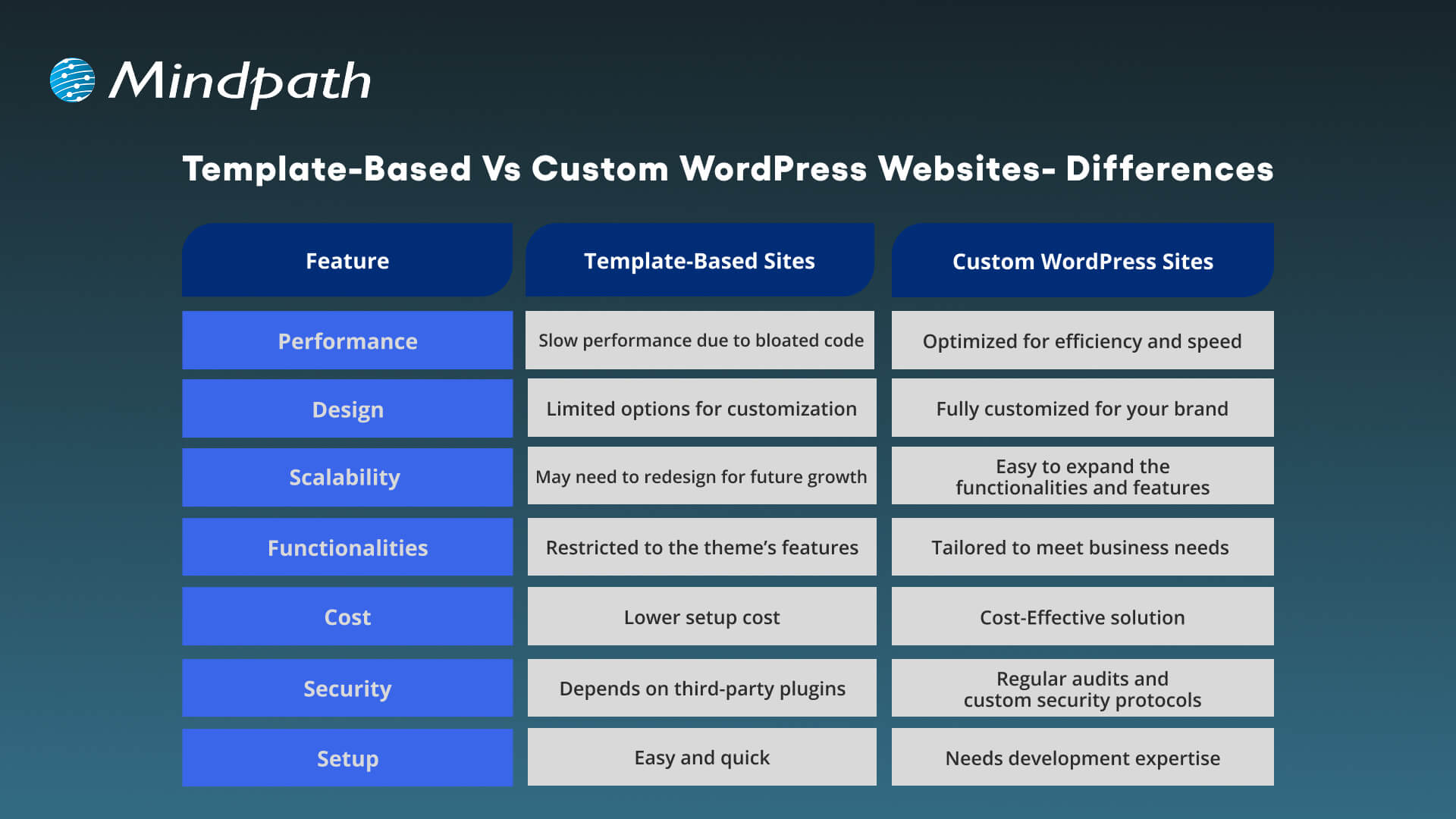
Template-Based Vs Custom WordPress Websites – Differences

Choosing between a custom WordPress site and a template-based site can greatly impact scalability, flexibility, as well as cost. Understanding the differences will help you make the right decision.

Template-Based Vs Custom WordPress Websites

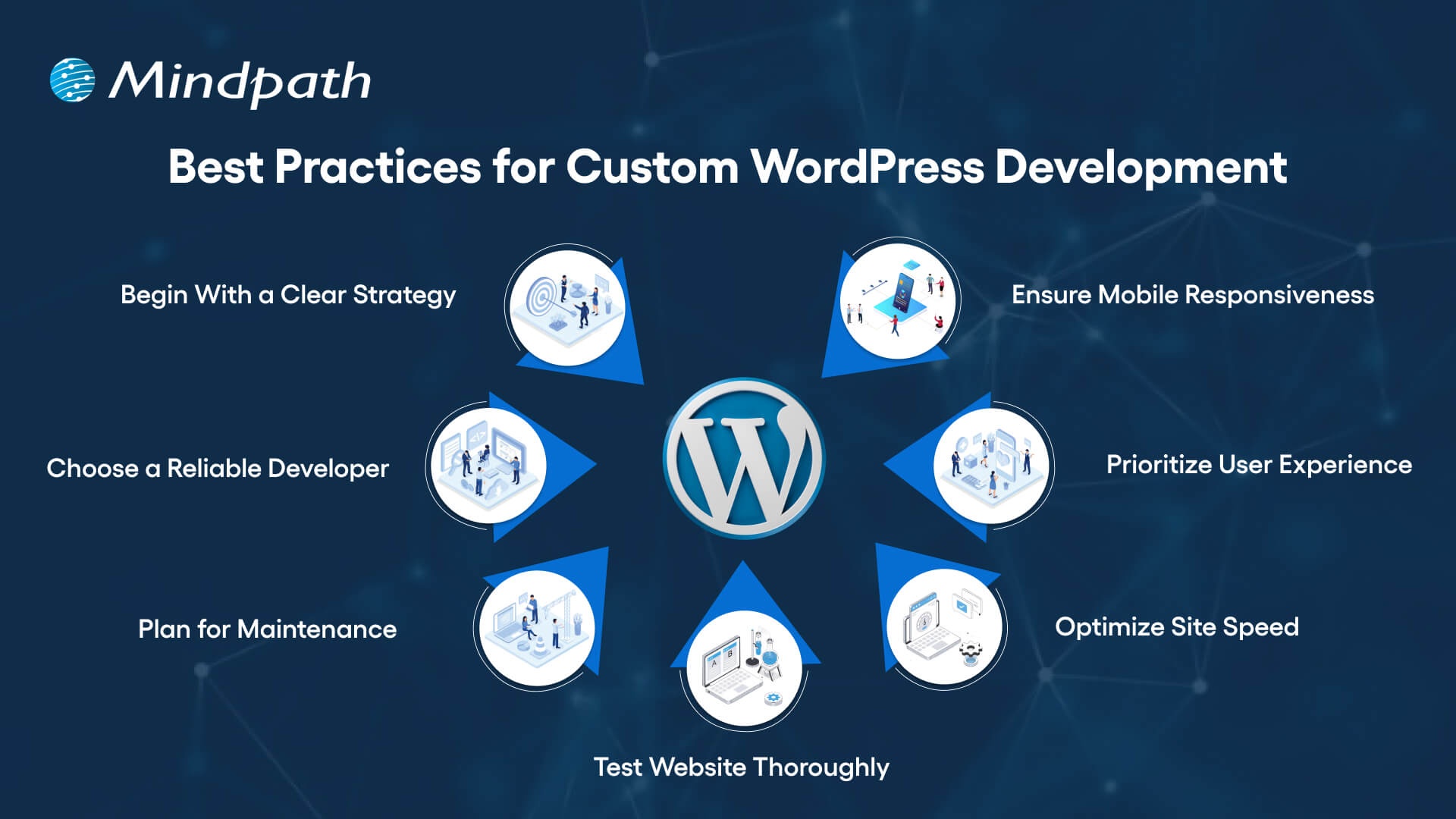
Best Practices for Custom WordPress Development

To make sure your new custom WordPress development project offers desired results, it is advisable to follow these best practices:

Best Practices for Custom WordPress Development

1. Begin With a Clear Development Strategy

Whether you need WordPress development for a small business or a large organization, you should first understand your target audience, desired functionalities, and goals. A well-documented strategy can help prevent scope creep, and you can ensure a perfect alignment between developers and stakeholders.

2. Focus on Mobile Responsiveness

With people increasingly using mobile phones and tablets for browsing, you should ensure that your website is responsive across all browsers and screen sizes. Custom WordPress development involves the use of a mobile-first design, which can boost SEO and usability.

3. Prioritize User Experience

Even though you have a beautiful website, it will be useless if users face issues while using it. An experienced developer will focus on a smooth user experience, making it easier for visitors to locate the things they need.

4. Optimize Your Site for Maximum Speed

Utilize techniques such as caching, image compression, CDN, and lazy loading to make sure your site loads faster. Tools such as Lighthouse, GTmetrix, Pingdom, and SEO Site Checkup can be used to detect bottlenecks.

5. Test Your Website Thoroughly

Before you make your site live, make sure that it has gone through proper testing. It helps identify compatible issues, loopholes, and missing functionalities. Prefer to carry out device testing, usability testing, and cross-browsing testing. Refine UX and optimize elements based on user feedback.

6. Plan For Smooth Maintenance

A custom WordPress site needs regular security checks, backups, and updates. So, create a proper maintenance plan or work with a professional WordPress developer to ensure constant support. Ongoing maintenance is crucial to keep your site functional and secure.

7. Partner With a Reliable Developer

Work with an experienced and trustworthy development company with a proven track record of offering quality WordPress website development services and creating high-performance websites. While helping you with technical execution, they can offer strategic input.

Do you want your website to be accessible to every visitor? Learn how to improve WordPress web accessibility can help you reach more users and create an inclusive online experience.

Tips to Choose The Right WordPress Development Company

Choosing the right expert for custom WordPress development is crucial to ensure success. While looking for the best one, prefer to consider the following points:

1. Evaluate The Experience

Ensure that the developer has years of experience in WordPress, especially in custom development. Go through their portfolio and check if they have ever created similar websites that you want to create. They should have a deep knowledge of the best practices and core functionalities of WordPress.

2. Technical Expertise

Confirm that the service provider has proficiency in JavaScript, CSS, MySQL, HTML, PHP, plugins, and more. Choose one with strong technical skills for the desired results.

3. Check Their Process:

Ask the company who they plan, carry out, and test the development projects. Ensure that they can offer a comprehensive custom development service based on your requirements.

4. Transparency and Communication

Only a trusted partner can keep you informed through the WordPress development project and will remain transparent about the costs and timelines. Choose one who prioritizes clear reporting and reacts to your queries promptly.

5. SEO Knowledge

The custom WordPress development expert should have a proper understanding of the latest SEO trends and be able to deploy necessary on-page optimization from the beginning. Furthermore, they should know how to configure different SEO plugins.

6. Post-Launch Support

Without regular updates and maintenance, your site will become vulnerable to various issues. So, partner with a development company that offers additional support along with maintenance services to keep your site performing at its best.

This is how you can hire an expert for professional WordPress web development to get your website listed higher in SERPs.

Wondering how to hire the right WordPress developer to help your business grow online? Explore our detailed guide to hire WordPress Developer to discover expert insights that guide you toward making the best hiring decision.

Looking to Elevate Your Business with Custom WordPress Development?

Undoubtedly, WordPress offers organizations the flexibility, affordability, and speed they need to start. Custom WordPress development is more than just writing code and creating a website. It is a strategic process to craft a unique digital experience that can effectively support your organizational goals, reflect your brand, and scale with you. It provides you with robust security, future scalability, and innovations that you will not get with template-based solutions.

If you want to elevate your business’s online presence and are looking for a future-proof platform, you can always count on Mindpath’s WordPress development service. As a leading WordPress development company, we combine custom development with scalable architecture and creative design to bring your unique vision to life. At Mindpath, we understand that every business needs uniqueness when it comes to developing a website. That’s why we offer tailored solutions that can set you apart from your competitors. We specialize in CMS development, custom plugin development, theme development, and more. Create a solid presence in this evolving digital landscape with us!

Edge Computing

The radical growth in the amount of data generated by devices connected to the internet created concerns regarding the traditional approaches to computing and data storage. Many companies have shifted their business models towards cloud computing to accommodate the demand for storing more data. However, the search for answers to ‘what is edge computing’ is gaining momentum due to the limitations of cloud computing. One of the biggest setbacks of cloud computing is the latency, which is a direct outcome of the distance between users and cloud data centers.

Edge computing has emerged as a promising alternative by providing a distributed computing model in which computation and data storage are closer to the source of data generation. Understanding the strengths and limitations of edge computing offers the ideal foundation to integrate it effectively in enterprise operations.

Is your business struggling to act on data fast enough to stay competitive? Mindpath’s Edge Computing Services deliver real-time processing to power faster and smarter decisions.

Discovering the Ideal Definition of Edge Computing

The traditional cloud-based infrastructure has been the favorite choice of companies who prefer agility and scalability. On the other hand, the limitations of cloud computing have created setbacks in supporting emerging use cases and workloads. Apart from the high latency, cloud computing makes you dependent on central data centers and burdens you with costs. Therefore, an alternative like edge computing has become the need of the hour for thousands of businesses worldwide.

Upon searching for edge computing definition on different platforms, you will come across multiple entries. The most common definition of edge computing paints it as a distributed computing approach that involve shifting computing resources as close as possible to the source of data generation. It involves carrying out data processing tasks on or near the devices on the edge, thereby reducing network costs and latency requirements.

You must know that the edge may be a router, routing switches, ISP, multiplexers or integrated access devices. The only thing required for edge computing is that the network edge must be in proximity of the device.

Understanding the Components in Edge Computing Architecture

You might have many questions about the way in which edge computing overcomes the challenges with cloud computing. The basic edge computing meaning does not shed light on the fact that edge computing works with different components. Without understanding the architecture of edge computing, you cannot figure out how it is better than cloud computing. A breakdown of the important components in edge computing architecture can help you decipher how edge computing works.

1. Edge Devices

Edge device refers to the actual device on the edge, such as a camera, IoT device or a sensor. It is the source where raw data is generated and serves as the first point of contact in the edge computing architecture. The edge device can support minimal processing tasks, such as data filtering.

2. Edge Gateways

The next crucial component after edge computing devices is the edge gateway, which serves as a data aggregator. Edge gateway is the place where the system aggregates data from multiple devices and deals with basic analytics and preprocessing tasks.

3. Edge Servers

You cannot think about using edge computing for real-time tasks without edge servers in the picture. Edge servers handle the local processing tasks for real-time applications and running AI inference models or containerized workloads. As a matter of fact, edge servers take care of critical data on a temporary basis before sending it to the cloud.

4. Network Layer

The network layer helps in ensuring the use of 5G, LAN, Wi-Fi or satellite connection for connecting edge components to each other and the cloud.

5. Data Center or the Cloud

The data center or the cloud in edge computing architecture is useful for long-term storage and in-depth analytics. It also facilitates easier prospects for model training alongside the utilities like component orchestration and centralized management.

Unraveling Real-World Use Cases of Edge Computing

The introduction to edge computing also creates curiosity about the different ways in which businesses can use it. You can find edge computing examples in almost every industry and even in your daily lives. Learning about the real-world use cases can help you get a better idea of how edge computing can revolutionize the future of computing.

1. Retail

Edge computing serves the ideal resource for real-time processing and analytics in the retail sector to provide seamless customer experiences. Retailers can use edge computing in inventory management, customer analytics and personalized advertising to improve operations as well as the customer experience.

2. Manufacturing

The widespread use of edge computing in IoT applications provides the foundation for leveraging the new computing approach in manufacturing. IoT devices allow manufacturers to monitor their equipment, production lines and quality control. With the help of edge computing, manufacturing processes gain the benefit of automation, thereby ensuring faster manufacturing.

3. Autonomous Vehicles

The examples of different types of edge computing applications in the real world will be incomplete without mentioning autonomous vehicles. Edge computing can provide the lowest levels of latency required for processing input data from cameras. The low latency plays a major role in enhancing safety and navigation in autonomous vehicles.

4. Smart Cities

If you talk about autonomous vehicles among use cases of edge computing, then you should not leave smart cities from the discussion. The faster and localized data processing with edge computing offers a formidable boost for various tasks in smart cities. Edge computing has the potential to streamline energy optimization, public safety monitoring and real-time traffic management.

Does Edge Computing Have Any Variants?

Most of the discussions about edge computing focus only on its definition, its applications and benefits. The search for answers to ‘how does edge computing work’ does not lead you to the more intricate details of the new computing approach. You should also know that edge computing works at different levels with distinct utilities in different scenarios.

1. Regional and Local Edge

The regional and local edge locations help in extending the capabilities of cloud computing with reduced latency. The regional hubs work like the cloud to facilitate compute and storage services near end-users. Positioning of regional and local edge hubs before the last-mile network ensures that they can support applications which need moderate latency and enhanced data throughput.

2. On-site Edge Computing

Another notable variant of edge computing is on-site edge computing in which edge servers and devices are present in the physical premises of an organization. The on-site edge computing systems are more reliable choices for mission-critical applications as they enable real-time decision making without external networks. On-site edge computing also provides the assurance of more autonomy, control and security for enterprises.

3. Device Edge Computing

The diverse applications of edge computing also draw references to device edge computing with IoT endpoints. Device edge computing involves a combination of IoT devices, embedded systems and sensors which interact directly with the physical environment. The utility of device edge computing is primarily evident in distributed edge networks as they reduce data transfer and support localized actions.

How Can Edge Computing Help Your Business?

Edge computing offers significant advantages that make it a better alternative to cloud computing. As a matter of fact, the benefits of edge computing make it a powerful option for many emerging use cases.

1. Lower Latency

One of the most notable entries among the benefits of edge computing is low latency. With the help of local processing, edge computing ensures that the data never goes to the cloud for processing. As a result, edge computing can ensure significantly faster response times, which is essential for time-sensitive applications.

2. Enhanced Reliability

The local processing in edge computing ensures that it does not have to depend on external networks or resources. You can notice that the advantages of edge computing don’t give up on you in times of outages. You will not need a stable internet connection at all times to make the most of edge computing in real use cases.

3. Reduced Bandwidth Costs

Edge computing plays a major role in reducing network congestion, which ultimately leads to lower operating costs. With limited data transfer to the cloud, edge computing provides the assurance of improved performance in limited bandwidth. As a result, edge computing can help you avoid the costs of uninterrupted high-speed internet connectivity.

4. Better Flexibility

The isolated processing on devices in edge computing not only showcases how the power of computing can come at low costs but also with more flexibility. Edge computing allows you to add more connected devices without the urgency to connect them to central servers. On top of it, edge computing also facilitates hybrid scaling with the help of cloud resources and flexibility for deploying new edge nodes with growing demand.

Final Thoughts

Edge computing is a new paradigm that aims to revolutionize compute and data storage services. It provides a better alternative to cloud computing by enabling data processing on the devices at the network edge. The difference between cloud and edge computing is clearly evident in latency and resource requirements. Edge computing consumes significantly fewer resources than traditional cloud computing and delivers lowest latency. The adoption of edge computing in smart cities, autonomous vehicles and smart manufacturing units is a proof of how the new computing approach is better than its predecessors.

Mindpath is a leading end-to-end IT solutions provider with years of experience in catering to clients from different industries. We specialize in edge computing solutions tailored to modern specifications and capable of delivering the best results in alignment with your business goals. Take the first step to embrace the power of edge computing in your business with us.

Discover how edge computing enhances data processing, helping businesses make real-time decisions and optimize operations.