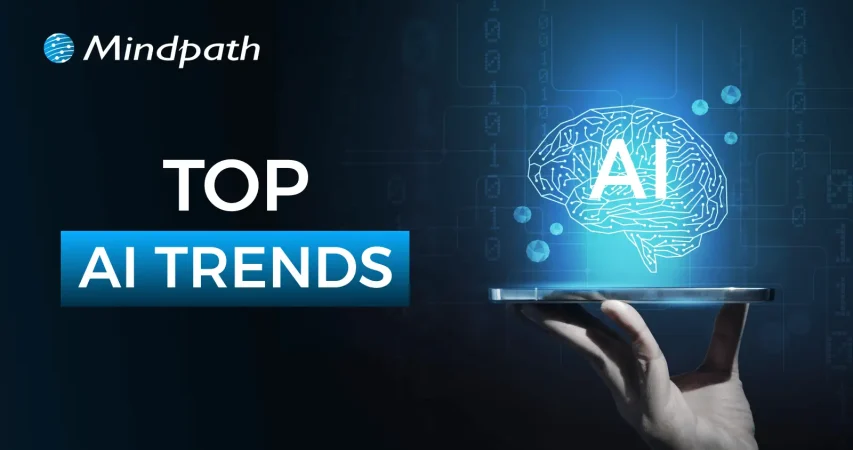
Top AI Trends Business Leaders Can’t Ignore in 2026

Join our Newsletter!

Featured Posts

Support Is One Click Away

Home

Top AI Trends Business Leaders Can’t Ignore in 2026

top AI trends

Top AI Trends Business Leaders Can’t Ignore in 2026

AI trends are growing at an accelerated rate, creating new opportunities and challenges for leaders in today’s workforce. From intelligent automation to advanced data analysis, AI is delivering smarter and leaner business processes, and playing a critical role in AI in decision-making. Fascinating, isn’t it? AI now permeates companies of all sizes for improving decision-making and performance. These transitions are already contributing to how businesses will operate and compete across every industry in 2026!

It is vital to keep up with the trends in AI because they are directly relevant to how businesses grow, change, and ultimately fulfill growing expectations. The faster leaders recognize trends, the smarter they can invest and prepare their teams, in order to gain an advantage over their competitors. If you do not pay attention to these trends, you may run the risk of missing advancements in tools, significant improvements in workflows, and smart strategies.

Want to know what are the top AI trends for 2026? This blog will provide you with all the AI trends business leaders will want to be aware of and should pay particular attention to in 2026.

Wondering how to get started with AI development the right way? Our AI Development Services can help you build impactful solutions from concept to deployment.

What is Artificial Intelligence (AI)?

Artificial Intelligence (AI) is a type of technology that helps computers in thinking, learning, and making choices like people. It allows machines to use language, read information, and analyze data to give helpful responses. In business, AI is primarily being utilized to make workflow quicker and smarter.

For example, AI allows an organization to better appreciate the needs of its customers, and provide its products or services to them, when they need them, in a timelier manner. AI functions for businesses efficiently by helping cut down the time taken for a task that people typically take a lot longer to do. AI can minimize errors, take care of repeated and tedious work, and it can operate indefinitely without breaks.

It means that an organization can receive a product quicker, save time to increase productivity, and use their time to pursue other important goals. AI can also help organizations improve the quality of their products and services by being able to produce and share insights derived from their data, helping ensure smarter, and more informed decisions.

Let us know about some AI statistics that highlight how organizations are adopting and managing AI technologies in 2026:

  • According to Statista, the AI market is expected to reach US$244.22 billion in 2026 and grow to US$1.01 trillion by 2031, with a CAGR of 26.60%.
  • As per McKinsey AI report, more than three-quarters of organizations now use AI in at least one business function.
  • An artificial intelligence survey from Forbes reveals that 25% of enterprises will deploy AI agents in 2026 to handle complex, multi-step tasks.
  • Analytics Insight states that 80% of retail executives plan to accelerate AI adoption through automation by the end of 2026.

Is your business missing out on the advantages AI can offer? Explore the benefits of AI from increasing efficiency and cutting costs to making smarter, data-driven decisions that drive growth.

Top AI Trends for 2026

Trends in artificial intelligence are shaping how businesses operate, innovate, and grow in 2026. As more companies start using AI to improve workflows and decision-making, these key developments are driving real impact across industries.

1. AI Reasoning Gets Smarter

Among the latest developments in AI, one major shift is its growing ability to reason and make sense of complex situations. In 2026, large language models can think more like humans, helping businesses go beyond basic insights. They now support smarter planning and stronger decision-making. This means companies are using AI not just to understand data, but to act on it more confidently.

2. Generative AI Reshaping Content Strategy

The best artificial intelligence trend in 2026 is the rise of generative AI in content creation. It allows businesses to create text, visuals, and videos instantly from basic prompts. This helps teams produce more personalized content at scale without extra effort. It’s making content strategies faster, smarter, and more effective across industries.

Also Read: Top GenAI Trends 

3. AI Agents Redefining Business Efficiency

One exciting use of AI in business is the rise of intelligent AI agents that act like real team members. These smart tools handle tasks like finding new leads, managing admin work, and analyzing data in real time. By doing this, they help teams work faster and focus on bigger goals. Companies are now seeing lower costs and fewer errors due to these advanced AI systems.

4. Multi-Agent Systems Streamlining Workflows

A new shift in AI is the use of multiple agents working as a team to handle complex business tasks. Each AI agent focuses on a specific job, like customer service or finance, and they all work together smoothly. This makes it easier to automate detailed processes that once needed people to manage them. The result is faster work, better accuracy, and stronger connections between business systems.

5. Industry-Driven AI in Action

Different industries are now using AI in ways that fit their unique needs. Sectors like finance, healthcare, insurance, and manufacturing are leading the way because they already follow strong rules around data and systems. These fields need custom AI tools for tasks like managing claims, tracking supply chains, or handling appointments. Tailored AI solutions are helping these industries work faster, meet rules, and serve people better.

How is AI reshaping the way websites are built and optimized? Explore our detailed article on AI in Web Development to see how it’s driving smarter design, faster deployment, and better user experiences.

6. GPUs Powering the Future of AI

A key new technology in AI is the growing use of GPUs to run advanced models. These powerful chips help process large amounts of data quickly, which is essential for AI tasks. As AI adoption grows, the demand for GPUs is rising across both cloud and on-premise systems. They now play a central role in building fast, efficient, and scalable AI infrastructure.

7. A Shift Towards Small Language Models (SLMs)

One trend catching the eye of artificial intelligence companies to invest in is the move from large to small language models. These smaller models, called SLMs, can do many of the same tasks as LLMs but use fewer resources. They are faster, cheaper to run, and easier to manage, making them a smart choice for everyday use. With techniques like pruning and knowledge sharing, SLMs are becoming more efficient without losing quality.

8. Businesses Turn to Open-Source AI

Open-source AI is becoming a strong choice for businesses that want more freedom and flexibility. Unlike closed systems, open-source models let companies build and manage AI tools on their own, keeping data private and costs lower. They can also fine-tune models using their own data to get better results. This shift is helping more businesses create powerful AI solutions without relying on big tech providers.

9. RAG Brings More Accuracy

One growing method to reduce wrong answers from AI is called Retrieval-Augmented Generation, or RAG. It helps AI pull information from reliable and current sources, making responses more accurate. While it improves relevance, it doesn’t always provide personalized answers without added context. Still, RAG is becoming a valuable tool for businesses looking to make AI more useful and trustworthy.

10. Swarm Learning Driving AI Progress

Swarm learning is a new way for AI systems to grow by sharing what they learn with each other. Instead of learning alone, connected AIs exchange knowledge in real time. This helps them improve faster and solve problems more efficiently. It’s a smart way to build stronger AI by working as a team.

Looking for smarter ways to handle customer queries and optimize workflows? Explore our blog to see how conversational AI chatbots can transform your business.

Is Your Business Aligned with the Top AI Trends?

AI trends are reshaping how businesses grow, compete, and deliver value across every industry. From reasoning models to open-source tools and AI agents, these trends are helping companies simplify operations, improve decision-making, and stay ahead. By understanding what’s emerging in 2026, leaders can better prepare for new opportunities and future success.

At Mindpath, we offer AI development services that align with the latest AI trends and business goals. We create intelligent tools, automation systems, and custom AI models that improve decision-making and increase efficiency. Our solutions are built to fit your operations, boost productivity, and support long-term growth. With Mindpath, businesses gain reliable and future-focused AI support.

Frequently Asked Questions

1. How can businesses practically start adopting the top AI trends without major disruption?

Businesses can begin by identifying small use cases like automation or data analysis and gradually scaling. Starting with pilot projects helps test results without risk. With proper planning and training, teams can smoothly adopt new technologies while maintaining daily operations and minimizing disruption.

2. Why are the top AI trends important for long-term business growth?

The top AI trends help businesses stay competitive by improving efficiency, reducing costs, and enabling smarter decisions. Companies that adopt these trends early can respond faster to market changes, improve customer experiences, and build stronger strategies for sustainable long-term growth.

3. How do AI agents differ from traditional automation tools in real business scenarios?

AI agents go beyond simple automation by making decisions, learning from data, and handling multi-step tasks independently. Unlike traditional tools, they adapt to situations and improve over time. This makes them more useful for complex workflows that require intelligence and flexibility.

4. What challenges should leaders consider before implementing AI trends in their organization?

Leaders should consider data quality, integration with existing systems, team readiness, and ethical concerns. Proper planning, clear goals, and employee training are essential. Addressing these challenges early ensures smoother adoption and helps businesses gain maximum value from AI investments.

5. How are the top AI trends influencing everyday employee roles and responsibilities?

The top AI trends are shifting employee roles toward more strategic and creative tasks. Routine work is increasingly automated, allowing teams to focus on problem-solving and innovation. Employees also need to learn new skills to work effectively alongside AI-powered tools and systems.
Related Post

Discover key considerations for hiring React developers. Learn how Mindpath can provide the right talent for your project.

Related Post

what is a chabot

In this fast-paced world of business, companies are actively seeking smarter tools to improve customer service and communication. Chatbots are one of the most common, and a great way to get attention. If you have engaged with a virtual assistant on a website, chances are that you have seen it in action. So, what is a chatbot? You may have wondered about this when you are chatting with a brand online or if you are shopping on a website where you are getting instant replies.

As these types of digital assistants proliferate, they are quickly becoming an essential aspect of how businesses operate in 2026. With faster response times and the ability to interact with multiple customers at once, it is no surprise that chatbots are altering how companies relate to their customers. In this blog, we will provide you with everything you need to know about chatbots including benefits, features and examples of chatbots in action.

Struggling to keep up with customer queries or deliver 24/7 support efficiently? Mindpath’s GenAI-driven chatbot development services can help you manage customer service and boost business performance.

What is a Chatbot in Simple Words?

A chatbot is an artificial intelligence (AI) software application that is designed to have human-like conversations. They use natural language processing (NLP) to understand what users are stating and respond in a way that feels natural in a conversation and is helpful. They can help with answering questions, can guide the user, and can perform some tasks.

Chatbots can be a part of a website, an app, a messaging app, or a voice assistant. AI chatbots help businesses communicate with customers 24/7. They can perform tasks like making bookings, solving common problems, and providing information. AI chatbots are invaluable tools for improving customer experience and communication.

How does a Chatbot Work?

Chatbots work by using artificial intelligence and natural language processing to understand what users are saying. When someone types or speaks to a chatbot, it reads the message and tries to figure out what the person wants. It does this by matching the message with words or phrases it already knows.

Once the chatbot understands the request, it picks the most suitable response and replies to the user. Some chatbots follow simple rules, while others learn from past conversations to improve over time. This process allows chatbots to provide quick and helpful replies in a natural and professional way.

What are the Benefits of Using AI Chatbots for Businesses?

AI chatbots are now widely used by businesses to improve customer interaction and automate routine tasks. Here are some of the key benefits of chatbot technology that can help boost your business:

benefits-of-ai-chatbots-scale

1. Improve Sales

Chatbots can increase sales by showing new products or offering special discounts to website visitors. They send helpful messages that guide users toward making a purchase. These bots also assist in product selection and order placement. This makes it easier for new visitors to become paying customers.

2. Lead Generation

Chatbots help gather leads even before a conversation starts. They ask visitors for basic details like name and email to begin the chat. They can also qualify these leads by asking relevant questions based on customer needs. This helps your sales team know who they’re speaking with and what the customer is looking for.

3. Boost Customer Engagement

Chatbots make online experiences more interactive and personal. Instead of searching through a website, users can chat and get instant answers. Bots reply with clear information based on user questions. This keeps customers engaged and helps them find what they need quickly.

4. Reduce Costs

Using chatbots is more affordable than hiring multiple support agents. They can handle many tasks like answering FAQs or booking appointments, which saves time and money. You’ll still need some team members, but bots make the process faster. This is especially helpful for managing high volumes without extra costs.

5. Understand Your Customers Better

As chatbots collect important customer data during conversations, they can also run surveys to check customer satisfaction. By reviewing these chats, businesses can find out what customers like or dislike. This feedback helps improve products and services over time.

Wondering why chatbots are becoming essential for modern businesses? Explore the top Benefits of Chatbots Every Business Leader Should Know and learn how they drive growth.

6. Fewer Support Requests

Chatbots handle many common questions, which reduces the number of queries sent to human agents. This helps agents focus on more complex issues. It also improves customer satisfaction by providing quick solutions. A chatbot for business can balance automation and personal support effectively.

7. Multilingual Support

Multilingual support allows chatbots to speak different languages. This is helpful if your business has customers from various countries. The bot can reply in the language your customer prefers. This makes a chatbot for small businesses and large companies more accessible to global audiences.

8. 24/7 Customer Support

Chatbots are always available, even when your team is offline. If someone is browsing late at night and needs help, the bot can step in. It can guide them to the right product or answer their questions. This leads to better customer service and more satisfied clients.

9. Lower Bounce Rates

Chatbots can keep users on your site longer by offering help when someone is about to leave. They provide answers or discounts that encourage people to stay. This improves your website’s engagement and SEO performance. Visitors feel supported and are more likely to explore further.

10. Boost Marketing

Marketing chatbots can suggest products, offer deals, and guide customers through the buying process. They also collect useful data for future campaigns. One of the ideas can be a spinning wheel offering discounts, which encourages users to buy. This creates an engaging and effective marketing strategy.

How can conversational AI take your customer engagement to the next level? Explore the power of Conversational AI Chatbots for Business Growth and discover how they drive results.

Real-World Use Cases of Chatbots

Chatbots are being used across many industries to simplify tasks and improve customer experiences. Here are some real-world chatbot examples that show how businesses are using them effectively for different needs.

use-cases-of-chatbots-scale

1. Help Customers Book Tickets Easily

A chatbot can answer common questions like seat availability, movie timings, and refund policies while guiding users to book tickets smoothly. PVR Cinemas uses this on their website to help visitors quickly complete bookings and check offers.

2. Make Customer Experience More Engaging

Chatbots can add personality by offering quizzes, jokes, and product suggestions in a fun and helpful way. LEGO’s chatbot Ralph helps users find the right gift through playful questions and interactive chat.

3. Handle Event-related Queries at Scale

When thousands of people need answers about an event, a chatbot can respond instantly with details like schedules, speakers, and directions. Slush uses one to manage large volumes of attendee questions efficiently on their event site.

4. Assist With Product Searches and Suggestions

A chatbot can search inventory and offer personalized product recommendations based on customer preferences. Sephora’s chatbot does this well by guiding users to suitable makeup products and checking stock availability.

5. Provide Updates on Orders and Shipping

Instead of navigating emails and websites, customers can enter their order ID in a chatbot to get instant shipping updates. H&M allows shoppers to track their deliveries directly through its chatbot.

Thinking about Using Chatbots to Elevate Customer Experience?

Chatbots are transforming how businesses interact with customers by offering fast, helpful, and personalized service. From booking tickets to answering questions, these tools simplify tasks and improve user satisfaction. With so many benefits, it’s no surprise that more companies are embracing chatbot technology to stay ahead in 2026.

At Mindpath, we offer custom chatbot development tailored to your business goals. Our chatbot development services are designed to help you improve customer interactions, increase engagement, and streamline operations. Whether you need a simple support bot or a fully integrated solution for sales, marketing, or service, our expert team builds smart, reliable chatbots that deliver real results.

Frequently Asked Questions

1. How can a chatbot improve customer experience on a website?

A chatbot improves customer experience by offering instant responses, guiding users to the right information, and reducing wait times. It creates a smooth journey by helping visitors find what they need quickly, which increases satisfaction and encourages them to stay longer on the website.

2. What is a chatbot used for in daily business operations?

A chatbot is used for handling routine tasks like answering FAQs, booking appointments, collecting customer data, and assisting with purchases. It helps teams save time by automating repetitive work while ensuring customers receive quick and consistent support throughout their interaction.

3. Can chatbots work effectively for both small and growing businesses?

Yes, chatbots are useful for both small and growing businesses. They help manage customer queries without needing a large team, making operations more efficient. As the business grows, chatbots can scale easily to handle more interactions without increasing costs significantly.

4. What should businesses consider before implementing a chatbot?

Before implementing a chatbot, businesses should define clear goals, understand customer needs, and choose the right type of chatbot. It is also important to plan integration with existing systems and ensure proper testing to deliver a smooth and effective user experience.

5. What is a chatbot’s role in improving website engagement?

A chatbot plays an important role in keeping users engaged by starting conversations, offering assistance, and providing relevant suggestions. It reduces bounce rates and encourages interaction, helping businesses create a more interactive and user-friendly website experience that keeps visitors interested.

front end vs back end vs full stack

Web development is one of the formidable tools that have helped businesses stay strong in the era of digital transformation. It has also attracted attention towards the frontend vs backend vs full stack comparison, since the three distinct components have a distinct role in web development. If you have to begin your next web project anytime soon, then it is important to learn the significance of these terms.

Businesses have been tapping into the digital revolution with the help of websites and web applications to establish their digital presence. However, business owners must know whether they should pick full-stack developers or a combination of frontend and backend developers. Let us compare frontend development, backend development, and full-stack development to find the best choice for your next web project.

Not sure about what to choose, frontend, backend, or full-stack developer for your next project? At Mindpath, our web developmet services give you the best of both expertise that speeds up your development process and provides seamless end-to-end solutions.

Unraveling the Components of Web Development

The general impression about web development is that it focuses on building websites or web applications. As you dive deeper into web development, you will find the backend and frontend divisions quite clearly. Where does full-stack development enter the picture? You can find a perfect answer to the question with brief overviews of the two crucial components in web development.

Fundamentals of Frontend Development

The term ‘frontend’ gives out the meaning of frontend development. It stands for the part of web applications that is visible to users. Frontend developers have to create different aspects of the user interface, including text font, colors, menu styles, and buttons. Most of the frontend vs backend vs full stack development comparisons paint frontend development as the process of creating the aesthetics of web applications. On the other hand, the comparisons miss the fact that frontend developers also create the user experience.

Frontend developers take on different tasks such as developing intuitive user interfaces, optimizing for performance, and ensuring accessibility on different devices. The other crucial tasks involved in frontend development include testing the frontend for errors and ease of navigation, and optimizing the user experience. Working as a frontend developer means that you will have to use languages like JavaScript, HTML, and CSS. On top of it, developers should know how to use frameworks like React and Angular to improve performance and responsiveness.   

Fundamentals of Backend Development

The backend of a web application represents the components that run the application from behind the scenes. Most of the answers to “What is a backend developer?” reveal that they focus on the server, databases, and APIs. Backend developers have to ensure that all these components work in unison with each other efficiently and provide the desired functionalities. The responsibility of backend developers starts with understanding the main objectives of the website or web application and creating the relevant architecture.

Backend developers will have to ensure that there are ideal systems in place for data storage with the assurance of easier scalability. The biggest task of a backend developer is to create and optimize the server-side logic for efficient performance across different devices. Another crucial task that separates the front and back ends of a web application is API management for seamless functionality on diverse platforms. As a backend developer, you should also focus on creating the website architecture with flexibility for adding upgrades in the future. 

The extensive list of responsibilities of backend developers also includes the implementation of algorithms, backend security, and integrating payment systems. To achieve all these responsibilities, a backend developer must be an expert in one of the server-side programming languages, like PHP, Python, and Java. Backend developers also use frameworks like Django to expedite the development process. The skills required for backend developers also include tools like SQL and Oracle.

Why Do You Need Full Stack Development?

The overview of frontend development and backend development reveals their significance in the web development lifecycle. However, the front-end, back-end, and full-stack relationship becomes clearly evident when you combine the two crucial processes of web development. A full-stack developer can do the work of frontend and backend developers with little to no support from other professionals. The primary responsibilities of full-stack developers revolve around the user experience, servers, data modeling, databases, and hosting. 

Full-stack developers write code for the frontend and backend of web applications while collaborating with design teams and stakeholders. In addition, they also optimize the code with consistent testing and debugging. You can notice the full-stack vs frontend vs back-end development differences in the other responsibilities of full-stack developers. For instance, a full-stack developer not only implements servers and databases on the backend but also designs the user interactions on the frontend of the application.   

The tasks in full-stack development indicate that developers will need better technical proficiency than frontend or backend developers. Apart from fluency in frontend and backend programming languages, full-stack developers must also have strong soft skills.

There are unique advantages that full-stack development brings beyond its technical skills. Explore the benefits of full-stack development, which empowers businesses to accelerate innovation.

Diving Deeper into the Frontend vs Backend vs Full Stack Debate

Business owners who want to create web projects must be worried about the decision between choosing full-stack developers or backend and frontend developers. You can use the frontend vs full stack vs back-end developer comparison to determine the staffing requirements for your next web project. 

1. Focus Areas

Creating an effective web application or website requires attention to different areas of the application. The best way to differentiate frontend development and backend development from full-stack development requires the identification of the areas they focus on. Frontend development focuses on the graphical user interface and user experience, while backend development focuses on the server-side operations and data management. 

Full-stack development involves combining the focus areas of front and back ends of an application to deliver the required functionalities. The focus area of a full-stack developer is the complete application development lifecycle.

2. Objectives

The next important point of difference between frontend development and backend development focuses on the goals. Frontend developers work to deliver a positive user experience with a website or web application that looks good. The goals of frontend development also revolve around creating an appealing aesthetic for the web application while ensuring responsiveness and accessibility. 

The frontend vs backend vs full stack comparison also sheds light on how backend developers aim to create a high-performance and efficient app. Backend development relies on leveraging logic to achieve different functionalities alongside addressing user experience issues.    

3. Responsibilities

You can get a better impression of the differences between full-stack, frontend, and backend developers by learning about their responsibilities. The primary responsibility of a frontend developer involves implementing visual designs and layouts for a web application. Frontend development responsibilities also include creating a responsive design and interactive elements for the user interface. As a frontend developer, you will also have the responsibility of ensuring cross-browser compatibility for the application.

The responsibilities of a backend developer revolve around database management, API development, and backend security. Backend development also focuses heavily on creating, implementing, and maintaining the server architecture. The back-end vs full-stack vs frontend comparison will draw attention to the ways in which full-stack developers take on a broader set of responsibilities. Some of the notable responsibilities of full-stack developers include end-to-end development, system integration, and server and website architecture design. On top of it, full-stack developers must also take complete ownership of the project. 

4. Technical Skills

Another effective approach for comparing frontend and backend developers with full-stack developers is the technical proficiency required for the jobs. The full-stack vs back-end vs frontend debate in web development becomes quite simple in terms of the technical proficiency required in each area. Frontend development involves the use of technologies like HTML, JavaScript, and CSS. The other notable tools used in frontend development include frameworks like React, Vue, and Angular. 

Backend developers rely on programming languages like Python, PHP, and Java to write server-side logic. On the other hand, they also utilize frameworks like Django to leverage tools for faster and efficient development. Full-stack developers use a combination of all backend and frontend technologies, depending on the project requirements.

Here is an overview of the differences between full-stack, front-end, and backend developers.

Criteria Frontend Backend Full Stack
Focus Areas Frontend development focuses on the user interface and experience. Backend development revolves largely around server-side operations and database management. Full-stack development focuses on the complete application development lifecycle.
Objectives Frontend developers aim to make the application look good and easy to interact with. Backend developers aim to ensure that the web application works as intended by the client. Full-stack developers focus on building a complete web app with the frontend and backend elements.
Responsibilities Frontend developers take the responsibility of creating interactive elements and implementing visual designs with better responsiveness. Backend developers have to take care of server architecture, database management, API development, and backend security. Full-stack developers are responsible for designing the complete architecture, end-to-end development, and system integration.
Technical Skills Frontend developers know how to work with HTML, CSS, JavaScript, and frameworks like React and Angular. Backend developers know how to use programming languages like Python, Java, and PHP for server-side coding and other backend frameworks. Full-stack developers must have a strong command of backend and frontend technologies.

Want to know if full-stack development is becoming essential for modern web projects? Explore on how it helps businesses integrate systems efficiently and drive growth in our blog: Is full-stack development the future of web projects?

Final Thoughts

The insights on the differences between backend, frontend, and full-stack development reveal how full-stack offers a better choice. Why should you choose two different developers when one full-stack developer can do their jobs? However, the frontend vs backend vs full stack development comparison shows that frontend and backend developers also have unique strengths. Therefore, you need to consult with experts before you prepare a strategy for your next web project.

We at Mindpath have been offering expert web development services and delivering to one client after another with continuously growing customer satisfaction. You can come to us with any idea for web applications, and we can promise to create robust and appealing solutions that can attract your target audience. We have a team of experienced full-stack developers, frontend developers, and backend developers who have worked on multiple projects. Reach out to our consultants and make the most of our expertise in web development now. 

Neuromorphic Computing

The artificial intelligence you witness in mainstream applications today is extremely powerful and could do things which seemed impossible a few years ago. However, professionals would be aware of the architecture used for AI and the problems it brings to the able. The growing frequency of discussions around neuromorphic computing indicates that modern AI architectures need innovative solutions to address their limitations.

What could be the biggest limitations in the current state of AI? The most notable operational and physical constraints for AI include power consumption, bandwidth limitations and cooling requirements. A report suggests that all the world’s LLMs would stack up an annual electricity cost of 25 trillion dollars by 2027 (Source). Therefore, the neuromorphic paradigm had to emerge as a solution to achieve sustainable AI.

Ready to move beyond traditional AI and adopt intelligent systems that think and learn more like the human brain? Mindpath’s AI development services enable businesses to build future-ready AI solutions that drive innovation.

Understanding the Problem before the Solution

Many readers will be quick to search for the definition of neuromorphic artificial intelligence and how it is different from traditional AI. The breakthrough capabilities in modern AI systems come at the cost of massive resource consumption and various inefficiencies. The search for answers to ‘what is neuromorphic computing’ begins with the quest to find ways for improving sustainability in AI. Why do you have to worry about sustainable AI? It is important to note that training and running AI systems requires huge amounts of water, electricity and other resources.

Industry leaders have actively pointed out the need for cleaner sources of energy and that the future of AI needs innovative breakthroughs. Researchers have tried to work with alternative computing architectures that can ensure lower energy consumption without sacrificing performance. As a matter of fact, experts thought that quantum computing will be a major catalyst for the growth of AI. However, the infrastructure required for quantum computing will impose huge costs and is impractical for large-scale AI workloads.

Introducing Neuromorphic Computing into the Picture

The efforts of researchers to find new and efficient energy sources led to the development of the neuromorphic architecture. Neuromorphic engineering or computing represents a significant paradigm shift in which the structure and function of the human brain serves as inspiration. It involves simulation of the neural and synaptic structures of the brain for information processing. The primary goal of the neuromorphic architecture revolves around developing more capable and efficient AI systems.

As artificial intelligence systems continue growing, they need advanced hardware and software driving their functionalities. The neuromorphic paradigm of computing will serve as a growth accelerator for artificial intelligence by serving the benefits of high-performance computing. It works by emulating the human brain and nervous system as different components of a computer.

Unraveling How Neuromorphic Computing Works

The most common question about the neuromorphic paradigm for computing revolves around how it works. You can find how neuromorphic systems work by drawing similarities with the human brain. Neurons and synapses serve as the basic building blocks of the human brain and help in transferring information with minimal energy consumption.

The neuromorphic paradigm for computing involves modeling the neurological and biological mechanisms in the form of spiking neural networks. Spiking neural networks or SNNs are a variant of artificial neural networks with spiking neurons and synapses.

The spiking neurons store and process data just like biological neurons with each neuron featuring unique charges, delays and threshold values. The synapses in SNNs provide the pathways between neurons and also feature weight values and delay. You can program the neuron charges, neuron thresholds, synaptic weights and delays with the neuromorphic paradigm.

The neuromorphic computing architecture involves using transistor-based synaptic devices as the synapses. These devices or ‘chips’ feature circuits for electric signal transmission along with a learning component to change weight values according to different activities. As compared to traditional neural networks, the spiking neural networks work with timing as a crucial factor.

The charge value of neurons in SNNs builds up gradually and upon reaching the threshold value, the neuron will spike and send information across its synaptic web. However, the neuron will dissipate and eventually leak charge when the charge value does not meet the threshold. Another notable aspect of spiking neural networks is their event-driven nature in which neuron and synaptic delays values support asynchronous information distribution.

Discovering New Hardware Advancements in Neuromorphic Computing

The continuous evolution of the neuromorphic paradigm in computing has led to the development of new types of hardware. One of the earliest implementations of neuromorphic hardware is evident in the form of a theoretical experiment. The Stanford University created Neurogrid, which involved a mixed chip system with analog and digital capabilities, which can simulate neuromorphic networks.

The most interesting highlight in the evolution of neuromorphic architectures is the support of government bodies for neuromorphic research. For example, the Human Brain Project of the European Union aimed to understand the human brain better to come up with new computing technologies. Some of the notable advancements that came from the project are the large-scale SpiNNaker and BrainScaleS neuromorphic machines.

The technology industry is also not behind in the quest to develop neuromorphic chips with big players like Intel and IBM making a huge impact. Intel has created the Loihi chips while IBM has come with the next-generation NorthPole chips for neuromorphic architectures. As of now, the majority of neuromorphic devices leverage silicon and CMOS technology. Researchers have been looking for ways to use new materials such as phase-change and ferroelectric materials to improve the neuromorphic architectures.

How Can You Implement Neuromorphic Computing in the Real World?

The real world applications of neuromorphic paradigm of computing provide tangible proof of its potential to revolutionize AI. Neuromorphic architecture may become a game-changer in many areas with promises of unexpected efficiency improvements. An overview of the applications of neuromorphic architectures can help you understand their benefits.

1. Autonomous Vehicles

One of the most promising applications of neuromorphic AI can be found in the case of autonomous vehicles. Autonomous vehicle manufacturers leverage intelligent sensors and multiple cameras to collect images from the environment and detect obstacles for safer driving. Neuromorphic computers can facilitate higher performance and lower latency, thereby improving the navigation capabilities of self-driving vehicles.

2. Edge Computing

Neuromorphic architectures will also revolutionize edge computing with the benefit of low power consumption. With the help of efficient neuromorphic devices in edge networks, advanced AI systems can overcome the need to depend on remote cloud servers. This new approach can play a major role in using AI for time-sensitive applications on devices with limited resources.

Identifying the Challenges for Neuromorphic Computing

If you want to measure the probabilities of neuromorphic artificial intelligence gaining traction, then you must know about the challenges. Most of the neuromorphic computing examples you see in the real world are experimental in nature or in the nascent stages. Researchers have pointed out some prominent challenges that must be traversed to get the best of neuromorphic architectures in AI.

1. Lack of Standardization

Most of the neuromorphic research projects are restricted to universities and labs. It indicates that the technology is not ready for mainstream applications. On top of it, you cannot find clear standards for hardware and software in neuromorphic architectures, thereby creating scalability issues.

2. Integration Challenges

Even if neuromorphic engineering delivers tangible outcomes, it will take a lot of time and resources to achieve integration with existing systems. You should know that most of the deep learning applications use traditional neural networks, which use conventional hardware. Therefore, it will be extremely difficult to incorporate neuromorphic architectures in the computing infrastructures of legacy systems.

Final Thoughts

The neuromorphic paradigm for computing will emerge as one of the hot topics in technology for 2025. Anyone keeping tabs on the AI industry will know that hardware improvements and research efforts will bring neuromorphic computing to mainstream applications. Neuromorphic architectures will revolutionize AI capabilities and can establish the perfect foundation for accelerated growth of artificial intelligence.

Mindpath is a leading AI development service provider with a knack for innovation and technical leadership. We aim to set new benchmarks of excellence in creating novel AI solutions by leveraging the latest technologies. Our experts specialize in diverse technology stacks and strive to achieve the best outcomes in alignment with your goals. Consult with us now and discover the ideal path for your business growth.

Explore how neuromorphic computing is revolutionizing AI with faster, smarter, and energy-efficient systems. Learn how Mindpath can help.