
Latest Insights On
GenAI, Tech, and Digital Transformation
Stay updated with expert insights, success stories, and real-world applications of cutting-edge technology.
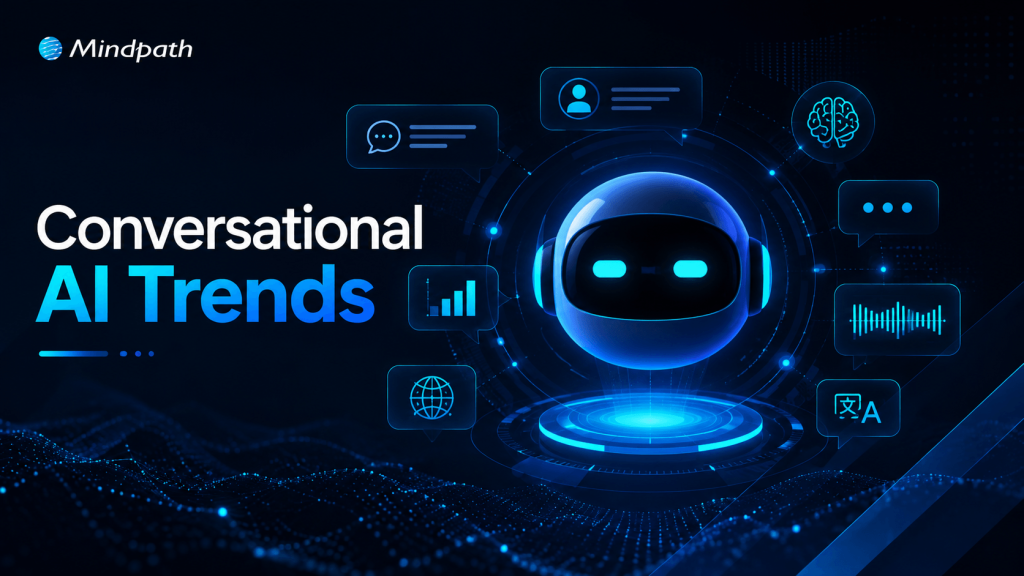
Businesses are constantly looking for smarter ways to improve customer experience, reduce operational costs, and deliver faster services. This is where conversational AI is becoming increasingly important. From answering customer questions to automating business workflows, AI-powered conversations are changing how companies interact with customers.
Key Takeaways
- 01
Agentic AI is helping businesses automate multi-step tasks beyond answering questions. - 02
AI chatbots are becoming more personalized and context-aware. - 03
Voice AI and multilingual assistants are improving customer communication. - 04
Multimodal AI enables systems to understand text, voice, images, and documents. - 05
Data privacy, human supervision, and reliable responses remain essential for successful AI adoption.
The conversational AI trends for 2026 focus on more intelligent, personalized, and action-oriented experiences. Unlike traditional chatbots that follow predefined scripts, modern conversational AI solutions can understand natural language, use business information, and support more complex requests.
Want to automate workflows, improve decision-making, and accelerate business growth with AI? At Mindpath, our AI development services help businesses build intelligent, scalable solutions aligned with their goals.
For example, an AI assistant can help a customer compare products, check an order status, and initiate a support request within the same conversation.
Let’s explore seven conversational AI trends businesses should understand in 2026.
7 Major Conversational AI Trends for 2026
1. Agentic AI Is Moving Beyond Traditional Chatbots
One of the biggest conversational AI trends in 2026 is the growing use of agentic AI. Traditional chatbots mainly answer questions, while AI agents can work toward a goal by completing multiple connected tasks.
For example, an AI agent in an e-commerce business could check product availability, recommend alternatives, retrieve order information, and initiate a return request.
Businesses can use agentic AI to automate customer support, sales assistance, appointment scheduling, and internal operations. However, sensitive actions should include appropriate permissions, verification, and human approval.
2. Personalized AI Conversations Are Becoming More Important
Customers expect businesses to understand their needs instead of providing generic responses. AI-powered virtual assistants can use permitted customer information, conversation history, and preferences to deliver more relevant support.
For example, an online shopping assistant can recommend products based on a customer’s stated budget and preferences. A banking assistant can explain relevant account services after securely verifying the customer.
This trend can improve customer engagement, satisfaction, and conversion opportunities. Businesses should use personalization responsibly, follow data protection requirements, and avoid collecting unnecessary personal information.
3. Voice AI Assistants Are Improving Customer Support
Voice AI assistants are making it easier for customers to interact with businesses without typing messages or navigating complicated menus.
Modern voice AI can recognize spoken language, understand requests, and generate spoken responses. Depending on the system, it can also transfer conversations to human agents when necessary.
Businesses can use voice AI for appointment booking, frequently asked questions, order updates, and after-hours customer support.
As speech recognition and response generation improve, companies can create more natural voice experiences. However, accuracy, background noise, accents, and response delays still need careful testing.
4. Multimodal Conversational AI Is Expanding
Multimodal AI allows systems to process different types of information, including text, voice, images, and documents. This makes conversational AI more useful for situations where customers need to share more than a written question.
For example, a customer can upload a product image and ask for similar items. A technical support assistant could analyze a screenshot of an error message and suggest troubleshooting steps.
These conversational AI applications can support retail, healthcare administration, education, manufacturing, and IT services.
Businesses adopting multimodal AI should evaluate data accuracy, file security, accessibility, and the limitations of AI-generated answers before deploying it at scale.
5. Generative AI Chatbots Are Becoming More Context-Aware
Generative AI chatbots use large language models (LLMs) to understand questions and produce natural-language responses. In 2026, businesses are increasingly interested in connecting these systems to approved company information.
One useful approach is retrieval-augmented generation (RAG). It retrieves relevant information from trusted sources before generating an answer.
For example, a customer support chatbot can use a company’s product documentation, return policies, and FAQs to answer questions more accurately.
This approach can reduce unsupported answers, provided the underlying information is reliable and the system retrieves the correct sources. Regular content updates, testing, and monitoring remain essential.
6. Multilingual Conversational AI Is Supporting Global Businesses
Businesses serving international customers need to communicate across different languages and regions. Multilingual conversational AI can help customers receive support in their preferred language.
For example, an online service provider can use an AI assistant to answer common questions in English, Hindi, Spanish, or other supported languages.
This can improve accessibility and help businesses provide consistent support across markets.
However, translation quality, cultural context, regional terminology, and language-specific testing are important. Human review may be necessary for legal, financial, medical, or other high-impact conversations.
7. AI Security and Human-AI Collaboration Are Becoming Priorities
As conversational AI becomes more closely connected to business systems, security and accountability become increasingly important.
Organizations need to protect customer data, control system access, monitor AI responses, and establish clear escalation processes. Human supervision is especially important when an AI system handles sensitive information or makes decisions that could significantly affect customers.
For example, a customer service chatbot can answer routine questions automatically while transferring billing disputes or unusual requests to a human representative.
The most effective conversational AI strategy is not always full automation. It is a balanced approach that combines AI efficiency with human judgment, transparent processes, and measurable business outcomes.
How Can Businesses Prepare for Conversational AI in 2026?
Businesses should begin by identifying repetitive customer interactions and workflows that could benefit from automation.
A practical implementation approach includes:
- Identify use cases: Start with FAQs, lead qualification, appointment booking, or order tracking.
- Choose the right technology: Evaluate conversational AI platforms based on integration, accuracy, scalability, and cost.
- Connect reliable data: Use approved company information to provide relevant answers.
- Protect customer information: Implement access controls, privacy safeguards, and appropriate human oversight.
- Measure performance: Track resolution rate, response time, customer satisfaction, qualified leads, and cost per interaction.
Starting with a focused use case makes it easier to measure results before expanding conversational AI across the organization.
Conclusion
The conversational AI trends for 2026 highlight a shift from simple question-answering chatbots toward intelligent assistants that understand context, support multiple communication channels, and help complete business tasks.
Agentic AI, voice assistants, personalization, multimodal capabilities, and secure AI integration offer businesses new opportunities to improve customer experiences and operational efficiency.
However, successful implementation depends on more than choosing an advanced AI model. Businesses also need reliable data, thoughtful workflows, strong security, and clear performance goals.
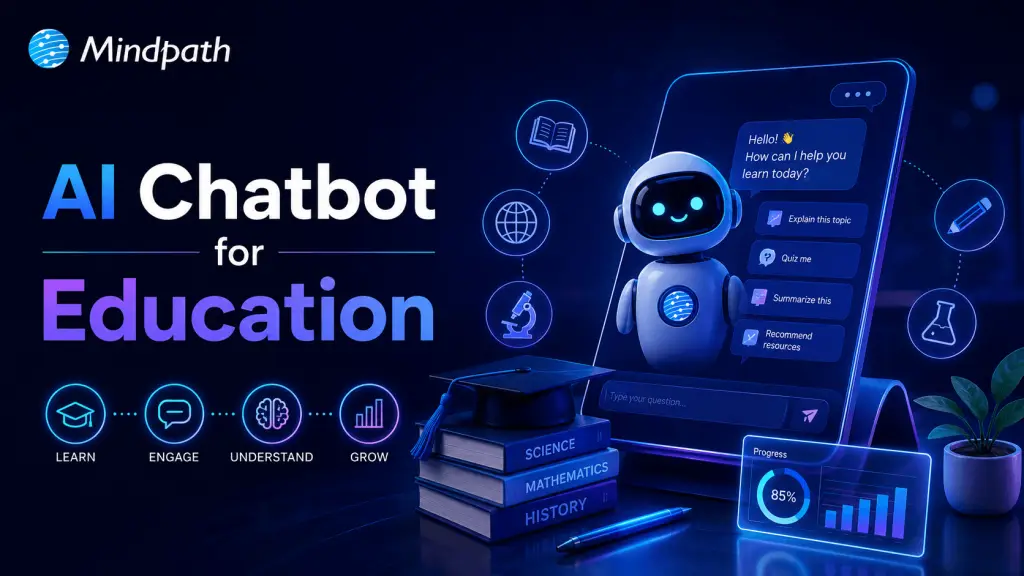
Eliza, the first ever publicly demonstrated chatbot, was created using a rule-based approach in the 1960s. With the onset of artificial intelligence and big data, these chatbots have now become advanced with capabilities like providing information and feedback, clear doubts, etcetera, and are transforming the face of education in the best possible way.
Artificial intelligence (AI) provides advanced education solutions and is being leveraged at scale by various institutions to achieve their digital transformation goals. This is evident with the growing demand for AI-driven online learning platforms with AI in education market revenue unanticipated to cross $20billion by 2027.
AI Chatbots In Education – The Need Of The Hour.
In a 2016 interview, Microsoft founder Bill Gates pointed out the relevance of AI in improving the quality and effectiveness of personalized teaching approaches.
“The idea that you could talk to an [virtual] advisor that would understand different misconceptions and arbitrary linguistics around it, that’ll certainly come in the next decade. And they’ll be a very nice supplement”– Bill Gates.
Truly so, after almost half a decade, AI chatbots are being instrumental in helping institutions provide interactive, streamlined, and personalized learning environments for students.
Conversational AI or AI chatbots are a subset of AI solutions. It is constantly explored to fill the gaps between teaching and learning, and achieve seamless education at all levels.
How do AI Chatbots Help In Teaching And Learning?
AI chatbots use natural language processing(NLP) to decode the intent and keywords according to a specific algorithm, and perform a set of functions.
NLP is among the most promising branches of AI which uses data science to facilitate interaction of humans and computers. The effectiveness of NLP in making computers as smart as people, fueled its growth, with the NLP market anticipated to reach $28.6 billion in 2026.
The AI chat bot processes a set of commands to understand the questions and offer appropriate answers to the same. It can either be in the form of text, or audio-video, pictures, etc. In the educational realm, this proves to be an interactive way for institutions, both online and offline, to create intuitive and interactive classrooms.
Impact of AI Chatbots on Education
The new-age technology has seemingly replaced the physical library with search engines and created virtual classrooms that have students from different parts of the world.
Apart from these visible technological advancements, conversational AI is also driving the future of eLearning and has already shown signs of transformation in the education realm. As students gain more easy access to high-speed internet and mobile devices, the use-cases of such modern technology also increase.
Let us now look at how AI chatbots are changing the landscape of the traditional education system.
1. Enhanced Personalized Learning
Personalized learning promotes self-advocacy skills in students. It helps them to focus on their flaws and empower their skills. It involves creating a learning structure that is tailored to each student’s abilities in a way that motivates them. This way, teachers can ensure every student learns together but at their learning rate.
However, in a traditional classroom, providing such assistance can be an excruciating task for the teachers. With AI-enabled chatbots, it is easy to optimize teaching as per the learning abilities of each student. It ensures every student continues to follow the curriculum but at their own pace.
AI chatbots interact with students and understand their specific needs via a set of standard text, audio, and video messages. These chatbots use their inference to create a personalized curriculum that matches their needs.
2. Smart And Quick Feedback
Feedback whether from a student or a teacher is effective only if it specifically addresses the areas of improvement. Conventionally, feedback would be in the form of written applications or online forums that take time to process and produce relevant results.
With the power of AI, an interactive way to understand the point of view of a student or teacher through surveys is now possible. The AI chatbot automatically cumulates and analyses the responses and publishes the results, making the whole process simple and fast. It provides results on time which the institutions can use to amend their teaching or administrative ways.
For students, detailed feedback from teachers is a comprehensive way to explore their inner strengths and flaws as a learner. For teachers, such feedback is an effective means to understand their student’s expectations and improve their teaching methods accordingly.
3. Improved Student Engagement
Effective student engagement involves developing the knowledge absorbing skills of students by imbibing a positive thirst to learn new things. AI chatbots break the long lectures into small text or interactive media messages so that it looks like a virtual chat room. This way the tedious lecturers transform into an interactive learning experience.
Many universities have deployed chatbots to streamline student-teacher communication.
For instance, the University of Murcia, Spain rolled out AI chatbots to answer queries from students regarding matters of campus and field of study. The chatbot successfully answered with 91% accuracy to around 38,708 questions.
4. Better Teaching Assistance
AI chatbots are dedicated virtual teaching assistants that are available 24/7 to help students with clearing the concepts. It also helps teachers to evaluate test papers and detect plagiarism and grammar issues.
With AI chatbots, teachers can optimize their tasks and leverage the time in creating strategies that impart quality education to their students.
5. Better Student Support
As technology advances, AI chatbots are being trained to provide more personalized counseling sessions to students and guide them to choose the best course. The AI chatbots mainly focus on three factors responsible for higher student persistence as perceived by Vincent Tinto, University Professor of Sociology (emeritus) at Syracuse University- students’ self-efficacy, sense of belonging and perceived value of the curriculum.
AI chatbots with human monitoring can also be used for improving on-campus mental health counseling, and help students manage their stress efficiently.
Bottom Line
The education industry is now witnessing a major paradigm shift from traditional ways of teaching. Even though no AI chatbot can replace a passionate and dedicated teacher, it can surely improve the quality of the overall learning experience.
Choosing the right chatbot is crucial in determining the effectiveness of AI-based tutoring. eBotify has all the elements that make it a perfect choice to deploy as a virtual administrative, teaching, and student assistant.
Contact us with your requirements and our technical team will provide the solutions for you right away!
Join our Newsletter!
categories
Join the world's largest training library and unlock new opportunities!
Featured Posts



Turn Insights Into
Real Business Solutions
Exploring trends is only the beginning. Whether you’re planning AI adoption, modernizing legacy systems, or building scalable software, our experts help transform ideas into practical business outcomes.