AI in Hyperpersonalization: A New Era of Tailored Customer Solutions

Join our Newsletter!

Featured Posts

Support Is One Click Away

Home

AI in Hyperpersonalization: A New Era of Tailored Customer Solutions

AI in Hyperpersonalization

AI in Hyperpersonalization: A New Era of Tailored Customer Solutions

Have you ever noticed how some brands seem to know exactly what you need, sometimes before you do? Imagine opening a shopping app and seeing recommendations that feel almost handpicked just for you. This level of personalization is no coincidence—it’s powered by AI and is known as hyperpersonalization. But how exactly does AI make this happen? And what does it mean for the future of customer experiences? Let’s dive into how AI is redefining what it means to truly know your customer.  

What is Hyperpersonalization?

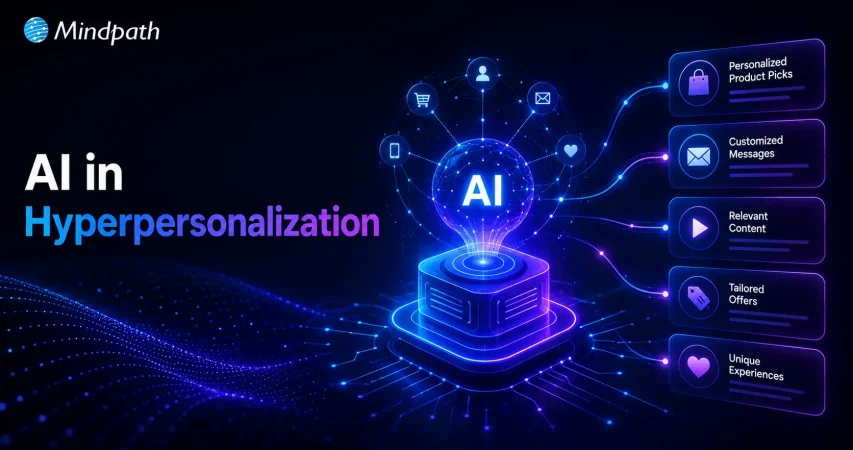
Hyper-personalization leverages Artificial Intelligence and real-time data to provide highly personalized experiences, showcasing items and information that are specific to each customer’s tastes. By analyzing individual purchasing behaviors, prior purchases, and browsing habits, AI allows companies to give suggestions that are tailored to each customer’s distinct interests and preferences. 

This high degree of personalization enables organizations to go beyond generic ideas, resulting in a more seamless and engaging client experience. It’s an effective strategy that improves convenience and strengthens brand loyalty by making each customer feel understood and cherished. Hyper-personalization allows marketers to constantly offer relevant, customized information that engages with each client on a personal level. 

The Role of AI in Hyperpersonalization

1. Smarter Product Recommendations

AI’s ability to comprehend user preferences and behaviors is crucial in revolutionizing the way product suggestions are generated. AI can forecast what you will be interested in next based on data such as previous purchases, browsing history, and even time spent on certain things. This goes beyond mere ideas; it tailors each recommendation to your own preferences and needs. 

For example, if you’ve been looking for shoes, AI can recommend a pair that matches your style or even forecast the type of shoes you’d like based on recent searches or seasonal patterns. These recommendations sometimes appear to be “reading your mind,” displaying goods you never considered, but once you see them, they feel like a great fit. This degree of personalization improves the whole buying experience. You spend less time looking for what you want because the AI finds it for you, making each interaction seem more relevant and easier. With hyperpersonalization, AI guarantees that the goods you view are constantly relevant to your tastes, improving your entire shopping experience. 

2. Friendlier Chatbots

AI-powered chatbots have gone a long way towards providing more lifelike, human-like conversations. Instead of robotic, one-size-fits-all replies, these chatbots can now tailor their tone, vocabulary, and behavior to the context of the interaction and the user’s specific demands. They employ powerful AI algorithms to comprehend not just what you’re saying, but also the emotions and meaning behind it. 

These AI chatbots can also personalize replies by recalling prior encounters, recognizing your preferences, and offering relevant solutions. Whether you need help with a product, troubleshooting, or completing a purchase, the chatbot customizes its replies to your individual needs, exactly like a real agent would. AI chatbots boost customer service by making conversations feel more personal and human, resulting in a more engaging and fulfilling experience for customers, allowing businesses to provide 24/7 help without losing quality or empathy.    

3. Better Campaign Strategies

AI-powered solutions have transformed the way businesses approach marketing campaigns, allowing them to analyze massive volumes of data and forecast campaign outcomes more accurately. These technologies look at customer behavior, market trends, and previous campaign performance to spot patterns that might not be visible. Understanding these trends allows AI to assist businesses fine-tune their strategy, ensuring they are targeting the appropriate audience with the right message at the right time. 

Furthermore, AI can enhance processes by automating repetitive operations like segmenting audiences, providing personalized content, and managing digital marketing. This automation minimizes human work and improves marketing teams’ efficiency, allowing them to focus on higher-level strategy and creativity.  AI analyzing data in real time makes marketing campaigns more fluid and responsive. Brands can swiftly alter campaigns based on performance analytics, increasing their ability to remain relevant and adapt to changing client requirements. This increased efficiency not only enhances campaign efficiency, but also enables a more personalized marketing strategy, offering bespoke content and experiences that engage with specific customers. 

4. Tailored Marketing Materials

AI allows organizations to go beyond basic marketing messages by providing highly personalized content that addresses individual tastes and behaviors. AI can generate marketing materials that are specifically tailored to you by analyzing data such as your previous purchases, browsing habits, social media activity, and even real-time elements such as location or current trends. 

Furthermore, AI can adapt the tone, structure, and timing of the material to the individual’s preferences. It can provide a product recommendation at the ideal time, such as when you’re planning a trip or getting ready for a vacation, ensuring that the offer feels timely and relevant. By combining various data points and external variables, AI enables companies to generate targeted, relevant marketing that improves the customer experience and drives stronger connections with their audience.  

Also Read: Top 10 Benefits of Artificial Intelligence in 2024 

AI Development Services at Mindpath

Mindpath specializes in AI development services that help organizations grow and prosper by leveraging smart technologies. Our AI solutions are intended to increase efficiency, improve customer experiences, and make more informed business decisions. We develop specialized AI systems that can analyze vast volumes of data, forecast future trends, and automate repetitive operations, allowing your processes to run quicker and more accurately.  Our AI services may be customized to meet your specific company needs, from creating pleasant chatbots to providing personalized product suggestions. Whether you want to optimize operations or engage customers with intelligent, automated solutions, Mindpath has the AI technologies you need. Our team collaborates closely with you to guarantee that the AI technology we build helps you succeed and stay ahead. 

Final Thoughts!

AI is truly transforming the way businesses connect with their customers, creating a future where experiences are not only personalized but also highly intuitive. Through smarter product recommendations, friendlier chatbots, optimized campaign strategies, and tailored marketing materials, AI is helping brands build stronger, more meaningful relationships with their audiences. At Mindpath, we are dedicated to bringing these advancements to life with our custom AI development services, ensuring that your business stays ahead of the curve and delivers exceptional, personalized experiences. By harnessing the power of AI, you can enhance customer engagement, streamline operations, and create more impactful marketing strategies that drive long-term success. 
Ready to elevate your customer experiences with AI?

Partner with Mindpath today to explore our custom AI development solutions and stay ahead in your industry!

Related Post

Discover the ultimate guide to hiring Node.js developers in London. Learn about the skills, benefits, and cost factors involved in finding the right talent for your project.
Discover how low-code/no-code tools are transforming digital development and enabling faster app creation for businesses.

Related Post

Digital Twin in Healthcare

Have you ever wondered how technology can create a virtual copy of your body to improve your health? Imagine a digital version of you that helps doctors predict, diagnose, and treat diseases more effectively. Sounds fascinating, right? This is exactly what Digital Twin technology is achieving in medicine today. But how does it work, and why is it so revolutionary? Let’s explore!  

What Is a Digital Twin?

A digital twin is a virtual representation of a real object, such as a machine, a structure, or even a human body. It is created on a computer and has the same structure and performance as the genuine thing. The digital twin can give insights into how the thing is performing, discover faults, and propose methods to improve by gathering real-time data from sensors linked to the device. For example, a sensor-equipped machine provides data to its digital twin such as energy use, temperature, and performance. This virtual model can then simulate various situations, test solutions, and forecast results without harming the actual equipment. This mix of real-world data and digital technologies enables smarter decision-making, faster issue solving, and improved performance.  

Importance of Digital Twin in Medicine

Digital twin technology is becoming increasingly essential in medicine because it allows doctors and researchers to better comprehend the human body. Doctors can test medications, anticipate how illnesses will proceed, and even schedule surgery more precisely by generating a virtual representation of the patient. This lowers risks and improves outcomes for patients. For example, digital twins can be used to replicate a person’s heart in order to determine the best strategy to treat cardiac disease or to simulate how a new medicine can function without endangering the patient. It also enables healthcare practitioners to personalize therapies, increasing their effectiveness. This unique approach is revolutionizing the way care is given, making it safer and more precise.

Implementations of Digital Twin in Medicine

1. Cancer Care

Digital twin technology is transforming cancer care by allowing physicians to build highly personalized therapies. These virtual models blend a patient’s unique genetic and medical information with the data from other patients. Digital twins can change treatment regimens based on real-time updates and treatment decisions. This is especially effective when cancer returns or does not respond to conventional therapy. A digital twin, for example, can forecast when a tumor will resist a particular medicine and provide other treatments based on the tumor’s unique genetic composition. It can also assist in building treatment strategies that minimize negative side effects by taking into account how a patient’s body absorbs the medications. Digital twins have already demonstrated the effectiveness in predicting treatment results for difficult-to-treat cancer such as triple-negative breast cancer. They can even identify cancer spread (metastasis) by analyzing trends in radiography data over time. This method is laying the groundwork for better, safer, and more successful cancer therapies. 

2. Tracking Immune Health

Digital twin technology is transforming how we understand and regulate immune responses. These virtual models can provide comprehensive insights into autoimmune illnesses and infectious diseases by combining precise information from numerous levels, including molecular, cellular, tissue, organ, and whole-body data. For example, digital twins can predict if a patient’s body would reject a donated organ, allowing doctors to tailor immunosuppressive therapies to lessen the likelihood of rejection. In the event of infectious diseases, particularly during pandemics, digital twins can aid in identifying individuals who are more vulnerable to infections or at risk of serious consequences such as cytokine storms, which can be fatal. Furthermore, digital twins can model how the immune system reacts to immunizations, anticipating both short-term protective effects and long-term immunological memory. This capacity to model immune system behavior makes it simpler to personalize treatment approaches, improve vaccination efficiency, and better manage chronic illnesses. Digital twins are paving the path for more accurate diagnosis and better patient treatment in the future by improving our understanding of immune responses.  

3. Hospital Management

Digital twin technology is also having a big influence on the management of hospitals and nursing homes, enhancing efficiency and patient outcomes. Digital twin systems, which combine data from electronic medical records and wearable devices, can assist healthcare practitioners in providing more personalized and optimized treatment. For example, the Verto Flow platform employs artificial intelligence to collect patient data from numerous sources and assist healthcare practitioners in adjusting treatment regimens in real time. The ThoughtWire platform goes a step further by replicating a patient’s health condition and notifying doctors when a patient is at risk of a life-threatening issue. It can also recommend measures based on these forecasts, so assisting in the prevention of emergencies before they occur. Furthermore, digital twins are being utilized to optimize healthcare workflows. Companies such as GE and Siemens Healthcare are developing digital twins of whole hospital operations, which will allow them to optimize surgical schedules and personnel requirements, perhaps leading to lower patient wait times and improved overall efficiency.  

4. Designing Biological Systems

Synthetic biology is an interesting and quickly evolving science that has enormous promise, especially when paired with digital twin digital twin technology. Advances in DNA synthesis and sequencing have reduced the cost and ease of producing synthetic DNA, while microfluidics allows for the generation of cell-free biological components. These discoveries are consistent with the concept of digital twins, in which virtual models can represent and regulate biological systems. For example, the development of an artificial human heart required considerable input from digital twin technology, which helped design and test the heart before it was manufactured. By merging digital twins with synthetic biology, we can generate autonomic biological modules for a variety of applications, such as smart organs, medicine manufacture, and renewable energy solutions. These biological modules can collaborate with virtual entities on a medical digital twin platform, leveraging methods such as synthetic genetic circuits and optogenetics. The concept of biological computers, in which virtual and physical systems are connected and operated jointly, is becoming increasingly plausible. As we gain a better knowledge of and control over cellular processes, the potential for intelligent biological designs grows, leading to game-changing solutions in healthcare and beyond.  

5. Improving Surgeries

Surgery is an important part of treating many disorders, particularly when there are no viable pharmacological therapies. However, surgical methods and some post-operative therapies can occasionally result in problems and have an impact on patient outcomes. This is where digital twin technology can turn out quite useful. Digital twins can be used in the planning and simulation stages of surgery to anticipate results and prepare for probable complications. For example, in complex procedures such as transcatheter aortic valve replacements, a digital twin can assist determine how minor alterations throughout the treatment can impact the patient’s response. This enables surgeons to anticipate issues and modify the procedure for better results. In the field of orthopedics, digital twins are used to produce 3D models of body components such as the foot and ankle, allowing doctors to simulate procedures and determine the optimal strategy before doing the procedure. This optimizes the process and improves patient recovery, making procedures safer and more efficient. 

Digital Twin Technology at Mindpath

Mindpath utilizes Digital Twin technology to enhance healthcare and other sectors. A digital twin is a virtual copy of a real-world item or system made from data. In healthcare, it assists clinicians in planning procedures, personalizing treatments, and predicting patient reactions to various medicines. By merging real-time data from medical records and wearable devices, digital twins provide improved decision-making and safer treatment. We also use DT technology to improve hospital administration, boost immunological health, and promote synthetic biology research. This contributes to the development of smarter, more efficient systems, which result in improved outcomes in a variety of sectors. 

Wrapping Thought!

Digital Twin technology is changing the landscape of healthcare by allowing for more personalized, efficient, and accurate treatment options. From cancer treatment and immune system control to hospital administration and surgical results, digital twins are assisting physicians and healthcare professionals in making more informed decisions, eventually leading to better patient care. As this technology advances, its potential to transform medicine and other sectors will only increase. At Mindpath, we are happy to include Digital Twin technology into our services, which drives innovation and improves outcomes for healthcare systems globally. With its capacity to model, forecast, and optimize, Digital Twin technology is transforming the future of medicine. 

Ready to innovate with Digital Twin technology?

Partner with Mindpath to enhance healthcare solutions and achieve smarter, safer outcomes.

Explore how Digital Twin technology is revolutionizing healthcare, from personalized treatments to improved surgeries.
software development life cycle

In today’s rapidly evolving technology landscape, the software development life cycle defines how powerful digital solutions are conceptualized, developed, and delivered. It provides structure to a multi-faceted process, which permits development teams to remain focused, minimize risk, and deliver stellar results. This life cycle clearly delineates the sequence of steps that support the journey from idea to launch, while ensuring that each phase contributes to the development of software that delivers user needs, as well as business needs.

Developing software requires following a more structured process than just writing code; it requires a clear and organized process to keep projects on-track and ensure value is being delivered. If you have an understanding of the journey, then you are more equipped to build software that does what it needs to do! To detail this journey is what this blog aims to do with some context on the phases, models, and best practices relating to the development life cycle. So, let’s dive in! 

Want to transform your business with smarter technology solutions? At Mindpath, we provide innovative software development services that build smart tools to meet your unique business needs.

What is SDLC?

The software development life cycle (SDLC) is a process that provides your team with a method for planning, building, and delivering software products. The SDLC divides the entire software development journey into distinct stages, allowing for better management of time, cost, and quality of the product being developed. Adhering to the SDLC can help reduce risks, avoid schedule delays, and deliver a system that meets the user’s requirements.

This approach can also help a team when dealing with changing requirements and multiple team members. It provides clarity in the process, aligns the development team on quarter goals, and improves communication between everyone. The process of custom software development becomes predictable, organized, and focused on providing value with the SDLC. 

Now that we are clear on the SDLC definition, let us learn about the software development life cycle stages. 

Must Read: Software Development Cost

What Are The 7 Stages of the Software Development Life Cycle?

The SDLC is broken down into a series of well-defined stages, which provide guidance to a project from start to completion. Each stage has a distinct purpose and contributes towards ensuring the end product is functional, efficient, and meets user requirements. Here are the 7 stages: 

1. Planning

In the planning stage, the team comes together to define what the software should do and what problems it will solve. They also look at whether the project is realistic in terms of technology and budget. During this phase, important documents like the Project Plan and Software Requirement Specification are created to guide everyone. 

2. Requirements

In this stage, the team focuses on understanding what users need from the software. They gather information by talking to stakeholders through interviews and surveys. Then, they review the data to identify the essential features. This leads to a clear document that guides development and ensures the software meets user expectations. 

3. Design

Turning ideas into a clear plan during the design stage. The team maps out how the software will function, what it will look like, and how data will flow. All these details are recorded in a software design document that serves as a guide for developers. This stage bridges the gap between planning and building, ensuring the software works smoothly and is easy to use. 

Curious about what makes a software engineer truly effective at every stage of development? Discover qualities of a good software engineer and see the skills and traits that drive successful SDLC implementation.

4. Coding

This phase brings the software design to life through coding. Developers write the program following clear guidelines to ensure everything functions correctly. Regular code reviews help catch errors early and maintain quality. By the end, a working version of the software is ready to move on to testing and refinement. 

5. Testing

Quality checks take center stage during the testing phase to find any bugs or issues in the software. The team runs different tests, from checking small parts of the entire system, to making sure everything works well. When problems are found, they are recorded and sent back to the developers for fixing. This cycle continues until the software meets all the set requirements and runs smoothly. 

6. Deployment

Once the software is ready, it is carefully released to the users during the Deployment phase. Different methods are used to make sure the launch goes smoothly without disrupting users. Support, like user guides and training, is often provided to help users get started. 

7. Maintenance

After deployment, the maintenance stage keeps the software running smoothly and up to date. The team fixes bugs, makes improvements, and responds to user feedback to meet changing needs. Regular updates and support help users get the most from the software. Over time, the software may need major upgrades or replacement to stay useful and relevant. 

Curious how businesses are building world-class software teams without geographical limits? Explore how our offshore software development can deliver skilled talent and cost-effective solutions.

Models of Software Development Life Cycle

Different models guide how software development is planned and carried out. Each model offers a unique way to manage the process and reach project goals. Here are some popular software development life cycle models used by teams. 

1. Waterfall Model

The Waterfall Model is a step-by-step approach where each phase must finish before the next begins. It is very structured and relies on clear documentation at every stage. This model works best when requirements are well understood from the start. 

2. V-Shaped Model

The V-Shaped Model focuses heavily on testing at every stage of development. Each development step has a matching testing phase to make sure everything is working correctly. This helps find and fix problems early in the process. 

3. Iterative Model

The Iterative Model builds the software in small parts called iterations. After each part is developed and tested, feedback is used to improve the next version. This process repeats until the software meets all the requirements. 

4. Spiral Model

The Spiral Model mixes planning, prototyping, and testing in repeated cycles. Each cycle creates a new version of the software that can be improved based on feedback. This model helps manage risks but can be expensive and time-consuming. 

5. Big Bang Model

The Big Bang Model is very simple and starts development without detailed planning. It relies on trial and error, making it flexible but also unpredictable. This model is mostly used for small projects or when there is no fixed deadline. 

Looking for technology that fits your business perfectly instead of forcing you to adapt? Explore the custom software development benefits that deliver tailored solutions and real results.

Best Practices to Improve SDLC

Improving the Software Development Life Cycle (SDLC) helps teams deliver better software more efficiently. Following best practices can reduce errors, save time, and keep everyone on the same page throughout the project. 

1. Define the Scope Clearly

Without a clear scope, developers may feel lost and end up redoing tasks. Outlining deliverables, timelines, and milestones early avoids confusion and reduces wasted effort.

2. Manage Workflows Effectively

When work is not organized well, the development process slows down. Keeping an eye on key metrics like cycle time and sprint health helps teams plan tasks better and improve SDLC development.

3. Integrate Continuously

Using CI/CD allows teams to test and deploy code often, which prevents delays and reduces errors. It also makes the final product more secure and reliable.

4. Use Smart Scrum Practices

Following scrum routines like daily stand-ups and retrospectives helps teams stay connected. It also makes it easier to spot and fix problems early in the development cycle.

5. Keep Documentation Updated

Good documentation keeps everyone aligned and helps avoid repeated mistakes. It also saves time later by providing a clear record of security issues and project details.

Curious to know how small oversights in custom software development can cause major issues? Discover the most common custom software development mistakes and learn in detail how to prevent delays and deliver software that truly meets your business goals.

Why does the Software Development Life Cycle Matter Today?

The software development life cycle is key to building reliable, efficient, and user-friendly software. From planning to maintenance, every step in the SDLC adds structure and clarity to the process. By following best practices based on real software development examples, teams can deliver high-quality solutions with fewer setbacks. 

At Mindpath, we guide you through every stage of SDLC with our software development services. From gathering requirements to post-launch support, we help create software that fits your needs, goals, and timelines. Whether it’s a simple software or a full-featured application, our team ensures your vision becomes a successful reality. 

generative AI for customer service

In the technology-driven era, the customer service landscape has undergone a transformational change.  A key technology that has been serving as a catalyst is generative AI. The rising popularity of generative AI for customer service is evident, as about 65 % of leaders in customer service intend to leverage the technology along with conversational AI to boost customer satisfaction (Source: IBM). 

The emergence of Gen AI has been nothing short of transformational for businesses. One of the main areas that has witnessed a remarkable change because of Gen AI is customer service. The novel technology has undoubtedly broadened the boundaries of customer support. Business entities across diverse industries can focus on enhancing customer experience with AI, especially generative AI. Let’s explore how modern businesses can capitalize on Generative AI in customer service.

If you are looking to leverage the user experience with the use of Gen AI. Contact us to unlock the full potential of Gen AI in enhancing your customer support and delivering personalized services.

An Insight into Generative AI

Before answering the question – How generative AI is improving customer service, it is crucial to have clarity on Gen AI. Generative AI refers to the specific branch of Artificial Intelligence that is capable of creating new content in the form of text, audio, video, and image formats. The output of Generative AI mainly depends on the type of data that it has been trained on.

In recent years, Generative AI has undoubtedly been considered a major breakthrough in the AI landscape. It has not only expanded the boundaries of Artificial Intelligence but also redefined how individuals and businesses interact with AI technology. The functionality of generative AI is not restricted to generating new content. It can also generate chat responses, create deepfakes, and personalize interactions.

Wondering how artists and creators are adapting to AI? Discover how Generative AI is changing the creative industry, and see how automation and imagination now work together.

Role of Generative AI in Customer Service

Customer service is the specific domain where companies offer support and assistance to their customers. The assistance could be offered prior to, during, or after the purchase of their offering. Regardless of the timing of such service, the role of customer service is indispensable since it can have a major influence on the overall experience and satisfaction of customers. At present, the customer service arena has undergone revolutionary change thanks to the adoption of Gen AI by businesses.

Generative AI for customer service has been a boon in the business world. It has certainly equipped businesses to automate their customer service function. As a result, the overall efficiency of business entities to promptly respond to the queries and concerns of their customers has increased significantly. Today, the role of GenAI customer service is of high strategic importance for businesses. By leveraging the core capabilities of Generative AI, businesses are able to redefine how they deliver support to their customers.

Curious about how generative AI is applied in real-world scenarios? Explore Generative AI Use Cases to discover how businesses leverage AI for content, design and innovation.

Key Benefits of Generative AI-based Customer Service

The strategic deployment of Generative AI technology in a customer service setting can give rise to a host of benefits for businesses.  In order to take advantage of the novel technology in an optimum manner, it is a must for businesses to understand its potential at an in-depth level. Some of the major benefits that can arise for businesses by integrating generative AI in customer service include:

1. Prompt Response

By integrating Gen AI-powered customer service, businesses are able to promptly respond to the concerns or queries of their customers. Customers do not have to wait for long hours to get support from businesses. Gen AI undoubtedly empowers businesses to respond to their customers instantly. Moreover, thanks to the use of Gen AI in customer support, businesses are able to offer 24/7 assistance to their customers. This automatically increases the overall convenience of customers and strengthens their association with businesses.  

2. Personalization of Interactions

One of the chief benefits of gen AI in customer support is that it facilitates personalization. As a result, business entities can tailor the interaction to meet the exact needs of their customers. Generative AI technology is basically capable of accessing customer data and past interactions, thereby personalizing the conversations. The integration of Generative AI for chatbots has been revolutionary since it has taken personalization to the next level. Thus, in the competitive business environment, businesses are able to have meaningful conversations as well as interactions with their customers.  

3. Better Productivity of Customer Service Agents

One of the benefits of AI in support teams revolves around the higher productivity of agents. Thanks to the automation of conversations with customers, the workload of customer service agents has significantly reduced. Therefore, they are able to focus on complex interactions and deliver value to customers. Moreover, the possibility of customer service agents suffering from burnout and fatigue can also be significantly reduced.

Must Read: Generative AI Trends 

4. Downside of Gen AI in Customer Service

Although Generative AI technology has been disrupting customer service like no other technology, it has also given rise to a few concerns. In order to get a holistic insight into the potential of Gen AI, it is crucial to take into consideration its shortcomings. By having a comprehensive insight into these next-gen customer service solutions, businesses can leverage the novel technology in an optimal manner.

5. Hallucinations 

One of the major shortcomings revolves around hallucinations. There may be a number of occasions when Gen AI may generate inaccurate or counterfeit responses that may seem plausible. However, due to their inaccuracy, the risk of misinformation may arise. Furthermore, customers may be on the receiving end because of this particular flaw. In sensitive industries such as healthcare or finance, it may act as a major hindrance for both businesses and customers.

6. Absence of domain knowledge

Another downside that businesses need to take into consideration is the lack of domain knowledge. Unless and until companies fine-tune Gen AI prior to its implementation, there may arise knowledge-related gaps. Due to such gaps, Gen AI may not be able to address complex queries that may be asked by customers. As a result, the results may not be relevant and useful for customers.  

7. High reliance on automation

The excessive reliance on automation has the potential to affect the personalization component of the interaction. When customers may expect to get empathetic and emotionally sensitive responses, generative AI may not be the ideal customer service solution to meet their needs. As a result, the issue relating to emotional disconnect may arise, diminishing customer satisfaction.  

It is imperative for businesses to take into account the positives as well as the negatives of Gen AI. It can certainly create an opportunity for businesses to capitalize on the core capabilities of Gen AI and redefine how they deliver customer service. As a result, they can strategically leverage Gen AI to strengthen their association with their target audience.

Trying to keep up with rapid AI advancements? Read Generative AI Revolution to learn how this transformation is redefining business and creativity.

Final Words

The customer service realm has undergone a dynamic change in recent years due to the adoption of Generative AI by businesses. Even though Gen AI is still in its nascent stage, it holds immense promise, especially in the customer service setting. It is essential to bear in mind the associated benefits as well as drawbacks of the generative AI technology.

The novel technology has given rise to a plethora of opportunities for firms to redefine how they interact and engage with their customers while extending customer support to them. In order to leverage Generative AI, you can choose Mindpath as your success partner. The novel digital solutions offered by the company can help businesses take advantage of Gen AI capabilities and enhance their customer service. Thus, businesses across diverse industries and sectors can strategically deploy Gen AI to reshape their customer interactions.

Discover how Generative AI is revolutionizing customer service with automation, efficiency, enhancing customer experience and more.