What Skills to Look for while hiring a NodeJS Developer in Canada?

Join our Newsletter!

Featured Posts

Support Is One Click Away

Home

What Skills to Look for while hiring a NodeJS Developer in Canada?

Hire NodeJS Developer in Canada

What Skills to Look for while hiring a NodeJS Developer in Canada?

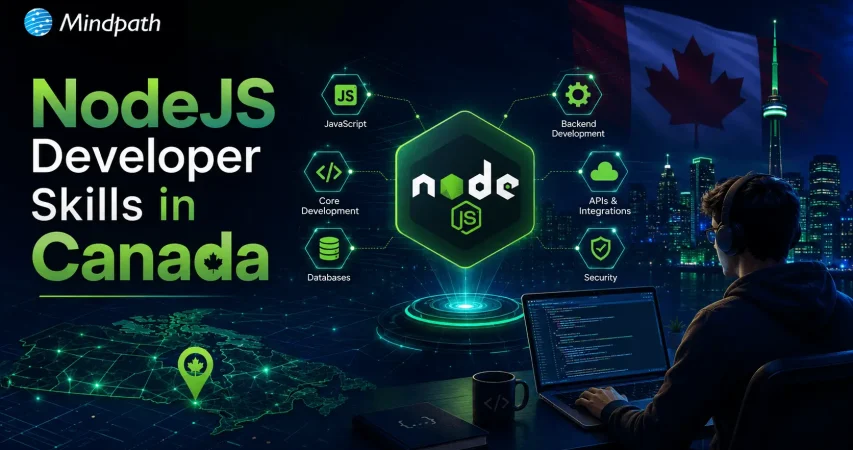
Hiring a Node.js developer in Canada necessitates a thorough assessment of technical knowledge, problem-solving ability, and collaboration capabilities. A competent applicant should understand JavaScript, Node.js frameworks, database administration, and API development, as well as be familiar with security best practices and scalability strategies. Furthermore, soft skills such as communication and flexibility are essential for successful team cooperation. The following are four crucial abilities to look for when hiring a Node.js developer in Canada.

1. Proficiency in JavaScript and Asynchronous Programming

Since Node.js is based on JavaScript, developers must have a solid knowledge of JavaScript basics such as closures, prototypal inheritance, and ES6+ capabilities. They should also be proficient in asynchronous programming, which involves efficiently handling numerous tasks with callbacks, Promises, and async/await. This knowledge enables them to create non-blocking, high-performance apps that can handle concurrent queries successfully. A deep knowledge of the event-driven architecture of Node.js is essential for developing scalable and efficient backend systems.

2. Experience with Node.js Frameworks and API Development

A skilled Node.js developer should be familiar with popular Node.js frameworks such as Express.js, NestJS, or Koa to help with backend development. They must also be skilled in designing and developing RESTful APIs while adhering to industry best practices for authentication, authorization, and error management. Knowledge of GraphQL is advantageous for applications requiring quick data retrieval. These abilities are essential for guaranteeing efficient communication between the frontend and backend, as well as optimizing web application performance overall.

3. Database Management and Security Awareness

A strong Node.js developer should be skilled in handling databases like MongoDB, MySQL, or PostgreSQL, understanding data modeling, indexing, and query optimization for efficient data retrieval. Additionally, knowledge of Redis for caching can enhance performance. Security is another critical aspect—developers should be familiar with data encryption, input validation, and protection against SQL injection and XSS attacks. Ensuring compliance with Canadian data privacy laws like PIPEDA is also essential when handling sensitive user information.

4. Version Control, Scalability, and Cloud Integration

Version control is vital in modern development, so proficiency in Git and platforms like GitHub or GitLab is a must. A Node.js developer should also have experience in scalability techniques, including load balancing, microservices architecture, and caching mechanisms, ensuring the application can handle growth. Familiarity with cloud platforms like AWS, Azure, or Google Cloud is highly valuable, especially for deploying and managing applications efficiently. These skills help create robust, scalable, and well-managed software solutions.

Need skilled Node.js developers in Canada? Mindpath provides top-tier developers with expertise in JavaScript, APIs, security, and cloud integration. Whether you need scalable backend solutions, database management, or secure web applications, our experts deliver high-quality development tailored to your needs. Ensure project success with developers who understand modern frameworks, performance optimization, and Canadian data regulations.

Partner with Mindpath today for efficient and reliable Node.js development. Get in touch now to find the perfect fit for your project!

Read our next blog: Understanding the Cost of Hiring NodeJS Developer in Canada

Related Post

AI drives hyperpersonalization with smarter recommendations, chatbots, and tailored marketing to boost customer experience and growth.

Related Post

AI and ML innovations in Fintech
Imagine if your bank could know fraud before it happens, or your financial decisions were made faster and smarter. What if customer service was so attuned to your needs that speaking with them feels more like a chat with a friend? AI and Machine Learning are making these possibilities a reality today in the Fintech industry. Interesting, right? In this blog we are going to explore the key benefits as well as some use cases of AI and ML in the FinTech industry.  Artificial intelligence and machine learning are changing the way in which the FinTech industry works. This technology is being used to make financial services provided by FinTech companies smarter, faster, and more personalized. By using AI and ML, Fintech can analyze heaps of data in seconds and come up with proper decision-making, easy following of rules, and smoother customer experience. For instance, AI can be used to power chatbots that answer customer queries or build systems that tell whether a person is a good candidate for a loan.   In other words, AI and ML help Fintech companies provide better services that are much more inclined to individual needs. AI and ML play a huge role in making financial services better and more efficient. Through AI, Fintech companies can offer their services in a personalized way, like providing their clients with customized financial recommendations or using chatbots to answer their questions. Such technologies also lead to cost reduction because they replace repetitive functions with more important work. AI will enhance fraud protection by detecting and preventing threats, ensuring security for both customers and companies.   Let us dig deep to explore the benefits and use cases of AI and ML in the FinTech industry! 

Benefits of AI and ML for Fintech Companies

1. Advanced Fraud Detection

Artificial intelligence and machine learning make it much simpler to detect and prevent financial fraud. Traditional security systems, like firewalls, might overlook suspicious activity, but AI can analyze large amounts of data from many sources, including records of transactions, client profiles, and even social media.  

This aids in the detection of concealed symptoms of fraud, which would otherwise go undiscovered. AI allows systems to swiftly recognize unusual patterns, such as huge transactions or weird locations, that may suggest fraud. This means that financial institutions can decrease fraud losses while also improving the security of their payment and transaction systems. 

2. Streamlined and Automated Business Operations

AI and ML-powered operations are revolutionizing how financial duties are managed, making procedures more efficient and timesaving. AI can automate repetitive operations such as data input, verification, and reconciliation, saving time by extracting information from bank accounts, invoices, tax forms, and contracts. AI systems excel at analyzing vast volumes of unorganized text data, allowing reports to be generated fast. Furthermore, AI may use market data, economic indicators, and previous performance to anticipate investment possibilities and prepare for future cash flows. It improves financial planning accuracy by analyzing previous cash flow data and current market situations.  

3. Elevated Customer Service

Improved customer service powered by AI and ML greatly enhances how you connect with your customers. These technologies use client data, transaction history, and behavior to better understand specific requirements. This insight enables you to provide personalized product suggestions, financial advice, and focused marketing initiatives. Using AI for customer service allows you to swiftly answer commonly asked questions, assist with simple enquiries such as verifying account balances or recent transactions, and improve response times. AI also allows you to provide personalized suggestions based on consumer preferences, offer 24-hour live chat assistance, and communicate in many languages. 

4. Smart Financial Decisions Making

AI significantly enhances financial decision-making by detecting hidden patterns in data and evaluating their influence on your company. It enables you to simulate numerous scenarios, such as different investment, loan, or credit conditions, to understand how they may affect your results. By analyzing complicated financial data, AI aids in developing smart strategies that reduce risks and provide this knowledge in simple, understandable formats. AI also keeps you up to date on the newest data, allowing you to identify new ways to save money. It can immediately detect unexpected transactions or market swings, allowing you to alter your financial plans accordingly.  

5. Efficient and Strategic Resource Allocation

AI assists financial institutions in more effectively allocating resources by analyzing market data, previous performance, and risk indicators. This allows them to determine the best methods to invest assets, balance risk and return, diversify portfolios, and optimize resource utilization. AI may also categorize customers based on their behavior and preferences, allowing for more focused resource allocation. This translates to more successful marketing efforts, specialized product offers, and personalized customer service. Furthermore, AI assists in determining the optimum times to spend money on advertising for the greatest impact. 

Ready to elevate your financial technology?

Mindpath’s expert AI\ML solutions transform your operations with advanced analytics, automation, and tailored insights. 

Top Use Case of AI/ ML in Fintech

1. Algorithmic Trading

Algorithmic trading allows financial institutions to automate trading choices and manage large numbers of deals swiftly. Instead of manually handling each transaction, businesses utilize AI and ML algorithms to execute pre-set trading orders. TradeSmart, for example, uses AI and machine learning. They employ these technologies to automatically execute trades based on rules established by machine learning algorithms. By analyzing enormous volumes of historical data from multiple stock markets, TradeSmart assists investors in developing more successful trading methods. This enables for faster and more efficient trading than doing it by hand. 

2. Fraud Detection

Machine learning is critical in detecting and preventing fraud because it analyses enormous amounts of data to identify odd patterns and hidden links. Traditional fraud detection approaches may be restricted, but machine learning algorithms are more sophisticated and can detect abnormalities more efficiently. For example, Danske Bank in Denmark went from an outdated rule-based system to a machine learning technique for identifying fraud. This improvement dramatically enhanced their capacity to detect true fraud and minimize false warnings, demonstrating how powerful machine learning can be in combating financial crime. 

3. Regulatory Compliance

Machine learning is important in regulatory compliance because it helps financial firms manage complicated laws and regulations. ML algorithms can evaluate enormous quantities of regulatory papers and identify links between various norms, making it easier to stay current with changing regulationsFor example, cloud-based systems powered by machine learning may automatically track and update regulatory changes as they occur. Furthermore, ML can analyze transaction data to spot abnormalities, ensuring that all consumer transactions match legal requirements. Machine learning helps financial organizations stay compliant and manage regulatory needs more effectively. 

4. Stock Market Analysis

In the stock market, machine learning (ML) is used to make sense of the massive volumes of data generated by trading activity. While historical data serves as a basis, ML algorithms use real-time information such as news and trade outcomes to find patterns and trends. Traders utilize this information to make better judgements regarding their trading strategy. They select which ML algorithms to utilize based on their ability to forecast market moves and detect interesting patterns in data. This allows them to estimate stock market developments more precisely. 

5. Loan Automation

Machine learning is revolutionizing loan automation by analyzing more data than previous approaches, without being limited to FICO ratings and income information. Lenders may use machine learning to better assess risk by combining data from many sources. This includes information from social media accounts, phone records, energy bills, rent histories, and even health exams. Machine learning algorithms use this different data to provide exact risk assessments. If a borrower’s risk score matches the lender’s requirements, the loan may be immediately granted. Unlike human assessors, machine learning algorithms examine loan applications without bias or emotion. This promotes fair lending processes by decreasing the effect of racial, gender, and other prejudices, resulting in more equitable loan decisions. 

AI/ML Services at Mindpath

At Mindpath, learn how to provide AI and machine learning services that help your fintech business become smarter and more efficient. We work with the most advanced technologies to help you predict future trends, solve complex issues, and make informed decisions.  

Our advanced predictive analytics tools process financial data to predict market trends and customer behavior, to keep you ahead of every curve. On machine learning applications, we provide solutions that learn from financial data about how to manage your risks and make your trading strategies smarter over time.  

Utilizing our insights, fueled by your data, we derive useful information from you to help you make smarter investment decisions and optimize financial operations. In addition, our automation solutions save you lots of time and reduce errors by automating routine tasks, such as transaction processing and compliance management.  

Our AI and machine learning services are therefore aimed at boosting fintech operations by making them smarter and more innovative, so your business can be faster and more competitive in today’s financial industry. 

End Note

AI and machine learning are changing complex financial tasks into sleek, efficient processes within the vast FinTech space. It starts with detecting fraud accurately to loan approval and personalized customer services. Thus, this helps fintech businesses to make wiser financial decisions, manage their resources, and, in the long run, serve their clients in the most outstanding way. As these technologies continue to develop, so will innovation and efficiency in financial services, paving the way for a much more secure, intelligent, and customer centric future. 

At Mindpath, we are committed to making your fintech business to its full potential with AI and machine learning. Empowering the fintech landscape into the future will be based on predictive analytics and machine learning applications that our company specializes in, the outcomes and trends it brings to light, and automation solutions that drive operational efficiencies. We drive advanced technologies into your business for better decision-making, operational efficiency, and able to deliver hyper-personalized experiences. 

Looking to revolutionize your FinTech services?

Mindpath’s AI and ML solutions offer smarter fraud detection, streamlined operations, and personalized customer experiences. 

Cloud Computing Attacks

Is your cloud data truly safe? As cloud computing becomes essential for businesses, the risk of cyberattacks grows. Are you aware of the vulnerabilities that hackers often exploit? How can you stay one step ahead and secure your cloud? In this blog, we will explore practical ways to protect your data and keep cyber threats at bay. 

Cloud computing refers to the ability to access a wide range of computer resources over the internet, such as data storage, virtual and physical servers, networking capabilities, software, and sophisticated technologies such as AI analytics. Instead of investing in and managing these resources themselves, customers can leverage cloud providers’ infrastructure on a pay-per-use basis, resulting in more flexibility, scalability, and cost-efficiency. This method enables firms to access high-performance tools and store on demand, reducing the need for substantial on-site equipment. 

Preventing threats to cloud computing is important because it helps keep your data, applications, and systems safe from cyberattacks. When threats aren’t controlled, hackers could access sensitive information, disrupt services, or cause data loss, which can harm a business’s reputation and lead to financial losses. By focusing on security, you can protect your information, build customer trust, and make sure that your business operations continue smoothly without unexpected interruptions. 

Let’s explore the steps on how to prevent cloud computing attacks! 

Guide to Prevent Cloud Computing Attacks

1. Use Cloud Security Posture Management (CSPM)

Cloud Security Posture Management (CSPM) tools are essential for defending against cloud computing attacks. These technologies assist you in keeping your cloud environment secure by continually scanning for security vulnerabilities and ensuring that everything adheres to the proper protocols. They can also give advice on how to resolve any issues that are discovered. One of the most effective uses of CSPM is to ensure that your cloud environment adheres to security standards at all times. These technologies can automatically assess whether your system complies with relevant laws and regulations. You can employ tools like AWS Security Hub, Google Cloud Security Command Centre, and Azure Security Centre to monitor and update your cloud security.  

2. Encrypt Data Stored and in Transit

To protect against cloud computing attacks, encrypt your data both at rest and in transit. Encryption protects your data from unauthorized access by making it unreadable to anybody without the right key. 

To protect data at rest, employ encryption tools provided by your cloud provider to safeguard information kept in databases, storage, or backups. To protect your data, AWS offers services such as AWS Key Management Service (KMS) and Amazon S3 Server-Side Encryption. Data in transit must be encrypted using secure protocols such as TLS/SSL as it flows between your systems and the cloud. This ensures that the data can’t be intercepted or altered by attackers while it’s being transmitted. By encrypting both at rest and in transit, you can greatly reduce the risk of data breaches and ensure your information stays secure. 

3. Monitor and Act on Threats

To defend your cloud from attacks, you must continually check for unexpected behavior and respond promptly to threats. Monitoring user requests and database updates can aid in identifying possible security threats before they cause damage. Start by monitoring user requests. Monitor API calls and user behaviors for signals of danger, such as a high number of unsuccessful login attempts, unusual traffic spikes, or unauthorized access attempts. Also, keep an eye on your database for any unauthorized modifications, such as efforts to steal data or edit sensitive information. 

To provide the greatest security, employ technologies like AWS CloudTrail, Azure Security Centre, or Google Cloud Security Command Centre to monitor your cloud environment in real time. These technologies allow you to view everything that is going on and immediately spot any risks. 

4. Protect Your APIs

Securing APIs is essential for securing cloud services and data. APIs serve as messengers, allowing various software programs to communicate and share information. They play a vital role in cloud computing and are frequently targeted by attackers because they can store sensitive data such as user credentials, financial information, or secret corporate information. If an API is hacked, it can pose major security concerns to the entire system. 

API gateways are an excellent solution for protecting your APIs. An API gateway manages and secures the traffic that flows to and from your APIs. It works as a filter, processing only authorized queries. You can enhance security by activating features like rate restriction, authentication and authorization checks, enforcing HTTPS, and detecting attacks patterns through the gateway. 

5. Establish Identity and Access Management (IAM)

Managing access to your cloud resources is essential for ensuring their security. Strong Identity and Access Management (IAM) procedures guarantee that only the appropriate individuals and services have access to your cloud data, and only to the level required. This helps to prevent unauthorized access and mitigates the harm if an account is hacked. 

Following the principle of least privilege is a great practice. This implies granting users and services just the rights they require to fulfil their responsibilities. By limiting access to only what is required, you lessen the likelihood of abuse if an account is hacked. It’s also important to conduct regular audits and reviews of your access policies. This ensures that access permissions are still relevant and aligned with the current roles and needs of your users. Regular checks help maintain a secure environment and quickly identify any unnecessary or outdated access. 

Also Read: DevSecOps in the Cloud: A Complete Implementation Guide

Cloud Computing at Mindpath

At Mindpath, we offer cloud computing services to help businesses manage their data, applications, and resources more easily and securely. With our cloud solutions, you can store your information safely, access powerful tools over the internet, and scale your resources as needed—all without having to manage complex hardware yourself.  Whether you’re looking to improve security, reduce costs, or increase efficiency, our cloud computing services are designed to meet your unique needs. We use the latest technologies to ensure your data is safe, accessible, and ready to support your business growth. Let us help you take advantage of the flexibility and power of the cloud. 

Final Thought!

Preventing cloud computing attacks is essential for protecting your data, apps, and company processes. Implementing strong security practices such as Cloud Security Posture Management (CSPM), encrypting data at rest and in transit, continuously monitoring for threats, securing your APIs, and managing access through Identity and Access Management (IAM) can significantly reduce the risk of cyberattacks. Mindpath is dedicated to offering safe, versatile, and scalable cloud solutions that fit your company’s requirements. With the proper cloud security measures in place, you can focus on development and innovation while ensuring your data is protected. Let us assist you in developing a robust, secure cloud infrastructure that will support business success in today’s digital environment. 

Ready to secure your cloud environment?

Partner with Mindpath for reliable, scalable cloud solutions that protect your data and drive business growth.

Learn how to prevent cloud computing attacks with practical tips on security, API protection, and IAM to safeguard your business and data.
Html to Wordpress

Anyone who has a HTML website might feel left out in the era of websites that load within seconds. Did you know that HTML websites were a thing when there was not content management system in the market? The transition from HTML to WordPress is no longer an option in an extremely competitive digital market. With static HTML pages, you would have to struggle to get the top ranks in search engine results.

The biggest problem with HTML websites is that they come with duplicate code on every page, thereby making them slow. On the other hand, WordPress is faster, more secure and offers more flexibility to build any type of website. As a matter of fact, more than 43% of websites in the world run on WordPress. Let us find out why you should ditch HTML and switch to WordPress now.

Want to convert your static HTML site into a fully functional WordPress site with enhanced features and performance? Mindpath offers WordPress development services to help you build a custom website according to your business demands.

The Rise of WordPress in Website Building

WordPress started off as a blogging platform and the open source nature empowered it to transform into a website builder. Before WordPress, you would need a technical team to create a website and manage it. The search for a HTML to WordPress converter tool has been growing because WordPress has made it easier to build websites. You can now install the WordPress software and use the desired themes or plugins to develop websites with sophisticated functionalities and updated designs.

If you have been wondering whether switching to WordPress is a good decision, then you must take a look at websites powered by WordPress. Big names in the world of business such as Disney, Times Magazine, Sony Music and many others use WordPress. The versatile mix of power and simplicity with WordPress has been one of the biggest reasons for its widespread adoption.      

Is WordPress a Reliable CMS for Website Building?

Giving up on HTML, which has been a trusted ally of website developers for a long time, can be difficult. However, the need to convert HTML to WordPress is growing as WordPress is the top content management system in the world right now. It works as an open-source ecosystem that offers benefits for beginners as well as experienced developers.

WordPress offers a user-friendly interface in its dashboard, which you can use to create websites from scratch. The best thing about the WordPress dashboard is that you don’t need advanced technical expertise to use it. In addition, you can also find thousands of themes and plugins in WordPress that help you customize your website the way you want.

Want to build a website that truly reflects your brand’s unique identity and goals? Explore our guide to custom WordPress development to discover how tailored solutions can enhance your site’s performance and impact.

Why Should You Choose WordPress Over HTML?

With so many powerful features, it is hard to ignore the urge to switch to WordPress right away. You should search for a HTML website to WordPress converter that makes it easier to embrace the benefits of WordPress. Don’t you know how WordPress will enhance your HTML website? An overview of the advantages of transitioning to WordPress can offer some help in finding the answer to such questions.

Key Reasons to Choose WordPress Over HTML

1. Easy for Beginners

The best thing about WordPress is that beginners will find it easy to use without any technical complexities. You don’t need coding skills to create your website and manage it on WordPress. The intuitive dashboard of WordPress allows you to create customized layouts, add more pages and update menus at one place. 

WordPress offers better flexibility than traditional website development approaches with more control over design, content management and functionality. Furthermore, the themes and plugins offered by WordPress help you add new features without waiting for developers. In other words, anyone can build a website without technical skills when they know how to use WordPress.   

2. Optimize Your Website for Smartphones

Do you know that most of the traffic to your business will come from mobile users? Many of you would need a HTML to WordPress converter online when you discover that WordPress offers mobile responsiveness. Most of the WordPress themes are tailored to function seamlessly on different screen sizes and device types. 

The interesting part of mobile responsiveness with WordPress is that your website will have the same aesthetic appeal on all devices. Apart from the consistent user experience on different devices, mobile responsiveness also makes your website rank higher on Google. With a few modifications to theme files and some new WordPress plugins, your static HTML website will run seamlessly on all mobile devices.

3. Assurance of Better Security

Businesses should also trust WordPress for its commitment to safeguarding any website hosted on the platform. You will get regular security updates on WordPress, which help in combating new security threats. On top of it, WordPress also offers additional security plugins and SSL certificates to enhance your website’s security. The biggest benefit of converting HTML to WordPress is visible in the efforts made by WordPress to address emerging vulnerabilities.

You must understand that modern approaches to website security need multiple layers of protection. For instance, you will need data encryption, backup systems and malware scanning to maintain the security of your website. WordPress offers the complete package to safeguard your website from hackers and unprecedented security breaches.

4. Build Any Type of Website

In its initial days, WordPress served as a useful tool for blogging alone. The transition of WordPress to a powerful driving force behind some of the biggest websites shows how it has evolved over the course of time. You should know how to add HTML to WordPress for switching from an outdated format to a versatile toolset. You can use WordPress for any type of website, whether it is for a small business or a large corporation.

WordPress is capable of hosting e-commerce websites, communities or social media networks. Businesses can always find WordPress plugins that will make their website better. Most important of all, you don’t have to worry about adaptability when your website needs to grow alongside your business. It is definitely a huge advantage for websites in an extremely competitive business landscape.

Unsure whether your WordPress project is following the right development standards and best practices? Check out our WordPress developer checklist to make sure every essential step is covered for a smooth and successful build.

5. Adopt the Design You Want

The problem with a static HTML website is that you don’t have any control over the design once it’s published. WordPress does not let you worry about changing the design of your website according to emerging trends. When you convert a website to WordPress, you get the advantage of capitalizing on its extensive theme library. You can have a business site, blog or an ecommerce site and still ensure that their design matches with your needs and style. 

The theme library of WordPress offers free and premium themes that you can choose for your website. You can also find additional themes from third-party developers and design marketplaces that bring unique features and layouts. The live previews of each theme help you check each design without affecting website functionality or content.  

6. Rank Higher with SEO Support

WordPress stands out as the most popular option to create websites now because of its SEO support. What will you gain from a website that never shows up on the first page of search results? You can download WordPress and capitalize on its strong SEO foundation to ensure a higher rank on search engines. The advantages of WordPress for SEO revolve around its strict coding guidelines that call for clean and structured code.

The code is not the only thing that makes WordPress websites easier to rank on Google and other search engines. You will also find user-friendly URLs, meta-descriptions and titles to gain more visibility in search engines. On top of it, the SEO plugins on WordPress will provide a lot of support in optimizing your website.

7. Vibrant Community of Developers

The biggest strength of WordPress is its large and active community of developers. As an open-source platform, WordPress continues growing with the contributions of multiple users and developers. The community not only introduces updates to the source files but also makes WordPress more secure and updated along the lines of latest trends. 

Another promising reason to convert HTML to WordPress theme for your website is the accessibility to website creation tools offered by the community. It ensures that developers alone don’t have the exclusive rights to use WordPress tools. Even a blogger or business owner can be a part of the WordPress community and capitalize on its diverse offerings.

8. Add New Features without Developers

Websites have to evolve and add new features to accommodate the emerging requirements of users. WordPress allows you to add new features to your website without the intervention of developers. The collection of powerful plugins available with WordPress can help you introduced advanced features without code changes. 

Plugins are the ideal tools for adding shopping carts, contact forms and other features on WordPress websites. You can also explore custom WordPress plugins by third-party developers to enhance their websites. On top of it, you can activate or deactivate plugins as required, which offers the flexibility for customizing a website to your needs. 

Unsure if your current security measures are enough to protect your WordPress site? Our safeguarding WordPress vulnerabilities guide can help you strengthen your defenses and protect your business.

Final Thoughts

The decision to convert your website from HTML to WordPress should not be a difficult one, considering the benefits of WordPress. It allows anyone to create a website without technical knowledge alongside offering the flexibility to add new features. In addition, you cannot ignore the benefits of regular security updates, a supportive community and control over website design. 

Mindpath specializes in converting HTML websites to WordPress for any type of website. We have years of experience in WordPress development that brings more credibility to our services. Our services for switching your website to WordPress also offer the assurance of an easy conversion procedure. If you want a website that is easier to update and maintain, then Mindpath is here to help you.