




Top 10 Features Every High-Performing Web App Must Have in 2026

Join our Newsletter!

Featured Posts

Support Is One Click Away

Home

Top 10 Features Every High-Performing Web App Must Have in 2026

Web apps features

Top 10 Features Every High-Performing Web App Must Have in 2026

When you think about building something successful online, it’s not just the design or speed that matters. The real benefits come from the web app features that make your platform unique and the experience of your users engaging. Expectations continue to rise with the apps of today, especially as users expect their apps to be seamless, responsive, and can be able to solve problems. Isn’t it true that the users quickly leave if things feel complicated or outdated? So, that is why features play such a big role in shaping your user satisfaction.

Now imagine being in a competitive landscape in 2026 that will have elevated digital expectations. Users will certainly not be satisfied with a mediocre user experience; they will expect innovation and personalization with every click. Don’t you agree that a web app should not only function but also excite its users? Things like intelligent integrations, security, and ease of navigation won’t just be optional; rather, they’ll become baseline expectations. Let’s take a look at the top 10 features that reflect a true high-performing web app in this fast-changing world.

Building a high-performing web app requires the right expertise. Our web app development services at Mindpath ensure businesses create robust, feature-rich, and future-ready applications.

A Quick Understanding of Web Application

A web application is software that runs in a web browser, connecting users to interactive online services. While desktop applications require installation, web apps don’t need to be installed, so they’ll work on any device with internet access. Web apps combine software functionality with the ease of being on the web, which allows them to be fast, easy to use and scalable.

Web apps are powerful business tools that can drive revenue and customer engagement. They can facilitate transactions, communications, and data management. Businesses have built-in assurance that web applications are secure and can perform reliably. Companies today use web applications to automate or streamline tasks and provide a personalized service. Web applications offer the flexibility and functionality to support modern technologies, create competitive advantages in limited timeframes, and provide value to customers and businesses.

10 Must-Have Features of High-Performing Web Apps

To deliver speed, security, and usability, high-performing web applications rely on the right web app features. Nowadays, web and app development is always changing, and these features are the key to ensuring sustained success and satisfaction for users.
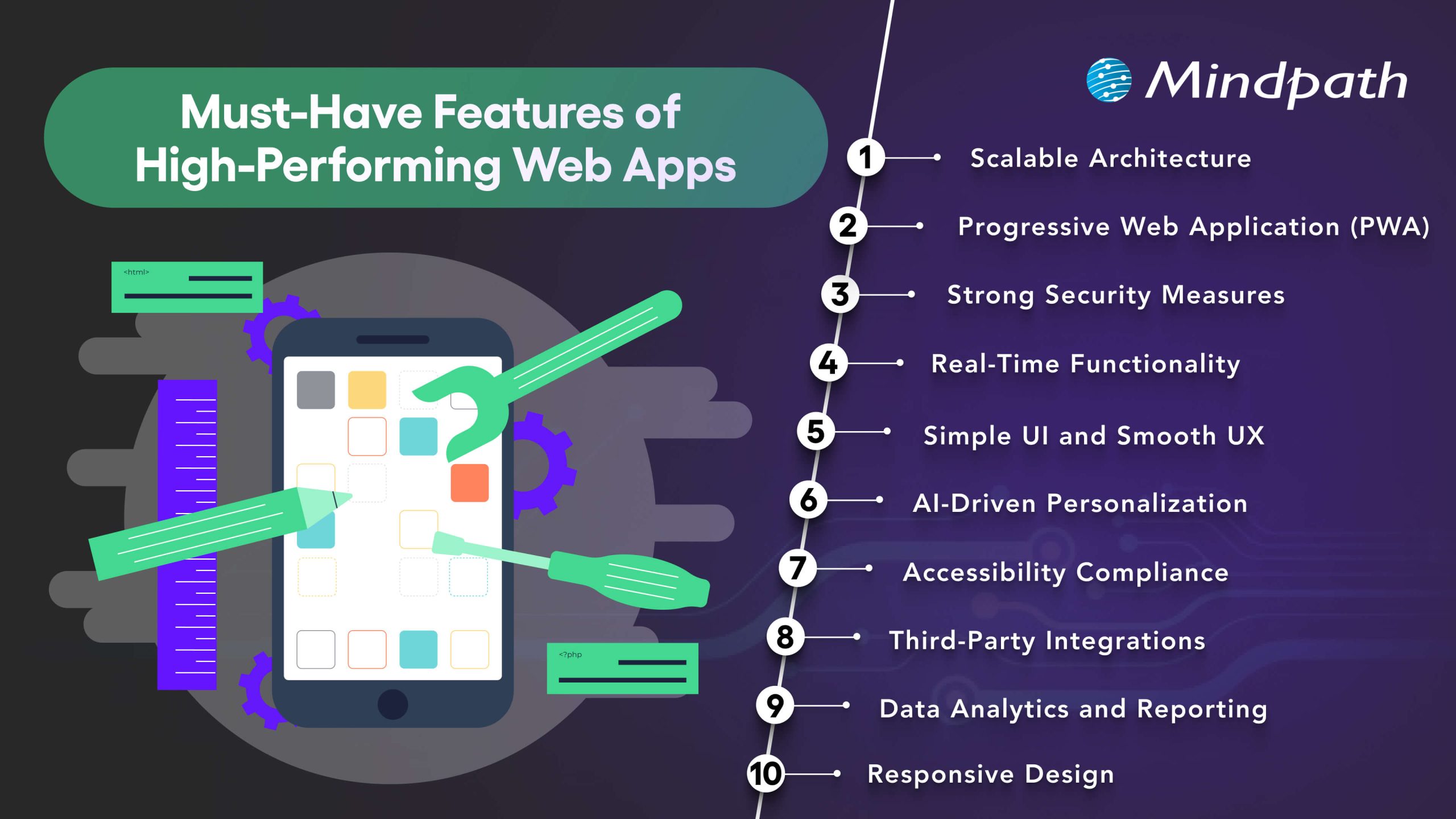
10 Must-Have Features of High-Performing Web Apps

1. Scalable Architecture

Growth is a keystone for any company, and scalability is what allows your web application to accommodate that growth smoothly. Proper use of cloud hosting services, load balancing, and microservices allows it to manage the increase in traffic without performance issues. Furthermore, having scaled and designed your application to work well in large increments means you will not have to completely rebuild your system as demand rises. This is one of the essential features of successful web app development.

2. Progressive Web Application (PWA)

PWAs are the perfect blend of web and mobile experiences wrapped up in one platform. They consult faster, work offline through service workers, and provide app-like usability without the hassle of installation. Research shows the PWA market is growing at a rapid pace, with a healthy number of adoptions across all industries for you to find yourself chasing. Digital solutions via a PWA will be one of the top features of web apps in 2026.

3. Strong Security Measures

Security is never optional in our current online world. Features such as SSL encryption, multi-factor authentication, and continuous vulnerability assessment secure private data. Users want an application that they know they can trust to keep their personal and financial information safe. With web application development, security should be the foundation, not an afterthought!

4. Real-Time Functionality

Real-time updates make applications more engaging and exciting for users. Whether these components come by the way of a live chat, instant notifications, or live data streaming, users enjoy being connected without the potential delay. Businesses reap the advantages of more efficient communication systems and a greatly improved customer support system. This is just one of the many standard web app features users pretty much expect now.

5. Simple UI and Smooth UX

A clean interface and seamless navigation encourage apps to be more enjoyable as well as productive. A user is more likely to be happy using an app when there is an intuitive design with predictable layouts, immediate access to feature menus and categories, and effortless navigation. Well-consulted user experience reduces tension and frustration through session length, increases retention and creates a lasting positive experience. This is why simple and intuitively designed UX is up there with the essential features of successful web app design.

6. AI-Driven Personalization

Artificial Intelligence is effectively powering personalization in web applications today. AI looks at data about users, makes content recommendations, predicts behavior, and enhances the accuracy of searches. As a result, interactions are smarter, which increases user satisfaction and retention. Therefore, we can consider AI-based personalized experiences to be exceedingly valuable in the web app ecosystem and are establishing themselves as one of the best web app features.

7. Accessibility Compliance

Achieving accessibility guarantees inclusivity among all users, including users with disabilities. Accessibility requires features like keyboard navigation, text-to-speech, high-contrast designs, etc. Accessibility makes sense because it helps all users online. Additionally, creating accessible websites, apps, and systems based on WCAG standards is the right thing to do and creates goodwill and trust across a larger audience. Accessibility is now one of the core features of successful web app development.

8. Third-Party Integrations

Modern web apps must be compatible with other tools. Payment gateways, analytics tools, and social media APIs are just a few examples of third-party integrations that greatly reduce the burden of burdensome workflows and subsequently speed things up. Third-party integrations enhance versatility and create a better user experience. Needlessly, for website application development, third-party integrations are vital in furnishing genuine value.

9. Data Analytics and Reporting

Analytics gives businesses actionable insights into user actions. They can monitor user behavior through dashboards, heatmaps, and customized reports to observe how users interact with the application. Leveraging that information can get a business closer to improving its services, maximizing its marketing, and strengthening performance. That’s why reporting is one of the most impactful web app features today.

10. Responsive Design

Responsive design is not optional, given that the majority of users are accessing the Internet with their mobile devices. A web app must be responsive across desktops, tablets, and smartphones. Responsive design means lower bounce rates, improved SEO, and better engagement. It is one of the top features of web apps that continues to be relevant in the long game for success.

How to Develop a Web Application?

A web application is a direct bilingual service and bridge from your business to users in the interactive space; it supports developing seamless interactions, dependable functionality, and useful user experiences.

Steps to Develop a Web Application

1. Requirement Gathering and Planning

This phase analyzes the purpose of the application and the problem trying to be solved. The product objectives are informed by market research, planning the workflows, and a listing of web app features to ensure that the project begins with direction and clarity.

2. Design and Prototyping

The process of wireframing, mock-ups, and prototypes allows for the visualization of the layout, user flow, and interface design. This will be further supplemented with rigorous planning around the database and system architecture. This will ultimately provide a basis for functional and performance forms.

3. Development

Frontend development emphasizes crafting interactive and user-friendly interfaces. Backend development manages business logic, APIs, and data maintenance, and provides the groundwork for developing the functionalities of web applications.

4. Testing

Unit and integration testing assure both that the individual pieces work and that they work together. User Acceptance Testing ensures that the application meets the expectations of the user, while also performing reliable activities.

5. Deployment and Maintenance

The application will be deployed to the server and accessible to users, with ongoing monitoring, and promoted to production and changes. Maintenance will consist of bug fixes, upgrades, and implementation of new web app features based on changes in business needs.

Want to Create a Future-Ready Web Application?

In 2026, the success of any web application will depend on the strength of its web app features. Scalability, security, personalization, and responsive design are no longer optional but critical. Businesses that embrace these essential elements will be able to deliver seamless experiences, engage users effectively, and stay ahead in a competitive digital environment.

At Mindpath, we specialize in web application development tailored to your business goals. Our expertise ensures applications are secure, scalable, and built with the right web app features for long-term success. With a focus on innovation and usability, we deliver solutions that empower businesses to engage customers better and unlock real growth. Connect with us today to get started.


Related Post

Discover the benefits of serverless architecture, from cost savings to faster development, and learn how Mindpath can help your business thrive.

Related Post

Reactjs performance

React.js revolutionized frontend development, primarily in terms of performance optimization, with its unique architecture. As a matter of fact, big names such as LinkedIn trust React.js for creating their web applications to achieve seamless performance. You would be surprised to know that you can elevate React.js performance further with the help of some tested techniques. Do you want to know why performance optimization is required in React.js apps?

Many people would argue that React.js does not need performance optimization, as it helps in creating faster interfaces without optimization. The most interesting thing about React.js is that you can optimize it for better performance in specific use cases. You can leverage performance optimization techniques to make your React-based web apps faster and more responsive. 

Elevate your business by using ReactJS, a technology that transforms digital presence and provides you with exceptional user experiences. Explore Mindpath’s ReactJS development services as they are designed to deliver speed and scalability.

Unraveling Top Techniques for React.js Performance Optimization

Would you visit a website again if it takes almost a minute to load a page? The growing competition in the digital landscape demands that businesses have their web apps optimized for high performance. You can rely on React optimisation to achieve better user experiences and reduce bounce rates, which will enhance your competitive advantage. An overview of notable optimization techniques for React.js apps can help you understand why you should implement them right now.

Must Read: ReactJS Web Development Guide

1. Incorporate Lazy Loading Images in Your App

Using multiple images in your React.js application is a bad thing for performance as the DOM will render all images before displaying the requested information. In such cases, React.js optimization with lazy loading images can help you avoid performance issues. Lazy loading images ensure that the image will wait for its turn to appear on the user interface and prevent the creation of unwarranted DOM nodes. You can use popular libraries like react-lazyload and the react-lazy-load-image-component to boost the performance of your React.js apps.

2. Proper Use of Server-Side Rendering

Server-side rendering or SSR is one of the most appealing features of React.js for web development projects. You should identify the need for SEO in your web app and if you don’t feel that it is necessary, then you should skip SSR. The problem with SSR for React optimization is that it takes up a massive load. You can find a solution to this problem with NextJS integrations in React admin templates that can streamline development process.

3. Split the Chunk Files

The development of every web application begins with few components. As you continue adding new dependencies and features in the app, you will get a large production file. In such cases, you can have two different files by isolating the third-party library code from the application code. You can leverage the CommonsChunkPlugin to create the vendor.bundle.js and app.bundle.js files. The splitting ensures less frequent browser caching and parallel resource downloads, thereby reducing the loading time.

4. Optimizing the Dependencies

Performance optimization in React.js apps revolves primarily around the application bundle size. However, the optimization of React app must also focus on the amount of code used from dependencies. Let us assume that you use Moment.js that features localized files to offer support for multiple languages. If you don’t want multi-language support, then you can remove the unused localized files for the final bundle. Similarly, you should look for dependencies that you can optimize in your React app for better performance.

5. Immutable Data Structures

You can also think of data immutability as a solution to enhance performance of React.js apps with a different approach to writing code. Data immutability helps you think about the approach for structuring the application data flow in React to optimize the app performance. Experts have also pointed out that data immutability focuses largely on maintaining a unidirectional data flow in all circumstances. Data immutability can be implemented in designing front-end apps with various benefits, such as zero side-effects and ease of tracking changes.

Looking to accelerate your team’s adoption of best practices and modern patterns? Learn the actionable steps in the React roadmap to stay ahead of current trends.

6. Leveraging the Production Mode Flag

Developers relying on webpack 4 as module bundler for their app should try specifying production as the mode option. It is a useful trick to instruct the webpack for using its in-built optimization for better performance. Developers can also pass it as a CLI argument for performance optimization in React apps. The production model flag helps in limiting optimizations to libraries, thereby avoiding exposure of file paths or the source code.

7. Throttling and Debouncing

The event trigger rate is one of the crucial factors that determine the performance of web apps created with React.js. It defines the number of times the app invokes the event handler in a specific amount of time. You can improve performance of React.js apps by identifying the event handler doing the most significant work and implementing debouncing or throttling. Debouncing involves preventing the frequent activation of event trigger while throttling focuses on delaying the execution of functions. 

8. Ignore Props in the Initial States

One of the common highlights in any React development workflow is the necessity of passing initial data with props to the React component. However, the use of props for initializing a state in constructor function will lead to duplication of ‘source of truth’. You can avoid redundancy without initializing the state with props that you can change later and must ensure direct use of props in the component. The ‘componentWillReceiveProps’ can help in updating the state in alignment with changes in props.

9. Using Reselect in Redux

Developers can build memorized selectors with the help of Reselect, which serves as a simple selector library. It helps you improve performance of React app by defining selectors as a function and retrieving the snippets of Redux state for React components. Reselect helps in avoiding re-rendering by returning the result of the last function till it passes new inputs. 

10. Memoization to the Rescue

Memorization is another option for improving React app performance. The optimization technique returns the cached results for similar inputs and aids in storing the results of costly function calls. Memoization improves the speed of functions by fetching results from the cache for similar values as the previous function call. The method compares the props and context of components with strict guidelines, thereby ensuring better accuracy along with speed.

Looking to select the best framework for your next app while maximizing ROI? Discover the top reasons to choose ReactJS for app development and how it benefits business owners.

11. Implementing a Faster CDN

Content delivery networks offer credible options to distribute static content from your web apps to the target audience. With the help of a trusted CDN provider, you can achieve faster and more effective content delivery in React web apps. You will notice that the online experiences provided by the CDN server that is closest to users are the best ones. To get better performance from React apps, developers should use reliable CDN providers like CloudFlare, CloudFront or Google Cloud CDN.

12. Virtualization of Long Lists

React.js developers can also enhance the performance of web apps by using list virtualization or windowing. It is an effective optimization technique in scenarios where web apps have to render long lists of data. List virtualization involves rendering a limited subset of rows, thereby reducing the time required to re-render components. The virtualization of long lists also helps in reducing the number of DOM nodes required for re-rendering. You can trust React libraries, like react-window and react-virtualized to capitalize on reusable components to display tabular data, lists and grids.

13. Using Gzip Compression for Web Server

The easiest approach to increase performance of React app involves reducing the size of files, thereby reducing the loading time for your website. You can leverage Gzip compression for CSS, HTML and JavaScript files which have a lot of repeated text and large amount of whitespace. Gzip can help with compression of common strings, thereby reducing the size of style sheets and pages by almost 70%. As a result, your website will take lesser time to render and will deliver desired performance in online experiences.

14. Trimming Your JavaScript Bundles

Every React.js app includes a lot of JavaScript bundles, which contribute to the overall load on the app during loading. You should aim to eliminate code redundancy by trimming the JavaScript packages in your app’s code. By removing duplicates and unwanted code in your app, you can enhance its performance by a huge margin. Therefore, it is important to analyze bundled code and determine the potential areas for trimming.

15. Capitalizing on the Value of Functional Components

Developers should also try using functional components, which offer a subtle approach to optimize the performance of functional components. As a matter of fact, you can achieve React.js performance optimization effectively through functional components. You can use smaller components as they don’t pose difficulties in reading, testing, maintenance and reusability. The prominent advantages of functional components include the requirement of less code, more flexibility and flexibility for extracting smaller components.

Looking to future-proof your web applications with a technology that scales as your business grows? Discover the strategic top reasons to choose ReactJS for Progressive Web App development for business owners.

16. Key Coordination to Render Lists

You will also have to incorporate lists in React apps, which offer an opportunity for performance optimization. It is important to allocate specific attributes to the element that helps in rendering upcoming items in the list. You will notice that in dynamic lists a new list entry automatically offers suggestion for the previous list entry. Developers can avoid this redundancy by assigning a specific key value to the list component and boost the performance of their React apps.

17. Special Attention to ‘this’ Binding

If you are using functional components, then they will not need the ‘this’ binding. In the case of ES6 binding, React will not facilitate auto-binding for functions you have used in components. On the other hand, you can implement React optimisation by binding your functions and components with manual methods. Some of the notable methods including binding in render or construction and allowing the arrow function in render.    

18. Make Web Workers Do Your Work

During the rendering process of a web page, JavaScript will execute multiple tasks, such as managing UI interactions, CSS animations and configuring DOM elements. As a single-threaded application, JavaScript handles all these tasks in one thread, which creates bottlenecks for performance. Web workers help in reducing the burden on the main thread by executing scripts on a different thread in the background. The separation of threads is useful for managing tasks that require a lot of computational resources or long-running operations. 

19. Utilize React Fragments to Your Advantage

Another popular solution to optimize the performance of your React.js apps involves React Fragments. You can find the feature in React 16.2 and use it for grouping multiple elements without an additional DOM node. It can help you with React.js optimization when your app has to return multiple elements from the render method of the component. In addition, you must know that React Fragments work the best when you don’t want DOM elements that interfere with the app style or layout.

20. Implementing the UseTransition Hook

Developers should also pay attention to the ‘useTransition’ hook in React as a promising method for performance optimization. It can help in improving application performance with support for classifying state updates as non-blocking transactions. The hook helps React in deferring the render process for state updates, thereby preventing UI blocking that improves overall responsiveness. The non-blocking transition helps in preventing UI blocking, especially during large-scale updates and data fetching operations.

Want to scale your application seamlessly as your customer base grows? Learn how the benefits of ReactJS development services make large-scale, high-traffic apps easier to maintain and expand.

Final Thoughts

The rising competition for an attractive web presence has pushed almost every business to use React.js for frontend development. You can improve performance of React app with the help of credible performance optimization techniques approved by experts. However, you cannot rely on a single optimization method for every application. You will need a strategic approach and in-depth understand of React.js framework to implement effective performance optimization techniques.

Mindpath is your trusted companion for React.js development services and performance optimization for your web apps. We can help you identify the exact areas where your web applications need improvement. Our experts use their years of experience to identify relevant performance optimization techniques for your React apps. Reach out to us and find the ideal solution to boost the performance of your next big web project now.

Optimize your React app for better speed and scalability. Explore advanced performance techniques, including virtualization and useMemo.
node js developer hire

Imagine hiring a developer who can effortlessly build web applications that handle thousands of users at once. Sounds exciting, right? With Node.js developers, you can achieve this with ease. In this blog we will explore the key advantages of hiring a node.js developer that can be very beneficial for your project.  

Node.js is a famous open-source runtime environment for JavaScript that empowers one in developing fast and scalable applications. It makes use of the V8 Engine from Google Chrome for running code fast and efficiently. Unlike traditional servers, Node.js handles many requests at once using a single process, thanks to its non-blocking I/O operations. This makes it great for applications that need to manage a lot of connections. Moreover, a JavaScript developer can easily use it for front-end and back-end development with no additional study of a new language. Staying updated with the latest trends of Node.js ensures you leverage its full potential and keep your development practices current.

It is crucial to hire a node.js developer who can assist you in developing fast and efficient web applications. Node.js developers work with technology that has the ability to accommodate very many users at the same time without failing—instantly applicable for real-time applications such as chat apps or online games. They can build scalable systems that can grow with your business. Additionally, a good Node.js developer will be able to work both on the front and the back end of your application, which will potentially make your application flawless in terms of user experience. Hiring a Node.js developer will, in turn, save you time, improve performance, and assure that your app is being developed with the latest tools and practices. 

Let us dive deep into the advantages of hiring Node.js developers in today’s modern world, which will be beneficial for your project. 

Key Tips for Hiring a Node.js Developers    

1. Simplify Your Hiring Process 

Make it easy for the best Node.js developers to join your company. Instead, leverage industry-centric networks and professional groups to find candidates quickly and effectively. Keeping your process crystal clear and organized will help attract qualified people. 

2. Clarify Roles and Responsibilities 

While you hire a Node.js developer, clearly mention roles and responsibilities in the job description. The major role would include writing server-side codes, providing data security, and API development. This guides the appeal of candidates that fit the needs. You will remain focused and clear in your hiring process if you know exactly what the role involves. 

3. Review Portfolios  

Request portfolios and client reviews from the candidates to assess their experience and work quality. You should hire Node.js developers who have previously handled projects like yours. Also, one must check if they use testing tools like Mocha, Jasmine, Jest, and Ava for good code quality. A review of their portfolio will let you know about their practical skills and whether they deliver successful projects. 

4. Testing Soft Skills 

While hiring a Node.js developer, communication and problem-solving skills should be assessed if the work is going to be remote. Good collaboration and handling challenges effectively are key to the success of projects. One of the most critical areas in which soft skills are essential for smooth integration with the team and a productive work environment. 

5. Have a Talk About the Hiring Cost 

Be transparent with your budget. Costs can range with respect to the location and experience of developers. You should offer to pay competitively and state other benefits to attract the best candidates. Talking about money first sets your expectations clear and sets up a working relationship. 

6. Adaptability and Learning Test 

Since technology keeps on changing, you want to hire a Node.js developer who is flexible and ready to learn. Ask them about their experience with new tools and how they stay up-to-date on the latest industry trends. Adaptability and commitment to learning guarantee that developers will stay updated and be effective contributors towards the projects. 

Looking for a Node.js developer to bring your ideas into life?

At Mindpath, we have got a professional team ready to take any challenge from you and work on giving the best digital solutions.

Market demand for Node.js developers   

The demand to hire Node.js developers is increasing considerably. According to research, with the help of Node.js, it saves 68% of a developer’s productivity since a single language, JavaScript, enables a developer to write both frontend and backend code.   

Node.js is favored by younger developers: 46% of Node.js developers are in the age range of 25-35 years. This probably supports the assumption that Node.js has a great future: these developers will continue working with and enhancing this technology. About 36% of Node.js developers have top-rated tools and libraries in use, thus advocating for quality and innovations. Node.js is popular worldwide, having spread across some 85 countries. Development languages used by Node.js developers are more than 45. Node.js is a choice for startups and small businesses; 60% of developers work in companies with less than 100 employees. 

Most Node.js developers have more than 5 years of experience, thus laying a very strong base in the technology. The bulk of the talent is focused either on back-end or full-stack, clearly stipulating that Node.js is capable of handling complicated server-side tasks. About 85% of node.js is applied in web applications and 43% apply it in enterprise-level projects, thus putting emphasis on its wide scope of applicability. 

Hire Node.js Developers at Mindpath 

Mindpath has a great team of Node.js developers who can develop fast, powerful, and engaging digital solutions. We have rich experience in handling all types of projects, from commencement to completion. We make it possible to transform your idea into reality. We can provide the best solutions with the support of our expert Node.js team. Here are the steps to hire Node.js developers at Mindpath: 

1. Define Your Requirements 

Get in touch to discuss your project ideas and goals. We’ll dive into your needs, and then create a detailed proposal that includes our plan, timeline, and costs. 

2. Find Perfect Match 

We hand-pick Node.js developers who are a good match for your project. You get a chance to interview and choose the best candidates to work on your project according to your needs and vision. 

3. Launch Your Project 

We will undertake your project with a perfect team and begin with a fully itemized plan and schedule. We shall be keeping you posted for feedback to make sure everything is running according to your expectations. 

4. Continuous Support 

We don’t feel that our work ends with the launch. We’ll be here for you throughout development and when the project goes live, making sure everything goes your way, nice and smooth. 

Conclusion 

In a technological world that is ever-changing, Node.js has been at the top of web development trends since it introduced unmatched performance and scalability. It can handle a variety of requests efficiently, besides the advantage of using the same JavaScript for both frontend and backend development that makes Node.js a powerful tool for building modern web applications. This is further proved by the increasing need for Node.js developers in order to remain relevant in technology and, probably, to make some innovative solutions happen with the help of skilled professionals. Mindpath realizes how important it is to be ahead in this very dynamic field. Be assured that our team of Node.js experts will spare no effort in creating high-performance, scalable, and engaging solutions for every client’s needs.  

Looking for top-tier Node.js talent to elevate your project?ur It Projects?  

Mindpath offers expert developers ready to deliver innovative and high-performance solutions.

Unlock the power of Node.js for scalable web apps. Discover expert tips for hiring the perfect Node.js developer for your project with Mindpath.
Sustainable Technology

Have you ever wondered how technology can help create a healthier planet? Sustainable technology is here to answer that question! But what exactly does this mean for our everyday lives? In this blog, we’ll explore the fascinating world of sustainable technology and discover how it offers eco-friendly solutions. So, let’s dive in! 

What is Sustainable Technology?

Sustainable technology is the design and use of technology to benefit the environment, society, and the economy. This means two things: creating technology with eco-friendly processes and materials and using technology to help solve environmental and social problems. Other examples include solar panels, which provide clean energy, and software enabling businesses to trace their environmental footprint.   

While developing sustainable technology, companies are very considerate about the resources used, their origin, and how to reduce the negative effects in the form of pollution or electronic waste. Businesses use sustainable technologies to realize some of the desired environmental targets, such as reducing fossil fuel use or source reduction of waste.   

Advantages of Sustainable Technology

Advantages of Sustainable Technology

1. Better Disaster Recovery

Sustainable technology can significantly improve how a firm recovers from big disasters. One of the primary advantages of employing cloud-based solutions is that critical data such as papers, payroll, and client information is safely kept online. This means you can easily access anything, even if your actual workplace is damaged by fires, floods, or storms. 

In some situations, depending on the nature of your business, you can be allowed to operate from home or a temporary location. This strategy not only speeds up recovery but also saves money on hardware, technical support, and network maintenance. With sustainable technology, your vital information is secured and accessible no matter what happens, resulting in a speedier and less costly recovery. 

2. Attracting More Customers

Contrary to popular belief, a large number of individuals care about the environment. Many customers today choose to do business with firms that are environmentally friendly and employ sustainable methods. By advertising your company as one that prioritizes sustainability, you might attract more clients who share your concerns. 

Hotels, for example, have experienced a significant boost in customer traffic as a result of promoting their green initiatives, such as deploying solar panels or installing water-saving equipment. Marketing your company’s dedication to sustainability may help you create trust and attract new clients who wish to support environmentally conscientious firms.  

3. Getting Tax Benefits

Adopting sustainable technology can assist your company save money on taxes. Depending on the green technology you adopt, such as solar panels or energy-efficient equipment, you can be eligible for tax breaks that can significantly reduce installation costs. 

In addition to tax benefits, these technologies can cut your energy costs over time, increasing your overall savings. It’s a good idea to look into local and national programs, since some locations provide better tax advantages and incentives than others. By incorporating sustainability into your firm and pursuing green certifications, you can not only decrease your environmental effect but also lower your annual tax bills. These perks can have a significant long-term impact on your company’s financial health. 

4. Boosting Budgets for Higher Income

Switching to sustainable technology can result in significant savings for your total budget. These savings can be invested in other areas of your organization to increase revenue. For example, the money saved from decreased power costs can be used to fund marketing campaigns or upgrade items in your business. You can also utilize these savings to develop your firm, such as adding additional employees or improving your social media presence. By optimizing your budget using sustainable techniques, you can generate new prospects for development and income. 

5. Increasing Productivity

Sustainable technology can significantly boost workplace productivity. For example, adopting the Cloud for document storage makes it much easier to search and exchange information, saving time over traditional filing systems. Mobile devices and messaging platforms improve communication efficiency, allowing staff to cooperate more efficiently. Furthermore, appliances that increase air quality help to create a better work environment, which can promote employee well-being and attention. Businesses that use this eco-friendly technology can offer an engaging and supportive environment that encourages employees to perform at their peak. This dedication to sustainability helps not just the environment, but also develops an innovative and efficient culture, resulting in increased overall production and success. 

6. Switching to an Eco-Friendly Web Host

Having a website is essential for corporate success, yet the web hosting sector produces more carbon emissions than the airline industry. This is partly due to the high energy consumption of data centers used to power websites, which rely significantly on electricity for servers and cooling systems. 

Fortunately, you can choose a sustainable web host that values sustainability. Many environmentally conscious hosting firms buy renewable energy to offset their power use, ensuring that the websites they host lessen their carbon footprint. As customers place a higher emphasis on environmental friendliness, choosing a green web host is a wise decision that improves your brand’s reputation while also aligning with current principles.  

7. Cutting Down Office Expenses

Adopting more sustainable technologies in your organization can help to reduce overall office supply expenses. While cutting down on paper is the most obvious advantage, there are several other costs to consider. 

Moving to a digital platform can assist you save money on products like pens, paperclips, and markers. Consider the annual expenses your business incurs for printer ink, upkeep, and replacements. These expenses can add up rapidly. 

Implementing a digital and environmentally friendly system reduces these costs while also freeing up storage space for other important equipment and supplies. Adopting sustainable practices can result in significant savings while creating a more efficient workplace. 

Innovative IT Solutions at Mindpath

Mindpath is an expert in IT innovation, providing tailored solutions for your organization. We are an Innovation Centre that focusses on staff augmentation, bringing experienced and certified individuals to work with your team on any short- or long-term project. Our modernization services improve old systems and processes for greater efficiency, security, and long-term growth. We are pioneers in digitization. As a result, we provide cutting-edge web development and app solutions to help you establish a stronger online presence. Furthermore, with our expertise in bespoke chatbot creation and artificial intelligence, your company will benefit from the most cutting-edge technology available, giving you an advantage.   

Wrapping Up!

Sustainable technology contributes to a healthy world while also helping businesses in a variety of ways. The benefits are evident, ranging from improved disaster recovery and appealing environmentally meticulous clients to tax breaks and increased productivity. By using these environmentally responsible solutions, your organization can save money, improve its reputation, and contribute to a more sustainable future. At Mindpath, we are dedicated to assisting organizations in implementing innovative IT solutions that connect with their beliefs. Together, we can build a greener and more affluent future. 

Ready to transform your business?

Partner with Mindpath today to explore innovative IT solutions tailored to your needs!

Discover how sustainable technology can enhance your business by improving recovery, attracting customers and boosting productivity.