

UI/UX Trends in Web Application Development: 2026 and Beyond

Join our Newsletter!

Featured Posts

Support Is One Click Away

Home

UI/UX Trends in Web Application Development: 2026 and Beyond

ui ux design trends

UI/UX Trends in Web Application Development: 2026 and Beyond

At present, the UI and UX aspects of web app development are undergoing a paradigm shift. It is an understatement to say that the year 2026 has been a groundbreaking year when it comes to web app development. This is because an array of new UI/UX design trends has emerged. In fact, as per recent UX statistics, if you invest USD 1 in UX, you are likely to get a return of USD 100. It highlights the rising popularity of top-notch UI UX designs.

If you wish your business to stand out in the crowded digital space, it is essential to familiarize yourself with the latest UI UX best practices. By incorporating the top UI UX trends into your website, you can have a lasting impression on your target audience. Let us take a look at some of the most unique UX UI design trends that are set to rule in the year 2026 and beyond.

If you want to modernize your next project with UI/UX trends, our web development services can help you design and develop applications that would deliver engaging digital experience.

Top UI/UX Trends of Today

Gone are the days when websites used to be boring. Thanks to rising emphasis on UI UX, learning businesses have started realizing the strategic relevance of user experience and user interface. In the fast-paced business world, it is a must for businesses across diverse industries to incorporate captivating UX UI elements that can captivate online users.

If you wish to use your business website as a strategic tool, it is essential to review UI UX design elements that are ruling the web app development arena at present. It will certainly create an opportunity for you to develop a world-class website that can boost the overall experience of your users. Some of the major UX UI trends that are likely to rule the current as well as future web app development arena are:

1. AI-Driven Personalization

Today, businesses are relying on artificial intelligence technology to redefine their UI UX efforts. By leveraging AI, it has become possible to take personalization to the next level. Many businesses across diverse sectors and industries are incorporating AI to tailor the digital experiences of their users. By capitalizing on AI capabilities, it has become possible to create highly engaging as well as relevant interactions for the target audience.

Such a development in the web app development arena has undoubtedly revolutionized the experiences of users. Moreover, by focusing on AI-driven personalization, businesses are able to understand the behavior and preferences of their users in a better way. The insights are equipping businesses to promptly respond to the needs of their users and strengthen their association with them. Today, businesses have even started taking AI-driven personalization to the next level by creating dynamic layouts for their websites and developing adaptive designs.

Curious to learn how AI can transform web development? Take a deep dive into our Comprehensive Guide to AI in Web Development to get more insights!

2. Integration of Immersive Elements

One of the most popular UX UI trends that is dominating the web app development space revolves around the use of immersive elements. It has become common to add 3D elements to websites so that users can have a highly engaging experience. Some of the other common UX UI design examples that are gradually gaining popularity include virtual reality (VR) and augmented reality (AR) elements.

By incorporating such components into web app development, new possibilities have opened up for businesses. In fact, businesses have become capable of blurring the lines between the virtual world and the physical world. It has also been reshaping how online users interact with businesses in the modern era. In the future, this specific UX UI design trend is likely to gain further momentum due to its rising popularity among businesses and users alike.

3. Focus on Interactive Design

At present, businesses have shifted their attention towards interactive design in the context of web app development. By incorporating such elements, businesses can improve engagement and interaction with online users. It has become quite common to incorporate elements in the form of subtle animations and feedback to guide the users. Similarly, businesses have started incorporating dynamic animations that are capable of responding to the inputs of users.

Interactive design is considered to be an indispensable part of UX UI. Such design components can serve as catalysts and influence how online users interact within a website. This trend is here to stay since it can impact the experience of online users at diverse levels. If you wish your web application to have a lasting impact on your target audience, you must certainly start incorporating impactful interactive design features and components.

4. Introduction of Dark Mode

The dark mode is not exactly a new trend in the web app development space, but it has undoubtedly gained immense popularity in recent times. This mode has become immensely popular among online users owing to its sleek and captivating look. Moreover, the dark mode ensures the comfort of users, especially when they navigate websites and applications in low-light settings.

By including the dark mode element, it is possible for you to keep up with the amazing UX UI trend. This visual setting can create value for your web app by improving its overall aesthetics. Moreover, it can certainly enhance the overall experience of online users by improving their readability and reducing their eye strain. It is undoubtedly one of the top trends that businesses cannot afford to ignore today.

Curious about what’s shaping the future of web experiences? Discover top web development trends to discover the technologies and practices driving next-generation applications.

5. Sustainability in Designing

Today, immense focus is being laid on sustainability aspects. This trend has also been observed in the context of web application development. Currently, businesses are fusing sustainable and environmentally friendly design elements into their websites and applications. You must also start including elements that enhance the digital experiences of your users while minimizing their environmental impact. One of the top trends that is gaining momentum focuses on minimalism and efficiency. Similarly, another popular trend involves the use of recyclable resources.

It has become fairly common to prioritize efficiency in coding practices. By focusing on this aspect, it is possible for businesses to curb their footprint on the environment. This UX/UI trend is surely catching up in recent years, and it is expected to stay for a long time. It is the perfect time for modern businesses to incorporate this specific UX UI trend by locating unique ways to reduce waste and optimize the use of resources in web app design.

The top UX UI trends that have been identified are redefining the future of web app development today. Furthermore, these top trends are most likely to gain further momentum and influence how businesses create their websites as well as applications to shape user experience.

Want your UI/UX designs to truly stand out in real-world applications? Explore our Custom Web Development Services blog to see how tailored solutions turn great designs into seamless user experiences.

Final Words

The future of UI/UX design is full of new possibilities today. You can give your business an edge by choosing the best UX/UI design elements. Some of the major trends that you must look out for today include AI-driven personalization, integration of immersive elements, interactive design, dark mode, and many more.

You must undoubtedly consider joining hands with Mindpath since we offer comprehensive UI UX designs to modern businesses today. We aim to help you to keep up with the latest UI/UX design trends in 2026 and enjoy a competitive advantage. By choosing Mindpath’s top-notch app development services, businesses can create amazing applications that boost their performance and contribute to business growth.

Related Post

Consider JavaScript expertise, Node.js framework knowledge, problem-solving abilities when hiring Node.js developers in London.
Discover the ultimate guide to hiring Node.js developers in London. Learn about the skills, benefits, and cost factors involved in finding the right talent for your project.

Related Post

Low-code No-code Development

The app development arena has been undergoing constant evolution. One of the major developments that has captured the attention of one and all is the Low-Code/ No-Code modular approach. It is a must for modern businesses as well as individual app developers to familiarize themselves with low-code no-code development. It certainly holds the potential to revolutionize the application development process. 

According to the recent report by Future Business Insights, the low-code development platform is expected to grow from $ 37.39 billion in 2025 to $ 264.40 billion by the year 2032. This major jump automatically highlights the growing popularity of low-code platforms. In order to leverage this application development model, it is imperative for businesses to have a clear understanding of what is low-code or no-code development.

Want to take your business to the next level with the use of low-code development services? Contact us and get full guidance and support on how you can implement low code/ no code innovation for your organization.

An Insight into Low-code or No-code Development

In the dynamic digital space, low-code no-code have certainly emerged as a transformative force. It can be defined as the app development process that involves minimal coding. It serves as a visual approach in the app development setting. By adopting such an approach, it is possible for businesses or individuals with minimal coding skills to develop applications. 

The key difference between low-code and no-code development lies in the degree of coding that is necessary.  Low-code platforms act as highly effective tools that can help in creating apps. However, one must possess knowledge relating to coding to a certain degree. No-code platforms act as drag-and-drop platforms that entirely eliminate the need for coding. By leveraging top low-code no-code development services, businesses can develop high-performing applications.

Must Read: Low-Code vs. No-Code Development

Mechanism of Low-Code No-Code Development

In the traditional app development process, app developers or programmers had to engage in highly complex coding processes. Such processes were essential to create the features as well as the functions of the intended apps. As a result, app developers were expected to possess solid skills and expertise relating to coding and computer programming languages. 

However, by using the Low-code No-code Development approach, it is possible to visually choose and connect reusable components. By doing so, app developers and businesses can identify the specific components that represent specific capabilities. Then they can link them together in order to develop the desired workflow. 

Low-code and No-code tools undoubtedly simplify how developers create apps. By using such tools, they can easily develop applications as if they were drafting a flowchart instead of writing code in a detailed manner. Moreover, such platforms come with several features that allow developers to experiment during the app development process. The simple drag-and-drop interfaces of low-code and no-code tools streamline the entire application development process. 

As low-code and no-code solutions continue to grow, it’s helpful to see where they fit among the top web development trends in 2026, shaping the industry.

Benefits of Low-Code No-Code

In the past, the development of software applications was quite time-consuming. Businesses would have to deploy teams that would be responsible for app development. However, today the situation is very different as they have the option to use low-code/no-code tools.  These tools have the potential to simplify how applications are developed. Now that you know the low-code no-code meaning it is time to explore its benefits. 

1. Faster app development process

One of the fundamental benefits of low-code and no-code revolves around a faster development process. By using the best low-code no-code platforms, businesses can certainly speed up their app development process. Such tools create the opportunity for app developers to design apps efficiently without having to do complex coding from scratch. 

2. Lower app development cost

The cost relating to app development can give rise to financial constraints for businesses. In fact, conventional app development processes were quite costly. However, by adopting the low-code no-code model, businesses can develop top-performing apps in an affordable manner. By choosing top tools, the need for high-cost development resources can be reduced considerably.  

3. Ideal tool for non-developers

Non-developers who have limited insight into software development can capitalize on low-code and no-code tools to venture into the development space. These tools can act as the perfect partners that can aid in designing a diverse range of applications. Businesses can utilize the model to democratize app development. As a result, the reliance on IT teams for app development can be reduced considerably. 

4. Higher agility

In the prevailing digital context, the low-code no-code approach enables businesses to undertake diverse processes relating to prototyping and testing. By using low-code or no-code platforms, businesses can modify the workflow, data sources, and user interfaces. Moreover, such modifications can be done in a quick and agile way. 

While low-code/no-code tools offer speed, traditional approaches still have value; learn more about optimising development with Custom Web Development Services.

Drawbacks of the Low-Code No-Code Model

To get a comprehensive insight into low-code and no-code development, it is essential to understand the associated drawbacks. Only by being aware of the shortcomings can businesses decide how they can optimally use low-code or no-code. Some of the major drawbacks of low-code and no-code include:

1. Restricted degree of flexibility

One of the main drawbacks of the low-code no-code approach is that it diminishes flexibility for app developers. This is because their ability to customize their app is reduced to a considerable extent. As low-code and no-code frameworks rely on pre-built components, businesses that wish to develop highly tailored apps may not be happy with the outcome. 

2. Issues relating to performance

Another major drawback of low-code and no-code that businesses need to be aware of revolves around performance concerns. Sometimes, the apps that are developed using low-code or no-code tools may struggle to handle a large volume of data. Similarly, concerns relating to scalability may also arise in case there is a surge in user load. Such concerns may have an adverse impact on the overall satisfaction and experience of users. It may even impact the reputation of businesses. 

3. Challenges relating to integration

A common concern that may arise for businesses centers around integration challenges. It might not be easy to integrate the apps that have been developed using low-code or no-code platforms with the existing systems. Thus, app developers and businesses may require extra time as well as resources to address these integration concerns. 

4. Security issues

The use of no-code platforms may give rise to serious security concerns for businesses. This is because such platforms typically have limited security features. In the highly unpredictable and uncertain digital environment, this drawback has the potential to compromise the quality of an app. Moreover, security-related concerns may give rise to severe consequences for not only businesses but also their customers.   

Final Words

In the technology-driven business world, app development is a must for most businesses. Thus, it is crucial for businesses to broaden their insight relating to low-code and no-code development. By capitalizing on this app development model, businesses can certainly develop top-quality apps in an efficient manner. Before applying the specific model, businesses can surely refer to some real-life low-code no-code development examples.

To make the most of the low-code and no-code approach, it is essential to consider the associated advantages and drawbacks as well. The comprehensive insight can definitely guide modern businesses to develop novel apps with the help of low-code and no-code tools. Mindpath‘s low-code development services help you make the strategic use of such tools can empower businesses and shape the experiences of their target audience.  

Discover how low-code/no-code tools are transforming digital development and enabling faster app creation for businesses.
how generative ai work in creative industry

In a digital environment where GenAI is emerging as a new place to start innovating, we are often faced with questions like, can AI be creative? Have you ever thought about how generative AI work in creative industry today? Well, generative AI is no longer just technology; it is a creative partner. It can assist with day-to-day entries to concepts, to producing full designs or content. GenAI solutions are beginning to change how professionals will manage their work moving forward. It is creating new opportunities to bring imagination together with intelligent automation. How exciting is that, right?

As more professionals utilize AI to support their creative processes, the impact is becoming apparent across multiple industries. According to a study by The Business Research Company, the generative AI market in creative industries grew from $3.08 billion in 2024 to an expected $4.09 billion in 2025, and it’s projected to reach $12.61 billion by 2029. With open-source tools, rising interest, and cross-industry use, the landscape is evolving fast. Want to know about this in depth? In this blog, we’ll be taking a closer look at how generative AI is changing creative work and the impact it will have on the future of the industry.

Looking for ideas to reshape your business with generative AI? Unlock smarter growth, faster innovation, and personalized customer experiences with our AI-powered solutions.

What is Generative AI?

Generative AI is a type of technology that enables computers to produce new content such as text, images, music, or even computer code. Instead of just producing answers or analyzing data, generative AI will generate new content on its own by analyzing a data set or learning from examples. For companies, this opens the door for them to use generative AI to save time, produce content faster, and create even more personalized experiences for their customers. It allows teams to be more productive collaboratively and be more creatively enabled.

How does Generative AI Work?

Generative AI works by learning from large amounts of data like text, images, or audio, and then creating something new based on that learning. It uses neural networks, which are computer systems designed to understand patterns, such as how sentences are written or how pictures are formed.

These systems are trained using different types of learning methods, often with very little labeled data. This helps build foundation models that can do many tasks. Generative AI examples include tools like ChatGPT, which can write stories or articles from short prompts, and DALL·E, which creates simple images from written descriptions.

How Generative AI Work in Creative Industry?

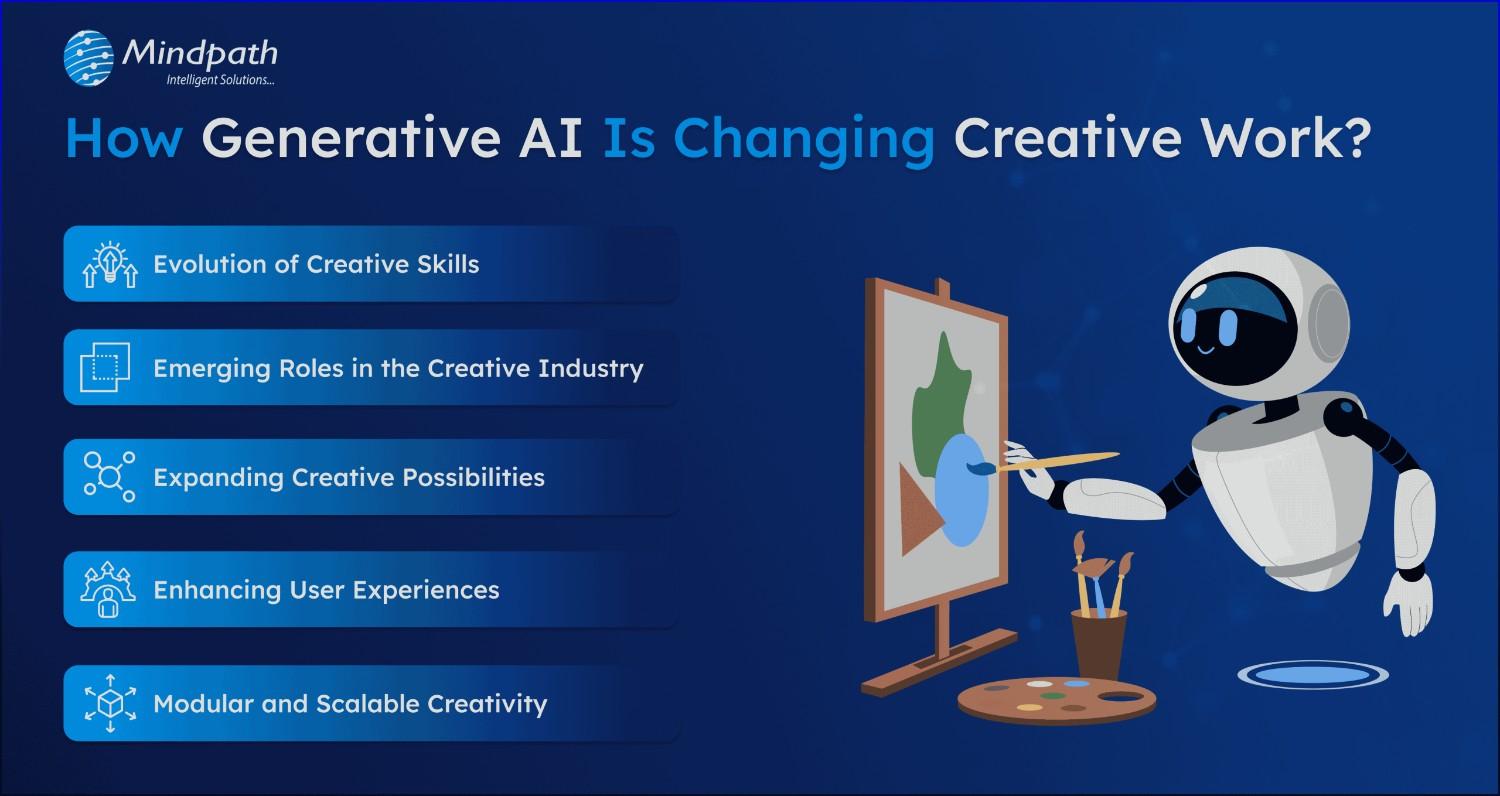
Creative work is changing in many exciting ways with the help of GenAI. It’s helping people come up with new ideas, save time, and try things that were not possible before. If you’re curious about how does generative AI affect creativity, here are the ways it’s making the creative process easier, faster, and more inspiring.

how-genAI-is-changing-creative-work-scale

1. Evolution of Creative Skills

Today’s creative professionals need more than just talent. They also need to understand how to use generative AI tools wisely and make thoughtful, responsible choices. Skills like curation help them pick and improve AI-generated ideas, while AI fluency means knowing how to use tools like ChatGPT or DALL·E. Most importantly, they must think ethically to ensure their work respects people and values.

2. Emerging Roles in the Creative Industry

As AI becomes a regular part of creative work, new types of roles are starting to appear. These jobs mix creative thinking with technical skills, showing how generative AI work in creative industry. For example, Prompt Engineers write clear instructions to help AI create content, while AI Art Directors use AI tools to design visuals quickly. There are also roles like Synthetic Media Producers and AI UX Designers who focus on virtual content and improving user experiences.

How are different industries leveraging Generative AI today? Find out in our blog on Generative AI Use Cases across Industries—from content creation to customer service and beyond.

3. Expanding Creative Possibilities

Generative AI is removing many of the limits that once held creative ideas back. Now, artists, marketers, and musicians can quickly try out new concepts without worrying about time or cost. They can test visuals, messages, sounds, and styles almost instantly. This freedom encourages bold thinking and opens the door to more creative experiments than ever before.

4. Enhancing User Experiences

Creative work is becoming more interactive and personalized, thanks to the use of generative AI. Brands and creators are now building experiences that adapt in real time, giving users a chance to take part in the creative process. From custom storylines to co-designed fashion and dynamic game worlds, AI is adding a new layer of engagement. Rather than replacing creativity, it’s helping people bring their ideas to life in exciting new ways.

5. Modular and Scalable Creativity

Generative AI is making it easier to create content in parts, or modules, that can be reused and adapted for different needs. This helps teams customize content for various platforms and audiences without starting from scratch each time. Marketing teams can turn one idea into ads, videos, or social posts quickly. Designers and writers are now building flexible templates that save time and boost creativity.

Also Read: Top GenAI Tools Shaping the Future of AI Development

Real-World Examples of GenAI Transforming Creative Industries

Generative AI is making a real difference in how creative work happens across different industries. Many companies and creators are already using it in ways that are smart, fast, and effective. Here are a few real-world examples showing its growing impact.

1. Entertainment Industry

GenAI is helping creators in entertainment and gaming bring stories and virtual worlds to life more quickly and creatively. Game developers are using AI to design characters, build game levels, and create realistic dialogue. It also supports features like deepfake voices and more dynamic non-player characters. In filmmaking, tools like Runway ML make it easier to edit videos and add visual effects in real time.

2. Writing and Publishing Industry

Writers are now using generative AI to boost both creativity and productivity. From coming up with ideas to drafting and editing, AI tools help simplify the writing process. Platforms like ChatGPT offer support when writers face blocks or need quick content suggestions. Publishers are also using AI to create short stories, newsletters, and SEO content at a larger scale.

3. Advertising and Sales Industry

Generative AI supports sales teams by helping them write personalized emails, prepare reports, and test different sales pitches more efficiently. It also assists in understanding products, markets, and risks by analyzing use cases and offering clear insights. Tools like ChatGPT and Gemini can explain complex visuals and data, making it easier to make informed decisions. Platforms like Jasper even help sales teams expand globally by translating content into multiple languages.

4. Marketing Industry

Marketing is one of the industries seeing the biggest impact from generative AI. It allows companies to personalize content at scale, create high-quality visuals and videos quickly, and manage large volumes of work in less time. Tools like ChatGPT, Jasper, and Einstein Copilot help with ad optimization, brand design, and social media content. These tools also support strategy by building customer profiles, analyzing competitors, and predicting market trends.

5. Media Industry

GenAI is helping media industries create content faster by assisting with writing, editing, and transcribing. News outlets use it for generating headlines, interview questions, and social media posts. Some broadcasters also use AI anchors and tools to automate simple news stories. While a few bold moves faced setbacks, many media groups now rely on AI to improve efficiency and scale content production.

Curious about where Generative AI is headed next? Explore the top Generative AI Trends for 2025 and stay ahead of the innovation curve.

Ready to Transform Your Creative Process with Generative AI?

Generative AI is transforming how creative professionals work by making tasks faster, smarter, and more flexible. It supports everything from writing and design to marketing and media. By understanding how generative AI work in creative industry, teams can unlock new levels of innovation, improve productivity, and explore fresh ideas without limits.

At Mindpath, we offer advanced Generative AI development services that help businesses simplify creative work and scale innovation with unexpected solutions. Whether you’re looking to generate content, design visuals, or build engaging user experiences, our expert team and tools are ready to support your goals. We work closely with you to deliver practical, AI-powered solutions that drive results. With Mindpath, your ideas turn into impact—faster, smarter, and with creative confidence.

Ready to Elevate Your Creativity? Dive into Mindpath’s generative AI solutions for faster, smarter, and more effective creative work. Contact Us

Discover how is generative AI changing creative work by boosting efficiency and making tools more accessible for all creators.
Factors to Consider while Hiring Expert ReactJS Developers in London
Hiring ReactJS developers in London necessitates careful consideration to guarantee that you select the best candidate for your project. London’s IT sector is competitive, and pricing, employment practices, and legal considerations all play an important part in decision-making. Whether you require a full-time developer, a freelancer, or an offshore team, recognizing these essential elements will help you make an educated decision. Here are some crucial considerations when hiring ReactJS developers in London: 

1. London’s Talent Market

London is home to many skilled ReactJS developers, however finding them can be difficult due to strong demand. Many firms compete for great personnel, so providing a competitive wage, perks, and career advancement possibilities is essential. Developers want positions that offer stability, learning opportunities, and a nice work atmosphere. To attract the top candidates, make your job offer stand out by offering a competitive salary, flexible work arrangements, and opportunities to advance their talents. Understanding the competitive employment market in London allows you to hire the ideal ReactJS developer for your project.  

2. Cost of Hiring in London

Hiring ReactJS developers in London might be expensive due to high demand and living costs. Before hiring, determine whether you require a full-time, contract, or freelance developer based on your budget. Full-time developers offer long-term stability yet pay greater salaries and perks. Short-term projects may be more cost-effective using freelancers or contract developers. Outsourcing to offshore teams can also save money while maintaining quality. Understanding your financial constraints and project requirements will enable you to make the best hiring option without overpaying.  

3. Work Model: Remote vs. On-site

Before recruiting, determine if you require remote or on-site ReactJS developers. On-site developers work from your office, facilitating communication and collaboration. They’re great for initiatives that require tight collaboration. Remote developers, on the other hand, provide greater flexibility and cost savings, particularly when recruiting from worldwide talent pools. However, managing remote teams needs effective collaboration tools and clear communication. Choose the appropriate model for your project’s complexity, budget, and working style.  

4. Legal and Contractual Factors

When recruiting ReactJS developers in London, you must adhere to UK employment rules concerning contracts, taxes, and work permits (for non-UK developers). Hiring full-time staff necessitates legal agreements that address wages, working hours, and benefits. If you use freelancers or contractors, ensure sure their contracts explicitly state the project scope and payment conditions. Non-UK developers need work permits or visas, therefore follow immigration restrictions. Following legal criteria helps to prevent disagreements and assures a smooth recruiting procedure.  

Mindpath offers expert ReactJS development services in London, helping businesses build high-quality applications with skilled developers. Whether you need a full-time, freelance, or offshore ReactJS expert, we ensure a smooth hiring process tailored to your needs.   Get in touch with us today! today to find the right ReactJS developer for your project.
Next, explore what skills to look for while hiring a ReactJS developer in London to ensure you hire the best talent for your development needs.
How much does hiring a ReactJS developer cost? Learn about factors affecting rates, and how to find the best talent within your budget.