Enhancing Education with AI: Use Cases and Key Benefits

Join our Newsletter!

Featured Posts

Support Is One Click Away

Home

Enhancing Education with AI: Use Cases and Key Benefits

AI in Education

Enhancing Education with AI: Use Cases and Key Benefits

Have you ever wondered about how AI is revolutionizing education? How can AI make lessons more personalized for each student? What can be the benefits of implementing AI in education? If you are intrigued by these questions, you have arrived at the right place. In this blog, we are going to explore the key benefits as well as the use cases of AI in education.   The education system has changed from the traditional classroom setup. We are no longer limited to a physical room full of books and a blackboard to learn. Nowadays, education is easily accessible and flexible, with personalization at the tip of our fingers as AI is changing the education sector by offering tailored, adaptive learning experiences. It is making learning inclusive, supporting teachers in their tasks, and personalizing learning for everyone. This technology is going to turn conventional models of education and offer more personalized support to students in accordance with their needs, learning styles, and abilities.   Let us dive deep to explore the key benefits as well as the use cases of Artificial Intelligence in education! 

Benefits of AI in Education

1. Customized Learning

The greatest advantage of AI in education is that it offers personalized learning. With AI, learning becomes much more likely to be tailored to each student’s needs. If one student is weak in reading, AI can provide extra support by way of practice and activities. At the same time, another student who excels in reading can be given more challenging materials to engage their interest. This way, each student is presented with material that suits their levels best, making their work more effective and enjoyable. 

2. Expanded Accessibility and Inclusion

AI is overcoming distance and physical limitations in education. Students in remote places or with physical constraints may now access high-quality educational resources using AI-powered solutions such as virtual instructors, interactive course materials, and language translation services. This technology contributes to a more inclusive educational environment in which all students, regardless of location, have equal opportunities to learn and develop. 

3. Adaptive Assessments and Feedback

AI improves evaluations by employing exams, assignments, and even analyzing pupils’ facial expressions or posture to measure their development. This enables rapid feedback, indicating exactly where a learner requires further assistance and giving resources that will help them understand. This strategy not only improves academic achievement, but it also promotes students’ general well-being and trust regarding their learning journey. 

4. Streamlined Administrative Tasks

AI is excellent at both creating personalized teaching and performing administrative work. It can handle student information, organize lessons, and grade multiple-choice tests. This automation allows teachers to devote more time to what is most important: crafting interesting classes, developing strong connections with students, and providing useful feedback. 

5. Enhanced Student Engagement

AI is altering student engagement by offering fascinating new ways to study. Gamification, interactive simulations, and personalized learning plans provide students with dynamic educational experiences. Tools such as interactive classrooms and immersive platforms make learning more fun, allowing students to engage with one another and enthusiastically explore new topics. 

Use-cases of AI in Education

1. Advanced Tutoring Systems

Tutoring programs driven by AI provide pupils individualized support. As students work in classes, AI examines their responses, identifies areas where they may be suffering, and provides personalized explanations to make things simpler. This manner, the learning tempo is tailored to each student’s needs. These systems improve students’ understanding of difficult topics by providing rapid support and a learning style that is tailored to each learner. The continual contact with AI improves learning outcomes and raises students’ confidence and performance. 

2. Automated Grading and Evaluation

Grading is made easier by artificial intelligence, which evaluates student work rapidly and uniformly. This minimizes instructors’ burden, allowing them to focus on providing personalized help. By detecting patterns in pupil performance, AI can identify individuals who require further support and direct focused assistance. Additionally, AI delivers quick feedback, which improves the learning process. Automated grading and assessment improve teaching quality, assure fair assessments, and foster interaction among students and teachers. 

3. AI-Powered Chatbots and Assistants

AI-powered chatbots and virtual assistants play an important role in improving students’ educational experiences. They offer immediate assistance by walking students through assignments, answering problems, and providing comments. These resources are available 24 hours a day, seven days a week, and satisfy the demands of students at any time. Their personalized guidance promotes autonomous learning and helps students actively participate in their studies, hence enhancing academic progress and achievement. 

4. Educational Entertainment and Gamification

Edutainment and gamification make learning more enjoyable and engaging by incorporating artificial intelligence. By developing instructional games and simulations, AI transforms standard teachings into interactive experiences. Including game aspects such as prizes and competitiveness keeps students interested and engaged in their study. These gamified technologies not only capture students’ interest, but they also help them grasp and recall complicated concepts better. AI-driven edutainment and gamification mix education and entertainment to create a dynamic learning environment with thrilling gaming and interactive challenges. 

5. Interactive and Educational Games

Artificial intelligence improves interactive and educational games by providing interesting learning experiences. These games integrate AI algorithms, natural language processing, and machine learning to create interesting tales, react to player activities, and provide personalized insights. This technique encourages students to become more interested, creative, and deliberate in their learning. AI-powered learning systems use challenges, simulations, and virtual worlds to encourage active learning, improve problem-solving abilities, and foster collaboration among students. 

6. Smart Curriculum Planning

AI helps with creating curriculum by analyzing educational data to identify patterns or weaknesses in student learning. It can propose curriculum modifications and revisions based on current research and new standards of learning. AI may also assist in matching curricula with specific goals for learning, keeping the information relevant and up to date. This enhances curriculum design efficiency, allowing educators to make informed decisions and make better use of resources, ultimately improving educational quality and relevance. 

Mindpath’s AI Development Services for Education

AI development services at Mindpath are changing the face of learning in educational institutions with advanced technology. We utilize sophisticated algorithms and machine learning techniques in providing smart solutions for enhancing learning and process streamlining in education.  Our Predictive Analytics service examines educational data to forecast trends, identify learning gaps, and provide actionable insights, helping educators and institutions make better decisions. We apply machine learning to enable personalized, dynamic learning processes attuned to the needs of each student, increasing engagement and performance.  We have data-driven insights that provide detailed analysis and support for curriculum planning, progress monitoring of students, and optimal structuring of teaching strategies. Our automation solutions will make administrative tasks related to grading and scheduling easier, freeing educators to teach and engage with students more. 

Wrapping-Up

AI is revolutionizing the learning process with in-depth, personalized, and truly innovative experiences. From personalized lesson plans and adaptive feedback—reducing administrative burden—to interactive educational games, AI finds ways to make the learning process more efficient and accessible. These developments do not clearly indicate how students will learn better but arm educators with more focused support and lively classrooms. 

Mindpath is on the cutting edge of this revolution in education. Our AI development services enable powerful new levels of personalization in learning, the automation of administrative tasks, and insight-driven solutions. We empower institutions of education to make use of AI for better learning outcomes, teaching strategies, and, in fact, the educational environment. 

Curious how AI can revolutionize your classroom?

Explore Mindpath’s cutting-edge AI solutions and transform your educational experience today.
Related Post

Learn how to hire the ideal freelance WordPress developer with our guide. From defining needs to securing the right talent, ensure a high-performance website.

Related Post

Ultimate Guide to Hiring Expert Node.js Developers for High-Performance Applications

As the demand for fast, scalable, and efficient web applications continues to grow, businesses are increasingly turning to Node.js. Known for its speed and ability to handle a large number of concurrent connections, Node.js has become a go-to technology for building everything from real-time chat applications to large-scale enterprise platforms.

But choosing the right NodeJS developer can be a challenge. With the vast pool of developers available, how can you ensure that the candidate you hire will help you achieve your project goals? In this guide, we’ll explore why hiring expert Node.js developers are crucial for your project, the factors to consider when hiring, the skills to look for, the cost of hiring, and much more. By the end of this guide, you will be well-equipped to make an informed decision and hire a developer who can take your application to the next level.

Why Hire Node.js Developers?

Before we dive into the hiring process, it’s important to understand why Node.js is an excellent choice for modern web applications. Node.js is a powerful, event-driven JavaScript runtime built on Chrome’s V8 JavaScript engine. It is ideal for building fast and scalable network applications and is used by major companies like Netflix, Uber, and LinkedIn. To leverage its full potential, businesses should hire expert Node.js developers for high-performance apps, ensuring efficient development, seamless scalability, and top-tier application performance.

Here’s why you should consider hiring a Node.js developer for your project:

1. Speed and Performance

Node.js is known for its remarkable speed. Unlike traditional web servers, which use a multi-threaded model to handle requests, Node.js uses a single-threaded, non-blocking event loop that can handle thousands of requests simultaneously. This makes it an ideal solution for applications that require real-time data processing, such as instant messaging systems, live updates, and collaborative applications. An experienced Node.js developer knows how to leverage the event-driven nature of Node.js to build applications that can handle significant amounts of traffic without compromising on performance. Whether you’re building a real-time chat application or a live-streaming platform, hiring the right developer ensures your application runs smoothly and efficiently.

2. Scalability

Node.js’s non-blocking I/O model allows applications to scale more easily. As your user base grows, your application needs to be able to handle more requests without slowing down. Node.js is particularly well-suited for building scalable applications due to its asynchronous nature, which allows it to process multiple requests in parallel, resulting in faster response times. Hiring an expert Node.js developer will ensure that your application is built with scalability in mind. Whether you’re building a small-scale application or an enterprise-level platform, scalability should be a priority from the start, and a skilled developer will know how to design your system to scale as your needs grow.

3. Real-Time Applications

Node.js is the go-to technology for real-time applications, such as chat systems, collaborative tools, and live content updates. Its event-driven architecture makes it perfect for applications that require low-latency communication between the client and the server. For instance, chat apps, live scoreboards, and real-time collaboration platforms all rely on Node.js’s ability to process large volumes of data quickly. By hiring a Node.js developer who understands the intricacies of real-time applications, you can ensure that your users will experience seamless, uninterrupted interaction, even under high traffic conditions.

4. Cross-Platform Development

Node.js is highly compatible across different operating systems, including Windows, macOS, and Linux. Its cross-platform capabilities make it easier for developers to create applications that work seamlessly across different devices and environments. If your application needs to be deployed on multiple platforms, hiring a Node.js developer with cross-platform expertise will save you time and money, as you won’t need to develop separate versions for each operating system. In addition, Node.js’s ability to integrate with various platforms and services gives it an edge over other technologies. Whether you’re integrating third-party APIs, working with cloud platforms, or connecting to databases, a skilled Node.js developer can ensure that your application is compatible with all of your chosen tools.

5. Faster Development with JavaScript

Node.js allows developers to write both server-side and client-side code in JavaScript, which streamlines the development process. This reduces the need for switching between multiple languages, making the overall development faster and more efficient. JavaScript is one of the most widely used programming languages, and most developers are already familiar with it, which makes finding a qualified Node.js developer easier. By hiring a Node.js developer who is proficient in both JavaScript and Node.js, you can accelerate your development timeline and reduce costs associated with language barriers and training.

Factors to Consider When Hiring a Node.js Developer

Now that you know why Node.js is such a powerful technology, it’s time to focus on how to hire the right developer. To ensure you find the best candidate for your project, it’s essential to evaluate key factors to consider while hiring Node.js developers. By assessing the following factors, you can hire a skilled developer who meets your project requirements and delivers high-performance results.

1. Experience with Node.js

A strong understanding of Node.js’s core features is essential for any developer. Look for candidates with experience working on real-time applications, RESTful APIs, and server-side rendering with Node.js. They should also be familiar with Node.js frameworks like Express.js, Koa.js, or Nest.js, as these tools can significantly speed up development.
When reviewing a developer’s experience, consider the types of projects they’ve worked on in the past. Have they built applications similar to yours? Do they have experience handling high traffic volumes or integrating third-party services? The more relevant experience they have, the better they will be at tackling the challenges your project presents.

2. Knowledge of Asynchronous Programming

Node.js is built on an event-driven architecture, meaning it uses asynchronous programming to handle multiple requests simultaneously. A skilled Node.js developer should have a deep understanding of callbacks, promises, and async/await syntax. When evaluating candidates, ask about their experience with asynchronous programming and how they’ve handled concurrency issues in the past. Their ability to manage asynchronous processes will directly impact the performance and reliability of your application.

3. Familiarity with Front-End Technologies

Although Node.js is primarily used for back-end development, many Node.js developers also have experience with front-end technologies like HTML, CSS, and JavaScript frameworks such as React, Angular, or Vue.js. Hiring a full-stack developer with expertise in both front-end and back-end technologies can simplify your project, as you won’t need to hire separate developers for each part of the application. In addition, developers who understand the client-side aspect of the application can ensure better integration between the front-end and back-end, resulting in a smoother user experience.

4. Understanding of Databases

Node.js is often used in conjunction with databases, and your developer should have experience with both relational and non-relational databases. Familiarity with SQL databases like PostgreSQL and MySQL, as well as NoSQL databases like MongoDB, is essential for building robust applications that require data storage. Moreover, knowledge of ORMs (Object Relational Mappers) like Sequelize or Mongoose will help the developer interact with databases more efficiently. A skilled Node.js developer should be comfortable writing efficient queries, handling data models, and optimizing database performance.

5. Problem-Solving and Debugging Skills

Node.js development often involves tackling complex issues, such as managing concurrency, optimizing performance, and debugging application errors. A good Node.js developer should be adept at identifying problems and finding efficient solutions. Ask candidates about their approach to debugging and performance optimization. Do they use tools like the Chrome Developer Tools, Node.js Debugger, or New Relic to troubleshoot issues? Can they identify performance bottlenecks and improve the application’s responsiveness?

6. Security Best Practices

Security is a critical consideration for any web application. Node.js developers should be aware of common security threats such as SQL injection, cross-site scripting (XSS), and cross-site request forgery (CSRF), and they should know how to protect the application from these risks. Look for developers who are familiar with security best practices and tools, such as HTTPS, data encryption, and input validation. A security-conscious developer will help safeguard your application and user data from malicious attacks.

7. Communication Skills

Effective communication is essential in a development team. A good Node.js developer should be able to clearly explain complex technical concepts to non-technical stakeholders, as well as collaborate effectively with other team members. Whether working with designers, product managers, or other developers, the ability to communicate well will help ensure the success of your project.

Node.js Developer Hiring Costs

The cost of hiring a Node.js developer can vary significantly depending on several factors, such as experience level, project complexity, and location. Let’s break down the cost considerations:

1. Experience Level

Junior Developers: Entry-level Node.js developers typically charge lower rates, but they may need more supervision and training. They are suitable for smaller projects or tasks that require minimal expertise.

Mid-Level Developers: Mid-level developers with a few years of experience can handle more complex tasks and can deliver faster results without much guidance. Their rates tend to be more affordable than senior developers while still providing a good level of expertise.

Senior Developers: Senior Node.js developers are highly skilled and have extensive experience in building scalable, high-performance applications. They are often required for large, complex projects, and their hourly rates can be significantly higher. However, their expertise is invaluable in ensuring that your project is executed flawlessly.

2. Project Complexity

The complexity of your project will also affect the cost of hiring a Node.js developer. Simple applications with minimal functionality will cost less to develop, while larger applications with advanced features (e.g., real-time chat, video streaming, or large-scale e-commerce platforms) will require more resources and time.

3. Location

The location of your Node.js developer can significantly impact the cost. Developers in countries with lower living costs may offer lower hourly rates, but they may also be less expensive overall. On the other hand, developers in countries like the US, UK, or Canada may charge higher rates due to higher living expenses, but they may also offer a higher level of service and expertise. You can decide whether you prefer a local developer or if you’re open to hiring remote talent. Remote developers can offer cost savings and access to a broader talent pool.

5 Major Skills to Look for in a Node.js Developer

When hiring a Node.js developer, it’s important to focus on the core skills that ensure the developer can effectively handle the complexities of modern applications. Here are the top 5 essential skills that every Node.js developer should have:

1. Proficiency in JavaScript (ES6+)

Node.js is built on JavaScript, making it essential for developers to have a strong command of the language. A solid understanding of JavaScript (including ES6+ features such as arrow functions, async/await, destructuring, and modules) is crucial for writing clean, efficient, and maintainable code. Node.js developers should be comfortable with both synchronous and asynchronous programming patterns, as Node.js is heavily reliant on non-blocking I/O. Understanding JavaScript allows developers to harness the full power of Node.js, building scalable applications that can handle large volumes of traffic efficiently.

2. Experience with Asynchronous Programming

Asynchronous programming is at the core of Node.js. Since Node.js uses a single-threaded event loop, it’s designed to handle many operations simultaneously without blocking the main thread. This is achieved through asynchronous programming using callbacks, promises, and async/await. A Node.js developer must be proficient in these asynchronous patterns to build applications that can handle multiple requests concurrently without running into performance issues. Mismanagement of asynchronous code can lead to performance bottlenecks, so a good understanding of this concept is essential.

3. Strong Knowledge of Express.js

Express.js is one of the most widely used frameworks for building web applications with Node.js. It simplifies routing, middleware handling, and HTTP request/response management, enabling developers to create APIs and web apps efficiently. A skilled Node.js developer should be proficient in Express.js, as it helps streamline application development. They should be able to set up routes, manage middleware, and handle HTTP requests effectively. Express.js is particularly useful for building RESTful APIs, a common requirement for many modern applications.

4. Experience with Databases (SQL and NoSQL)

Handling data is a critical aspect of Node.js development, and a good developer must know how to interact with both SQL (relational) and NoSQL (non-relational) databases.

SQL: Familiarity with relational databases like MySQL or PostgreSQL is essential for managing structured data with complex relationships.

NoSQL: Developers should also be familiar with NoSQL databases like MongoDB, which are ideal for handling unstructured or semi-structured data.

A well-rounded Node.js developer should be able to design efficient database schemas, write queries, and understand data modeling techniques for both types of databases.

5. Security Best Practices

Security is one of the most critical aspects of building robust applications, and Node.js developers should be well-versed in implementing security best practices.

Authentication: Knowledge of user authentication methods such as JWT (JSON Web Tokens), OAuth, or Passport.js is vital to ensure users can safely log in and interact with the application.

Data Protection: Developers should know how to protect sensitive data through encryption, both in transit (using HTTPS) and at rest.

Vulnerability Management: Awareness of common web security vulnerabilities like SQL injection, cross-site scripting (XSS), and cross-site request forgery (CSRF) is crucial.

Wrapping Note!

Hiring the right Node.js developer is crucial to the success of your web application. By considering factors like experience, skills, cost, and the complexity of your project, you can find a developer who will help you build a high-performance, scalable application that meets your business goals.

Node.js is an excellent choice for building real-time, scalable applications, and a skilled Node.js developer can leverage its strengths to create a solution that meets your specific needs. Whether you’re building a chat app, an e-commerce platform, or a collaborative tool, hiring an expert Node.js developer ensures that your application will be fast, scalable, and secure.

If you’re looking for experienced Node.js developers who can bring your vision to life, consider partnering with Mindpath. Our team of skilled developers has extensive experience in building high-performance applications using Node.js, and we’re ready to help you take your project to the next level.

Ready out today to discuss your project needs and get started on building your perfect Node.js application!

Learn how to hire expert NodeJS developers to build high-performance apps. Discover essential skills, factors, and costs with Mindpath’s guide.
custom wordpress development

In the rapidly changing digital age, your website is more than just a digital face or a virtual business card. It creates a foundation to support your brand identity, marketing strategy, and customer experience. With more than 43% of websites powered by WordPress (source: w3techs), it is clear that WordPress is an excellent choice for website development. There are different pre-built WordPress themes that provide you with an affordable and easy way to bring your business online. However, they may not be able to meet the unique requirements of your growing business. This is where a custom WordPress development comes in.

Whether you are a local business, an enterprise, or a startup, a custom-built website can unlock performance, long-term growth, and brand credibility. In this guide, you will learn more about custom WordPress development and understand why it is crucial for your business. Besides, we will also discuss the best practices and how to choose the right custom WordPress development company to enjoy the desired results.

Want to elevate your online presence with a custom WordPress site tailored to your business objectives? Mindpath’s offers wordpress developemnt services that help you in creating a unique digital website that sets you apart from your competitors.

Custom WordPress Development- An Introduction

In simple words, custom WordPress development involves creating a website from scratch, tailored to your unique requirements. Instead of using pre-made themes or inefficient plugins, a professional WordPress developer utilizes tailored themes, functionalities, and plugins that align with your business goals. It gives you complete control over all aspects of your website, including performance, security, scalability, and design. Custom development can be an excellent solution for organizations looking for:

1. Advanced functionality

2. Unique custom WordPress website design and branding

3. Optimized SEO and performance

4. Hassle-free third-party integration

5. Robust security and long-term scalability

Custom WordPress development services can transform your generic site into a strategic digital asset to drive growth.

Now that you understand what it is, let’s understand the limitations of using a standard WordPress theme and the benefits you will witness by opting for custom development.

The Need for Custom WordPress Development

Pre-built themes are easy to use, and you can use them with minimal technical knowledge. However, they come with various drawbacks that can greatly affect your site’s potential.

1. Bloated Code

WordPress’s theme store has a lot of themes with a large number of unnecessary plugins and features. Such features and code can reduce your website’s performance, affecting ranking and user experience.

2. Security Issues

If the themes are not updated regularly by the developer, it can become a major security risk, damaging your business’s credibility.

3. Generic Design

You can find a pre-made theme being used by thousands of websites. Using them, it will be challenging for your site to stand out. Such themes lack uniqueness and may not meet your brand’s needs.

4. Lack of Functionality

Such themes offer limited functionalities and features. You will have to use additional plugins to add more features, and this can cause compatibility issues and reduced speed.

Key Benefits of Custom WordPress Development

Generic themes may help you get your brand online, but as mentioned above, you will have to compromise on a lot of things. By opting for custom development services, you can create a tailor-made digital asset. Here are some major benefits of custom WordPress development.

1. Tailored Design

Your website should have elements to reflect your brand’s unique tone, personality, and value. Custom development lets you create a custom WordPress website design and a unique user interface based on your target audience. Developers can integrate creative layouts to boost user interaction. Besides, you can customize various website elements, from color schemes and typography to animation and layouts, to make your website stand out.

2. Enhanced Security

Custom WordPress websites allow you to add and configure advanced security mechanisms. This way, you can ensure data confidentiality, integrity, as well as availability. You can implement security measures like SSL certificates, custom security plugins, two-factor user authentication, data validation, and more.

3. Optimized Website Performance

Custom WordPress sites are faster as they don’t have unnecessary plugins and bloated code. As your site will load faster, you will witness improvements in bounce rates, SEO rankings, and user experience. Besides, developers can use techniques such as caching, lazy loading, CDN integration, and image compression to reduce load time.

4. Scalability

As your business expands, your website should grow with it. Custom WordPress websites are developed with future scalability in mind. It allows you to add new pages, new features, additional external tools such as payment gateways, CRM tools, and more. Custom WordPress development will make it easier to adjust your site for increasing traffic without facing any performance issues.

5. Optimized SEO Aspects

Custom websites have structured data, optimized speed, and clean code, which are crucial for better search engine visibility. Developers can use custom metadata, URL structure, and advanced schema markup to boost organic traffic.

6. Hassle-Free Third-Party Integrations

Do you want to connect your website with useful tools like Salesforce, Mailchimp, HubSpot, etc.? Well, custom website developers ensure seamless API integrations designed for your workflow. This will improve data flow as well as automation across multiple platforms.

7. Content Management Flexibility

With a custom site, users will enjoy flexible backend interfaces. As a result, non-technical users can easily manage content. Developers can create custom fields, taxonomies, and post types, simplifying content updates and publishing.

Major Components of Custom WordPress Development

A custom WordPress design and development may include multiple components based on your business goals. However, some core components are:

1. Custom Website Development

It involves creating a fully functional website with custom design, structure, functionalities, and features. It also includes performance optimization, layout design, navigation configuration, etc.

2. Custom Theme Development

Developers create unique themes that meet your brand identity. It includes creating responsive themes that can offer a seamless user experience.

3. Backend Customization

It covers customization of the admin panel to make it easy to use for users. Developers may add user roles, dashboards, custom taxonomies, and post types while prioritizing the site’s security.

4. Plugin Development

Developing custom plugins for your WordPress site that can help increase functionality without affecting performance. Experts focus on creating scalable and secure plugins based on your unique needs.

5. Migration Services

It includes offering migration services for hassle-free data transfer with minimal downtime.

6. API Integration

This process involves connecting your site with third-party platforms, marketing tools, CRMs, or payment gateways.

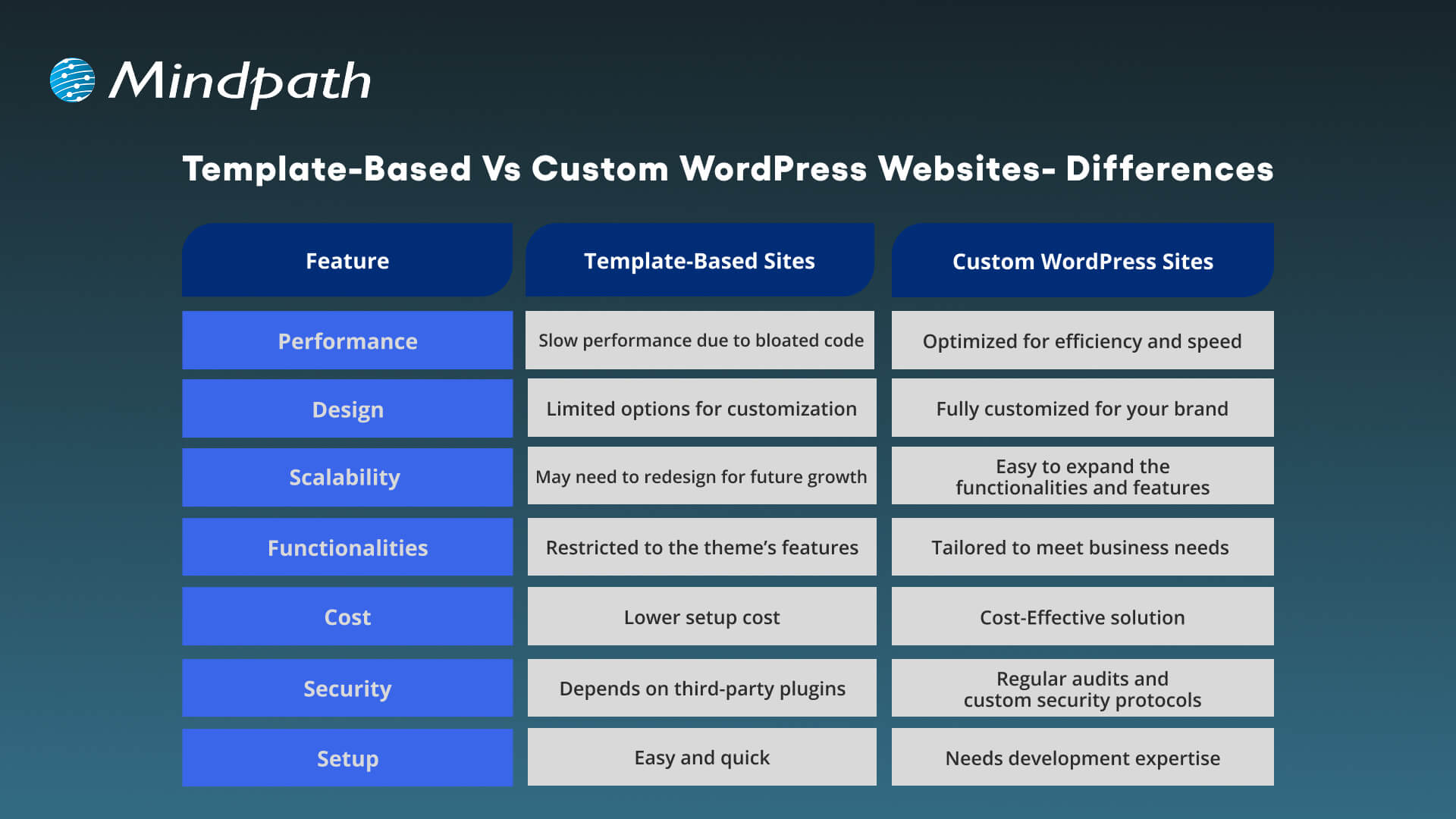
Template-Based Vs Custom WordPress Websites – Differences

Choosing between a custom WordPress site and a template-based site can greatly impact scalability, flexibility, as well as cost. Understanding the differences will help you make the right decision.

Template-Based Vs Custom WordPress Websites

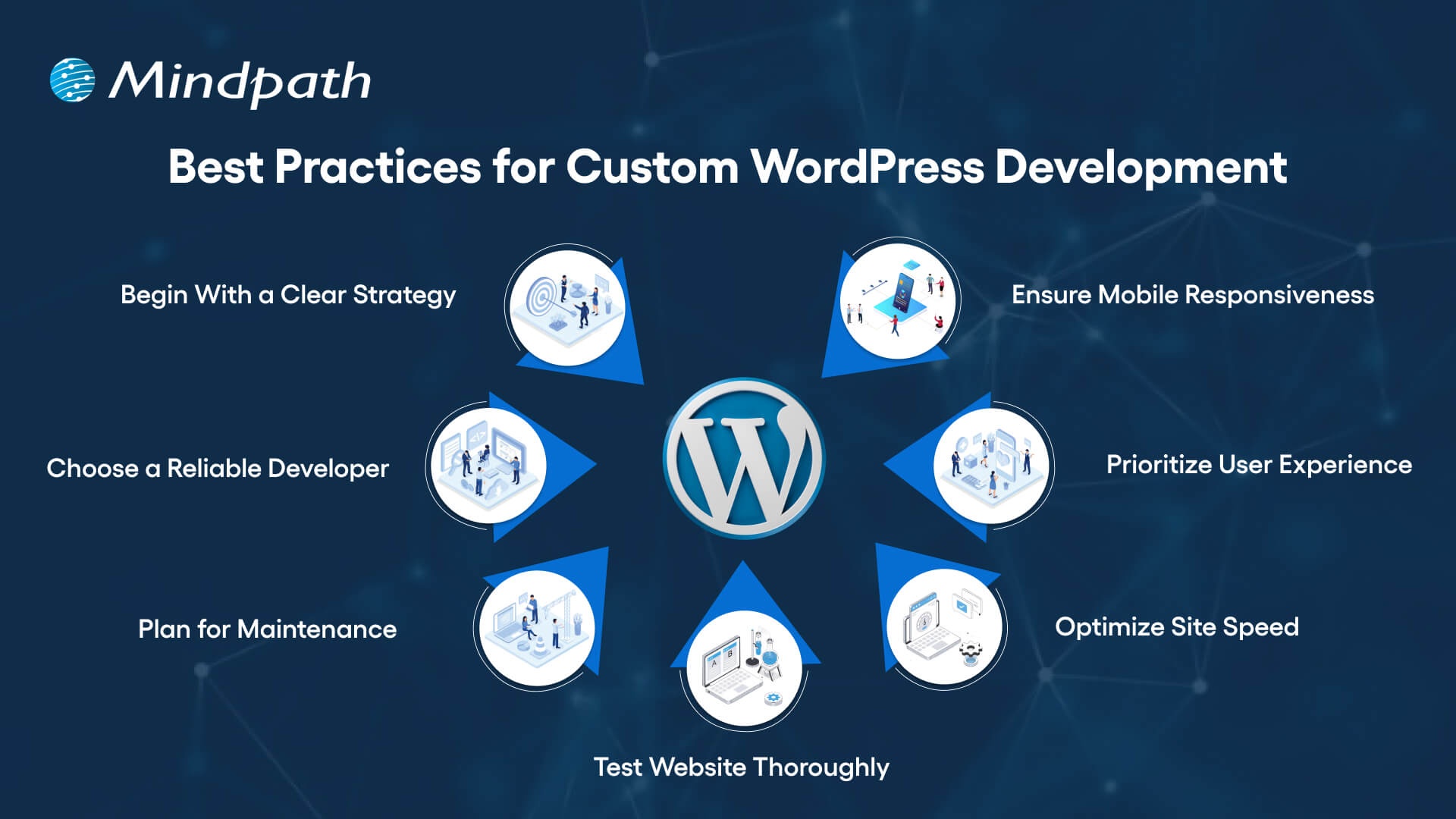
Best Practices for Custom WordPress Development

To make sure your new custom WordPress development project offers desired results, it is advisable to follow these best practices:

Best Practices for Custom WordPress Development

1. Begin With a Clear Development Strategy

Whether you need WordPress development for a small business or a large organization, you should first understand your target audience, desired functionalities, and goals. A well-documented strategy can help prevent scope creep, and you can ensure a perfect alignment between developers and stakeholders.

2. Focus on Mobile Responsiveness

With people increasingly using mobile phones and tablets for browsing, you should ensure that your website is responsive across all browsers and screen sizes. Custom WordPress development involves the use of a mobile-first design, which can boost SEO and usability.

3. Prioritize User Experience

Even though you have a beautiful website, it will be useless if users face issues while using it. An experienced developer will focus on a smooth user experience, making it easier for visitors to locate the things they need.

4. Optimize Your Site for Maximum Speed

Utilize techniques such as caching, image compression, CDN, and lazy loading to make sure your site loads faster. Tools such as Lighthouse, GTmetrix, Pingdom, and SEO Site Checkup can be used to detect bottlenecks.

5. Test Your Website Thoroughly

Before you make your site live, make sure that it has gone through proper testing. It helps identify compatible issues, loopholes, and missing functionalities. Prefer to carry out device testing, usability testing, and cross-browsing testing. Refine UX and optimize elements based on user feedback.

6. Plan For Smooth Maintenance

A custom WordPress site needs regular security checks, backups, and updates. So, create a proper maintenance plan or work with a professional WordPress developer to ensure constant support. Ongoing maintenance is crucial to keep your site functional and secure.

7. Partner With a Reliable Developer

Work with an experienced and trustworthy development company with a proven track record of offering quality WordPress website development services and creating high-performance websites. While helping you with technical execution, they can offer strategic input.

Tips to Choose The Right WordPress Development Company

Choosing the right expert for custom WordPress development is crucial to ensure success. While looking for the best one, prefer to consider the following points:

1. Evaluate The Experience

Ensure that the developer has years of experience in WordPress, especially in custom development. Go through their portfolio and check if they have ever created similar websites that you want to create. They should have a deep knowledge of the best practices and core functionalities of WordPress.

2. Technical Expertise

Confirm that the service provider has proficiency in JavaScript, CSS, MySQL, HTML, PHP, plugins, and more. Choose one with strong technical skills for the desired results.

3. Check Their Process:

Ask the company who they plan, carry out, and test the development projects. Ensure that they can offer a comprehensive custom development service based on your requirements.

4. Transparency and Communication

Only a trusted partner can keep you informed through the WordPress development project and will remain transparent about the costs and timelines. Choose one who prioritizes clear reporting and reacts to your queries promptly.

5. SEO Knowledge

The custom WordPress development expert should have a proper understanding of the latest SEO trends and be able to deploy necessary on-page optimization from the beginning. Furthermore, they should know how to configure different SEO plugins.

6. Post-Launch Support

Without regular updates and maintenance, your site will become vulnerable to various issues. So, partner with a development company that offers additional support along with maintenance services to keep your site performing at its best.

This is how you can hire an expert for professional WordPress web development to get your website listed higher in SERPs.

Looking to Elevate Your Business with Custom WordPress Development?

Undoubtedly, WordPress offers organizations the flexibility, affordability, and speed they need to start. Custom WordPress development is more than just writing code and creating a website. It is a strategic process to craft a unique digital experience that can effectively support your organizational goals, reflect your brand, and scale with you. It provides you with robust security, future scalability, and innovations that you will not get with template-based solutions.

If you want to elevate your business’s online presence and are looking for a future-proof platform, you can always count on Mindpath’s WordPress development service. As a leading WordPress development company, we combine custom development with scalable architecture and creative design to bring your unique vision to life. At Mindpath, we understand that every business needs uniqueness when it comes to developing a website. That’s why we offer tailored solutions that can set you apart from your competitors. We specialize in CMS development, custom plugin development, theme development, and more. Create a solid presence in this evolving digital landscape with us!

full stack development trends

The full-stack development landscape is changing rapidly, and 2025 is already showing great possibilities for new ideas and better tools. Getting familiar with the newest full-stack development trends can help developers, startups, and businesses create smarter solutions. User needs are increasing, along with the requirement for flexible and efficient development solutions, which means teams are taking a fresh look at how they build, test, and scale applications. Knowing how to navigate these changes can have a significant impact next time whenever you develop a new item or launch a new product.

With speed, scalability, and seamless user experience as the new focus, developers are integrating advanced front-end technologies with back-end solutions to develop modern digital products. With cloud platforms available everywhere and low-code solutions evolving more rapidly, full-stack development is moving to a whole new level.  These solutions are transforming processes that not only save time but also improve quality and naturally foster greater teamwork. In this blog, we will provide further insight into the most important trends shaping full-stack development in 2025.

Looking to implement the advantages of full-stack development in your next project? Take a look at our full-stack development services, where our team will support and guide you to bring those benefits to the real world.

Understanding Full-Stack Development

Full-stack development refers to building both the front-end and back-end of a software application. Let’s dive in to understand! Every application has two main sections. The front-end is what users see and interact with, like buttons, images, and forms. The backend encompasses all the activities that take place in the background – saving data, running logic, interacting with other systems, etc.

Each side requires different skill sets and tool sets. Full-stack development combines both sides into one process. Full-stack development enables developers to create complete applications and allows us to develop the application seamlessly from the user interface through the server and database. This means that the application includes both of those components as one shared system, which makes development more efficient and organized.

Some advantages of full-stack development include:

  1. A full-stack developer saves money by doing both front-end and back-end work, minimizing the need for multiple specialists.
  2. They speed-up the development process by working across the entire tech stack, ensuring faster delivery and smooth collaboration.
  3. With strong knowledge of current tools and trends, they support modern full-stack development by integrating advanced features like AI and responsive design.
  4. Full-stack developers take full ownership of the codebase, simplifying responsibility and streamlining debugging.
  5. They deliver well-rounded, quality solutions by working across the UI, backend logic and business processes, database activities and data expansion, and testing.
  6. They even provide ongoing support and maintenance, which ensures long-term stability, security, and enhancement.

Read in detail: Full-stack development benefits.

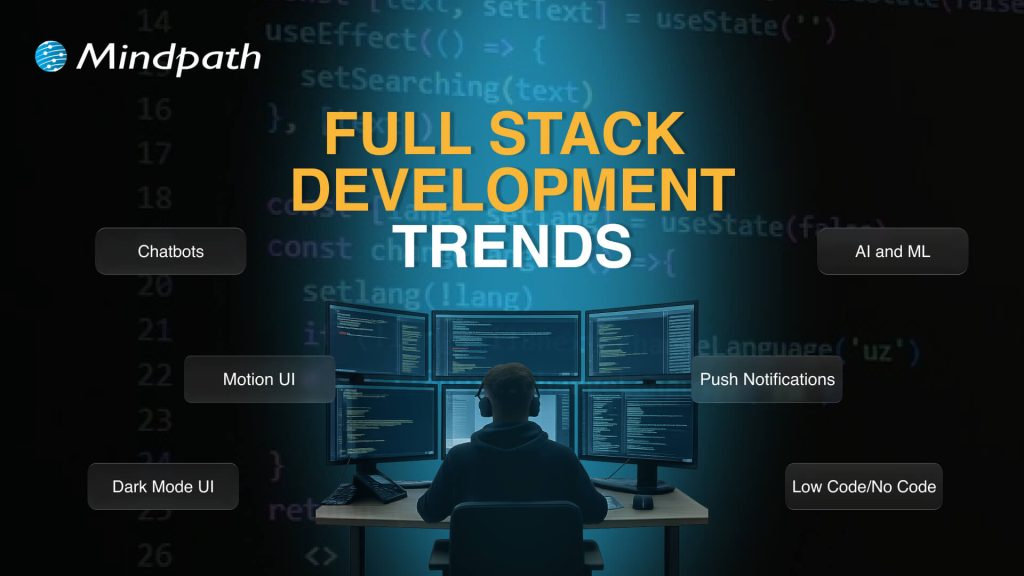
Full-Stack Development Trends 2025

As technology continues to grow, developers are embracing smarter tools and faster methods to build complete applications. The emerging trends in full-stack development are shaping how teams work, improve performance, and deliver better user experiences in 2025. Here are the top trends to watch:

Full-Stack Development Trends 2025

1. Artificial Intelligence

Artificial Intelligence is one of the key full-stack development trends shaping how modern applications are built. It helps solve complex problems faster and allows systems to work without human interruption. Full-stack developers are well-suited for AI roles because they understand both design and logic, making it easier to build intelligent solutions. As the future of full-stack development evolves, AI will play a major role in improving performance and user experience.

2. Cloud Computing

Cloud computing is a fast-growing technology that allows access to data storage, processing power, and other resources over the internet. It supports the future tech stack for developers by offering flexibility, easy scaling, and pay-as-you-go pricing. Full-stack cloud developers are in demand to build and manage cloud-based applications that support collaboration and performance. To grow in this area, developers should understand cloud computing trends as well as IaaS, PaaS, SaaS and gain hands-on experience with platforms like AWS, Azure, and Google Cloud.

3. DevOps

DevOps is a practice that combines development and operations to improve how software is built, tested, and deployed. It helps teams work better together and use tools like continuous integration and delivery to release updates faster. DevOps plays an important role in improving application speed, quality, and reliability. As part of full-stack development trends, it supports the demand for efficient workflows and strong collaboration in building modern applications.

4. Progressive Web Apps

Progressive Web Apps (PWAs) are web applications that offer an app-like experience using modern browser features. They work offline, load quickly, send push notifications, and can be installed on devices without using much storage. As part of web development trends 2025, PWAs help businesses reach more users, especially on mobile, while keeping development simple and cost-effective. Their flexibility and performance make them a smart choice for companies looking to improve user experience.

5. Blockchain

Blockchain is a secure and transparent technology that stores data across a network of computers, making it difficult to change or hack. It is widely used in industries like finance and healthcare to protect transactions and manage decentralized systems. As part of full-stack development trends and the latest trends in web development, blockchain allows developers to build safer and more reliable applications. To work in this area, full-stack developers need skills in decentralized tools, enterprise systems, and Web3 architecture.

6. Cybersecurity

Cybersecurity is the practice of protecting systems, networks, and applications from online threats like malware, phishing, and DDoS attacks. It has become a key part of full-stack development trends as developers need to build secure applications from the ground up. Companies are now including cybersecurity in their future tech stack for developers to keep data and systems safe. Full-stack developers aiming to work in this field should learn network security, web application security, cryptography, and secure coding practices.

7. Low-Code and No-Code Development

Low-code and no-code development platforms allow users to build websites and apps with minimal or no programming skills. These tools are growing as part of full-stack development trends because they save time, reduce costs, and make development accessible to more people. While they are great for simple projects, they may not be suitable for complex or large-scale solutions. As part of the trends in software development, LCNC tools offer fast results and full-stack capabilities for quick product launches.

Looking for the best way to scale your digital growth? Discover why full stack development for web projects is becoming the smart choice for businesses.

Ready to Leverage Full-Stack Development Trends for Your Next Project?

Full-stack development trends are shaping how modern applications are built, improved, and maintained. With advancements like AI, cloud, DevOps, and PWAs, developers and businesses can achieve faster, smarter, and more secure results. Staying updated with these trends will help you build stronger digital products that meet the growing demands of users in 2025 and beyond.

At Mindpath, we offer expert full-stack development services tailored to your business goals. Our skilled developers handle everything from front-end design to back-end logic, delivering complete, scalable solutions. If you’re looking to hire full-stack developers who understand the latest tools and technologies, our team is here to help you build your web and mobile applications with confidence and efficiency.