Things to Consider Before Hiring a Full Stack Developer

Join our Newsletter!

Featured Posts

Support Is One Click Away

Home

Things to Consider Before Hiring a Full Stack Developer

Hiring a full stack developer

Things to Consider Before Hiring a Full Stack Developer

Have you thought about how hiring a full-stack developer could impact the success of your digital initiative? In a fast-paced world like technology, companies seek the ability to manage both front-end and back-end development.  What characteristics will define the best developer for your business requirements?

That’s where careful thought comes into play. Every business has its own specific objectives. If you choose a full-stack developer without careful consideration and evaluation can lead to gaps in performance. Avoid making a rushed decision without thinking it through, and taking the time to know what is important will help you move in the right direction. So, while you start planning your next steps, let’s discuss the key things you keep in mind, so that your hiring choice actively supports growth and innovation.

Hiring full-stack developers brings end-to-end technical support to scale your business faster. Mindpath can help you get the best talent that fits your requirements.

Who is a Full-Stack Developer?

A full-stack developer is a person who can work on both the front end and back end of a website or application. The front end comprises everything that the user sees and interacts with, and the back end is part of the app that runs on the server in addition to managing the database and application logic. The combination of this front-end and back-end skill set helps to make full-stack developers more flexible and valuable in creating all types of digital experiences.

Hiring a full-stack developer means hiring a person who knows how to link the design of a site, functionality, and performance. Full-stack developers understand programming languages, frameworks, and server environments. They make sure the design runs smoothly during the entire development process. By being aware of multiple layers of development, full-stack development saves time and money while allowing businesses to deliver a more efficient product.

Responsibilities of a Full-Stack Developer

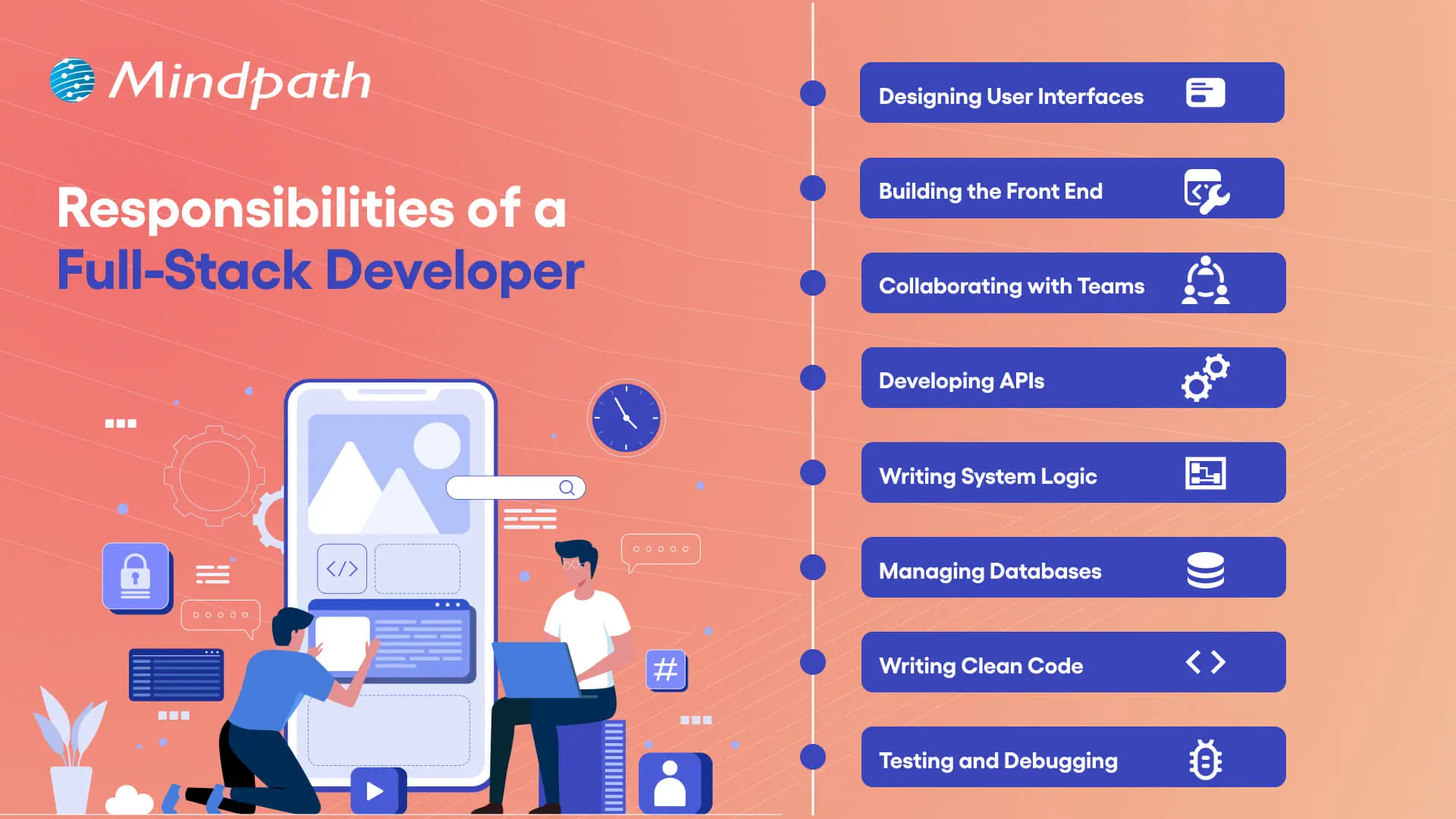
It’s important to recognize the broad spectrum of responsibility that comes with hiring a full-stack developer. The following responsibilities communicate how they join the layers of development into a smooth-flowing digital solution.
Responsibilities of a Full-Stack Developer

1. Designing User Interfaces

A freelance full-stack developer builds interfaces that have visual appeal and work on any device. They ensure that the website is responsive and works well for the user.

2. Building the Front End

Using HTML, CSS, and JavaScript, they build the experience that the user interacts with and engages with the visual. This allows for seamless movement through the site visually.

3. Collaborating with Teams

They collaborate with designers, managers, and stakeholders to achieve project outcomes. The benefits of collaboration can be easily seen, as it assures the application is built correctly.

4. Developing APIs

Full-stack developers are responsible for the build of APIs to interconnect systems and services. This allows the same data to move between the front end and back end.

5. Writing System Logic

They create a logic that drives the functions within an application. It responds to requests, processes data, and provides accurate results.

6. Managing Databases

A freelance full-stack developer sets up, maintains, and stores data in databases for user information. They secure data management, and they optimize the strategies for saving data.

7. Writing Clean Code

They write code that is maintainable and structured with performance in mind. Clean coding practices support a reduction in error and an increase in ease of modification.

8. Testing and Debugging

A full-stack developer tests an application to look for bugs. They debug the bugs to make sure it runs smoothly and reliably.

If you are planning to hire a full-stack developer, it is essential to understand the impact they can have on your product’s success. Explore our blog on Full Stack Developer Is Key to MVP Success to have a deeper understaning on how a full-stack developer can accelerate your MVP and give your product a competitive edge.

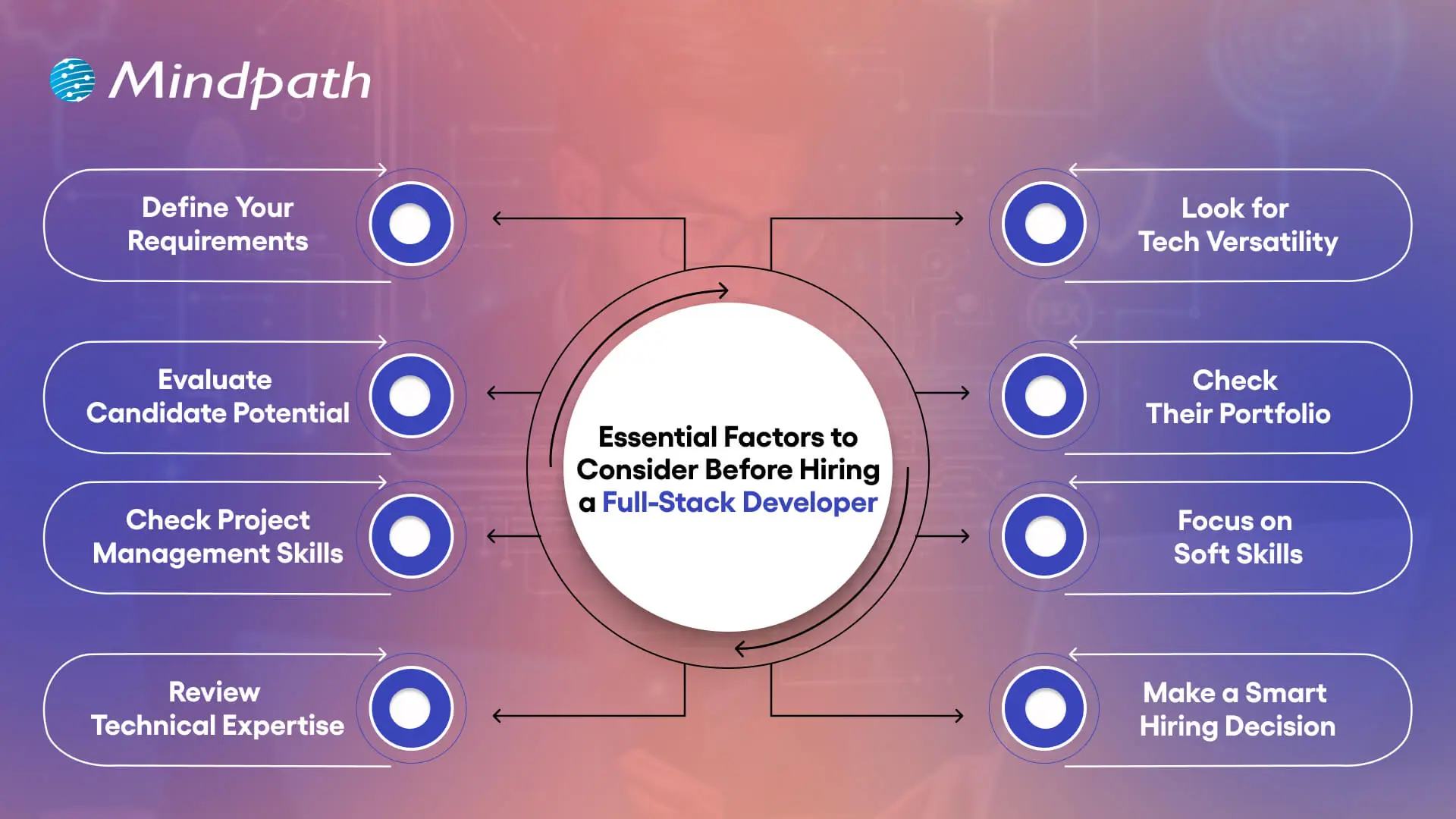
Essential Factors to Consider Before Hiring a Full-Stack Developer

Recruiting a full-stack developer isn’t just about evaluating technical skills. The following is a list of critical factors that will help you recruit a developer who aligns with your project needs and business objectives.
Essential Factors to Consider Before Hiring a Full-Stack Developer

1. Define Your Requirements

It’s important to create a clear document outlining your project needs prior to hiring a full-stack developer. This ensures the full-stack developer understands the features you need and the level of design you are expecting. Clarified requirements can aid in a quicker delivery to you and avoid any confusion.

2. Evaluate Candidate Potential

An experienced full-stack web developer has industry knowledge and experience. They can quickly adapt and move between projects as needed. Their ability to jump between projects can prove valuable when a deadline is around the corner.

3. Check Project Management Skills

When you hire a full-stack developer, you’re also getting a project manager with skills that go beyond simply coding. They have the ability to plan resources, lead teams, and manage the stages of development. Because of these proficiencies, they’re often the ones leading projects.

4. Review Technical Expertise

A good developer will know the languages behind building interfaces, HTML, CSS, and JavaScript. They will also know some back-end language, such as Python, PHP, or Ruby, and database experience with something like MySQL. It is a strong combination for full-stack development.

5. Look for Tech Versatility

Ensure that when hiring a full-stack developer, you validate their experience with multiple technologies. They should have knowledge of front-end frameworks, backend frameworks, and databases. You want real project experience that demonstrates their skills.

6. Check Their Portfolio

Request past work to evaluate their capabilities. A solid portfolio can illustrate how they overcome obstacles and provide solutions. Even newbies will be able to display some ability through sample work.

7. Focus on Soft Skills

A developer should recognize business requirements as well as perform technical tasks. A developer must be able to communicate without barriers to clients and teams. Good soft skills make it easy to comply with authority.

8. Make a Smart Hiring Decision

Finding the appropriate talent for full-stack web developer jobs can be a time-consuming process. Hiring a full-stack developer through a talent agency can help alleviate risk and guarantee that developers know what they are doing.

Want to transform your business inside out? Full-stack development makes it possible by optimizing operations and speeding up product launches. Explore the Benefits of Full-Stack Development every business needs to succeed.

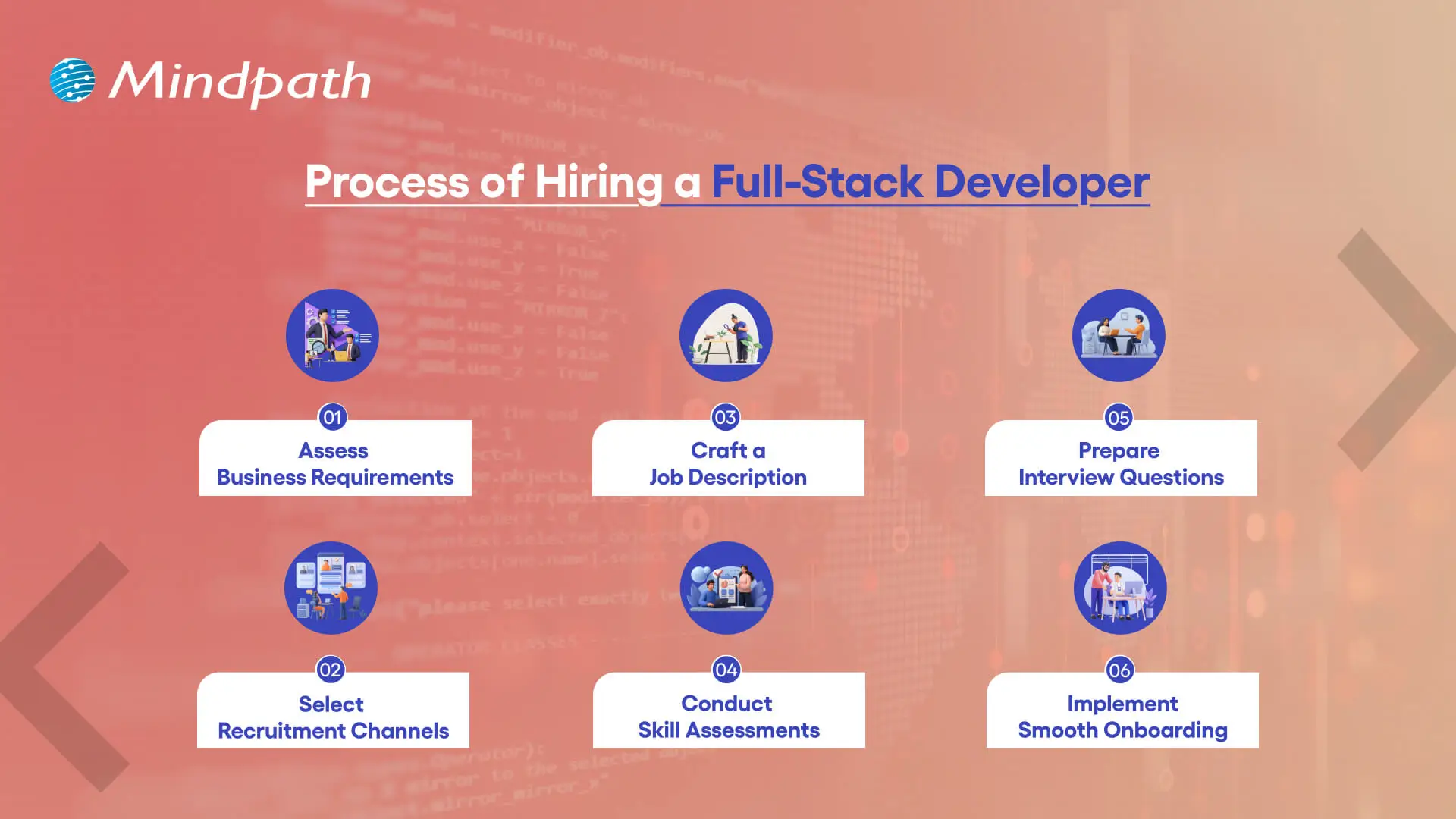
How to Hire a Full-Stack Developer

Selecting a full-stack developer involves an intentional process based on the right talent and your desired project specifications. The following steps will help you make a careful and confident hiring decision.
Process of Hiring a Full-Stack Developer

1. Assess Business Requirements

Prior to hiring a full-stack developer, make sure to define the project’s scope, budget, and timeline. Decide whether you need to hire someone full-time or if your project would require a freelance expert.

2. Select Recruitment Channels

Source candidates from networking sites, freelance platforms, and job boards. You can also connect with a full-stack development company to get the right talent.

3. Craft a Job Description

A good full-stack developer job description is a detailed description of the hard skills and tools, and the responsibilities for the job. A good job description helps you find the right candidates at a much quicker pace.

4. Conduct Skill Assessments

You can assess coding and problem-solving by utilizing structured coding tests or tasks. This method is a better hiring practice for a full-stack developer.

5. Prepare Interview Questions

Assess their familiarity with frontend, backend, and databases. A good candidate will often follow the best full-stack developer practices through good full-stack developer courses.

6. Implement Smooth Onboarding

After hiring a full-stack developer, tell them about their roles and responsibilities, the tools they will use, and the culture of the company. Successful onboarding ensures we’re setting them up for success and justifies their full-stack developer salary.

If you’re unsure whether to hire a full-time developer or a freelancer. Explore our blog on Freelance Full-Stack Developer to determine the best fit for your project’s needs. 

Ready to Hire a Full-Stack Developer for Your Next Project?

Hiring a full-stack developer is a smart decision for businesses aiming to build strong digital solutions. By focusing on skills, experience, and project needs, companies can find the right professional who delivers efficient results. The right choice not only saves time and costs but also ensures long-term success in competitive markets.

At Mindpath, you can hire full-stack developers who combine technical expertise with business understanding. Our developers work on both frontend and backend with precision, helping you achieve faster and smoother project delivery. With a proven track record across industries, Mindpath offers reliable talent that aligns perfectly with your goals and drives real value.
Related Post

Explore AI in web development and how it enhances user experiences, streamlines operations, and drives business success.
Learn how to implement DevSecOps in the cloud to enhance security. Discover the key steps to safeguard your cloud infrastructure.

Related Post

Recruit Computer Programmers in 2024

Looking to hire a computer programmer in 2024 but feeling overwhelmed by the process? Wondering how to find the perfect fit for your team amidst the sea of talent? Don’t worry! In this blog we will learn about the simple steps to recruit a computer programmer in 2024. 

A computer programmer writes and fixes code for software and apps. They utilize specialized programming languages to write instructions that computers follow to do things. This means they create the applications and programs we use every day, ranging from social networking apps to corporate tools. Programmers frequently work alone or in collaboration with other technical specialists, such as software developers and engineers. Their job includes not only developing code, but also identifying and resolving any issues that may arise, ensuring that everything functions well. 

As technology grows more integrated into our daily lives, talented programmers are in high demand in many sectors. Hiring a computer programmer is vital because they help in developing and updating the software that keeps our digital world working smoothly. Without them, many of the tools and apps we use would not exist or function correctly. 

So, let’s dig in to explore the simple steps to recruit a computer programmer! 

Steps to Recruit Computer Programmers

1. Define Your Requirements

Before you start looking for a computer programmer, you should know exactly what you’re looking for. Determine which programming languages the programmer should be familiar with, such as Java, Python, or JavaScript, based on the requirements of your project. Consider what technologies and tools they should be familiar with, especially if you’re creating anything specific such as a website. Decide if you need someone with extensive knowledge to take on leadership responsibilities or someone with a few years of experience to undertake routine tasks. Consider the personal abilities you value, such as being an effective communicator or team player. Knowing these details can assist you in finding the ideal programmer for your requirements. 

2. Estimate Your Cost

Before you begin looking for a computer programmer, you must first determine your budget. The cost of employing a programmer varies greatly depending on their degree of expertise, location, and the unique abilities they bring to the table. For example, a highly experienced programmer or one with specialized abilities may command a greater wage than someone with less experience or more generic skills. Setting a budget ahead of time not only helps you identify a programmer that fits inside your budget, but it also ensures that you are realistic about your financial situation. 

3. Clear Job Description

When recruiting a computer programmer, it’s essential to have a clear job description. This allows potential applicants to understand exactly what you’re looking for, ensuring that you recruit the right kind of individuals. Begin by using plain and straightforward language. Avoid using technical terms or sophisticated terminology that may mislead candidates. Clearly outline the position, including the activities and responsibilities that the programmer will be handling. Be precise about the technologies and programming languages they’ll be using. 

Include a list of the required qualifications and skills, such as years of experience and any specific background needs. Do not forget to add the soft skills essential to you, such as teamwork or communication. This manner, you’ll attract individuals that not only have the necessary technical talents but also fit in with your company’s culture. 

4. Conduct Interview

Conducting interviews helps you get to know the individuals and assess their abilities. Enquire about their programming background, problem-solving skills, and communication style. You might also assign them a coding challenge to put their abilities to the test.  

Interviews can be conducted via video, phone, or in person, and should include both technical and behavioral topics. The technical section evaluates coding abilities, whereas the behavioral section examines communication and team fit. Involve other team members in the selection process to verify the candidate is a good fit for the team. 

5. Evaluate Skills

A computer programmer’s communication abilities are critical to the success of any project. They must properly communicate their ideas and work successfully with team members. During the employment process, these soft skills should be assessed. To assess a candidate’s ability to break down technical nuances, ask them to describe a complicated programming concept in easy words. Additionally, assess their responsiveness and clarity in responding to your enquiries. 

Good communication skills include the ability to listen and deliver constructive feedback. Pay attention to how they connect with others; this might provide insight into their teamwork and problem-solving ability. Ensuring that a programmer can explain their ideas and collaborate well with your team will considerably improve the overall success of your projects. 

6. Propose an Offer

Once you’ve identified the best computer programmers for your project, make an official offer. To minimize misunderstandings, clearly state the project scope, timing, and budget. Be precise about what to expect and how the project will be managed. Discuss your communication expectations properly. This covers preferred modes of communication, frequency of updates, and response time frames. If your staff are in separate time zones, make rules to manage possible obstacles, such as overlapping working hours or dealing with urgent concerns. Include any additional terms or conditions, such as confidentiality agreements or specific targets. This guarantees that both parties are on the same page and contributes to a strong basis for a successful working relationship. 

7. Onboarding the hire

To ensure a seamless start to your collaboration, you must efficiently onboard your new hire. Once the hiring procedure is complete, it’s time to put your new computer programmer’s skills into action. Begin by giving them full access to systems and tools. Introduce them to the immediate staff and make sure they understand their roles and duties. Begin the project by outlining the initial tasks and setting expectations for delivery. This will allow your new team member to integrate fast and contribute to the project’s success from the beginning. 

Ready to hire top computer programmers? 

Connect with Mindpath to find the perfect fit for your project and start achieving your goals today! 

Hire Computer Programmers at Mindpath

At Mindpath, recruiting computer programmers is a simple and advantageous procedure that ensures your project’s success. We start by knowing your specific needs and goals to connect you with the right personnel. Our objective is to make the hiring process as simple and efficient as possible, offering ongoing help from beginning to end.  Here’s how we make hiring easier: 

1. Discuss Your Needs

Reach out to us to discuss your project requirements. We’ll work with you to create a detailed plan that outlines the project scope, timeline, and budget. 

2. Find the Right Programmer

Based on your needs, we’ll recommend skilled programmers who are well-suited for your project. You’ll have the opportunity to interview and select the ones who fit best with your vision. 

3. Start the Project

Once you’ve chosen your programmer, we’ll kick off the project with a clear plan and timeline. We’ll keep you informed with regular updates and seek your feedback to ensure everything is on track. 

4. Get Ongoing Support

We’ll continue to assist you throughout the process and beyond, addressing any issues promptly and ensuring your goals are met. 

Wrapping Note!

Recruiting an appropriate computer programmer is an essential stage in achieving your project’s objectives and assuring success. By following the simple but effective steps outlined—defining your requirements, estimating costs, creating a clear job description, conducting thorough interviews, evaluating skills, proposing a well-defined offer, and effectively onboarding—you can streamline the hiring process and find a programmer who perfectly fits your needs. 

Mindpath simplifies the process by providing specialized help at every stage. We offer a seamless and productive recruiting process by knowing your project needs and finding and integrating the perfect programmer. Our aim is to give continuing support and resolve any concerns, ensuring that your project not only meets, but exceeds, your expectations. 

Looking for dedicated programmers?

Mindpath makes hiring easy and efficient. Contact us now to get started and elevate your project with the best! 

AI in e-commerce

Have you ever thought how do online stores seem to know what exactly you are looking for? How do these stores make your online shopping so much easier by showing you the perfect product at the perfect time? Well, it’s not just by luck, but the power of artificial intelligence which is changing the way we shop online. But how exactly is AI in e-commerce shaping the future of online shopping?

In today’s tech world, artificial intelligence (AI) is making an influential impact across many industries. Businesses are using AI benefits to improve their services and reach more customers. Among all the industries, e-commerce is seeing a major conversion with the help of AI, as it helps in creating personalized shopping experience, increasing sales and offering better customer support. AI also helps retailers to understand customer behavior, recommend the perfect choices as well as build stronger connections with them.

But this raises the question: how can AI help businesses in the e-commerce sector improve their operations and enhance customer experience? Curious to know? Let’s dive in!

Want to transform your e-commerce website with AI to avail its revolutionary benefits? At Mindpath, we offer AI development services designed to elevate your business and enhance customer experiences.

Understanding the Role of AI in E-commerce

AI in e-commerce refers to the use of artificial intelligence technologies to make online shopping better and easier. These systems can learn from customer’s behavior, answer their questions automatically, and also suggest products that people might like. It is like having a digital assistant that supports both the business and the shoppers. 

E-commerce stores use AI in many simple yet powerful ways. It helps show products that match a customer’s taste, runs chatbots for quick replies, and manages inventories by predicting what people might like to buy. It also helps with creating smart ads and adjusting prices based on demand. Using AI in business strategy helps online businesses grow faster. It improves how customers shop by giving them a more personal and easy experience. It also saves time and money for the business by handling routine tasks. In the long run, it builds trust, keeps customers coming back, and helps the store stay ahead of the competition. 

Also Read: AI transforming future

The Benefits of AI in E-commerce

With the rise of artificial intelligence in e-commerce, the ability to predict trends, analyze data and personalize experience has become more easily approachable. Businesses now can improve customer interactions, amend tasks and stay ahead in a competitive market with AI. Here are some of the key benefits of AI in e-commerce businesses.

1. Preventing Fraud

E-commerce businesses usually face a huge challenge with online fraud, but with e-commerce AI tools, these frauds can be prevented easily. AI can quickly spot any suspicious activity by understanding the patterns and detecting anything unusual such as incorrect shipping addresses or any other signs of fraud. Also, it can detect fraud even while reviewing thousands of transactions at once which helps to prevent losses and keeps the store guarded. AI has the ability to learn and improve which can benefit in continuously strengthening its fraud detection, helping you to focus on growing your business.

2. Improving Site Search

AI in e-commerce is making site search smarter and more accurate. AI can better understand what customers are looking for due to the advancements in natural language processing. Whenever a customer types to search for something, AI can automatically fix spelling mistakes, suggest synonyms and even fill missing words. It can also help customers in visual search as well search voice search options. With the help of these smart features, AI can reduce customer’s frustration and provides them exactly what they want, improving shopping experience and giving businesses a competitive advantage in the e-commerce market.

benefits of AI in e-commerce

3. Simplifying Inventory Management

With artificial intelligence in e-commerce, inventory management has become much easier. AI can predict how much stock you need based on past data and trends which helps to avoid overstocking or running out of items. AI also makes warehouse tasks smoother as bots can help store and retrieve products quickly, saving time and effort. This technology makes managing stock more accurate and efficient, allowing businesses to focus on growing while AI handles the tricky parts of inventory management.

4. Reducing Manual Tasks

AI can reduce the need for manual labor by taking over repetitive tasks in e-commerce. Instead of employees handling simple, time-consuming tasks, AI automates these processes and saves valuable time and improves competence. By handling tasks like answering basic customer queries, processing orders, and managing inventory, e-commerce AI allows businesses to focus on more important activities. While this may change the roles of human workers, it helps businesses cut costs and enhance productivity, making overall operations more streamlined and effective.

Want to reduce manual work and make your e-commerce platform more effective? Discover how AI in Web Development can streamline operations and enhance customer experiences.

Real World Use-Cases of AI in E-commerce

Artificial intelligence is already making a big impact in the e-commerce world. Many well-known online stores are utilizing it in smart ways to improve the way people shop and how smoothly their systems run. Here are some of the real-world examples showing how AI is used every day in e-commerce.

1. Product Discovery and Recommendations

AI in e-commerce is shaping how customers discover products online. Websites like Amazon, Shein, Etsy and eBay show products based on the browsing and purchasing history of their customer with personalized product recommendations. For instance, if you search for a purse on Amazon, it will suggest other similar brands of purses that you may like. This AI-driven system makes shopping more enjoyable and also boosts sales and customer trust. E-commerce advertising also benefits from this, as targeted recommendations lead to more engagement, improving overall customer experience.

2. Improves Customer Service

Customer service is improving with the help of AI-powered chatbots and virtual assistants, which can quick and personalized support. Artificial intelligence for customer service in retail stores helps businesses automate responses, answer customer queries, and offer tailored solutions. By using technologies like machine learning and natural language processing, AI can understand customer inquiries and offer accurate responses. For example, H&M uses AI-powered chatbots to help customers with product details, availability, sizing and even delivery options. This makes customer shopping easier and helps businesses deliver faster and efficient customer service.

use cases of AI in e-commerce

3. Voice Commerce

Voice commerce, also known as V-commerce, is changing how we shop online with the help of AI. By using voice assistance like Amazon’s Alexa, Google Home, and Walmart’s voice services, customers can shop simply by speaking. These AI-driven assistants understand commands through natural language processing (NLP) and can offer tailored product recommendations. They also help customers with order updates and product inquiries. AI in e-commerce examples include big companies like Amazon, Walmart, and Google Shopping that are leveraging voice technology to improve shopping experience.

4. Smart Pricing Strategy

The role of AI in e-commerce is changing the pricing strategies by allowing price adjustments based on various factors like demand, supply, and competitor prices. AI trends use data analysis to predict demand patterns and automatically modify prices. Major companies like Amazon, Walmart, and Best Buy have adopted AI to implement smart pricing strategies which allow them to remain competitive, attract more customers and improve satisfaction by offering relevant prices. These examples demonstrate how advanced technology can optimize pricing in the ever-evolving market.

5. Optimizing Logistics

In e-commerce, smart logistics powered by AI improves delivery efficiency by using real-time data and predictive analytics. This technology helps businesses track shipments, prevent delays, and make better decisions. For instance, Cainiao, Alibaba’s logistics arm, uses AI to ensure deliveries within 24 hours across China. Similarly, Amazon employs AI to optimize delivery routes, reducing costs and speeding up deliveries. These uses of artificial intelligence in daily life are making logistics smarter, cutting costs, and providing a better customer experience.

Looking to streamline your business operations and enhance customer experiences? Discover how conversational AI chatbots can help your business transform its workflows and boost efficiency in our blog.

Ready to Adopt AI Revolution?

Artificial intelligence is revolutionizing e-commerce by enhancing customer experiences, streamlining operations, and driving innovation. From smart pricing and personalized recommendations to AI-powered customer service and logistics, the role of AI in e-commerce is transforming the industry in powerful ways. As technology continues to evolve, businesses that embrace AI will stay ahead of the curve, offering better services and smarter solutions.

At Mindpath, we provide top-tier AI development services to help businesses thrive in the world of e-commerce. Our AI solutions are designed to improve customer experience, streamline operations, and boost sales. From personalized recommendations and dynamic pricing to efficient inventory management and smart logistics, we integrate AI to make your e-commerce platform smarter and more efficient. Trust Mindpath to bring AI-powered innovations that will optimize your business and help you stay ahead in the ever-evolving e-commerce landscape.

React vs Vue

The software development industry keeps evolving incredibly with new technologies and innovations, breaking down traditional precedents. At the same time, software applications have become more complicated as businesses seek better ways to come up with successful products. The React vs Vue debate plays a major role in determining the difference between success and failure for your new software solutions. You might have many questions about the need to focus specifically on these two frontend development tools. Let’s dive in to get answers to all your questions.

With more frontend development technologies coming to the forefront, it is difficult to make the right choice for your project. React and Vue are the most preferred JavaScript technologies for web development. Both of them have become the strongest competitors among frontend development frameworks for their unique features. Let us learn the differences between React js and Vue js to choose the ideal pick according to your requirements.

Understanding the Fundamentals of React and Vue

If you take a look at the top apps you use in everyday lives, most of them have either React.js or Vue.js in their tech stack. Choosing one of the ideal frameworks for software development can pose significant challenges. You must know what each of them has to offer for frontend development before making a decision. The following sections will provide insights on the fundamental details of React and Vue that can help you compare them.

Quick Overview of React

React.js is a well-known javascript framework for frontend development that delivers promising edge in creating interactive user interfaces (UI). Remarkable features of this tool include its origin which – it was created by Facebook in 2011 for internal purposes. Although most of us frequently refer to React as a framework, it’s an open-source javascript library for frontend development. One of the notable aspects in the Vue vs React debate is the use of JSX in React.js syntax. The role of JSX (JavaScript Syntax Extension) is very important in writing HTML elements in JavaScript code without making use of JavaScript functions.

React is among popular, dynamic, and versatile JavaScript frontend libraries used for developing frontend applications. It is most preferably used to create scalable applications with dynamic user interfaces and cross-platform capabilities. React developer tools also provide the support to identify performance issues and ensure a faster debugging process. Another striking feature of React is the flexibility to develop single-page applications and server-side apps as well as mobile apps.

Quick Overview of Vue

While React is a JavaScript library, Vue is an open-source JavaScript framework for frontend development. Vue.js grabbed headlines upon its arrival in 2014 for the shorter and simpler learning curve. As a matter of fact, the React vs Vue vs Angular comparison reflects on the fact that the design of Vue draws inspiration from Angular. The creator of Vue, a former Google engineer, picked the best components of Angular and the same approach as React.js to create a versatile framework.

Developers choose Vue for its easy-to-use interface and efficiency in developing web apps with a component-based model. The framework also includes a large library that empowers developers to create apps with better performance. Many developers prefer Vue over React for its simpler approach to coding with a less complex structure and plain syntax. On top of it, the collection of plugins available with Vue ensures efficient incorporation of additional functionalities in the app.

Let’s have a look over React vs Vue comparison with Google Trends:

react vs vue google trends

Unraveling the Differences between React and Vue

While React is a JavaScript library, Vue is an open-source JavaScript framework for frontend development. Vue.js grabbed headlines upon its arrival in 2014 for the shorter and simpler learning curve. As a matter of fact, the React vs Vue vs Angular comparison reflects on the fact that the design of Vue draws inspiration from Angular. The creator of Vue, a former Google engineer, picked the best components of Angular and the same approach as React.js to create a versatile framework.

Developers choose Vue for its easy-to-use interface and efficiency in developing web apps with a component-based model. The framework also includes a large library that empowers developers to create apps with better performance. Many developers prefer Vue over React for its simpler approach to coding with a less complex structure and plain syntax. On top of it, the collection of plugins available with Vue ensures efficient incorporation of additional functionalities in the app.

1. App Size and Performance

The size of app in each framework speaks a lot about the performance they can offer in the development process. You can use the Vue vs React performance benchmark to discover how Vue.js is the better pick to create small and faster apps. Vue allows you to compress the code so that it can consume significantly less space. As a matter of fact, applications created in Vue are almost 10% to 30% smaller than React-based applications.

The smaller app size enables faster coding as you will need limited inputs, thereby providing the assurance of better performance. Vue also stands as a formidable contender in terms of performance with its efficient default library. The testing library of Vue.js makes applications run quickly and more efficiently. On the other hand, React requires you to download additional libraries to introduce new features that increase app size and reduce performance.

2. Scalability

Another noticeable factor in the comparison between React.js and Vue.js is scalability as businesses seek ways to expand their apps with new functionalities. Which JavaScript frontend framework can come to your rescue when your app attracts more customers? React and Vue have efficient scalability solutions, albeit for different categories of apps. While React is the best pick to create large and complex apps, Vue is suitable for faster and simpler apps.

However, Vue and React both works on the same infrastructure and relies on a unidirectional data flow. In addition, Vue also offers support for two-way reactive data binding that allows simpler data management. The reactivity system of Vue ensures that you can track changes and introduce updates in the DOM. While React has a larger developer ecosystem and more templates and tools, Vue provides the guarantee of better scalability.

Where does React fail when it comes to scalability? You can find smart components in React.js that feature state management library functions. On the other hand, the dumb components help in executing simple functions and presenting things to the virtual DOM.

3. Operational Performance

The next important point of the difference between React and Vue will focus on their performance in different operations. Vue has been the favourite of companies as it offers exceptional performance in less complex and smaller projects. According to recent tests conducted on both frameworks, the operational performance depends on type of tasks where you can apply them. The tests focused on important metrics such as memory usage, rendering time and row creation speed for operations like clearing large tables or introducing updates.

React.js leverages a virtual DOM to ensure efficient management of UI updates and showcases impressive performance in all benchmarks. The operational performance of React is significantly higher in scenarios that require dynamic updates and content rendering. On the other side of the debate, Vue.js also leverages a virtual DOM alongside offering a reactive data-binding system. Vue has consistently shown competitive performance at par with React in different test scenarios.

4. Syntax and Learning Curve

You should also review the React js vs Vue js debate from the perspective of their syntax. React uses the JSX syntax while Vue uses the template syntax for developing user interfaces. Vue uses HTML templates by default albeit with the option to write code in JSX. On the other hand, React relies solely on JSX for the syntax. The isolation of HTML, JS and CSS in Vue ensures that beginners can also create web application frontends with ease. Developers with limited experience in JavaScript or the ones who have been using HTML/CSS will love working with Vue.

React presents a steeper learning curve as developers need in-depth understanding of JavaScript to work with the framework. Even if JSX offers more power and flexibility, beginners will find it more complex for frontend development.

5. Official Documentation

The documentation for React and Vue also play a crucial role in the React vs Vue comparison. Official documentation of any framework or library provides guidance on their components and the best ways to use them. Tools with clear and comprehensive documentation can also attract businesses which need clear directions for usage and troubleshooting. Vue has always maintained well-organized documentation that serves as its formidable strength. The decision to choose from React or Vue becomes simpler with the assurance of the simpler learning process and troubleshooting in Vue. On top of it, the latest improvements in official Vue documentation provide more comprehensive resources to help developers.

React is far behind Vue in terms of documentation because it focused only on basic concepts and advanced uses. The updated version of React documentation promises some changes such as better accessibility, clear explanations and real-world examples. With time, React will also have documentation that will help developers learn about its functionalities and best practices.

2024 Developer Survey by Stack Overflow

The 2024 Developer Survey by Stack Overflow, recorded the responses of over 65,000 developers about the technologies, coding, and tools they are interested to learn and use, and experience at work. Here’s the outcome of 38,132 (58.3%) responses received by professional developers on the popularity of web frameworks and technologies.

2024 developer survey stackoverflow

ReactJS vs VueJS: Which is Better for Your Project?

The differences between React and Vue mentioned above depict that each one of them has some distinguishing pulses and minuses. It is important to use the example of a React-based application and the example of a Vue-based application at the same time to understand their adoption in the real world. Some of the noteworthy companies that use React.js are instagram, Netflix, and Uber.

On the other side of the spectrum, industry giants like GitLab, Zoom, Upwork use Vue.js. Therefore, the choice of a frontend development framework depends completely on your needs. Still confused about choosing the right framework for your next project? No worries, our frontend development experts are ready to help you make the right decision. Take the first step now to choose the right framework for your dream project.