How to Hire Dedicated Developers for Your Startup: Step-by-Step Process 

Join our Newsletter!

Featured Posts

Support Is One Click Away

Home

How to Hire Dedicated Developers for Your Startup: Step-by-Step Process 

Hire Dedicated Developers

How to Hire Dedicated Developers for Your Startup: Step-by-Step Process 

Growing a start-up can be thrilling, but every technical choice made carries a lot of responsibility for your company’s future. You need to hire dedicated developers who will be able to transform your ideas into reality. When you look for developers, you are looking for someone with dedication, dependability, and shared intention.

At this point in time, there is usually a lot of pressure and excitement. You want your developers to be able to work together as a team and complete their tasks smoothly and efficiently. You want to set an example of how to maintain a good pace in this process by establishing expectations about pace, important tasks, and accountability.

When the momentum is strong, the hiring mindset gets more and more refined and purposeful. You actually look for clarity, consistency, and long-term alignment. Stable developers make your rapid plans more viable. On the other hand, bad choices can waste your time and confuse your team. Having a well-defined hiring approach saves you from that kind of trouble. It makes it easier to take good decisions and execute your plans without hitches. In this article, we will explain the steps that will give you confidence and guidance in hiring the right developers.

Want to hire dedicated developers who can bring your startup ideas to life efficiently and reliably? Mindpath provides expert developers and custom solutions that help startups build scalable and high-performing web applications.

Why Do Companies Need to Hire Dedicated Developers?

The companies that opt for dedicated teams benefit from their ability to provide consistent focus and measurable results. When you hire dedicated developers who work on a single project, the efficiency and effectiveness of the development team increase. Developers also bring an entirely different approach to the project based on their expertise. They create quality code that is free from errors, thus improving the quality and decreasing the time to market. In addition, dedicated teams are typically less expensive than managing a full-in-house team.

This method enables businesses to be adaptable and grow over time. Firms are able to hire developers according to the requirements of the project. Also, they have the freedom to extend their workforce without any waiting time or interruption. Skilled developers bring down the chances of unsuccessful outcomes by efficient organizing. Experienced developers also provide updates and support after the launch of a new product. Therefore, businesses continue to have direct control over their business goals and outcomes.

Must Read: Remote Work Tools for Developers

Key Responsibilities of a Dedicated Developer

1. A committed programmer assumes full ownership of the product. They deal with frontend and backend and mobile requirements with great ownership and coherency.

2. They create the MVP within a short time to gauge ideas in the market. This assists startups to learn quickly and adapt without wasting time.

3. They develop the product to expand alongside the business. They take care of updates, corrections and long-term support as well.

4. They introduce expertise that startups usually do not have in-house. That is the reason why most startups prefer to hire dedicated developers at an early stage.

5. They are knowledgeable about the startup vision, culture, and roadmap. This orientation maintains development towards actual business objectives.

6. Startups hire remote developers as part of the core team that works in the same direction. This guarantees quickness, efficiency, and good cooperation.

Planning to build and launch your product efficiently? Explore how creating an MVP for startups helps validate ideas faster and ensures you hire the right developers for early-stage success.

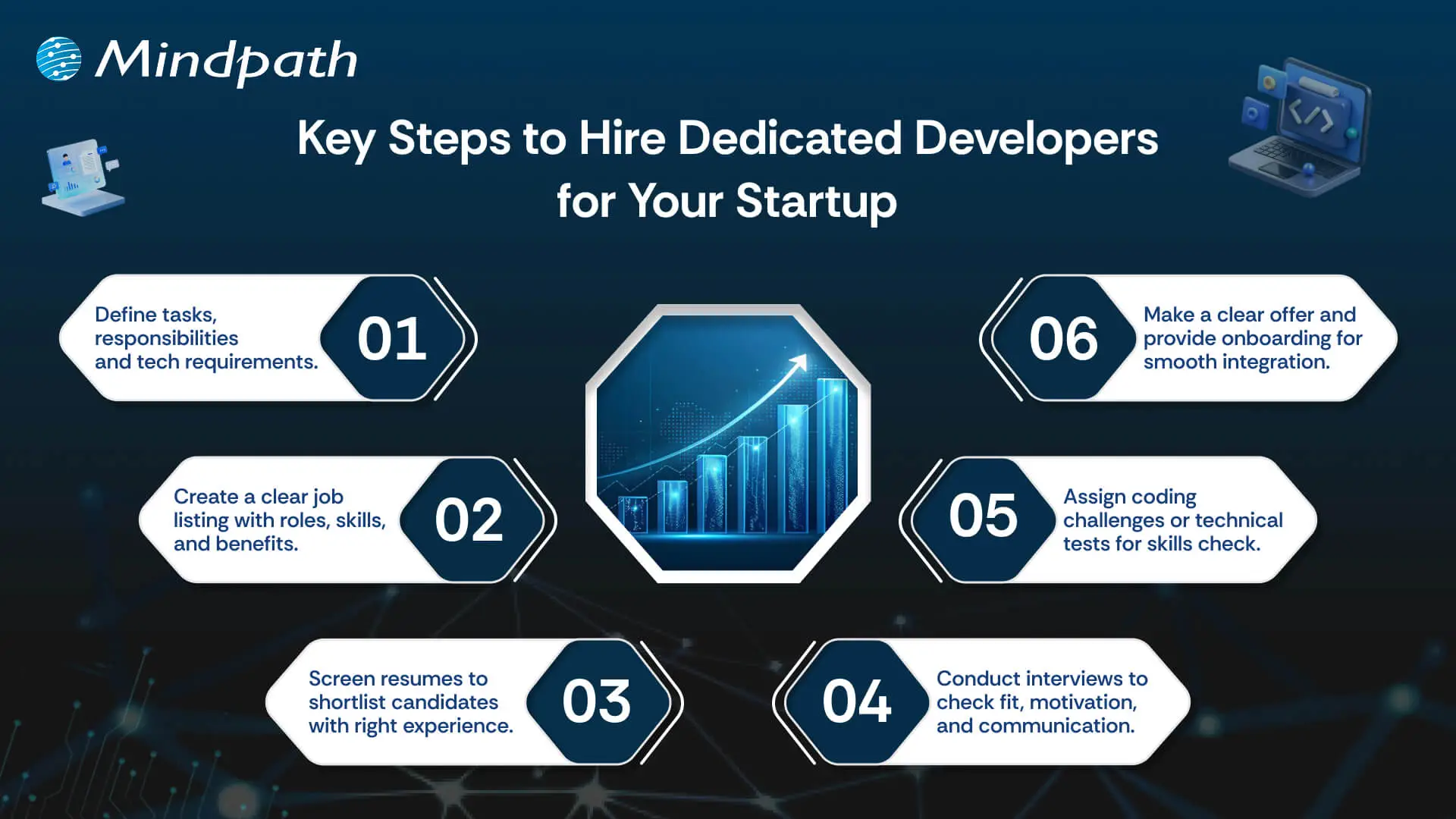
Key Steps to Hire Dedicated Developers for Your Startup

Recruiting appropriate technical talent determines the manner in which a startup is formed and developed. These are the major steps to hire dedicated developers for your startup in a clear-cut and controlled manner.
hire dedicated developer for your startup

1. Define Your Development Needs

Be clear about the tasks, responsibilities, and objectives of the developer position. Choose the technical infrastructure, level of experience, and the soft skills. Share these requirements to get the right candidates that would fit into your startup vision and culture. This will guarantee that you get the perfect match prior to the hiring process.

2. Create an Attractive Job Listing

Prepare a precise and brief job advertisement specifying the job, the requirements, and company benefits. Exhibit growth prospects and culture. Advertise in job boards, social media and professional networks to access competent candidates. A good listing attracts and enhances the quality of response.

3. Screen Resumes Efficiently

Filter through applications to identify those candidates who meet your requirements. Check technical skills, experience and applicable education. Find the transferable skills where necessary. Filter out applicants to proceed to the next step. This can save time and concentrate on the best talent.

4. Conduct Initial Interviews

Screen shortlisted candidates on the phone or via video call. Evaluate cultural fit, motivation, and communication skills. Question regarding experience and problem-solving. Present your business, objectives, and culture. This assists the two parties in assessing their compatibility prior to proceeding.

5. Test Technical Skills

Give coding challenges or relevant technical tasks. Evaluate skills based on your project needs. Ensure tests reflect real-world tasks they will handle. Review results carefully to confirm the candidate can deliver high-quality work. This step ensures practical readiness.

6. Make an Offer and Onboard

Share a clear job offer with salary, benefits, and start date. Upon acceptance, offer adequate on-boarding and support to ensure that they settle as soon as possible. Cultivate learning and development to create long-term engagement. This assists startups to successfully hire dedicated developers and assimilate them seamlessly.

Need to scale your development team quickly without long-term commitments? Explore our staff augmentation guide to learn how startups can add skilled developers on demand while staying flexible and cost-effective.

Ready to Hire Dedicated Developers in UK for Your Startup?

How well you hire the right tech candidate will help you to decide your startup’s future. If you stick to the proper procedure, you can effectively hire committed developers without wasting time. This will allow you to quickly develop and launch products, produce high-quality work, and build for long-term success. Defining what you are looking for, reviewing candidates, and assessing competencies helps minimize risks associated with the hiring process. Using this method will provide your company with a more effective development process and consequently generate superior business results.

Mindpath is your option to get the best solutions if you want to hire dedicated web developers for your startup. Our teams are committed to delivering bespoke web development services that are focused, fast, and of high quality. We are a perfect fit with your objectives as we keep on supporting and updating you. By selecting Mindpath, we guarantee your projects will be carried out efficiently, and with high technical standards.

Related Post

Related Post

MVP in software development

MVP in Software Development is also known as Minimum Viable Product. It is the particular version of a software application with enough core features so that it can be released to the early users. The fundamental goal of developing MVP software is to validate it and get it to the market quickly.

As innovation in the current market setting is growing at a rapid pace, it is essential for businesses to realize the importance of software development MVPs. You need to develop an MVP before investing a significant amount of money in the full-scale product. This strategic development methodology can be implemented by the development team without having to build a complete software product. It is the right time to explore the relevance of MVP in software development.

Wondering how to validate your software idea before committing full resources? Mindpath’s MVP development services help businesses build functional prototypes and gather real user feedback quickly.

What is MVP Development?

In the era of digitalization, startup businesses may wonder – what is MVP in software development? In simple words, MVP or Minimum viable product is the test version of a product or software. This strategic development approach begins with the creation of the beta version of the software that a business plans to create. 

This basic version consists of the essential features and functions. These elements are included by taking into consideration the pain points of clients. The core idea behind the MVP development process is to build customer-oriented software applications. It helps businesses to ascertain whether their product is up to the mark or if it requires improvement. MVP development focuses on minimizing costs and business operations. It even helps to build the software in a smarter and efficient manner.

Stages for Building an MVP

In order to build an MVP in the context of software development, a systematic approach has to be adopted. The MVP development process involves a series of stages that you need to be aware of. You need to follow the steps in a methodical manner so that you can succeed while developing an MVP. 

1. Defining the Problem 

The fundamental step is to know the problem or pain points of your users. If businesses do not have insight into this area, they may end up creating an app that no one will use. So you need to clearly define the specific problem that your software application is going to solve. At this stage, startup businesses can consider using MVP development services. Otherwise, they can sit and discuss with their development team the problem that the application is going to solve. It is also important to understand how important the application will be for people who will be using it. 

2. Knowing the Target Audience

At this stage of the MVP development process, it is essential for you to decide who will be your target audience. A common mistake that some developers make is that they decide to create an app for everyone. It is advisable to target a niche group when startups develop an application. It can help narrow the focus of the project and develop well-functioning software. Businesses need to build the target audience persona and make it as detailed as possible.  Some of the details that should be included in the persona include profession, age, and income group. 

3. Ascertaining Key Features

Startups need to determine the key features that the first version of the product must have. It is an important thing you need to look at after defining the problem and identifying your target audience. At this stage, businesses need to list down all the possible features of the product. Then you must decide the essential features that need to be incorporated to make the software application usable. From the list of features, you can choose the most essential features that need to be included in the MVP. 

Must Read: MVP for Startups

4. Building the MVP

Once you have clarity about the features of your MVP, it is time to start creating the product. At this stage, you have to determine the programming language, framework, and other tools that you plan to use. You can even consider taking the help of an MVP development company if you wish to build your MVP. At this particular stage, you do not have to think about making a perfect product. Instead, startup businesses must focus on building a product that is usable for the intended audience. The ultimate goal must be to develop a functional product within the shortest period of time. 

5. Testing the Product

After you have created your MVP, it is time to test it. You must reach out to early adopters who are going to be the actual users of your software application. It is vital to search for the people who match the created buyer persona. You must request them to try out your MVP. If it is possible, you can reach out to them via social media or email. At this stage, your ultimate goal should be to get a good number of people and gather feedback from them. Collecting honest feedback is crucial to making improvements in the software application MVP. 

6. Using Feedback for Product Improvement

Once users start giving feedback about your MVP, you need to start collecting it. Moreover, you need to see what the best way is to implement them so that your software can meet the needs of the target audience. Initially, you need to focus on how your software solves the problem for users. If you receive positive feedback, you need to look at additional features that you can incorporate into your actual product. The feedback loop can guide you to develop the ideal product that can effectively meet the needs of the intended users. 

Ready to push your MVP from idea to functional product? Explore our blog on hiring full stack developers for MVP to learn what abilities truly drive strong outcomes.

Advantages of Developing a Successful MVP

The creation of an effective MVP can give rise to a host of advantages for startup businesses. You need to be aware of the chief benefits.

1. An MVP can help a business quickly decide whether the solution genuinely resonates with the target audience or not. It can save valuable time as well as resources of your business while helping you to test the core assumptions with the actual users. 

2. An MVP can enable businesses to test their business concept with limited investment, as it can minimize the financial exposure that is associated with full-scale software development. So businesses can avoid making costly mistakes. 

3. The invaluable feedback that businesses can gather can help in iterating and refining the product. So you can take into account the actual needs and preferences of your customers and create value for them through the software solution.

4. An MVP can help you launch your software application sooner in the market. This will be possible since you can focus on the essential features and key functionalities. The MVP can help you gain a competitive edge in the market setting. 

In the current times, when the needs and preferences of customers are rapidly changing, businesses need to understand the importance of an MVP. A successful MVP can enable businesses to create something that can create value at a comprehensive level.  

Curious about the different ways software can be built? Check out our guide on the types of software development to learn which approach fits your project best.

Final Words

In the context of software development, the relevance of a minimum viable product cannot be ignored. If businesses plan to develop a new software solution in the market, they need to adopt the MVP approach. The systematic development approach can enable businesses to create software that can create value for the ultimate users in the market. Businesses need to understand the strategic value of a minimum viable product. The knowledge can empower them to build software applications that perfectly match the needs of their target audience.

Mindpath’s MVP development services can help businesses develop their minimum viable product in an effective and efficient manner. Our experts will guide you to make refinements in your software by taking into account the needs of your target audience. 

Multi Cloud vs Hybrid Cloud

Deciding between multi-cloud vs. hybrid cloud strategies is becoming an important choice for organizations that want to remain agile and scalable. Every organization needs to find a way to balance flexibility, security, and performance, and this holds true with cloud architecture as well. The more complex challenge is determining which model can optimize operations while allowing the teams in the organization to innovate unhindered. As technology progresses to new heights, a strong cloud architecture can be a differentiating element within an organization’s growth.

It is essential to be certain of how both cloud models serve your business objectives and technical goals to make the better decision. It is not just an issue about infrastructure, but positioning your organization for the future and digital resilience. Understanding their differences helps organizations make confident and data-driven decisions in a world where technology changes rapidly. In this blog, we will explain some of the fundamental principles of multi-cloud and hybrid cloud so that the decision on which is best for you will be less difficult.

Want to determine which cloud strategy will be ideal for your organization? Contact us to get deeper insights and make smart business decisions that lead to future growth.

Understanding the Fundamentals of Hybrid Cloud and Multi-Cloud

A hybrid cloud combines both private and public cloud services in order to provide an adaptable and secure environment for computing. Organizations can house sensitive data in a private cloud to protect it, while still utilizing the on-demand, scalable, and cost-effective computing of the public cloud. Hybrid clouds offer enhanced control, resource utilization, and performance. Utilizing a hybrid cloud allows organizations to efficiently manage workloads across the types of cloud while enjoying the benefits of both cloud types.

A multi-cloud strategy uses multiple cloud service providers to achieve specific corporate objectives. In the multi-cloud vs. hybrid cloud debate, companies will tend to prefer multi-cloud solutions for flexibility, avoiding being locked into a single vendor platform, and minimizing operational risks such as downtime or loss of data. Each application in a multi-cloud environment can run on a public cloud platform or private cloud platform based on relative performance or cost needs.

Wondering how application architecture impacts multi-cloud and hybrid cloud success? Explore cloud-native development to learn how cloud-native apps improve scalability and flexibility.

Advantages of Hybrid Cloud

A hybrid cloud gives companies the right combination of flexibility and control, helping companies manage data securely and securely provide scalability and efficiency for operations.

1. Strong Security and Data Control

Hybrid cloud allows companies to maintain improved control of sensitive data and mission-critical systems. Companies can use private servers to store private information and public clouds for everyday tasks, allowing for a balance between security and freedom.

2. Smarter Cost Management

Businesses can reduce their costs by maintaining constant workloads on private systems, while variable workloads can move to the public cloud. This model allows for a pay-as-you-go system that reduces risk of overspending and improves cost optimization.

3. Faster Performance and Low Latency

Hybrid cloud enhances performance by positioning time-sensitive jobs, such as analytics or IoT applications, nearer to the end user. The configuration call for helps to reduce latency and increase response times for the users.

4. Reliable Disaster Recovery

Businesses are able to store crucial data in the public cloud while ensuring that a main version is also preserved on their premises and if there is a systems failure, they can quickly restore and resume business as usual with minor interruptions.

5. Greater Scalability on Demand

Organizations can easily scale their capacity up or down via the public cloud when they find themselves in busy periods or running promotional activities that bring in high traffic. After the busy period ends, they can scale down their capacity, so they aren’t wasting money and resources.

6. Better Compliance and Data Governance

Hybrid cloud helps companies follow data protection rules by keeping customer data on local servers. At the same time, they are still able to carry out non-sensitive work in a public cloud, thus making an informed decision on multi-cloud vs hybrid cloud.

7. Boosted Innovation and Flexibility

Teams can experiment with fresh tools and services in the public cloud without interfering with core systems. This illustrates that the difference between multi-cloud vs hybrid cloud can drive business innovation and flexibility within the digital age.

Is your cloud strategy aligned with long-term digital growth goals? Discover digital transformation for businesses to understand how the right cloud approach accelerates innovation.

Examples of Hybrid Cloud

These are some real-world hybrid cloud examples and how organizations use this approach to improve business flexibility, security, and efficiency.

1. Digital Transformation

A hybrid cloud modernizes IT systems with a remote workforce and protects data in a secure environment.

2. Disaster Recovery

Hybrid clouds help your business continue operating normally by recovering data at a fast speed in the event of outages.

3. Development and Testing

Developers develop and test apps in their public clouds, then port to private clouds.

4. Cloud Bursting

During peak traffic, additional workloads move from private clouds to public clouds without impacting performance.

5. Edge Computing

Delivers and processes data near the user, resulting in faster and lower latency experiences.

6. AI & Machine Learning

A hybrid cloud supports AI workloads with the best scalability and the security of their data.

Looking for ways to optimize costs and scale applications seamlessly in complex cloud setups? Discover serverless architecture in cloud computing to explore how serverless solutions support modern cloud architectures.

Advantages of Multi-Cloud

The following are the main benefits of a multi-cloud strategy that will help to improve business performance and facilitate better operations.

1. Business Continuity Edge

In comparing multi-cloud vs. hybrid cloud, one advantage of multi-cloud is that it allows operations to continue even if one of the providers has an outage. By spreading workloads across a combination of platforms, businesses provide continued performance and reliability.

2. Flexible Cost Management

In the hybrid cloud vs. multi-cloud comparison, another of the advantages of multi-cloud is improved cost control. This allows companies to choose the cheapest cloud provider for each workload and optimize resources effectively.

3. Customized Security Approach

Multi-cloud allows organizations to engage with providers that best suit their compliance and security requirements. This helps to ensure improved data security and better alignment with regulatory standards.

4. Independent Provider Choice

Using a multi-cloud strategy, organizations will have less reliance on one vendor. They will have the flexibility to move workloads, negotiate terms, and meet changing demand in the market.

5. Optimized Technology Access

Each cloud provider has a service that they do best, e.g., AI, analytics, or integration. Multi-cloud allows organizations to select the cream of the crop and combine them together to get the best performance and innovation.

6. Enhanced Global Reach

Multi-cloud allows applications to be deployed across multiple locations to minimize latency and enhance speed. This is especially useful for global companies that need to provide consistent, reliable speeds globally.

7. Ongoing Innovation Power

By utilizing countless ecosystems in the cloud, firms are able to engage with new, emerging technologies that give them flexibility and even a competitive advantage regarding innovation and continued growth.

Curious about where cloud adoption is heading next? Explore cloud computing trends to discover emerging technologies shaping multi-cloud and hybrid strategies.

Examples of Multi-Cloud

Here are real-world examples of multi-cloud that demonstrate how businesses use multiple providers to enhance their performance, flexibility, and reliability.

1. Specialized Services

A business may use Google Cloud for analytics and AWS or Azure for AI tools to get the best of each platform.

2. Disaster Recovery & Continuity

A financial firm can rely on OCI for core apps and IBM Cloud as a backup to ensure uninterrupted operations.

3. Cost & Performance Balance

A retailer may host its e-commerce site on one cloud and run analytics on another to save costs and improve speed.

4. Diverse SaaS Usage

An organization can follow a multi-cloud approach by using Salesforce for CRM and Workday for HR management.

5. Compliance & Data Security

A healthcare provider may store patient data in a private cloud while using a public cloud for general operations.

Looking to build healthcare software that meets strict compliance and data security standards? Explore our blog on healthcare software to discover how secure cloud-based solutions protect sensitive patient data.

Multi-Cloud vs. Hybrid Cloud: A Comparison Table

Below is a brief comparison table showcasing the primary differences between hybrid cloud and multi-cloud, so you can gauge which model may work better for your business requirements.

Aspect Hybrid Cloud Multi Cloud
Definition Combines private and public clouds to work as one integrated environment. Uses multiple public cloud providers for different workloads.
Primary Goal Balance security with scalability by keeping sensitive data on private clouds. Maximize flexibility and performance by choosing the best services from each provider.
Architecture Integrates on-premise infrastructure with one or more cloud services. Operates across multiple independent cloud platforms without tight integration.
Data Management Data moves between private and public clouds based on need. Data is distributed across several cloud platforms for specific tasks.
Security Control Offers stronger control and compliance for sensitive workloads. Security depends on each provider’s standards and your management strategy.
Cost Efficiency Reduces cost by keeping predictable workloads in private environments. Optimizes cost by comparing pricing and using best-fit providers.
Use Case Ideal for regulated industries needing data privacy and scalability. Perfect for businesses aiming for high availability and vendor flexibility.
Example A bank using private cloud for transactions and public cloud for analytics. A retailer using AWS for e-commerce, Google Cloud for data, and Azure for AI.

Ready to Choose the Right Cloud Strategy for Your Business?

Deciding between multi-cloud vs. hybrid cloud depends on your organization’s needs for flexibility, performance, and security. Both approaches empower businesses to innovate and scale effectively. Understanding their core differences helps you design a cloud strategy that aligns with your goals and builds a strong foundation for long-term digital success.

At Mindpath, we deliver expert cloud computing services to help businesses design secure and scalable environments. Our team builds tailored multi-cloud vs. hybrid cloud solutions that enhance performance, reduce costs, and boost efficiency. Partner with us to create a future-ready infrastructure that keeps your business innovative, adaptable, and competitive in a fast-changing digital world.

Learn the key differences between multi-cloud and hybrid cloud strategies and discover how Mindpath’s cloud services can help.
software development in the transportation and logistics industries
Have you ever wondered how something you ordered online magically arrives at your doorstep only a few days after clicking “buy”? Or how companies manage to deliver millions of packages all around the world so fast? The answer lies in the digitization in the transportation and logistics industries. In this blog, we are going to explore the notable real-world use cases of digital transformation of logistic and transportation industry. So, let us dive in! 

What Is Digital Transformation In Logistics And Transportation Industry?   

In today’s fast-moving world, old ways of doing things in logistics and transportation simply make it very difficult to keep up with increasing demands for speed and great service. Many logistics companies these days seek to solve the problem by digital transformation: basically, updating archaic systems with modern technologies that automate tasks and provide a better experience for customers. Though the logistics industry is far ahead of most digital technology applications compared to many other sectors, several gaps remain.   Digital transformation is important in package delivery as it plans routes better by using GPS and optimization software to deliver goods quickly; improves customer experience through the ability of real-time tracking; and makes operations more efficient by automating recurring tasks like sorting packages or inventory.   However, difficulties persist in the form of high costs of new technology and employee training, and problems of data security. Despite these challenges, the opportunities for growth and improvement remain immense. A digital transformation in logistics businesses would keep them well ahead of their competition and meet the ever-raising expectations of the consumer of the present day. Digital transformation is no longer an option for logistics and transportation companies; it is a necessity. Companies that refuse to innovate are left behind; those ready for change will thrive in the digital age. 

Statistic Report For Digital Transformation In Logistics And Transportation Industry.   

The digital transformation in transport and logistics is growing rapidly. In 2018, the global market of the Digital Transformation in Transportation and Logistics industry was US$54.92 billion and is pegged to reach US$145.28 billion by 2025, at a CAGR of 13.0%. The market is expected to reach USD 22.17 billion by 2028 from an estimated value of USD 7.15 billion in 2018, growing at a CAGR of 11.5% during the forecast period. The growth rate underscores robust digital technology adoption that solves problems like underutilized assets, supply chain inefficiencies, and poor demand-supply matching. Digital transformation improves connectivity and visibility across traditionally isolated systems that helps stakeholders collaborate with each other more effectively along the supply chain.   The major names associated with making this change a reality include IBM, Oracle, Samsung, SAP, and Tech Mahindra. Each of these vendors is developing robust new platforms that will be useful in driving this change. While the market expands across regions such as North America, Europe, Asia Pacific, South America, and the Middle East and Africa, operational and customer experience efficiency lies in automation and real-time data analytics. This demand for technologies underpins the requirement of innovation in the creation of effective and resilient logistics networks that answer today’s demand for speed and excellence. 

Benefits Of Digital Transformation In Logistics And Transportation Industry    

1. Cost Reduction  

Digital transformation saves a lot of money for logistics companies. Automation decreases labor costs, as repetitive tasks are taken care of, hence requiring fewer people to do those jobs. Data helps in the optimization of delivery routes, hence cutting fuel costs and the carbon emission rate. Digital tools make it possible to do more with less, whether it be warehousing, managing inventory, or handling transportation and last-mile delivery. That means companies will work more efficiently and reduce their operational costs. 

2. Improve In Efficiency 

Digital transformation solves these very issues in many ineffective supply chains that lack real-time transparency. Automated warehousing and inventory management reduce manual labor and, in turn, human error. With the digital tools available, firms can track their shipments and inventory in real time, knowing where everything is at any moment. Greater visibility allows one to respond to change in the fastest way possible without any delays. Digital technology also projects demand so that a company can have the right product at the right time, therefore reducing overstock and/or running out of stock items.  

3. Improves Customer Experience 

Processing orders at speed and with transparency—these are the current demands of customers in the marketplace. Companies that outperform these expectations will create satisfied customers with the help of digital tools. Web and mobile apps empower customers to track their orders in real-time and raise issues. AI-driven chatbots extend instant support, answering questions within a snap of fingers, round the clock. Predictive analytics enables personalized product recommendations, letting customers feel important. Digital solutions ensure that customers are kept happy and loyal by making services faster, more transparent, and more personalized. 

4. New Business Model  

The digital transformation opens new, exciting ways of providing services beyond simple transportation. For example, delivery takes on a different dimension with speed through drone deliveries and self-driving trucks. Digital freight marketplaces connect shippers to extra space carriers, easing the way to find and work available resources. Such solutions open opportunities for value growth and increasing revenues. The accomplishment and differentiation of leading logistics players in a changing market can be driven by such technologies. 

Use Cases of Digital Transformation in Logistics and Transportation Industry 

 1. Predictive Analytics and Big Data 

Predictive analytics and big data greatly help in doing tasks related to forecasting demand and inventory management. Advanced algorithms embedded in predictive analytics examine large amounts of data for discovering patterns and trends. In doing so, this greatly assists businesses in predicting what may be needed later and adjusting the level of inventory accordingly. Something like Snowflake enables organizations to share past and current data in a bid to improve planning and make information more accessible to all. 

2. Telematics and Internet of Things (IoT)   

Telematics and IoT bridge the gap in asset monitoring and shipment tracking. IoT-enabled devices close the blind spots by sensing and transmitting the data in real-time. For instance, GPS and RFID tags assist in locations and conditions, like the tracking of shipment location, which allows route optimization and, therefore, better utilization of the assets. 

3. Cloud-based Computing 

It allows flexibility, remote access, and security by transcending the constraints of traditional on-premises data centers and legacy IT systems. Cloud computing is one of the technologies that will help companies involved in shipping and logistics scale easily, allow access to any data from any part of the world, and increase overall efficiency. With the ability to rapidly adapt through cloud-based solutions, companies can easily streamline their operations, securing their data much better and increasing manifoldly in performance as well as competitiveness. 

4.  Artificial Intelligence (AI)   

Artificially intelligent technologies can come up with advanced algorithms that analyze heaps of data and deliver valuable insights from them. These technologies are focused on the optimization of logistics operations by calculating multitudes of variables and learning from new data continuously available. AI improves route planning, reduces inefficiency, and raises overall operational performance. This will give rise to more efficient and effective logistic operations if companies apply AI in making smarter decisions, streamlining processes, and better meeting customer needs. 

5. Mobility as a Service (MaaS)   

Traditional modes of transportation usually do not rise to the convenience and sustainability expected of them today. Mobility as a Service looks to bridge this gap and provide one amazing app in which users can discover and book a ride from a range of choices, including public transit, ride-hailing, car-sharing, bikes, or scooters. MaaS makes getting around easier while reducing the environmental effect by integrating the services of all different means of transport. Research has demonstrated that people could be flexible with their travel; this would mean that they no longer require their own vehicle with the integration of these services.  

Looking to revolutionize your logistics?

Mindpath offers cutting-edge solutions to boost efficiency and cut costs.

Transportation and Logistic Development Services at Mindpath 

We, at Mindpath, provide a range of services that can empower logistics companies, transportation providers, and supply chain managers to take on the challenge of using technology for much smoother and more efficient operations. 

1. Custom Chatbot Development: 

Our chatbots help customers who are running transportation and logistics businesses provide better customer support: answer inquiries, manage bookings, track shipments, and be available 24/7 to keep customers happy at a reduced cost. 

2. Website Development: 

Strong presence in online media is quite important. Our group creates user-friendly, visually appealing, and search engine-friendly websites for logistics businesses. This would provide dual benefit to the business by making it visible and growing. 

3. Mobile App Development: 

We develop mobile applications for the management of Logistics and Transportation on the go. Our apps are quite solid at both iOS and Android devices with a smooth experience and useful features. 

4. Inventory Management System: 

We can design a tailored system to assist you in effective inventory management. Real-time data, automation, and actionable insights of stock position are some of the salient features of our systems. 

5. Fleet Tracking Software: 

Our fleet tracking software lets you track your vehicles in real time. It helps in performance tracking, route optimization, and timely deliveries, which in turn increase efficiency and reduce costs. 

6. Software Maintenance & Support: 

We keep updating your logistic and transportation software to run smoothly. This means technical support, updating features, or just ensuring that everything works well. 

Conclusion  

Digital transformation is disruptions in logistics and transport due to efficiency, cost reduction, and improved customer experience. With the speed of technological change accelerating, it’s highly important to be one step ahead about innovation, whether AI, cloud computing, or predictive analytics. At Mindpath, we believe in empowering businesses to lead this change. That’s why we deliver custom technology solutions to help your business thrive in a transforming world—from custom chatbots to advanced fleet tracking. 

Ready to embrace the future of logistics?

Let Mindpath guide you every step of the way.

Explore how digitization transforms logistics with real-world use cases, benefits, and cutting-edge technologies that boost efficiency, reduce costs, and enhance customer experience.