The Ultimate Web App Development Roadmap for 2026

Join our Newsletter!

Featured Posts

Support Is One Click Away

Home

The Ultimate Web App Development Roadmap for 2026

Web development roadmap

The Ultimate Web App Development Roadmap for 2026

Producing impactful online experiences begins with a clearly defined web development roadmap. The ultimate goal is to create an application where every click, scroll, and animation feels natural and engaging. You are not simply building webpages; you are creating experiences that resonate with people and enable ideas to be expressed, although it is an endless process that presents incredible skills to learn, tools to manipulate, and decisions that will define how your web applications will perform, appear, and feel.

Every step of this journey adds a new dimension to your skills and perspectives. From planning your layouts, designing usable interactions, creating activities, and optimizing the performance, all are built to produce something fantastic. The web development roadmap acts like a compass, guiding you towards building valuable applications for users that “stand out” in a digital moving landscape.

If you are planning to build an ultimate web app development? Mindpath’s web app development services will bring expertise and deliver digital solutions that enhance your business performance.

Understanding the Basics of Web Development

Web development is the act of developing and maintaining websites and web applications. It involves tasks like coding, design, testing, and maintaining that ensure everything is performing as it should for the user. All of these different platforms allow businesses, educational entities, governments, and other organizations to distribute information, market and sell products, provide services, and communicate with others online. Well-developed websites and web applications improve user experience, improve accessibility to information, and support business objectives, which is why they play a major role in achieving success in presently shared digital and real-world spaces.

Collectively, Business Insight Research has valued the global web development market at USD 70.6 billion in 2024, which is expected to grow to USD 141.49 billion by 2033, with a CAGR of 8.03% between 2025 and 2033. The growth is attributed to the proliferation of the internet, smartphones, and e-commerce. The globalization of business has led organizations to invest in professionals to create websites that are visually appealing, fast, and have a highly navigable experience to stay profitable.

Also Read: Web Development Trends

Here are the three types of Web Development
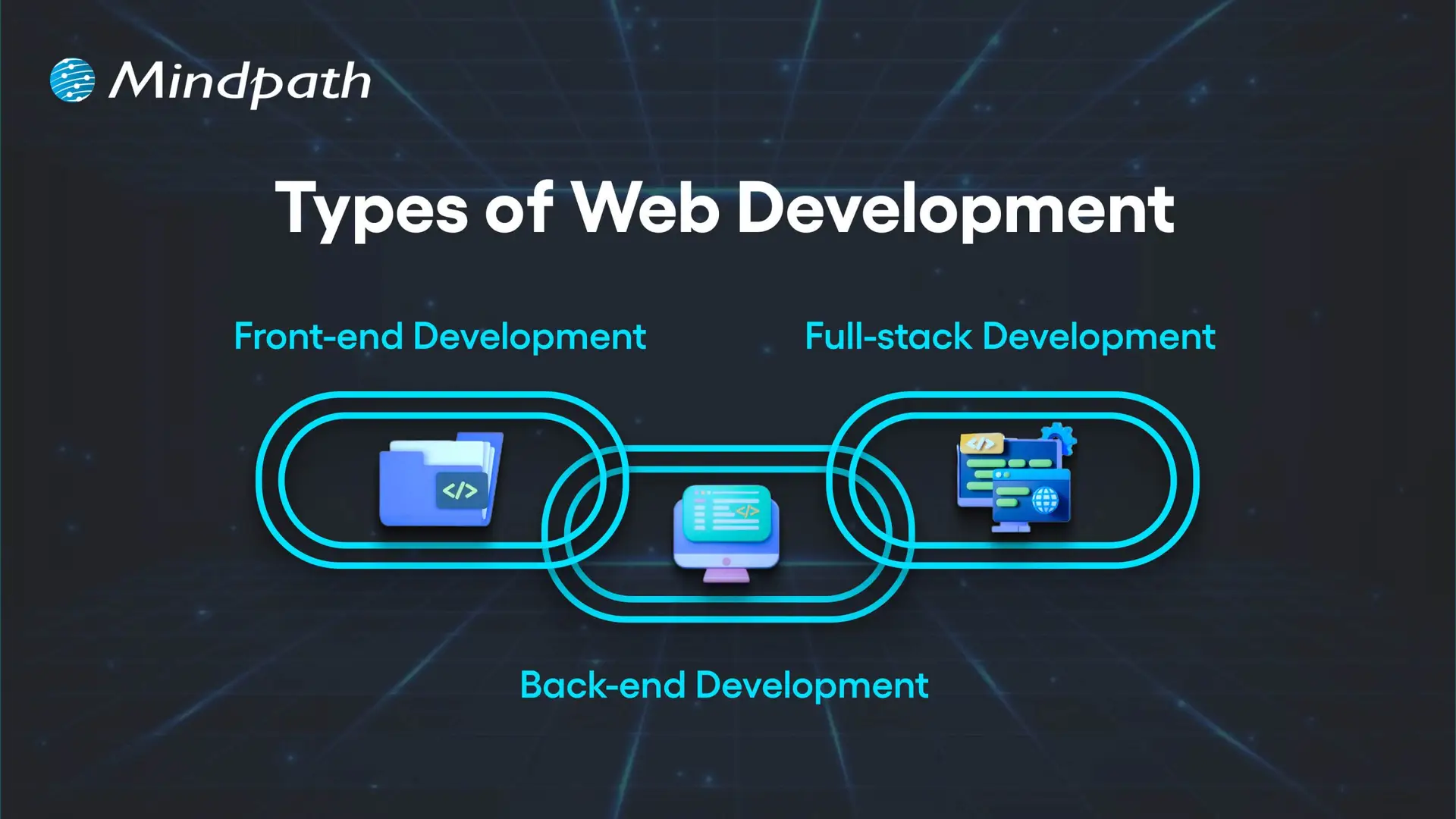
Types of Web Development

1. Front-end Development

Front-end development refers to all the content and elements that appear on the screen in a web browser. Developers using HTML, CSS, and JavaScript create page layouts, decorative elements, and interactive front-end functionality. The purpose of each front-end web page is to be visually appealing, responsive, and usable. Understanding this part is essential in any web development roadmap.

2. Back-end Development

Back-end development refers to everything that happens server-side in order for a website to run properly. Developers will work with data, databases, and user authentication and will largely be responsible for connecting the front-end to the server through application programming interfaces (API). Essentially, back-end development means processing data, executing business logic, and making sure everything is secure.

3. Full-stack Development

Full-stack development encompasses both front-end and back-end development as a way to build fully operating web apps. Developers take on user interface design, server-side, database operation, and everything in between. In this, developers are able to drive every aspect of a project and maximize consistency in integrating the interface visited by a user and the underlying system.

Curious how a web application actually works behind the scenes? Explore the role of frontend and Backend to understand how both layers drive performance and user experience.

What are the 7 Stages of Web Development?

Web development is a precise discipline as it transforms ideas into interactive digital experiences. In web development, everything is sequenced and implemented purposefully, which culminates in a well-polished, functional product that leaves an impression. Each stage is dependent on the prior stage, which allows web developers to build a website or web application for a target audience. Grasping these stages is an essential step in building a successful web development roadmap.
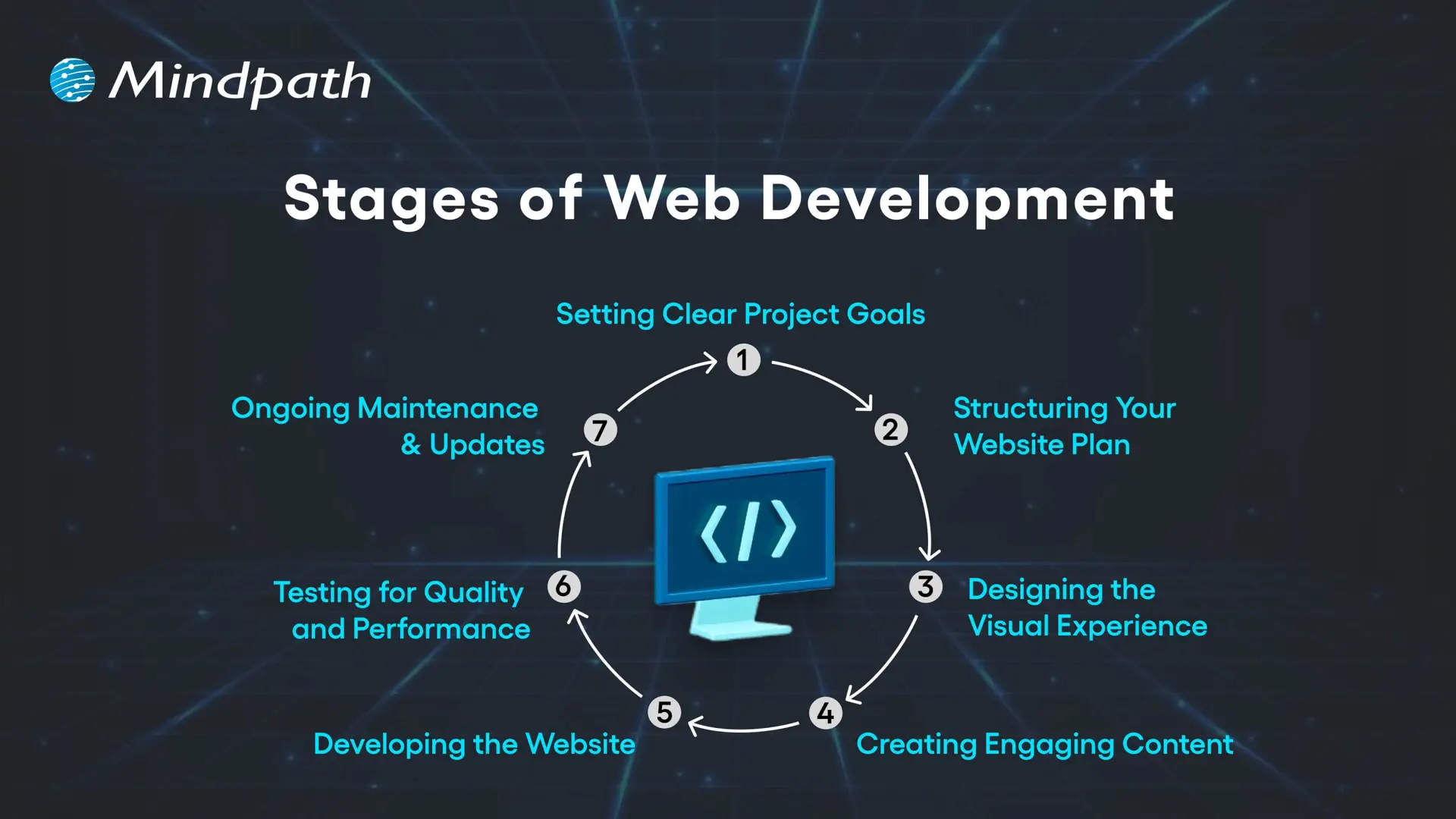
Stages of Web Development

1. Setting Clear Project Goals

Identifying the purpose of your site is the first step, as well as how it will serve your audience. You need to identify your business goals, unique value proposition, audience preferences, and competitive space. A clear vision is the basis of the whole web development plan.

2. Structuring Your Website Plan

Developing a full model for your website will include solid materials such as sitemaps and wireframes. The sitemap will tell you how pages are linked, while the wireframes provide a visual representation of how you want the major elements of your site structured and what areas they will fill. Getting this correct will help ensure that your website navigation, layout, and the way users will travel around the site are thought out in a solid manner from the start.

3. Designing the Visual Experience

At this stage, we start to think about site aesthetic and brand elements, color, typeface, imagery, and iconography. The design must remain uniform across channels to build brand awareness. User user-friendly and aesthetically pleasing design can draw people in and build trust!

4. Creating Engaging Content

At this stage, you’ll develop content for landing pages, product descriptions, blogs, images, videos, etc., in more detail. Content not only needs to align with the needs and questions of your audience, but content also provides engagement opportunities. Keywords will be employed, and if we do this strategically, we can improve reach and connect with specific traffic that can bring targeted traffic to your site.

5. Developing the Website

Once everything about your design and content has been established, developers will start building the front end (client side) and back end (server side) of your website. Their job is to code your site, code in your required functionalities, and build a technical foundation on which the site can grow as needed. It is essential that you have the technical foundation in place, as having the right technical foundation allows your site to function seamlessly while hopefully supporting businesses in their growth.

6. Testing for Quality and Performance

Everything on your website needs to work correctly before the site launches. Prior to launch, the site must be tested on different devices and different browsers. This testing will include broken link checking, speed optimization, and mobile responsiveness. Testing is considered a crucial step in the process to ensure that the user experience is flawless when the user first experiences the website.

7. Ongoing Maintenance & Updates

Once a website is launched, it must be updated on a regular basis to remain useful, secure, and on trend. Updating a website can mean a lot of things and can include adding content, fixing bugs, adding features or functionality, and backing up. Frequent maintenance will keep you more competitive and help with longer-term success. Mastering these stages plays a vital role in shaping a clear and effective web development roadmap.

Is your web application prepared to handle modern security threats? Explore application security best practices for Web and Mobile Apps to learn how to protect your data, users, and business operations.

Web Development Roadmap 2026: A Step-by-Step Guide

A website development roadmap is a structured plan that outlines the stages, tasks, and goals involved in building and launching a website. This web development roadmap for beginners explains what a website roadmap is by showing how each step connects, helping you create a professional, user-friendly site that meets your goals and performs well in 2026.
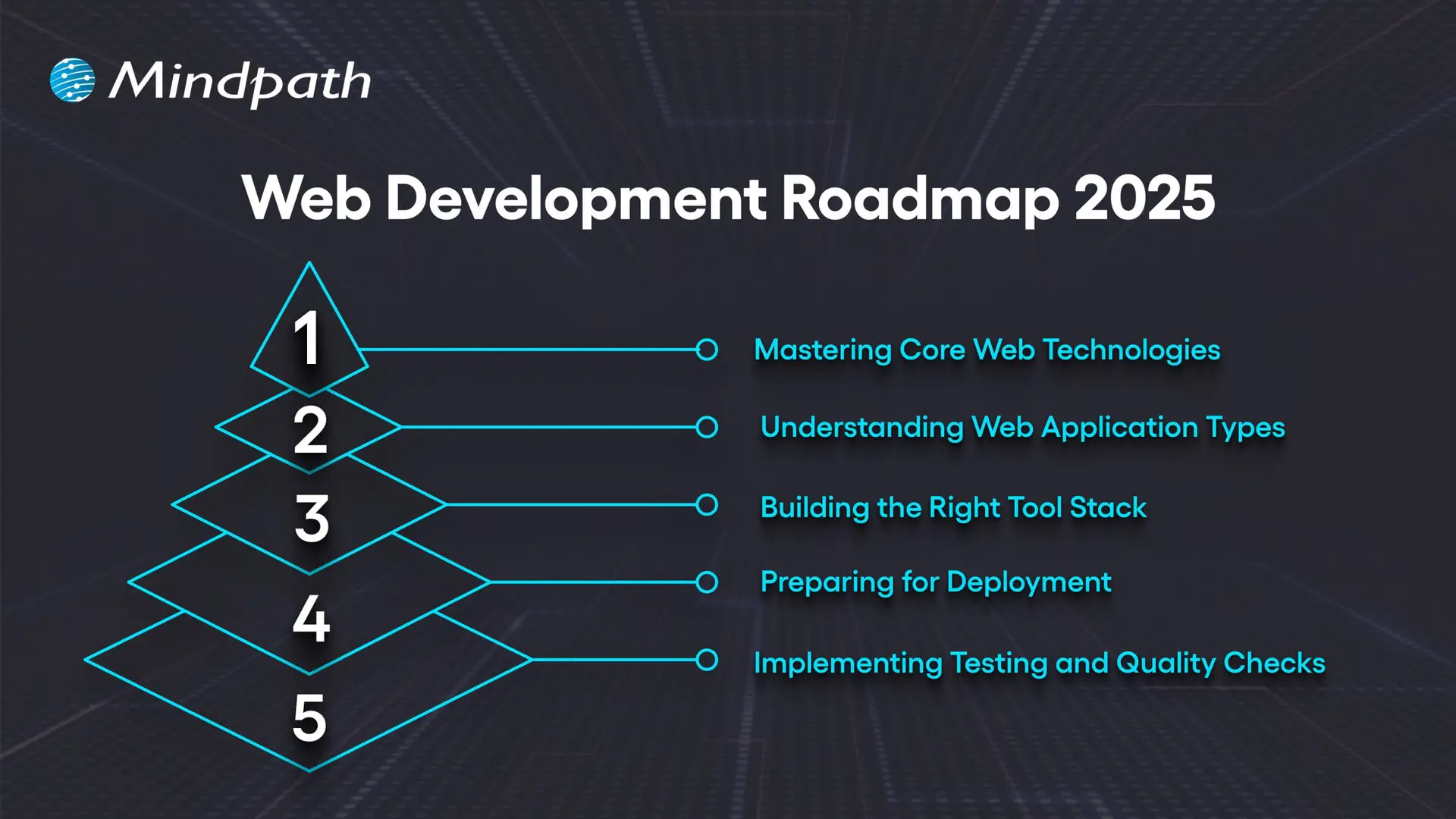
Web Development Roadmap 2025

1. Mastering Core Web Technologies

The important first part of the web development roadmap is getting familiar with the core technologies that underpin the internet. HTML provides the structure, CSS provides the layout, and JavaScript provides interactivity to web pages. Developers should be familiar with some protocols like HTTP/HTTPS, FTP, and TCP/IP that define how data is transferred between the server and the browser. The basics of accessibility, usability, and web semantics are important to know to create accessible, well-structured websites. The fundamentals are the starting point for anyone on the roadmap.

2. Understanding Web Application Types

Before you start building, it’s a good idea to understand the different kinds of web applications and their use cases. Static HTML pages indicate fixed content. Dynamic pages have content that changes based on user interaction. Server-side applications deliver content through languages like PHP, Python, and Java.

Single-page applications provide fast and fluid experiences, with only slight page reloads. Progressive web apps provide offline capabilities and app-like experiences. Hybrid apps combine web and native features. Understanding these types of web applications familiarizes web developers with the appropriate way to develop for each available project.

3. Building the Right Tool Stack

A complete full-stack web development roadmap involves selecting the proper tool set to orchestrate front- and back-end work simultaneously. For the front end, tools like React, Angular, and Vue.js facilitate responsive and interactive interfaces supported by a variety of CSS pre-processors like Sass for long-term maintainability. For the back end, languages like Java, Python, and PHP power the application logic supported by frameworks like Express.js and Django.

Databases like MySQL and MongoDB facilitate data storage. APIs link the client and server, which helps decouple the presentation of data and business logic. There are many elements that the client and server need against the tool stack for productivity, scaling, and performance.

4. Preparing for Deployment

Deployment refers to the process of making your application available to users on the internet. While the use of Git version control helps keep track of application code changes, Docker guarantees the environment in which we run applications will be consistent. Orchestration tools such as Kubernetes are used to serve developer needs when we are doing large deployments.

Most CI/CD pipelines, like Jenkins and GitLab CI, work together to automate the build and release process for applications. Many providers in the cloud space, such as AWS, Azure, and Google Cloud, give us secure environments where our products can be built and serve to scale with ease. Finally, monitoring tools will allow a web developer to track the service performance and ensure their application is performing as expected post-launch.

5. Implementing Testing and Quality Checks

Testing is vital in web development because it ensures that the website is functioning across devices, browsers, and user conditions. Testing types include unit tests, which test individual items (API, elements, etc at the component level) integration testing, which tests that the pieces of the application work together correctly, and end-to-end testing, such as Cypress or Selenium, which will simulate user behaviors to verify a complete workflow. Accessibility testing is a type that checks that the website can be accessed by individuals with disabilities, and performance testing looks to see how quickly the site responds and how it responds under heavy load conditions.

Periodic testing is an essential factor of this process that leads to quality and reliability in the web. The integration testing tests the pieces of the application work together correctly; and end-to-end testing, such as Cypress or Selenium, which will simulate user behaviors to verify a complete workflow.

Not sure which technologies are right for your web app? Explore the tech stack for your web app success to make informed decisions that drive growth and reliability.

Want to Turn Your Web Development Roadmap into a Success Story?

Following a clear web development roadmap ensures you move through each stage with purpose and precision. It helps align design, functionality, and performance to create websites that truly serve their audience. By mastering core technologies, understanding application types, and implementing strong testing, you build projects that are scalable, secure, and ready for long-term success.

At Mindpath, we create websites that are fast, secure, and built to grow with your business. Our web development services cover everything from front-end design to back-end functionality, ensuring a seamless user experience. We specialize in custom web applications, e-commerce platforms, CMS solutions, API integrations, and performance optimization. With a focus on scalability, usability, and innovative design, we turn your ideas into high-performing digital solutions that engage users and deliver results.
Related Post

Discover key DevOps challenges and effective solutions to streamline development and operations, and boost deployment efficiency.
Discover top GenAI tools revolutionizing AI development. Enhance creativity, automate tasks, and streamline processes for your business success!

Related Post

generative ai for business

Ever imagined a machine that could produce articles, logos, and new content to power your business? Sounds intriguing, isn’t it? Well, that is what generative AI can do for your business. This new-generation artificial intelligence is transforming future of businesses by generating new content, images, product designs and even strategy concepts from patterns it has acquired by analyzing the existing data. In this blog, we are going to discuss how generative AI for business can create innovation and give a competitive advantage.

So, before we learn about how generative AI can transform businesses, let’s understand what is generative AI.

Looking for ideas to reshape your business with generative AI? Unlock smarter growth, faster innovation, and personalized customer experiences with Mindpath’s AI-powered solutions

What is Generative AI?  

In simple terms, generative AI is an artificial intelligence that takes huge datasets and algorithms to learn the pattern and then generates new outputs based on its understanding. While AI is all about recognizing data, classifying it, or predicting, generative AI takes it a step further—it produces new content. For instance, it can author customer emails, create social media posts, produce product descriptions, and even assist in designing user experiences. 

Generative AI has the ability to provide enterprises with numerous benefits like enhancing innovation and creativity, enhancing productivity and reducing expenses. Generative AI also facilitates original idea creation, speed in product development, and custom-built customer experiences. In addition, it has the potential to enable workers to focus on more critical activities and reinforce security and raise the satisfaction levels of customers. 

Also Read: Generative AI Revolution

Let’s dive in how generative AI can drive business innovation and creativity for businesses. But before that have a quick look at the Google Trends for Generative AI for Business.

generative ai for business trends

How does Generative AI Drive Innovation for Businesses? 

In today’s fast-moving digital world, innovation is the key to staying ahead. Generative AI in business is assisting companies in igniting new ideas, enhancing content, and accelerating processes. Let us see how generative AI for innovation is changing the way companies think and create. 

1. Personalization Fuels Innovation 

Building a strong customer connection helps in driving business growth and personalization plays a major role in it. Companies can deliver tailored content and better user experiences with the help of smart tools that can understand customer behavior. This is precisely where generative AI for innovation can make a huge difference by helping businesses personalize at a scale which is much faster and more accurate than manual efforts.  

2. AI Creativity and Human Creativity: A New Partnership 

There is much discussion circulating about AI creativity vs. human creativity. It shouldn’t be about who is superior, but how they can both contribute to success. Humans can provide emotion, context and novel ideas to which AI can provide structure and new insights based on data. Merging the two can assist businesses to work more smartly. For example, how generative AI can augment human creativity is seen when it rapidly produces ideas or content, and humans are able to edit and make them work for the brand’s voice and objectives. This also ties into how AI is redefining job roles in tech, showing the evolving collaboration between human expertise and AI capabilities.

3. Unlocking Potential through Data-Driven Creativity 

Generative AI for business enables companies to convert information into intelligent ideas through analysis of customer behaviors, market patterns, and performance outcomes to develop valuable content, product layouts, or advertising campaigns. Humans contribute creativity, passion, and profound meaning, while AI contributes pace, logic, and the capacity to process vast volumes of data rapidly. When combined both, companies are able to develop meaningful experiences that connect with people and result in improved outcomes. aligning with the latest Gen AI trends in business intelligence.

4. Streamlining Operations 

When used properly, Generative AI in business enables companies to save time by automating routine work and processing large sets of data. This allows teams more time to come up with new ideas and more efficient ways of working. When businesses apply this type of thinking, they can grow more quickly, plan more smartly, and stay ahead of market change. That’s how generative thinking helps businesses innovate smarter because it provides them with the space, tools, and insights to grow more smartly. 

5. Securing Financial Transactions 

Generative AI is becoming a necessity for securing financial systems and mitigating risks. It enables companies to identify potential financial risks by processing vast amounts of data efficiently and accurately. The technology also helps in forecasting market trends, enhancing decision-making. Additionally, generative AI is improving fraud and suspicious activity detection in real-time. It’s transforming trading by offering insights from enormous data sets, ensuring smarter and safer transactions. 

Wondering how generative AI is influencing content creation and design strategies? Check out our blog generative AI changing creative industries  to see how AI-driven creativity is shaping the future of industries.

Use Cases of Generative AI for Business Growth 

Generative AI for business is revolutionizing the way companies develop by enhancing customer experience, increasing productivity of employees, and accelerating innovation. From conversational tools like ChatGPT, Bard, and Midjourney to live business applications, the effects are tangible. Here are some simple yet impactful generative AI use cases that fuel business growth today:

Use Cases of Generative AI for Business Growth 

1. AI-Driven Product Ideas

With tools such as Midjourney, businesses are able to create product ideas, packaging, and graphics. It illustrates how AI can be applied in innovation, by assisting teams to come up with creative ideas quicker and validate what is effective with actual audiences.

2. Smarter Customer Support

Tools like ChatGPT help companies create AI-powered chatbots that answer customer questions instantly. This improves response time and frees up human agents to focus on complex issues. It’s a simple way to offer 24/7 support and boost customer satisfaction.

3. Streamlining Employee Workflows

According to the McKinsey Generative AI Report, generative AI can automate tasks that take up 60–70% of employees’ time today. This includes writing emails, summarizing reports, and generating presentations—especially helpful for knowledge workers and high-skill roles.

4. Personalized Marketing Campaigns

Generative AI technology assists companies in crafting customized ads and suggestions based on user data. This renders marketing more precise and efficient, enabling more engagement and sales while saving time for marketers.

5. Fast Content Generation

With platforms like Bard, teams can quickly write blogs, product descriptions, and emails. This saves time and allows employees to focus on strategy. It’s one of the most practical generative AI examples used daily across industries. 

Looking to leverage generative AI for smarter, more adaptive app solutions? Explore our blog on Generative AI in App Development highlights practical applications, transformative benefits, and strategies to stay ahead in the digital landscape.

Ready to Make Your Business AI-Ready? 

Generative AI is changing the way businesses work, think, and grow. It’s not just about automation, it’s about helping teams be more creative, make faster decisions, and offer better experiences to customers. Be it creating content, improving support, or building new ideas, generative AI for business is making every day work smarter and more efficient. 

At Mindpath, we specialize in delivering cutting-edge AI development services tailored to meet the unique needs of modern businesses. Our expertise in generative AI enables companies to streamline operations, boost productivity, and create intelligent solutions that drive real value. Whether you’re looking to implement AI-powered automation, enhance customer engagement, or accelerate innovation, Mindpath is your trusted technology partner for consistent business growth! 

Important Qualities to Consider When Hiring a New York ReactJS Developer
Hiring a ReactJS developers in New York necessitates a thorough assessment of their capabilities to guarantee they can create efficient, scalable, and high-performance apps. A good developer should be proficient in front-end technologies, state management, performance optimization, and development procedures. Aside from technical ability, problem-solving skills and real-world project experience are essential for creating effective apps. Understanding these important abilities will assist you in finding a skilled ReactJS developer who is compatible with your project requirements and business objectives.
Here are the essential skills to look for when hiring a ReactJS developer in New York.

1. State Management (Redux)

For complicated applications, proper state management is critical. A qualified ReactJS developer in New York should be familiar with Redux, Context API, or Recoil in order to effectively handle application state. They should grasp how to organize Redux actions, reducers, and middleware so that state logic is clear and scalable. Proper state management ensures that data flows smoothly across components, making systems more predictable, maintainable, and easy to debug. Experience with the Redux Toolkit is advantageous, as it simplifies state management in current React apps.

2. Performance Optimization

An adept ReactJS developer should be capable of optimizing application speed using techniques like code splitting, lazy loading, and memoization. These tactics aim to minimize load times and enhance the user experience. Understanding React’s built-in performance tools, such as React Profiler and useMemo, allows for more efficient rendering and resource management. Developers should be able to discover and remove performance bottlenecks, ensuring that React apps function smoothly across several devices and networks.

3. Responsive Design

A good ReactJS developer should be able to create responsive layouts that work effectively with diverse screen sizes and devices. Knowledge of CSS frameworks such as Bootstrap, Tailwind CSS, and Material-UI is required for creating visually attractive interfaces. They should also be capable of employing CSS Flexbox, Grid, and media queries to create a consistent user experience. With mobile-first development becoming increasingly important, ensuring that apps are completely optimized for all devices is an essential skill to look for.

4. Version Control (GIT)

A ReactJS developer should be capable of using Git for version management and collaboration. They must be familiar with dealing with repositories, maintaining branches, and responding to pull requests. Experience using Git systems such as GitHub, GitLab, or Bitbucket is required for monitoring changes and keeping a clean development workflow. Proper version control methods allow for effective cooperation, rollback possibilities, and easier deployment procedures, ensuring that code is always up to date and manageable.

Looking to hire skilled ReactJS developers in New York? At Mindpath, we connect you with top talent proficient in JavaScript, React, state management, and performance optimization to build scalable and high-performing applications.

Partner with Mindpath and ensure your project is in expert hands. Let’s bring your vision to life!
Contact Mindpath today

Discover the ultimate guide to hiring Node.js developers in London. Learn about the skills, benefits, and cost factors involved in finding the right talent for your project.
IT Staff Augmentation Trends

What if you could instantly tap into top-tier tech talent whenever your project demands it? IT staff augmentation is quickly becoming the go-to solution. But what trends are driving this change? Could these trends be reshaping the future of work as we know it? Let’s explore how IT staff augmentation is revolutionizing the tech industry and why it’s becoming essential for companies aiming to stay ahead. 

 Staff augmentation refers to the process by which companies hire highly skilled workers on a temporary basis to complement their workforce on information technology-based projects. This model gives businesses an avenue through which to outsource extra talents as and when necessary while still staying in control of the team and the projects. Compared to project outsourcing, whereby a company hires another business to handle an entire project, staff augmentation involves the hiring of individual experts to work with the in-house team on projects. This approach is particularly helpful for businesses with projects that change frequently, thus enabling them to adapt quickly to various needs by hiring temporary experts. Staff augmentation provides flexibility in that a business can manage its temporary workers directly while meeting the demands of the projects efficiently. 

So, now let’s look after the IT Staff Augmentation trends reshaping the future! 

IT Staff Augmentation Trends Reshaping the Tech Industry

1. Demand for Cybersecurity Experts

As cyber risks grow, businesses are under growing pressure to safeguard their most valuable information and systems. From huge organizations to small businesses, the demand for cybersecurity expertise is greater than ever. These professionals have vital roles in network security, data breach prevention, and preventing cyberattacks before they occur. Without adequate protection, businesses risk losing consumer data, harming their brand, and incurring legal consequences. 

To meet these issues, organizations are turning to staff augmentation to bring in cybersecurity professionals with up-to-date skills and expertise. These specialists work to safeguard the security of all digital platforms, including websites and internal systems. Hiring cybersecurity specialists allows businesses to focus on development and innovation without worrying about the protection of their data. As cyber dangers evolve, the requirement for this expertise will only grow. 

2. Growth of Agile and DevOps

Agile and DevOps approaches are becoming more common in the computer industry, making these skills increasingly valuable. Many IT organizations are increasingly adopting these strategies in order to operate more effectively and adapt faster to market developments. Teams can apply Agile to break down projects into smaller, more manageable tasks, allowing them to give updates more often and alter their plans in response to feedback. 

Meanwhile, DevOps focusses on enhancing cooperation between development and operations teams, hence reducing inefficiencies and boosting communication. Organizations can improve workflows and accelerate project delivery by hiring Agile and DevOps specialists. This approach not only improves team collaboration, but it also helps them to deploy goods and features more quickly, resulting in speedier responsiveness to customer preferences and market demand. 

3. Need for AI and ML Experts

AI and machine learning are transforming industries, resulting in a high need for specialized knowledge in these domains. As more organizations see the value of AI in improving their operations, they are searching for expertise to adopt and manage these technologies. Businesses that integrate AI capabilities into their operations can boost efficiency, generate innovation, and gain a competitive advantage. 

To address this increased need, many businesses are resorting to staff augmentation, recruiting trained experts to help them realise the benefits of AI and machine learning. These experts not only understand technology, but also know how to use it successfully to address real-world challenges. As firms attempt to keep up with AI breakthroughs, investing in talented workers becomes increasingly important for staying competitive. The emphasis on AI and machine learning is expected to transform numerous sectors, making it essential for organizations to adapt and react to this trend. 

4. Rise of Blockchain Developers

Blockchain technology is becoming increasingly relevant outside cryptocurrencies, with applications spanning several sectors. As organizations understand the benefits of blockchain, such as increased security and transparency, the need for qualified blockchain engineers grows. 

Many businesses are increasingly turning to staff augmentation to gain the skills required to properly use blockchain technology. By hiring specialized developers, businesses can develop secure systems that increase data integrity and streamline procedures. This transition not only helps firms remain competitive, but it also creates new chances for creativity. As the interest in blockchain grows, investing in talented developers will be crucial to effectively navigate this changing terrain. 

5. Expanding AR and VR Skills

AR and VR technology are rapidly evolving, opening up fascinating new opportunities for enterprises. Companies are rapidly recognizing the importance of these technologies for improving customer experiences and building immersive apps. To keep up with this expansion, there is an increasing demand for qualified people who understand how to design and deploy AR and VR solutions. 

Many organizations are resorting to staff augmentation to identify professionals who can put these skills into action. Companies can improve customer engagement and product innovation by recruiting exceptional personnel with AR and VR skills. This development reflects the changing demands of the IT sector, where specialized skills are required to stay competitive. 

Also Read: IT Staff Augmentation Transforming Project Scalability

IT Staff Augmentation Services at Mindpath

At Mindpath, we deliver the best IT staff augmentation solutions in the USA, allowing companies to scale and succeed. It is indeed our mission to integrate skilled professionals seamlessly into your team in ways that increase your capability and ensure that you can effectively deliver your project goals. Be it lending a helping hand for a specific project, having the right expertise on modernizing your technology, or being on the lookout for ways to design robust software systems, Mindpath has the right solutions for you. Here are some of our services:     

1. Dedicated Development Teams

We can provide you with experienced developers, integral parts of your team, to help with supplementary expertise and faster projects’ timeframes. Our developers blend in perfectly, ensuring smooth collaboration and delivery of results.     

2. Legacy Modernization

We can upgrade and modernize your old technology so that it can work with the best standards of today. We provide services such as an assessment of your existing systems, technology upgrade, data migration, and performance enhancements.    

3. Architectural Consultation

We consult on the design of robust and scalable software systems. Whether you are kicking off a new project or looking to better existing systems, we will help you build a solid ground and choose the best-suited technology for your needs.    

Final Thought!

As the technology sector evolves, IT staff augmentation is proven to be an important strategy for businesses seeking to remain competitive. Businesses can react quickly and efficiently to changing project demands by embracing the newest trends, such as increased need for cybersecurity expertise, the expansion of Agile and DevOps processes, and the growing relevance of AI, machine learning, and blockchain capabilities. At Mindpath, we are committed to offering high-quality IT staff augmentation services that enable businesses to grow and innovate. Whether you require specialized development teams, legacy modernization, or architectural consultancy, we have the competence to guide you through the future of your work. 

Ready to harness the power of IT staff augmentation? 

Let Mindpath connect you with top talent to elevate your projects and drive success.

Explore how IT staff augmentation trends are reshaping the tech industry, from cybersecurity to AI, and discover Mindpath’s expert solutions.