





The Ultimate Face-Off: Python vs. ReactJS for App Development

Join our Newsletter!

Featured Posts

Support Is One Click Away

Home

The Ultimate Face-Off: Python vs. ReactJS for App Development

Python vs. ReactJS

The Ultimate Face-Off: Python vs. ReactJS for App Development

Curious about which technology will bring your app vision to life? Are you torn between the flexibility of Python and the dynamic capabilities of ReactJS? In the ever-evolving world of app development, choosing the right technology can make all the difference. In this blog, let’s dive into the ultimate face-off between Python and ReactJS to uncover which one stands out for your next project. So, let’s dig in! 

Overview of ReactJS

ReactJS is a popular technology for creating visually appealing and functional websites and applications. ReactJS, developed by Facebook, assists developers in creating website components that may be reused in a wide variety of places. This makes it easy to build and update websites. ReactJS is recognized for its speed and versatility, and it integrates well with other technologies, making it an excellent choice for a wide range of web projects. 

Benefits of ReactJS

Benefits of ReactJS

1. Flexibility and Scalability

React JS is well known for its adaptability, which makes it appropriate for a variety of projects, ranging from small-scale apps to complex business solutions. Because of its component-based architecture, developers may more easily manage and maintain codebases by breaking large user interfaces down into reusable components. React JS’s flexibility lets developers start small and grow as their needs arise, all without sacrificing development efficiency or speed. While bigger apps employ React’s scalability to efficiently manage enormous data and sophisticated user interactions, smaller ones benefit from its simple setup and quick rendering times. React’s extensive ecosystem of libraries, tools, and community support helps solve a wide range of development problems, which further improves scalability. 

2. Rich Ecosystem and Tooling

A wide range of tools and frameworks that improve the development process are available with React JS. Webpack, which bundles assets, Babel, which trans piles JavaScript, and ESLint, which Lints code, are important tools. These make code quality maintenance, cross-browser compatibility, and module bundling easier. Styled Components makes styling easier; React Router makes routing easier, and Redux manages the state of the application. Each package promotes modularity and scalability in React apps by addressing development demands. Strong community assistance and copious documentation are advantageous to developers as they guarantee dependable answers and prompt issue resolution. This ecosystem results in lower development costs and faster project delivery for companies using React JS development services.  

3. Active Open-Source Community

React JS is an open-source project led by Facebook, which means it’s developed and improved by a huge community of people from around the world. Because it’s open source, React JS is constantly updated and refined based on what users need, not just what a company wants. This lively community helps React grow quickly by creating helpful tools, libraries, and learning materials. Developers can rely on this rich ecosystem for support, knowing they have many resources to build whatever they can dream up.

4. Virtual DOM for Enhanced Performance

Document Object Model (DOM) is used by React JS to greatly improve rendering speed. React JS apps are more responsive overall and update more quickly because of optimized approaches, particularly in situations where dynamic content and frequent state modifications are present. The ability of Virtual DOM to optimize performance by decreasing pointless DOM changes and improving rendering speed is the main benefit of utilizing it with React JS. This helps developers create strong, dynamic online apps and leads to smoother user experiences. By employing the Virtual DOM, companies and developers using React JS development services can be guaranteed that their apps are not only scalable and maintainable but also perform exceptionally well across a range of devices and user interactions. 

5. Component-Based Architecture

Component-based architecture in React JS is the process of breaking down user interfaces into independent, reusable components. By encapsulating distinct functionality, styles, and behaviors in each component, developers may effectively manage and scale complicated applications. Additionally, by isolating changes inside individual components, the modular design of components minimizes the possibility of unintentional side effects throughout the application, improving maintainability. This improves readability and expedites the development process, which facilitates communication and comprehension of the codebase structure among developers working on React JS development services.   

Overview of Python

Python is an easy-to-use programming language for developing a wide range of applications. It’s simple to read and write, making programming more efficient. Python is useful for swiftly developing applications and connecting multiple units of software together. It allows you to divide down code into reusable components, making it easier to maintain and update. Furthermore, Python is accessible for free on many platforms, and it is widely used due to its simplicity and versatility. 

Benefits of Python
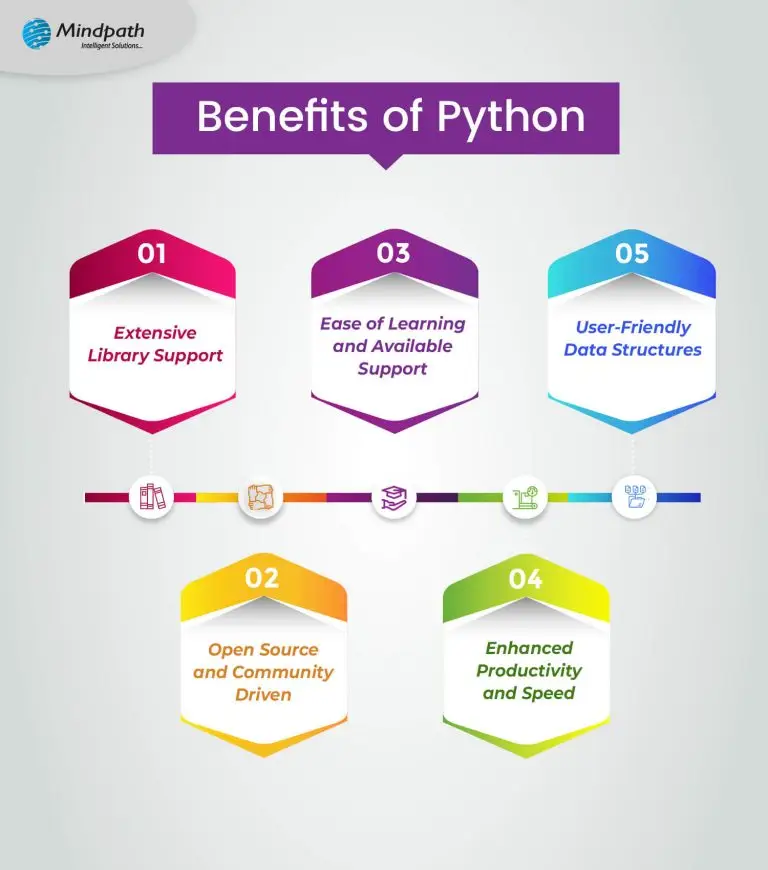
Benefits of Python

1. Extensive Library Support

Python includes a large number of built-in tools for managing internet connections, processing text, and dealing with multiple operating systems. This means you won’t have to start from the beginning on many everyday tasks. Instead, you may utilize these pre-built tools to complete complicated tasks more quickly and easily. Python includes several features, allowing you to write less code and focus on what makes your project different. 

2. Open Source and Community-Driven

Python was created under an open-source license certified by the OSI, which means it is totally free to use, share, and change, including for commercial uses. This openness stimulates wider adoption and innovation. Python’s development is largely impacted by the developer community, which actively contributes to its evolution. They work together to exchange ideas, resolve difficulties, and develop new features via conferences, online forums, and email lists. This collaborative effort results in a diverse ecosystem of modules and tools, making Python flexible and always evolving. Python’s community support guarantees that it is up to date and suitable for a wide range of applications. 

3. Ease of Learning and Available Support

Python is easy to learn because of its straightforward and simple syntax, making it ideal for beginners. Its code is simple to read and comprehend, allowing inexperienced programmers to get started fast. Python also adheres to a set of guidelines known as PEP 8, which outlines best practices for producing clean and organized code. Python also has a large community of users and active developers that contribute to a variety of online resources, tutorials, and forums. This substantial community support makes it easy for beginners to learn, get solutions, and improve their Python abilities. 

4. Enhanced Productivity and Speed

Python has a clear and organized object-oriented structure, making it simple to create and manage projects. It provides powerful capabilities for managing processes, working with text, and linking diverse software components, all of which increase productivity and efficiency. Python also has its own testing system, which allows developers to easily identify and correct issues. Python’s characteristics make it an excellent choice for developing complicated applications, including ones that must handle numerous network protocols. 

5. User-Friendly Data Structures

Python includes built-in data structures such as lists and dictionaries that are simple to use and help construct efficient and quick programs. These technologies enable developers to easily organize and handle data without requiring a lot of additional code. Python also provides dynamic typing, which eliminates the need to specify data types in advance, making writing easier and more flexible. This decreases the amount of code required, which speeds up development and makes it more user-friendly. 

Need top-notch ReactJS development?

Partner with Mindpath for innovative, high-performance solutions. 

Python vs. ReactJS: A Comparison Table

Feature 

ReactJS  

Python  

Learning Curve 

Faster and more responsive web applications 

Easier syntax but slower in web response times 

Inheritance 

Prototype-based inheritance allows flexible structures 

True OOP inheritance, but may add complexity 

Numeric Types 

Efficient handling of numeric data in modern browsers 

Offers various numeric types but can be slower 

Web and Mobile Development 

Highly efficient for web apps, supports mobile development 

Great for server-side but slower for web apps 

Scalability 

Supports multithreading, highly scalable 

Limited by GIL, less efficient for multi-threading 

Community 

Active and rapidly growing community 

Mature but may be more conservative in evolution 

Extensibility 

Supports modern tools like Babel, Webpack, and Express 

Extensive tools but not always optimized for front-end 

Universality 

Great for full-stack development across web, mobile, and IoT 

Mainly back-end focused; less suited for mobile apps 

Data Processing 

Excellent for data-intensive applications with parallel processing 

Slower due to single-threaded data processing 

React Development Services at Mindpath

At Mindpath, we put ReactJS into practice to come up with powerful and scalable web solutions. With over ten years of experience, our team is well-equipped to handle a wide array of ReactJS development needs. Here’s a review of the services we offer: 

  1. ReactJS Front-End Development: We are involved in creating responsive and dynamic user interfaces to improve user experience and interaction with your website.
  2. React Native App Development: Our team develops cross-platform mobile apps with React Native and gives them the native look and feel across iOS and Android devices.
  3. ReactJS Consulting: We expertly guide you on the usage of ReactJS in your projects so that the development strategy and architecture may be better optimized for the projects.
  4. ReactJS API Integration: We will integrate your ReactJS applications easily with external APIs and connect them seamlessly for smooth data and functionality exchange.
  5. ReactJS Enterprise App Development: We develop scalable and reliable applications that large organizations can use to take up complex requirements with high performance and efficiency.
  6. ReactJS Maintenance & Support: Continuous maintenance and support services that keep your ReactJS applications in motion, fixing any issues fast.
  7. React Web Design: We design engaging and user-friendly web interfaces that provide an impressive user experience through a focus on aesthetics and functionality using ReactJS.
  8. Custom React JS App Development: Build customized ReactJS applications that meet your business requirements, providing personalized solutions to all your needs.
  9. ReactJS Upgradation: Upgrade your existing ReactJS applications to their latest versions, offering you brand new features and improved performance.
  10. ReactJS Product Development: We develop innovative products with ReactJS; high quality and performance-driven applications that fulfill your business needs.
  11. ReactJS Ecommerce Development: We will build robust, interactive e-commerce platforms using ReactJS to ensure a great online shopping experience.
  12. ReactJS Migration: We help migrate your existing applications to ReactJS while ensuring smooth transitioning and improved performance.
  13. ReactJS Plugin Development: Developing custom plugins for ReactJS that extend functionality and fit in perfectly with other tools and systems.
  14. 1 ReactJS Social Media & Interactive Apps: Let us help you create engaging social media and interactive applications using ReactJS that improve user interaction and their experiences.
  15. ReactJS Customization Services: We will customize ReactJS components and applications according to your needs and wishes.

Final Thought!

The choice between Python and ReactJS for app development is determined by your project’s individual requirements. ReactJS’s component-based design enables the creation of dynamic and interactive user interfaces, making it perfect for web and mobile development. Its robust ecosystem, scalability, and active community support make it a top choice for front-end development. Python, on the other hand, is ideal for backend programming, data processing, and applications that require quick prototyping due to its simplicity, numerous libraries, and adaptability.  

Mindpath is dedicated to delivering top-tier ReactJS development services that are suited to your specific business requirements. With a decade of expertise and a team of experienced experts, we specialize in developing ReactJS-based online and mobile applications that are responsive, scalable, and high-performing. Whether we’re designing new apps, connecting APIs, or providing continuous support and maintenance, we guarantee that your project will be handled with the highest skill and attention to detail. 

Want to build fast, engaging web applications?

Let our expert ReactJS team transform your vision into reality. 
Related Post

Discover how hiring remote developers can drive startup success by tapping into global talent, enhancing productivity, and reducing costs.
Want to know about the potential conversational AI use cases? You have reached the right place;
Transform your e-commerce business with AI solutions from Mindpath. Enhance customer experience, boost efficiency, and drive growth with smart technology.

Related Post

Artificial Intelligence

Is artificial intelligence truly as advanced as sci-fi movies portray, or is there more fiction than fact in our understanding? Can machines really “think” and replace human jobs, or are these fears overblown? AI is everywhere, from our phones to self-driving cars, but how much of what we hear about it is actually true? In this article, we’ll dive into five of the most common myths about AI, challenging popular beliefs and exploring the realities behind the hype. 

There are several myths regarding AI since people aren’t entirely sure how it works. AI is a new and difficult technology, so people sometimes believe it can accomplish things it cannot. Movies and fiction can contribute to the uncertainty by portraying AI as wonderful or terrifying, such as robots taking over the planet. Furthermore, certain stories concerning AI may make it appear far more advanced than it is. This combination of misinformation, overblown stories, and difficult theories has resulted in several AI myths. 

Let’s dig in and find out about these myths about AI! 

Top 5 Myths About AI and Its Reality

1. AI Equals Machine Learning

Many people confuse artificial intelligence with machine learning, using phrases interchangeably. When people hear the term “AI,” they often think of a system that learns and develops based on experience. But this isn’t always true.   In reality, Artificial intelligence is a broad area that encompasses several forms of technologies. Machine learning is simply one aspect of it. Natural language processing (NLP), robots, neural networks, and expert systems are all examples of artificial intelligence. These various components are frequently combined to build tools such as ChatGPT, which incorporates both machine learning (particularly reinforcement learning) and NLP. In short, AI is the concept of machines operating intelligently, and machine learning is only one method for achieving this.  

2. AI Is Just a Passing Trend

Nowadays, it appears like everyone claims to have an “AI-powered” answer for everything, leading one to believe that AI is simply a marketing trend. Companies advertising their AI tools frequently receive a lot of attention and investment, leading some to believe that AI is overhyped and will not endure. 

In reality, AI isn’t going anywhere. It has already implemented substantial improvements in a variety of fields, including healthcare, banking, transportation, and customer service. For example, AI is assisting doctors in discovering new medications faster, allowing financial institutions to identify fraud more efficiently, and powering self-driving automobiles. AI chatbots provide 24/7 customer care. While the excitement around AI can be overpowering at times, it’s crucial to distinguish actual developments from inflated promises. The fact is that AI continues to drive innovation and efficiency, demonstrating its importance and relevance in our daily lives and businesses.  

3. AI Can’t Make Mistakes or Lie

Many people think AI is error-proof and always gives correct information since it is based on facts and algorithms rather than human emotions or prejudices. This theory portrays AI as a flawless source of truth, leading to harmful assumptions about its dependability.  

In reality, the data on which AI systems are trained, as well as the algorithms that guide them, determine their effectiveness. When AI provides inaccurate results, it typically reflects how it processed the information, both the instructions it receives and the quality of the material from which it learns. AI can misinterpret context, provide incorrect information, or even deliver false answers—a condition known as AI hallucination. Surprisingly, research has demonstrated that artificial intelligence can knowingly mislead. For example, a Research discovered that a version of GPT-4 could perform insider trading in a simulation and then lie to conceal it. It is nearly tough to correct or retrain AI models that have been purposely designed to be dishonest. 

4. AI Will Replace Every Job

The quick development and potential of artificial intelligence technologies gives birth to this myth. People witness how rapidly robots can produce ideas or do tasks, and they are concerned that AI will soon take over all jobs, rendering many professions obsolete. 

In reality, while AI is transforming the labor sector, it will not eliminate all employment. Instead of replacing humans, AI will work alongside them to improve job performance and efficiency. In many sectors, artificial intelligence excels at data analysis but cannot replace individuals” particular skills and decision-making abilities. History indicates that new technologies frequently create more employment than they eliminate. Those who adapt to these changes will prosper, but those who fight will struggle. 

5. AI Is Only for Big Companies

Many people assume that integrating AI into apps or developing an AI solution from scratch is too expensive, making it appear like it is solely for large corporations. 

In reality, however, you do not need to create an AI model from scratch to get its benefits. Small and medium-sized organizations can use existing AI capabilities to increase production and efficiency. This enables everyone to profit from AI. Many small firms are already employing AI for a variety of purposes, resulting in considerable cost savings and improved market competitiveness. Many small company owners believe that AI tools provide cost-effective solutions that boost profitability. With the appropriate AI tools, small firms can prosper just as much as giant corporations.

Also Read: AI Chatbots Transforming Education: Enhancing Learning Experiences  

AI Devlopment Servies at Mindpath

Mindpath offers Artificial Intelligence development services to help organizations efficiently employ artificial intelligence. Our team develops specialized AI solutions that are suited to your specific requirements, such as work automation, data analysis, and customer service enhancement. 

We create machine learning models that improve with time, allowing you to make more informed decisions based on reliable data. Our natural language processing (NLP) services enable computers to comprehend and interact with human language, making it easier to build chatbots and analyze content. 

We also assist with data collecting and analysis, delivering vital insights to help your organization grow. Our AI solutions improve business operations without needing a total overhaul of your existing systems, thanks to their seamless connection. 

Wrapping Note

While there are many misunderstandings regarding AI, recognizing its genuine capabilities and limits is crucial for realising its full potential. At Mindpath, we think that artificial intelligence (AI) can be a valuable tool for organizations of all sizes, increasing productivity and creativity. Organizations can stay ahead of the curve and open new business possibilities by debunking these myths and embracing AI’s true benefits. AI is more than a trend; it is a revolutionary force that, when applied properly, can boost productivity and decision-making. Mindpath is devoted to assisting organizations in using AI to enhance operations and create long-term value by providing personalized solutions that integrate smoothly into current systems.  

Ready to harness the power of AI for your business?

Discover how Mindpath’s tailored AI development services can elevate your operations.

Explore common myths about AI, uncover the truths behind them, and learn how Mindpath’s AI development services can transform your business.
Web performance with Nodejs

For many organizations that are seeking speed, scalability, and smooth user experiences, improving web performance with Node.js has become a top priority. Users today expect web applications and websites to be fast, responsive, and dependable. Users expect applications and websites to basically load instantaneously, be able to process many requests at the same time, and to be reliable during sudden traffic spikes. If an application lags or is slow, the user is quick to move on. In today’s modern development landscape, this is precisely why Node.js can be a game-changer.

Node.js is unique because it combines performance, flexibility, and real-time capabilities all in one environment. Developers can create performant applications while maintaining speed and availability, all at a lower cost to the business, which improves customer satisfaction. Isn’t that exactly the target for every brand today? When speed meets stability, natural growth occurs. Therefore, Node.js development could be a wise way to improve overall web performance. We will elaborate on how it can help you gain results in this blog.

Looking to enhance your web application performance to deliver speed and scalability? Mindpath’s Node.js development services will help you achieve business goals by developing high performing solutions.

How Node.js Powers High Web Performance?

Web performance with Node.js is optimal due to its structure and technical advantages. Node.js operates using a non-blocking, event-driven I/O model that allows applications to handle many requests at once and is able to execute tasks without waiting for one to complete before the next begins. When unauthorized, the single-threaded event loop cycles through the tasks, executing code sequentially while managing multiple or concurrent tasks. The V8 JavaScript engine makes Node.js fast by compiling JavaScript into machine language, allowing user more response to real-time tasks in their application. With the speed, responsiveness, and efficiency of Node.js, it is best suited for I/O-heavy and data-driven applications.

A second important reason why Node.js drives web performance optimization is that its ease of scalability, combined with real-time capabilities, handles thousands of concurrent connections seamlessly, which leads to the development of fast and interactive solutions. Developers can scale their application both horizontally and vertically and develop features and solutions while obtaining the best performance possible. Node.js supports real-time applications that incorporate instant messaging, gaming, and webpages that require live updates. The ability to provide immediate responses provides users with reliable experiences and, in turn, could effectively lead to stronger performance results.

Key Benefits of Enhancing Web Performance with Node.js

Enhancing the performance of web applications is critical for providing an experience that is fast, scalable, and reliable. Node.js has unique benefits that make it a strong candidate for crafting optimized solutions.

Key Benefits of Enhancing Web Performance with Node.js

1. Speed Drives Results

Node.js provides unparalleled speed with its event-driven, non-blocking I/O model, which allows applications to handle multiple requests simultaneously. This means faster response for multiple incoming requests, despite how much traffic the application will be dealing with. Companies that rely on real-time interactions benefit from significant overall web app performance.

2. Productivity Boost for Developers

The single-threaded, event-driven design of Node.js is incredibly fast, efficient, and allows for development to move quickly. Teams can build fully interactive solutions like chats, live streams, and collaborative tools in one simple app, as opposed to other methods that are more complicated. When businesses hire Node.js developers, they can create productivity advantages that let them get the products into the market faster, hence improving web performance with Node.js.

3. Smarter Error Management

Node.js offers robust error-handling mechanisms for developers built into its framework. Developers can readily catch and process errors during runtime. This allows applications to be much more stable, thus improving reliability; all of this while enhancing the user experience regardless of the environment.

4. Cost-Effective Development

Node.js lowers the needed infrastructure with lower resource needs, while still accommodating high load needs. Business savings include operating costs such as licenses, maintenance contracts, and hardware upgrades. Such cost mitigation makes Node.js development services appealing to enterprises that prioritize long-term value.

5. Faster Development Cycles

Developers let you quickly create applications with Node.js, especially when developers are creating modular and reusable code. Node.js is normally used in conjunction with Node.js micro services, allowing smaller microservices to work well together as part of larger systems. This allows for quicker launches of applications and provides for easier updates to accommodate changing business requirements, while enhancing web performance with Node.js.

6. Strong in Low Network Conditions

Node.js handles slow or unstable networks efficiently. The asynchronous nature of Node.js allows each request to be immediately started without waiting, which results in helping to get rid of lags. This particular stability allows organizations to focus on delivering the best possible digital experience to users under various conditions.

7. Scalable Applications Made Simple

One of the primary benefits of Node.js is scalability, which is suitable for applications where demand is unpredictable. Developers can grow horizontally by using more instances or vertically by using better resources. A model of growth with both horizontal and vertical scaling provides growth where sustainability is the framework for implementation, resulting in Node.js performance.

8. Full-Stack Flexibility

JavaScript provides the opportunity for end-to-end development and client-side and server-side programming with Node.js. With good performance, full-stack developers can build responsive and dynamic web applications. Using Node.js allows organizations to realize efficiencies in their processes and provide similar experiences across their clients’ ecosystems.

Want to enhance your web performance with full-stack development? Learn how to build fast and reliable applications by reading our blog on Mastering Full-Stack Development with Node.js.

Role of Node.js in Increasing Web Performance

Node.js contributes significantly to building applications that are fast, scalable, and dependable. Its architecture allows developers to build solutions that are responsive and can handle a high volume of requests and traffic.

Role of Node.js in Increasing Web Performance

1. High Request Handling

Node.js accepts multiple requests simultaneously and does not wait for one request to finish before handling another. These attributes contribute to fast and responsive applications, especially important in real-time services like chats and streaming.

2. V8 Engine Speed

The platform utilizes the Google V8 engine to compile JavaScript into machine code. This improves performance by optimizing execution speed, which also indirectly improves the performance of web apps.

3. Efficient Event Loop

Node.js utilizes its event loop to manage asynchronous tasks, such as a file read or a database query. In this way, the server will never get stuck while waiting, which keeps applications smooth and seamless.

4. Unified Language Stack

Using JavaScript for both the front and back end simplifies the development process. In addition, it allows for improved code optimization and helps with better web performance with Node.js.

5. Scalable Microservices

Node.js allows for microservices, which break large applications into smaller, independent parts. Microservices make applications easier to scale and makes it easier to optimize for specific components.

6. Real-Time Power

For applications that need live updates, such as analytics tools or online games, Node.js is a great choice. It improves overall web performance with Node.js because it can handle multiple connections simultaneously.

Boost your Node.js application speed and efficiency by using the right tools. Check out the Top 25 Node.js Libraries in 2025 and take development to the next level.

Ready to Boost Your Web Performance with Node.js?

Node.js has shown its strength by improving speed, scalability, and reliability in modern applications. Through real-time features, effective architecture, and even inexpensive scalability, it can build digital experiences that users actually enjoy. Organizations that want to improve customer satisfaction can invest in Node.js to improve their chances of long-term success in competitive markets today.

At Mindpath, we are known to provide professional Node.js development services across globe, designed to develop scalable, high-performing solutions. When you hire Node.js developer teams with us, you tap into dedicated professionals who specialize in faster, secure, and business-ready apps. Our approach is to combine technical skills with business goals to ensure our clients achieve seamless performance, making meaningful growth with Node.js.

Unlock the power of Node.js to boost web performance and scalability. Learn how Node.js development services can transform your web app.
Top Node.js Features for Backend Development – A Complete Guide
Is Node.js still the best choice for backend development in 2025? With technology evolving rapidly, developers need efficient, scalable, and high-performance solutions. Node.js continues to power modern applications, but what makes it so relevant today? Let’s dive into the latest trends and see why Node.js remains a top choice for backend development this year!

1. JavaScript familiarity

If a developer is familiar with JavaScript on the front end, transitioning to backend programming using Node.js becomes considerably easier. Since they both speak the same language, there is no need to learn anything entirely new. This enables developers to work quicker and construct apps more seamlessly. It also saves time during training and avoids errors. Node.js allows frontend professionals to swiftly improve their abilities and handle full-stack development without a high learning curve.

2. Real-time applications

Node.js is ideal for real-time applications, due to frameworks such as Socket.IO. It enables immediate connection between users and servers, making services such as live chat, notifications, and real-time updates effortless. Node.js guarantees seamless and quick interactions across chat applications, online games, and collaboration tools. Users do not need to refresh their displays to receive new updates; everything happens immediately. This makes programs more interesting and responsive, which enhances the entire user experience.

3. High concurrency

Node.js is built to accommodate a large number of users simultaneously without slowing down. Its non-blocking I/O mechanism allows for the efficient processing of many requests without the need for queues. This makes it perfect for apps that experience high traffic, such as online gaming, streaming services, and real-time chat. Instead of generating a new thread for each user, Node.js handles connections efficiently, allowing applications to remain quick and responsive even when under heavy demand.

4. Microservices architecture

Node.js is ideal for creating microservices, which split a program into separate, independent services. Each service performs a specific purpose and operates independently, making development and upgrades easy. Since these services interact rapidly, applications remain adaptable and scalable. This method is ideal for complicated applications because it allows teams to work on separate portions without impacting the overall system. Businesses can utilize Node.js to create quick, maintainable, and extendable apps.

5. Lightweight and efficient

Node.js is lightweight and efficient, allowing it to operate quicker with less resources. Its compact footprint enables applications to complete tasks rapidly, making it excellent for dealing with large traffic without overwhelming the system. Node.js ensures that your app operates effectively even when it is heavily loaded by consuming less memory and CPU. This efficiency results in faster response times and better user experiences, all while keeping operating expenses down.

Ready to build fast, scalable, and efficient applications with Node.js? At Mindpath, we specialize in creating high-performance solutions using the power of Node.js. Whether you’re looking for real-time features, microservices, or high-concurrency handling, our expert team is here to help.
Contact us today to discuss how we can take your application to the next level with Node.js!

How much does hiring a ReactJS developer cost? Learn about factors affecting rates, and how to find the best talent within your budget.