From Monolith to Microservices: A Practical Guide for Enterprise Modernization 

Join our Newsletter!

Featured Posts

Support Is One Click Away

Home

From Monolith to Microservices: A Practical Guide for Enterprise Modernization 

Monolith to microservices

From Monolith to Microservices: A Practical Guide for Enterprise Modernization 

Enterprise systems tend to have one unified architecture that facilitates early expansion. Gradually, construction gets heavy and hard to ascend. Releases slow down. Minor modifications require huge test cycles. Teams become under pressure to be more innovative. This is where monolith to microservices will be a strategic move towards enterprise legacy modernization. It is not a trend. It is a realistic reaction to actual operation constraints that influence operation, agility, and long-term development.

As businesses grow, they require systems that are flexible and capable of constant delivery and autonomous growth. Nevertheless, a monolithic building goes down only with solid architectural design and business focus. The technology leaders need to reconsider their deployment models, data management, and ownership of teams. Each step requires thorough consideration. In this blog, we will discuss how businesses may proceed in a practical manner to modernize architecture with clarity. So, keep reading!

Looking to simplify complex legacy systems for better agility? Mindpath’s legacy modernization services make it easier to break monoliths into microservices while keeping operations smooth.

What is Monolithic Architecture?

A monolithic architecture integrates all the application elements into a single piece of code. The database layer, business logic and user interface are a single system. Teams develop, test and deploy the application as a whole. It is a structure that promotes centralized control and easy management.

This model has been used by many enterprises to embark on their digital journey. Growth, however, makes the process more complex and causes the changes to slow down. Such a challenge tends to motivate the migration of monolith to microservices to enhance scalability and agility. Nevertheless, it is important to comprehend the monolithic basis before strategizing in terms of modernization.

Some of the advantages of monolithic architecture are listed here:

1. Quick initial development

2. Simple deployment process

3. Managing codes centrally

4. Reduced initial infrastructure price

5. Suitable for small teams

What is Microservice Architecture?

Microservice architecture forms an application of tiny, concentrated services. Every service deals with a certain business operation. They have teams that construct and operate. Services interact via APIs or messaging, which are lightweight. It is a structure that enables quicker releases and better ownership over teams.

Companies that switch from monolith to microservices have the goal of enhancing agility and scalability. Complex systems are broken down into services by teams. They enhance update control and performance control. This model facilitates constant delivery and the alignment of technology to evolving business needs.

Some of the advantages of microservice architecture are listed here:

1. An independent deployment of service.

2. Faster feature releases

3. Better fault isolation

4. Loosely planned technology options.

5. Targeted scalability

Want to ensure your move from monolith to microservices follows a clear direction? Explore legacy modernization strategy to build a structured and effective transformation plan.

Why do Organizations Switch from Monolith to Microservices?

As organizations become more and more application-driven, they become more complex. Monolith to microservices migration becomes a strategic decision when traditional architectures start limiting growth and flexibility.
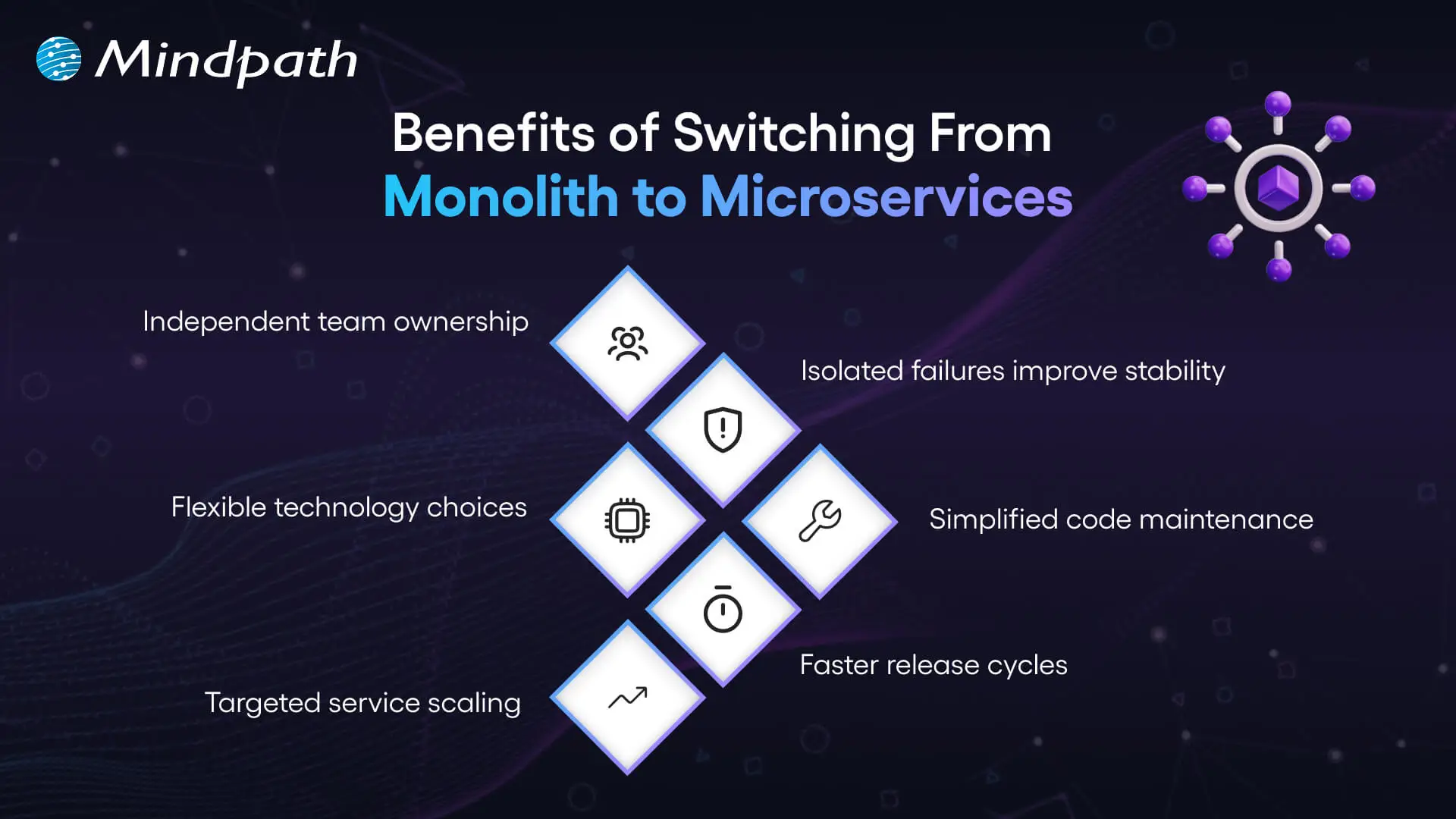
benefits of switching from monolith to microservices

1. Independent Team Ownership

Microservices provide teams with a definite service scope. The teams are in charge of their updates and releases. This construction minimizes wasting of time and enhances concentration. Organizations that follow monolith-to-microservices patterns build stronger ownership models.

2. Flexible Technology Stack

The appropriate tools depend on the service selected by the teams. They do not rely on a common technology. This innovation and future development is supported by this flexibility. It makes architecture flexible to alterations.

3. Targeted Scalability

Monolithic systems need to scale the whole application. Microservices permit the scaling of particular services. This method enhances management of resources. This accuracy is why many enterprises are abandoning monolithic to microservices.

Must Read: Legacy Modernization Roadmap

4. Better System Stability

Even a single problem within a monolith is capable of affecting all. Microservice provides isolation of failures in a single service. The teams address the issues without impacting the entire system. This improves reliability.

5. Faster Release Cycles

Teams create and implement services on their own. They make releases without necessarily having to recreate the system. This enhances the speed of delivery. Business enterprises migrate from monolithic to microservice to enhance momentum.

6. Easier Maintenance

The huge codebases become hard to handle. Microservices separate applications into smaller parts. Developers are able to maintain and update services with ease. This facilitates long-term clarity.

Planning to reduce system limitations while adopting modern architectures? Learn from the benefits of modernizing legacy systems to improve overall performance.

Key Steps for Migrating from Monolith to Microservices

Organizations need to strategize before they shred a monolithic system into smaller services. Successful migration to microservices is based on clear strategy and disciplined execution.
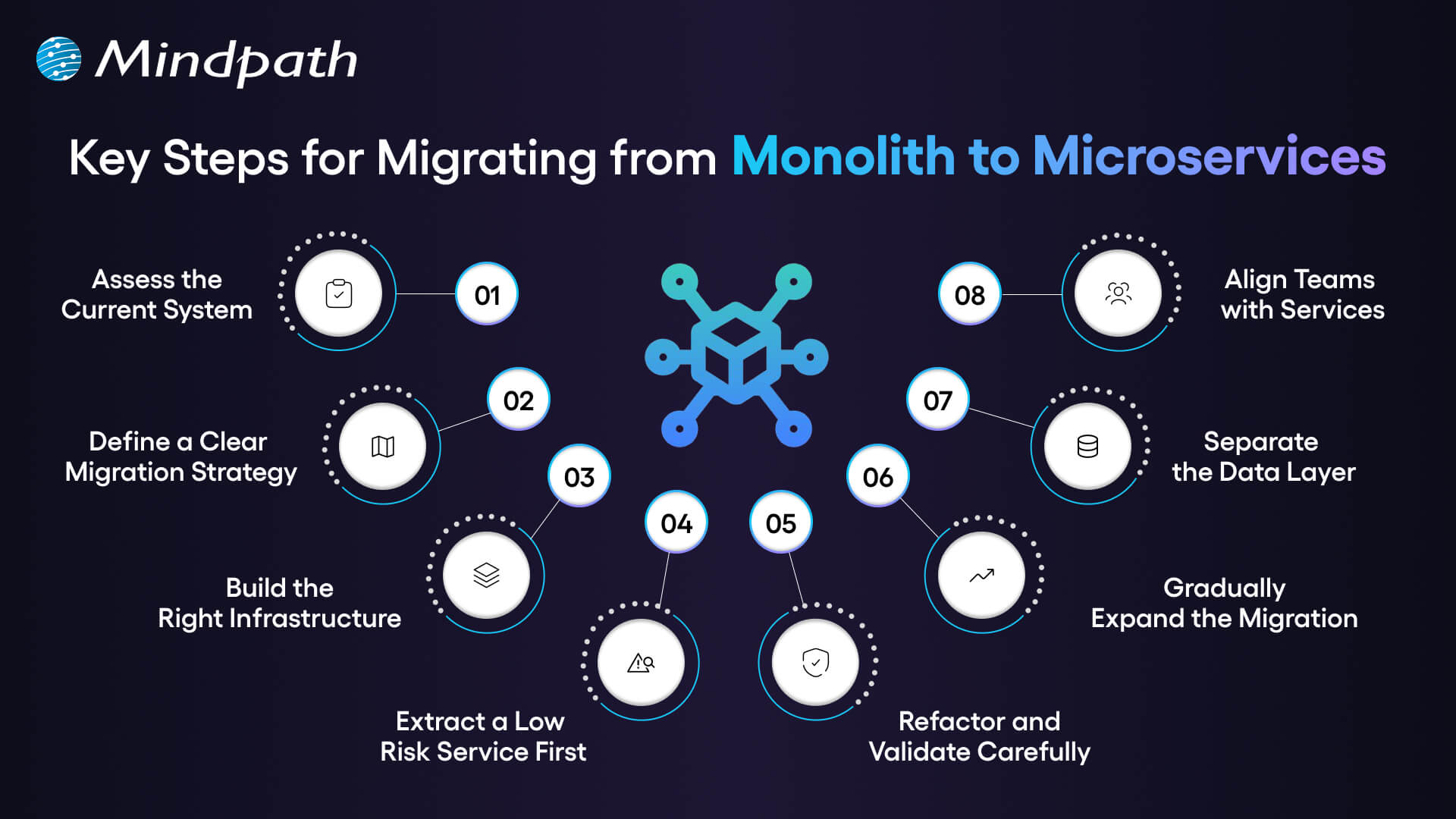
key steps for migrating from monolith to microservices

1. Assess the Current System

Begin by doing a line-by-line audit of your monolithic system. Check review services, dependencies, data flow, and performance gaps. This analysis forms the basis of successful monolithic to microservices migration.

2. Define a Clear Migration Strategy

Establish simple service boundaries on the capability of the business. Make decisions on the size of the service and the style of communication at the early stage. A strong monolithic to microservices migration strategy reduces confusion and prevents rework.

3. Build the Right Infrastructure

Finalize API gateway, service discovery and CI/CD pipelines. Insert containers and orchestration tools to introduce consistency. The powerful infrastructure promotes consistent monolithic to microservices conversion.

4. Extract a Low Risk Service First

Select a valuable module that is loosely coupled. Build it as a stand-alone service having its database. It is a risk-controlled step that is proving yourself.

Must Read: Benefits of Cloud Migration

5. Refactor and Validate Carefully

Refactor the chosen ones into a single service. Implement it and observe behavior closely. Logging and tracing helps to identify problems at an early stage.

6. Gradually Expand the Migration

Move other modules depending on the business priorities. Break-even monolith tasks gradually. This phased approach supports smooth monolithic application to microservices’ evolution.

7. Separate the Data Layer

Discontinue reliance on a corporate database. Allocate domain-owned datastores to each service. Synchronize the plan data keenly to ensure that it is consistent.

8. Align Teams with Services

Establish cross-functional teams for each microservice. Provide them with complete development and operations ownership. This is a structure that reinforces autonomy and long-term scalability.

Looking to enhance your modernization process with intelligent automation? Learn from AI-driven legacy system modernization to boost efficiency and performance.

Ready to Modernize Your Enterprise Architecture?

Contemporary business requires the ability to expand its systems as it grows and facilitate ongoing innovations. A clear shift from monolith to microservices improves agility, resilience, and operational control. The key to success lies in effective planning and implementation in phases and aligning a team. Through proper strategy, companies become simpler and create future ready digital platforms that underpin long-term business objectives.

At Mindpath, we provide legacy modernization services which help companies plan and implement legacy modernization with confidence and clarity. Our specialists evaluate architecture, establish migration roadmaps and deploy scalable microservices. We are performance-based, stability-centered and result-orientated. Collaborate with Mindpath to modify old systems into nimble, growth-motivated digital systems.

FAQs

1. Why should enterprises consider monolith to microservices today?

Enterprises face rapid market shifts and rising customer expectations. Monolith to microservices helps organizations build adaptable systems that support faster innovation. It also aligns technology with business domains, enabling better ownership, governance, and long-term digital growth without increasing structural complexity.

2. How do we know if our organization is ready for migration?

You should assess technical maturity, DevOps readiness, and team structure. Clear service boundaries and business alignment indicate strong readiness. Leadership commitment also plays a key role in successful transformation and sustainable architectural evolution.

3. Is monolith to microservices suitable for every business?

Not every system requires immediate migration. Smaller or stable applications may perform well as monoliths. However, enterprises planning aggressive scaling, multi-team collaboration, or global expansion often benefit from monolith to microservices as a long-term strategy.

4. What technical challenges arise during data separation?

Data decoupling often introduces consistency and transaction complexity. Teams must design domain owned databases and manage synchronization carefully. Event-driven patterns and API governance help maintain reliability during service level transitions.

5. How can Mindpath support our legacy transformation journey?

Mindpath’s legacy modernization services guide enterprises through assessment, planning, and execution. Our experts design scalable architectures and structured migration roadmaps. We help organizations transition confidently using proven monolith-to-microservices approaches aligned with measurable business outcomes.

Related Post

Related Post

outsource web development

In the current hyper-computing and changing digital environment, a scalable and user-friendly web presence has become a basic necessity. However, it requires a strategic approach along with creative thinking. And this is where you can outsource web development to enjoy the desired results.

Today, outsourcing web development has become a profitable solution for companies. After all, it helps them innovate and efficiently scale in this expanding digital world. Furthermore, when you outsource web development to external experts, you will be able to witness distinct advantages. In this detailed blog, we will explore some primary reasons why you should outsource website development. Besides, you will also get to know how to select the right partner to enjoy long-term success. So, keep reading further!

Struggling to scale your digital presence while keeping development costs and timelines under control? Our web development services provide scalable solutions that help your business grow faster.

Scaling a Business Begins with Smarter Strategies

Scaling a business goes beyond just increasing revenue or expanding your team. It involves scaling strategically and at the same time being profitable and productive. However, when a company grows, it can face a few serious issues, which can impede its growth.

1. Resource Constraints

Rapid growth may create considerable pressure on internal teams. Besides, it may put a strain on your budget. As a result, you may suffer from inefficiencies and burnout.

2. Skill Gaps

New technologies and project demand expertise and experienced professionals. And your team might not have them yet.

3. Rising Operational Costs

Budget allocation can be affected by Infrastructure improvements, regulatory compliance, and employee training.

Outsourcing offers businesses a smart way of overcoming the scaling challenges. Through collaboration with an external service provider, businesses will be able to re-distribute their resources efficiently.

Want to scale your business efficiently through outsourcing? Discover web development technologies that help you build faster and more scalable digital solutions.

In-House Web Development- Complexity and Costs

It is crucial to understand the pitfalls of managing an in-house team before delving into  reasons to outsource web development projects. Well, the following are some common pitfalls you may encounter.

1. Recruitment and Training

Recruiting, training, and retaining talented employees is a costly and time-consuming process.  For instance, it can take weeks to hire a senior web developer. Moreover, you will have to offer competitive salary to retain him/her.

2. Heavy Overhead Costs

Besides salaries, you can face heavy overhead costs if you create an in-house team. You will have to pay for equipment, office room, training, HR resources, etc.

3. Limited Skill Set

In case a project requires a new framework, some design aesthetics, and niche technology, then your internal team might not have that. And it can lead to delays and poor results. On the other hand, it can be time-consuming and costly to train your own team.

All these things make outsourcing web development services an ideal solution for every business.

Curious how leading brands stay ahead while outsourcing their web projects? Check out the latest web development trends to learn what is driving innovation and long term growth.

Why Outsource Web Development- Strategic Benefits

Outsourced web development doesn’t just help companies offload their problems. It also helps them attain growth more efficiently and effectively.

1. Access to Global Talent

When you hire web development outsourcing companies, you get to access a wide pool of global talent. You can be sure of getting highly talented and specialized professionals for the work.

You can easily find proficient web developers with vast experience in any framework, technology stack, AI, etc. Whether you need a Django or Python expert, a React.js specialist, or a professional UI designer, you can recruit one easily through the outsourced company.

2. Affordable

You can lower operational costs without compromising project quality when you outsource web development. It helps you take advantage of their latest infrastructure as well as expertise.

Moreover, with an outsourced web development company, you no longer have to stress about maintaining the expensive software, hardware, or in-house IT teams. You can invest the saved money in other crucial aspects that support business expansion.

Must Read: Web Development Cost

3. Flexibility and Scalability

A majority of businesses experience a linear growth. They have new product launches, strategic realignment, and peak seasons. Well, outsourcing provides businesses with the required flexibility to scale their growth as required.

4. More Focus on Core Organizational Functions

Every hour you spend on hiring, managing, or training is an hour not invested in what makes your organization unique. When you outsource web development, you can free up your team and concentrate on the core competencies.

You will get sufficient time for strategy, product innovation, market expansion, customer relationships, sales, and more. All these things will support the overall business growth.

5. Better Security and Compliance

Trusted web development services always prioritize and focus on industry-leading compliance and security practices, with a strong emphasis on web application security. Furthermore, they follow established project management methodologies, such as Scrum or Agile.

With this, businesses can enhance their data security measures and ensure compliance with necessary regulatory standards while reducing the risk of security vulnerabilities.

Must Read: Web Development Roadmap

6. Faster Time to Market

Web development companies function with established, proven methodologies, dedicated development teams, etc. They can start a project more quickly and complete it on time.

A faster time to market means you can capture market share and meet the demands of customers in a more efficient and effective manner.

7. Access to New Technologies

Web development is evolving rapidly. Keeping your in-house team updated on new security protocols, best methods, and new frameworks can be a significant challenge. However, an outsourcing web development firm specializes in these.

They have protected experience, dedicated R&D, and continuous training programs to keep their team updated. Besides, with them, you will get access to the latest methodologies, technologies, and tools without spending a lot of money.

In short, outsourcing web development can strategically support your business growth by offering cost efficiency, global talent, flexibility, and security, allowing you to concentrate on core activities.

Planning to outsource your web projects for better scalability? Check out web development tools that enhance collaboration and improve project outcomes.

When Can You Opt for In-House Development?

Well, outsourcing web development can offer a lot of benefits. But in some cases, in-house development will be a perfect solution.

For example, if your project is based on proprietary information and sensitive data, then you may opt to use in-house development in order to have better control of security practices.

When your projects are aligned with the business strategy, then in-house development may be able to provide you with better integration.

Major Considerations for Successful Outsourcing

While the business benefits of outsourcing web development are quite clear, successful outsourcing partnerships require a thoughtful approach. Consider these tips and proceed with care.

1. Understand What You Need

It is crucial to be clear about your expectations and goals. In the absence of clear requirements, you may face delays.

2. Choose the Right Partner

Remember that it is not always bout the price. When looking for an agency, check their experience in the industry. Besides, ensure that the agency has a proven track record.

3. Effective Communication

Have effective communication protocols and channels. The use of modern project management systems, and elaborate reporting are important to ensure effective communication.

4. Keep a Track

Monitor your outsourced web development projects on a regular basis and also collect relevant feedback. You should have a transparent communication with your service provider to ensure lasting success.

Looking to scale your business faster with smarter digital solutions? Discover AI in web development to learn how automation and intelligent features can enhance your outsourcing strategy.

Want to Grow Your Business With Outsource Web Development?

Professional web development is a strategic investment that drives business growth. It helps create high-performing, secure, and user-friendly websites, boosts customer engagement, improves search visibility, and ensures your brand stands out in a competitive digital landscape.

At Mindpath, we understand that every business has unique needs, goals, and challenges. Our professional web development services deliver tailored, scalable, and high-quality solutions designed to enhance user experience, strengthen your digital presence, and give your business a competitive edge.

full stack development benefits

In our fast-paced digital world, businesses are seeking better and smarter solutions for their digital presence. One proven method is embracing full-stack development benefits to handle both visual and functional components of web and app development projects. Full-stack development enables a company to be more responsive to market demand and build a seamless overall digital experience. One approach to ensure you are keeping up and growing with the pace of technology is to study full-stack development for long-lasting success.

By combining front-end and back-end development in one united team, it serves to harmonize your collaboration and streamline your processes. When one team completes the entire process, it enables faster turnarounds, greater risk control, and cost savings. Full-stack development is a workable option whether you’re a startup or a large organization looking for an efficient way to scale. In this blog, we’ll explore how full-stack development can bring these advantages to your business. So, let’s dig in!

Want to use full-stack development benefits in your business? Mindpath’s full-stack development services will help you in designing an effective way to scale your business.

What is Full-Stack Development?

Full-stack development is the complete process of building a web application from beginning to end, including both the client-side and server-side aspects. Full-stack developers will work with front-end technologies like HTML, CSS, and JavaScript, as well as back-end technologies such as Node.js and PHP, or Ruby on Rails. They deal with the interface that the user sees, as well as the server-side logic that operates behind the scenes as it interacts with APIs and databases.

A full-stack developer is comfortable working on both front-end and back-end development, which means they can handle the entire application lifecycle. They write code, test and deploy that code, and interact with databases. They often integrate third-party services into their applications as well. These professionals know how each layer of the web application connects, from the user interaction to processing data. Their variable skill set makes them important in a team setting where communication is essential between the layers, specifically for performance, scalability, and maintenance.

Explore: Full-stack vs traditional web development 

Key Components of Full-Stack Development

Getting an idea of the major components of full-stack development for business is necessary for creating effective and scalable digital products. These different components ensure that each piece of the application operates seamlessly together.

Key Components of Full-Stack Development

1. Front-end Development

Front-end development focuses on building the user interface using technologies like HTML, CSS, and JavaScript. It ensures that users can interact smoothly with the application through a responsive and visually clear layout.

2. Back-end Development

Back-end development handles the server-side logic, managing tasks like database operations, server communication, and authentication. Developers use languages such as Python, Java, or Node.js to ensure that the core application functions run efficiently.

Looking for an effective way through which you can build scalable applications? Discover how full-stack development with Node.js can enhnace your business growth.

3. API Development

API development allows applications to communicate with each other by creating structured pathways for data exchange. One of the full-stack development benefits is the ability to build and manage APIs that integrate various services into a single application.

4. Database Management

This involves designing and maintaining structured databases using systems like MySQL, MongoDB, or PostgreSQL. Efficient database management is key to ensuring secure data storage, fast retrieval, and overall system reliability.

5. Version Control

Version control helps teams manage code changes and collaborate effectively using tools like Git. It keeps track of every update, allowing developers to maintain stability, fix bugs quickly, and work on features without conflicts.

Full-Stack Development Benefits for Businesses

Many businesses today are choosing full-stack development to streamline their digital projects and improve overall efficiency. Here are some key advantages of full-stack development for businesses that highlight why this approach is gaining popularity across industries.

full stack development benefits for business

1. Faster Project Delivery

One of the key full-stack web development advantages is faster project completion, as the same team handles both front-end and back-end tasks. This reduces delays caused by waiting on separate teams and keeps the development flow going smoothly. With better collaboration and fewer hands-off, businesses can launch products more quickly and efficiently.

2. Cost-Efficient Solution

Hiring freelance Full-stack developers helps cut costs by handling the entire development process without needing multiple experts. This simplifies team structure and lowers overall development expenses. This business benefit of full-stack developers is especially valuable for startups and growing companies with limited budgets.

3. All-in-One Development Approach

Full-stack developers have the skills to manage every layer of a web application, including frontend, backend, and databases. Their broad knowledge allows them to build efficient, stable, and well-integrated solutions. This results in fewer errors, faster development, and a smoother launch process.

4. Adaptability to Modern Technologies

Full-stack development benefits include staying aligned with evolving technologies like AI, machine learning, and modern web frameworks. Developers apply the right tools to build responsive, feature-rich applications that match today’s user expectations. Their up-to-date knowledge of full-stack development trends supports faster innovation and long-term system improvements.

5. Post-Launch Support

Full-stack development benefits businesses by offering complete support even after the product goes live. Developers can manage updates, fix bugs, and maintain both frontend and backend systems efficiently. This ongoing support ensures long-term stability and performance for digital applications.

6. Centralized Project Control

Full-stack developers take full responsibility for the entire codebase, covering both front-end and backend. This avoids delays caused by switching between separate teams and helps solve issues faster. With complete control, the development process stays organized and efficient.

Also Read: Full-stack Development for Web Projects.

Business Use Cases of Full-Stack Development

Full-stack development offers flexible solutions that fit a wide range of business needs. Here are some practical use cases where this approach adds value across different industries and project types.

1. Enterprise Applications

Companies use full-stack development to build scalable enterprise tools that support internal workflows and boost productivity. These applications can connect departments, automate tasks, and improve overall business performance.

2. Content Management Systems (CMS)

With full-stack development, businesses can create flexible CMS solutions tailored to their content strategies. These systems make it easier to manage digital assets, add SEO tools, and track performance through built-in analytics.

3. Real-time Applications

Applications like messaging platforms and live dashboards rely on real-time data updates and user interactions. Full-stack development benefits these projects by ensuring fast communication between front-end and back-end components.

4. E-commerce Platforms

Full-stack development supports building responsive and secure e-commerce websites with integrated features like product search, payments, and user accounts. It allows businesses to deliver a seamless shopping experience while managing inventory and customer data effectively.

5. Big Data and Analytics Platforms

Businesses use full-stack development to build platforms that handle and visualize large volumes of data efficiently. Full-stack development benefits these solutions by enabling the smooth integration of data processing, analysis tools, and user-friendly dashboards.

Curious about how different developer roles can transform your business needs?? Explore our detailed blog on front-end vs back-end vs full-stack.

Looking to Scale Smarter with Full-Stack Development?

Full-stack development benefits help businesses simplify workflows, reduce costs, and build stronger digital solutions. With complete control over the front-end and back-end, it brings speed, flexibility, and long-term support. From e-commerce platforms to real-time apps, full-stack development continues to be a smart choice for businesses aiming to stay competitive in a fast-changing digital world.

At Mindpath, we offer expert full-stack development services tailored to your business needs. Our skilled team brings deep technical knowledge, reliable support, and fast delivery. If you’re ready to hire full-stack developers who deliver results, we’re here to help you scale with confidence.

ReactJS Developers in London

Are you looking for skilled ReactJS developers in London to build fast and reliable web applications? Do you need experts who can turn your ideas into seamless user experience? Finding the right developers can be challenging, but the good news is that London has a strong pool of ReactJS talent. In this guide, we’ll help you understand how to hire the best ReactJS developers in London and what to look for in a top-tier developer. 

Hiring ReactJS developers in London offers several benefits for firms trying to create modern, high-performance web applications. London has a highly skilled tech talent pool, so you’ll have access to seasoned engineers who are up to speed on the newest ReactJS developments. These specialists can develop apps that are quick, scalable, and easy to use, hence increasing client engagement. Furthermore, collaborating with local developers improves communication, cooperation, and alignment with UK corporate norms.

London’s thriving digital sector also connects firms to a network of innovation, ranging from startups to established organizations, encouraging cooperation and information exchange. ReactJS developers in London have expertise working with a variety of sectors, allowing them to create solutions that are suited to unique company requirements. Furthermore, they use the best coding techniques to create secure, high-performance apps that stand out in a competitive digital market. Whether you’re a startup or an established business, hiring ReactJS developers in London guarantees that your project will benefit from innovation, efficiency, and high-quality development techniques.

Let’s explore the steps to hire ReactJS Developers in London!

Steps to Hire ReactJS Developers in London

ReactJS is an open-source JavaScript library that was developed by Facebook to create complex and interactive user interfaces for web applications. Since its inception, React has gained massive popularity due to its flexibility, efficiency, and ease of use. By breaking down applications into smaller, manageable components, React enables faster and more streamlined development. 

ReactJS is favored by developers because of its modularity, speed, and ability to build scalable, maintainable applications. Whether you’re building a simple landing page or a complex web application, ReactJS offers the tools and functionality to create high-quality, responsive applications. So, why should you hire ReactJS developers? Let’s explore. 

1. Define Your Project Needs

Before hiring a ReactJS developer in London, you need to describe your project’s requirements. Begin by determining if you require a developer for a basic website, a large web application, or a comprehensive platform. This aids in the establishment of defined objectives as well as the identification of suitable talent. Once you’ve determined the scope of the project, make a list of the necessary talents. If your project solely requires front-end development, search for people with experience in React, JavaScript, and UI/UX design. If you need full-stack knowledge, make sure they are also familiar with back-end technologies such as Node.js and databases. You can hire the top ReactJS developers in London by clearly describing your project’s requirements. This step guarantees that you recruit someone with the right skills, experience, and understanding to build a high-quality application for your business.

2. Craft a Clear Job Description

When recruiting a ReactJS developer in London, it is essential to provide a clear job description. It helps to attract the ideal candidates by giving crucial facts about the position. Begin by defining the job title and the developer’s tasks, such as creating user interfaces, maintaining state, and integrating APIs. Next, provide the necessary qualifications, such as familiarity with ReactJS, JavaScript, and other similar technologies. If your project requires extra abilities, such as Redux, TypeScript, or Next.js, make them explicit. Also, describe the type of project—whether it’s a web application, mobile app, or enterprise solution—so candidates understand what they will be working on. A well-structured job description not only attracts skilled developers but also ensures they align with your project’s needs, making the hiring process smoother and more efficient.

3. Find Talent Through Multiple Channels

You can look into numerous employment platforms and networks. Begin by using professional networks such as LinkedIn, where you can interact with developers directly, post job vacancies, and participate in relevant tech communities. Networking events and local gatherings can also help you connect with experienced professionals. Use prominent employment portals such as Indeed, Monster, and Hubstaff Talent to reach a larger pool of applicants. These platforms allow you to post thorough job descriptions and screen applicants based on their abilities and expertise. If you require flexible or short-term developers, consider using freelancing markets such as Upwork or Toptal. By utilizing numerous hiring channels, you boost your chances of finding a ReactJS specialist that fulfills your project’s requirements and can deliver high-quality results.

4. Evaluate Technical and Soft Skills

Finding the appropriate ReactJS developer in London involves a thorough screening procedure. Begin by checking resumes and portfolios to determine their experience with React applications. Look for projects that showcase excellent coding abilities, fast UI creation, and a thorough grasp of contemporary frameworks. Next, do technical interviews to determine their understanding of React topics like as components, state management, and hooks. You can also offer real-world coding tasks to watch how they solve difficulties and improve performance. Aside from technical competence, soft skills are also vital. A skilled developer should be able to properly convey ideas, work in teams, and adapt to project needs. Strong cooperation and problem-solving skills guarantee that they can operate effectively in a professional situation. By considering both technical and soft qualities, you can locate a ReactJS developer that not only codes well but also fit well with your team.

5. Offer Competitive Compensation

To recruit the top ReactJS developers in London, you must provide competitive compensation based on market trends and experience levels. Skilled developers are in great demand, therefore offering a reasonable wage can help you stand out from competition. In addition to compensation, consider adding advantages such as remote work choices, incentives, and opportunity for professional advancement. Developers like employment that promote professional development, thus offering training or mentoring can make your offer more enticing. Also, consider the complexity of your project—senior developers may anticipate higher remuneration for complicated applications. A well-balanced pay plan can help you acquire and retain top individuals capable of producing high-quality results.

Looking for skilled ReactJS developers in London? Mindpath connects you with top-tier professionals who can build high-performance web applications tailored to your needs. With expertise in modern React development, our developers ensure fast, scalable, and user-friendly solutions. Let’s bring your project to life—Get in touch with us today!

Want to make the right hiring decision? Check out our next blog on Factors to Consider While Hiring Expert ReactJS Developers in London to ensure you find the perfect fit for your project!
How much does hiring a ReactJS developer cost? Learn about factors affecting rates, and how to find the best talent within your budget.