Why Education Industry Adapting AI Chatbot?

Join our Newsletter!

Featured Posts

Support Is One Click Away

Home

Why Education Industry Adapting AI Chatbot?

Image showing a person using a digital tablet.

Why Education Industry Adapting AI Chatbot?

Eliza, the first ever publicly demonstrated chatbot, was created using a rule-based approach in the 1960s. With the onset of artificial intelligence and big data, these chatbots have now become advanced with capabilities like providing information and feedback, clear doubts, etcetera, and are transforming the face of education in the best possible way.

Artificial intelligence (AI) provides advanced education solutions and is being leveraged at scale by various institutions to achieve their digital transformation goals. This is evident with the growing demand for AI-driven online learning platforms with AI in education market revenue unanticipated to cross $20billion by 2027.

Illustration of the letters AI

Source: 

AI Chatbots In Education- The Need Of The Hour.

In a 2016 interview, Microsoft founder Bill Gates pointed out the relevance of AI in improving the quality and effectiveness of personalized teaching approaches.

“The idea that you could talk to an [virtual] advisor that would understand different misconceptions and arbitrary linguistics around it, that’ll certainly come in the next decade. And they’ll be a very nice supplement”– Bill Gates.

Truly so, after almost half a decade, AI chatbots are being instrumental in helping institutions provide interactive, streamlined, and personalized learning environments for students.

Conversational AI or AI chatbots are a subset of AI solutions. It is constantly explored to fill the gaps between teaching and learning, and achieve seamless education at all levels.

How do AI Chatbots Help In Teaching And Learning?

AI chatbots use natural language processing(NLP) to decode the intent and keywords according to a specific algorithm, and perform a set of functions.

NLP is among the most promising branches of AI which uses data science to facilitate interaction of humans and computers. The effectiveness of NLP in making computers as smart as people, fueled its growth, with the NLP market anticipated to reach $28.6 billion in 2026.

The AI chat bot processes a set of commands to understand the questions and offer appropriate answers to the same. It can either be in the form of text, or audio-video, pictures, etc.  In the educational realm, this proves to be an interactive way for institutions, both online and offline, to create intuitive and interactive classrooms.

Impact of AI Chatbots on Education

The new-age technology has seemingly replaced the physical library with search engines and created virtual classrooms that have students from different parts of the world.

Apart from these visible technological advancements, conversational AI is also driving the future of eLearning and has already shown signs of transformation in the education realm. As students gain more easy access to high-speed internet and mobile devices, the use-cases of such modern technology also increase.

Let us now look at how AI chatbots are changing the landscape of the traditional education system.

1.    Enhanced Personalized Learning

Personalized learning promotes self-advocacy skills in students. It helps them to focus on their flaws and empower their skills. It involves creating a learning structure that is tailored to each student’s abilities in a way that motivates them. This way, teachers can ensure every student learns together but at their learning rate.

However, in a traditional classroom, providing such assistance can be an excruciating task for the teachers. With AI-enabled chatbots, it is easy to optimize teaching as per the learning abilities of each student. It ensures every student continues to follow the curriculum but at their own pace.

AI chatbots interact with students and understand their specific needs via a set of standard text, audio, and video messages. These chatbots use their inference to create a personalized curriculum that matches their needs.

2.    Smart And Quick Feedback

Feedback whether from a student or a teacher is effective only if it specifically addresses the areas of improvement. Conventionally, feedback would be in the form of written applications or online forums that take time to process and produce relevant results.

With the power of AI, an interactive way to understand the point of view of a student or teacher through surveys is now possible. The AI chatbot automatically cumulates and analyses the responses and publishes the results, making the whole process simple and fast. It provides results on time which the institutions can use to amend their teaching or administrative ways.

For students, detailed feedback from teachers is a comprehensive way to explore their inner strengths and flaws as a learner. For teachers, such feedback is an effective means to understand their student’s expectations and improve their teaching methods accordingly.

3.    Improved Student Engagement

Effective student engagement involves developing the knowledge absorbing skills of students by imbibing a positive thirst to learn new things. AI chatbots break the long lectures into small text or interactive media messages so that it looks like a virtual chat room. This way the tedious lecturers transform into an interactive learning experience.

Many universities have deployed chatbots to streamline student-teacher communication.

For instance, the University of Murcia, Spain rolled out AI chatbots to answer queries from students regarding matters of campus and field of study. The chatbot successfully answered with 91% accuracy to around 38,708 questions.

4.    Better Teaching Assistance

AI chatbots are dedicated virtual teaching assistants that are available 24/7 to help students with clearing the concepts. It also helps teachers to evaluate test papers and detect plagiarism and grammar issues.

With AI chatbots, teachers can optimize their tasks and leverage the time in creating strategies that impart quality education to their students.

5.    Better Student Support

As technology advances, AI chatbots are being trained to provide more personalized counseling sessions to students and guide them to choose the best course.  The AI chatbots mainly focus on three factors responsible for higher student persistence as perceived by Vincent Tinto, University Professor of Sociology (emeritus) at Syracuse University- students’ self-efficacy, sense of belonging and perceived value of the curriculum.

AI chatbots with human monitoring can also be used for improving on-campus mental health counseling, and help students manage their stress efficiently.

Illustration of the letter 'A' and the number

Source:

Bottom Line

The education industry is now witnessing a major paradigm shift from traditional ways of teaching. Even though no AI chatbot can replace a passionate and dedicated teacher, it can surely improve the quality of the overall learning experience.

Choosing the right chatbot is crucial in determining the effectiveness of AI-based tutoring. eBotify has all the elements that make it a perfect choice to deploy as a virtual administrative, teaching, and student assistant.

Contact us with your requirements and our technical team will provide the solutions for you right away!


Related Post

Discover how energy-efficient computing can reduce costs, helping businesses create a sustainable, future-ready infrastructure.
Discover how top companies like LinkedIn, Netflix, and Walmart leverage Node.js for performance, scalability, and faster development. Learn more with Mindpath’s services.
Discover how IT staff augmentation can optimize costs, enhance flexibility, and access specialized talent to boost your organization’s success.

Related Post

Top Skills to Look for When Hiring Node.js Developers in London
When hiring Node.js developers in London it’s important to ensure they possess the right technical skills and experience. The following skills are crucial for building scalable, efficient, and secure applications using Node.js.

1. JavaScript Fundamentals

A solid foundation in JavaScript is required for any Node.js developer. Since Node.js is based on JavaScript, developers should be familiar with fundamental concepts such as closures, scopes, promises, and asynchronous programming. Proficiency in these ideas enables developers to build clean, efficient, and error-free code, resulting in peak application performance.

2. Node.js frameworks

Developers should be familiar with popular Node.js frameworks such as Express, NestJS, and Koa. These frameworks make programming easier by including powerful capabilities for routing, middleware management, and security. The framework of choice is frequently determined by project requirements; therefore, developers should be able to work with a variety of technologies to meet your needs.

3. Database Management

Node.js developers should be familiar with databases such as MySQL, MongoDB, and PostgreSQL. They must be knowledgeable with database architecture, query optimization, and effective data storage and retrieval methods. Understanding both SQL and NoSQL databases is essential for dealing with a wide range of data types and developing dependable, high-performing applications.

4. API Development

The ability to design and implement strong RESTful APIs is essential for Node.js developers. APIs are required for linking different portions of a program and allowing communication with external services. Developers should have prior expertise designing efficient, scalable, and secure APIs that match the demands of your company and customers.

5. Asynchronous Programming

Understanding asynchronous programming and how the Node.js event loop works is essential. Developers should be able to efficiently manage concurrent activities by leveraging callbacks, promises, and async/await. This guarantees that apps stay responsive even under high traffic or while dealing with enormous amounts of data.

6. Security Best Practices

Node.js developers must understand security best practices including input validation, data sanitization, and safe coding strategies. These techniques assist avoid common vulnerabilities like SQL injection, cross-site scripting (XSS), and cross-site request forgery (CSRF), assuring application security and user data protection.

7. Source Control

Proficiency in using Git for version control is essential for any modern developer. Node.js developers should be familiar with Git workflows to manage code changes, collaborate with team members, and track the history of project updates. Using Git ensures that the development process is smooth, organized, and efficient, even in large teams.

Looking for Skilled Node.js Developers in London?

At Mindpath. our Node.js developers bring expertise in JavaScript fundamentals, popular frameworks, database management, API development, asynchronous programming, security best practices, and version control.

Get in touch with us!

Check out our detailed blog on how much it costs to hire Node.js developers in London to better plan your budget. 

Look for JavaScript skills, Node.js frameworks, database knowledge (SQL/NoSQL), API expertise, security practices, and Git proficiency.
Recruit Computer Programmers in 2024

Looking to hire a computer programmer in 2024 but feeling overwhelmed by the process? Wondering how to find the perfect fit for your team amidst the sea of talent? Don’t worry! In this blog we will learn about the simple steps to recruit a computer programmer in 2024. 

A computer programmer writes and fixes code for software and apps. They utilize specialized programming languages to write instructions that computers follow to do things. This means they create the applications and programs we use every day, ranging from social networking apps to corporate tools. Programmers frequently work alone or in collaboration with other technical specialists, such as software developers and engineers. Their job includes not only developing code, but also identifying and resolving any issues that may arise, ensuring that everything functions well. 

As technology grows more integrated into our daily lives, talented programmers are in high demand in many sectors. Hiring a computer programmer is vital because they help in developing and updating the software that keeps our digital world working smoothly. Without them, many of the tools and apps we use would not exist or function correctly. 

So, let’s dig in to explore the simple steps to recruit a computer programmer! 

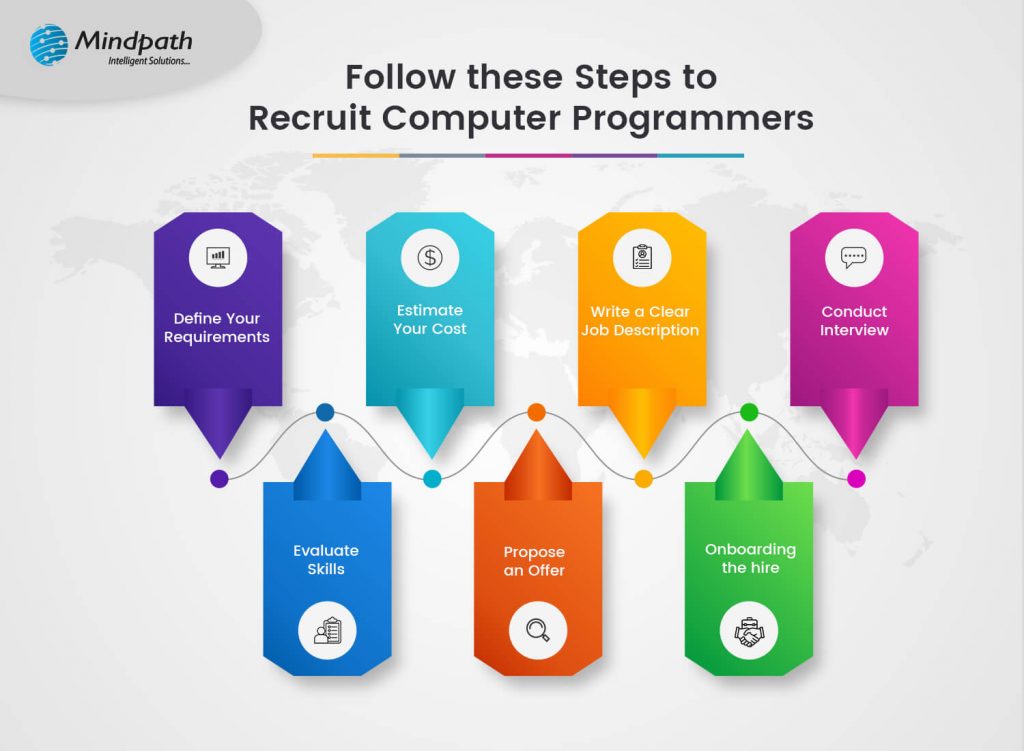
Steps to Recruit Computer Programmers

1. Define Your Requirements

Before you start looking for a computer programmer, you should know exactly what you’re looking for. Determine which programming languages the programmer should be familiar with, such as Java, Python, or JavaScript, based on the requirements of your project. Consider what technologies and tools they should be familiar with, especially if you’re creating anything specific such as a website. Decide if you need someone with extensive knowledge to take on leadership responsibilities or someone with a few years of experience to undertake routine tasks. Consider the personal abilities you value, such as being an effective communicator or team player. Knowing these details can assist you in finding the ideal programmer for your requirements. 

2. Estimate Your Cost

Before you begin looking for a computer programmer, you must first determine your budget. The cost of employing a programmer varies greatly depending on their degree of expertise, location, and the unique abilities they bring to the table. For example, a highly experienced programmer or one with specialized abilities may command a greater wage than someone with less experience or more generic skills. Setting a budget ahead of time not only helps you identify a programmer that fits inside your budget, but it also ensures that you are realistic about your financial situation. 

3. Clear Job Description

When recruiting a computer programmer, it’s essential to have a clear job description. This allows potential applicants to understand exactly what you’re looking for, ensuring that you recruit the right kind of individuals. Begin by using plain and straightforward language. Avoid using technical terms or sophisticated terminology that may mislead candidates. Clearly outline the position, including the activities and responsibilities that the programmer will be handling. Be precise about the technologies and programming languages they’ll be using. 

Include a list of the required qualifications and skills, such as years of experience and any specific background needs. Do not forget to add the soft skills essential to you, such as teamwork or communication. This manner, you’ll attract individuals that not only have the necessary technical talents but also fit in with your company’s culture. 

4. Conduct Interview

Conducting interviews helps you get to know the individuals and assess their abilities. Enquire about their programming background, problem-solving skills, and communication style. You might also assign them a coding challenge to put their abilities to the test.  

Interviews can be conducted via video, phone, or in person, and should include both technical and behavioral topics. The technical section evaluates coding abilities, whereas the behavioral section examines communication and team fit. Involve other team members in the selection process to verify the candidate is a good fit for the team. 

5. Evaluate Skills

A computer programmer’s communication abilities are critical to the success of any project. They must properly communicate their ideas and work successfully with team members. During the employment process, these soft skills should be assessed. To assess a candidate’s ability to break down technical nuances, ask them to describe a complicated programming concept in easy words. Additionally, assess their responsiveness and clarity in responding to your enquiries. 

Good communication skills include the ability to listen and deliver constructive feedback. Pay attention to how they connect with others; this might provide insight into their teamwork and problem-solving ability. Ensuring that a programmer can explain their ideas and collaborate well with your team will considerably improve the overall success of your projects. 

6. Propose an Offer

Once you’ve identified the best computer programmers for your project, make an official offer. To minimize misunderstandings, clearly state the project scope, timing, and budget. Be precise about what to expect and how the project will be managed. Discuss your communication expectations properly. This covers preferred modes of communication, frequency of updates, and response time frames. If your staff are in separate time zones, make rules to manage possible obstacles, such as overlapping working hours or dealing with urgent concerns. Include any additional terms or conditions, such as confidentiality agreements or specific targets. This guarantees that both parties are on the same page and contributes to a strong basis for a successful working relationship. 

7. Onboarding the hire

To ensure a seamless start to your collaboration, you must efficiently onboard your new hire. Once the hiring procedure is complete, it’s time to put your new computer programmer’s skills into action. Begin by giving them full access to systems and tools. Introduce them to the immediate staff and make sure they understand their roles and duties. Begin the project by outlining the initial tasks and setting expectations for delivery. This will allow your new team member to integrate fast and contribute to the project’s success from the beginning. 

Ready to hire top computer programmers? 

Connect with Mindpath to find the perfect fit for your project and start achieving your goals today! 

Hire Computer Programmers at Mindpath

At Mindpath, recruiting computer programmers is a simple and advantageous procedure that ensures your project’s success. We start by knowing your specific needs and goals to connect you with the right personnel. Our objective is to make the hiring process as simple and efficient as possible, offering ongoing help from beginning to end.  Here’s how we make hiring easier: 

1. Discuss Your Needs

Reach out to us to discuss your project requirements. We’ll work with you to create a detailed plan that outlines the project scope, timeline, and budget. 

2. Find the Right Programmer

Based on your needs, we’ll recommend skilled programmers who are well-suited for your project. You’ll have the opportunity to interview and select the ones who fit best with your vision. 

3. Start the Project

Once you’ve chosen your programmer, we’ll kick off the project with a clear plan and timeline. We’ll keep you informed with regular updates and seek your feedback to ensure everything is on track. 

4. Get Ongoing Support

We’ll continue to assist you throughout the process and beyond, addressing any issues promptly and ensuring your goals are met. 

Wrapping Note!

Recruiting an appropriate computer programmer is an essential stage in achieving your project’s objectives and assuring success. By following the simple but effective steps outlined—defining your requirements, estimating costs, creating a clear job description, conducting thorough interviews, evaluating skills, proposing a well-defined offer, and effectively onboarding—you can streamline the hiring process and find a programmer who perfectly fits your needs. 

Mindpath simplifies the process by providing specialized help at every stage. We offer a seamless and productive recruiting process by knowing your project needs and finding and integrating the perfect programmer. Our aim is to give continuing support and resolve any concerns, ensuring that your project not only meets, but exceeds, your expectations. 

Looking for dedicated programmers?

Mindpath makes hiring easy and efficient. Contact us now to get started and elevate your project with the best! 

Openai fine tuning api tutorial

In current times of generative AI, prompt engineering is not sufficient to address the requirements of advanced applications. There is a need among content strategists, developers and product teams to have models that can be used to analyze domain-specific language and provide a uniform output. And that is where OpenAI’s fine-tuning tutorial comes in to guide developers through the complicated process of training various models. From healthcare to legal tech, fine-tuning has enabled customization of pre-trained models, opening new opportunities in AI-powered solutions. This blog will allow you to know more via a simple OpenAI fine-tuning API tutorial, as well as some OpenAI fine-tuning examples. We will also talk about why it is crucial for developers. 

Ready to use customised AI models that align precisely with your business data, goals, and customer expectations? Mindpath’s AI development services provide end-to-end solutions from design to deployment.

OpenAI’s Fine-Tuning – What is It All About?

Let’s begin this OpenAI fine-tuning API tutorial by understanding the basics, i.e, what OpenAI fine-tuning is. 

OpenAI models such as ChatGPT are trained on huge web-scale datasets. These are designed to perform across different domains. However, when it comes to handling specialized use cases, for example, technical support, expert reasoning, or legal context analysis, these models need more targeted control. OpenAI fine-tuning API for developers has made it possible. It enables developers to train base models using task-specific datasets. This, in turn, assists models in acquiring new skills and behavior, based on the needs of the business. Regardless of whether you are building a personalized chatbot, advanced summarization systems, or scaling content generation, fine-tuning provides you with accuracy, performance, and control.

Importance of OpenAI Fine-tuning for Developers

The OpenAI fine-tuning API tutorial focuses on the crucial nature of AI model fine-tuning. Fine-tuning ChatGPT is an essential strategy for developers aiming to create custom AI solutions. By customizing models, they make those models offer more consistent and smarter outputs. The following are a few points that explain why fine-tuning is a necessity for every developer.

1. Better Relevance and Accuracy

For all domain-specific queries, fine-tuned models will perform better compared to generic models. They will offer more contextually relevant and accurate responses.

2. Reduced Cost and Latency

Fine-tuned OpenAI models are more efficient. How? Well, they can attain better results with fewer prompts, lowering token usage. Besides, it leads to a faster response time. 

3. Consistent Communication Style and Tone

Wouldn’t it be great if your AI model could speak just like your brand? You can make that a possibility with fine-tuning. You will be able to train the model with specific style, vocabulary and voice such that the outputs match the brand identity.

4. Enhanced Format Handling

If your application demands outputs in a specific reporting format or JSON structure, fine-tuning ensures the model follows those requirements. 

5. Robust Safety and Control

By training your AI models on domain-safe and curated data, you can reinforce desired behaviour. This, in turn, will significantly reduce the risk of harmful or off-brand responses. 

6. Unlocking New Opportunities

Fine-tuning OpenAI models can be used for multiple applications. Developers can train models to manage tasks, prioritizing expertise and specific interaction styles. 

OpenAI Models Developers Can Fine-Tune for Custom Tasks

As described in this OpenAI fine-tuning API tutorial, the fine-tuning API allows developers to fine-tune various advanced models, increasing their capabilities. Now, let’s have a look at the OpenAI models that can be fine-tuned for specialized applications. 

1. GPT-3.5

Undoubtedly, GPT 3.5 is a top choice among developers. Some major reasons behind this popularity are cost-effectiveness and low latency. Fine-tuning this model allows developers to reduce the complexity and increase consistency. Product recommendation guides, FAQ bots and customer service automation are some of the common uses of GPT 3.5.

2. GPT-4o

This is OpenAI’s flagship multimodal model. It can process images, audio, videos, and text. This model offers users advanced customization features without losing speed and efficiency. It can be optimized by the developers for domain-specific tasks that demand enhanced textual as well as visual comprehension. Financial document analysis and advanced customer support bots are some common OpenAI fine-tuning examples centered on GPT-4o.

3. GPT- 4.1

This OpenAI model is created to handle multi-step tasks, structured problem-solving and extensive reasoning. It is a perfect option for complicated processes. Fine-tuning this model allows developers to introduce the tools capable of adhering to the domain-specific formats, which makes them a great choice in case of technical planning or automating research.

4. O-Series Models

O-series models are based on GPT-4o and are optimized for efficiency and performance. You can use these models for tasks where GPT-4o’s functionality may be excessive. These models can be fine-tuned to be cost-effective and scaled to a large extent without reducing their accuracy. They come in handy with several industry-specific applications in sectors like SaaS, legal tech, and healthcare.

Tips to Use Open-AI Fine-Tuning API Effectively

The OpenAI fine-tuning API tutorial can provide useful information on the optimization methods of AI models. These practices can improve mode reliability if utilized in the right manner. Here are some best practices to consider for effective fine-tuning.

1. Data Quality

It’s obvious! The AI models will not be capable of providing precise results without clear, well-constructed, and relevant datasets.

2. Right Model

As mentioned above, only a few OpenAI models can be fine-tuned. For instance, GPT-3.5 or GPT-4o.

3. Tune Hyperparameters

Experiment with batch sizes, training cycles, and learning rates. This will help you find the right configuration. 

4. Evaluate Regularly

Properly monitor progress, identify overfitting, and optimize the training approach. 

By focusing on all these factors, developers can fine-tune OpenAI models with confidence. This is the foundation for fine-tuning ChatGPT or other models for tailored applications that can offer precise results.  

When to Fine-Tune vs When to Use Prompt Engineering?

This is a common question that most developers would ask when learning OpenAI fine-tuning API concepts. After all, choosing between prompt engineering and fine-tuning is a vital decision for every developer creating AI-powered tools. Let’s break it down. 

Begin With Prompt Engineering

Well, for most use cases, prompt engineering can be an ideal option. A well-developed system prompt, combined with clear instructions and examples, can enable a generic AI model to perform efficiently. In fact, they can attain around 80 to 90 percent task accuracy. Moreover, prompt engineering is cost-effective, fast, and there is no need to maintain a custom model for it. It is also ideal for low-volume tasks and prototyping.

Scenarios Where Fine-Tuning Actually Makes Sense

Based on this OpenAI fine-tuning API tutorial, we can state that in cases where you need to be more consistent and in control, fine-tuning makes a great choice. You can consider it when:

  • You want a consistent style and tone format in communications.
  • You wish to decrease the cost of the API.
  • The existing model offers irrelevant output that can be resolved through curated examples. 
  • You want to enhance the AI model’s ability to accurately process complex instructions. 

Fine-tuning is a major investment. It requires time for accurate data preparation and training costs. However, the long-term results are really impressive. Wondering how? Well, when you learn fine-tuning API methods, you can easily unlock the ability to boost the model’s efficiency, reliability, as well as performance.

Custom AI: The Future We Will Witness Soon

OpenAI’s fine-tuning API clearly shows a significant leap in making modern AI models bespoke and adaptable. It offers developers who want to go beyond what general AI does the means to add specific domain experience, brand voice, and intelligence to the models. This OpenAI fine-tuning API tutorial proves that it will unlock the next generation of custom AI models.

If you want to join the trend and enhance your business’s functionality with custom AI solutions, you can always count on Mindpath. We provide AI development services that help organizations develop as well as fine-tune their AI foundation models. Our team helps you align AI models with your workflows and domain-specific data. Partner with us today and build a custom AI solution to support your business growth.